


Choose an option to see quick actions and get help faster.
.svg)
The Real Difference Between a Mini Split and a Window Unit
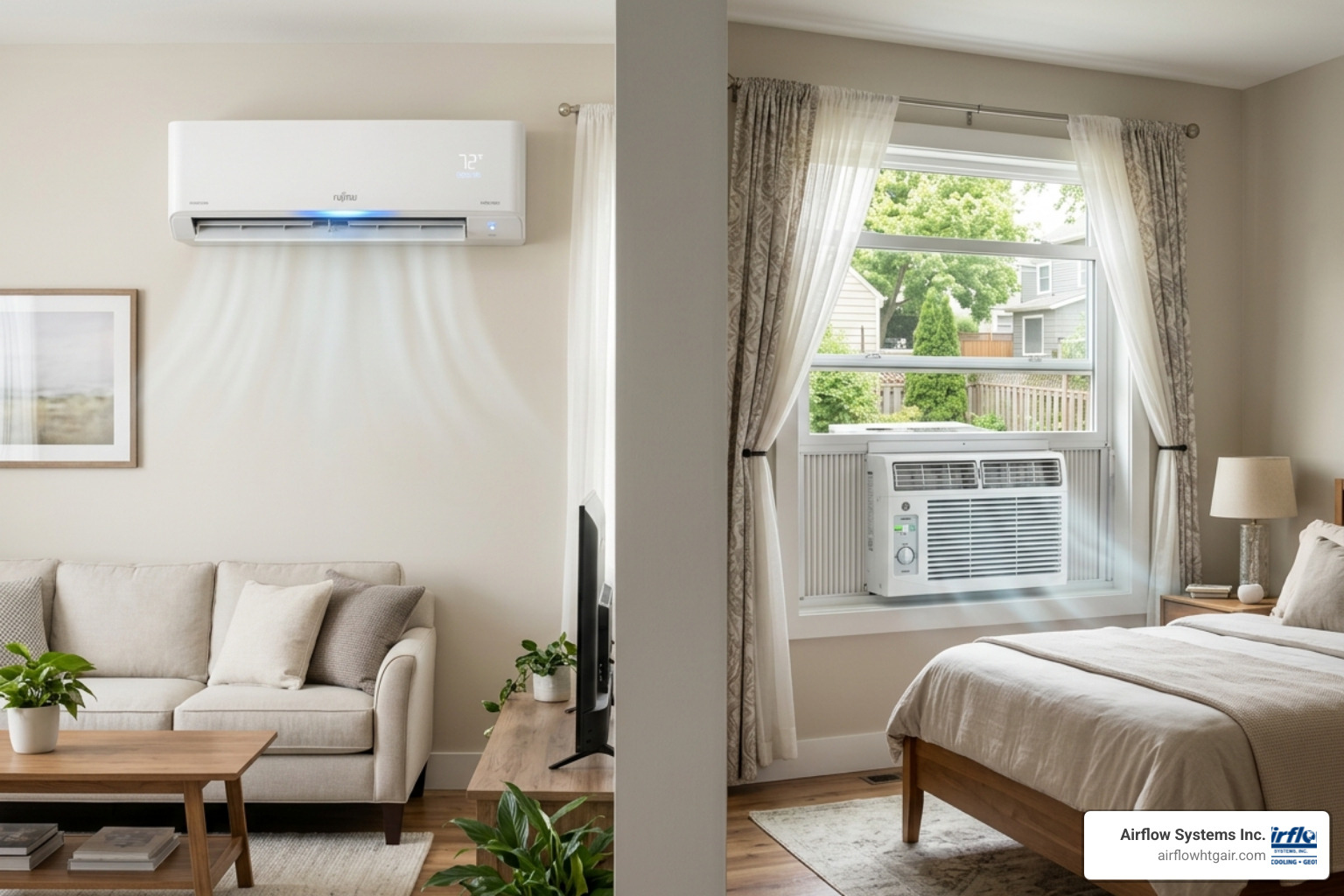
A mini split vs window unit comparison comes down to a few core factors most homeowners care about deeply: efficiency, comfort, noise, and long-term value. Here is a quick breakdown before we go deeper:
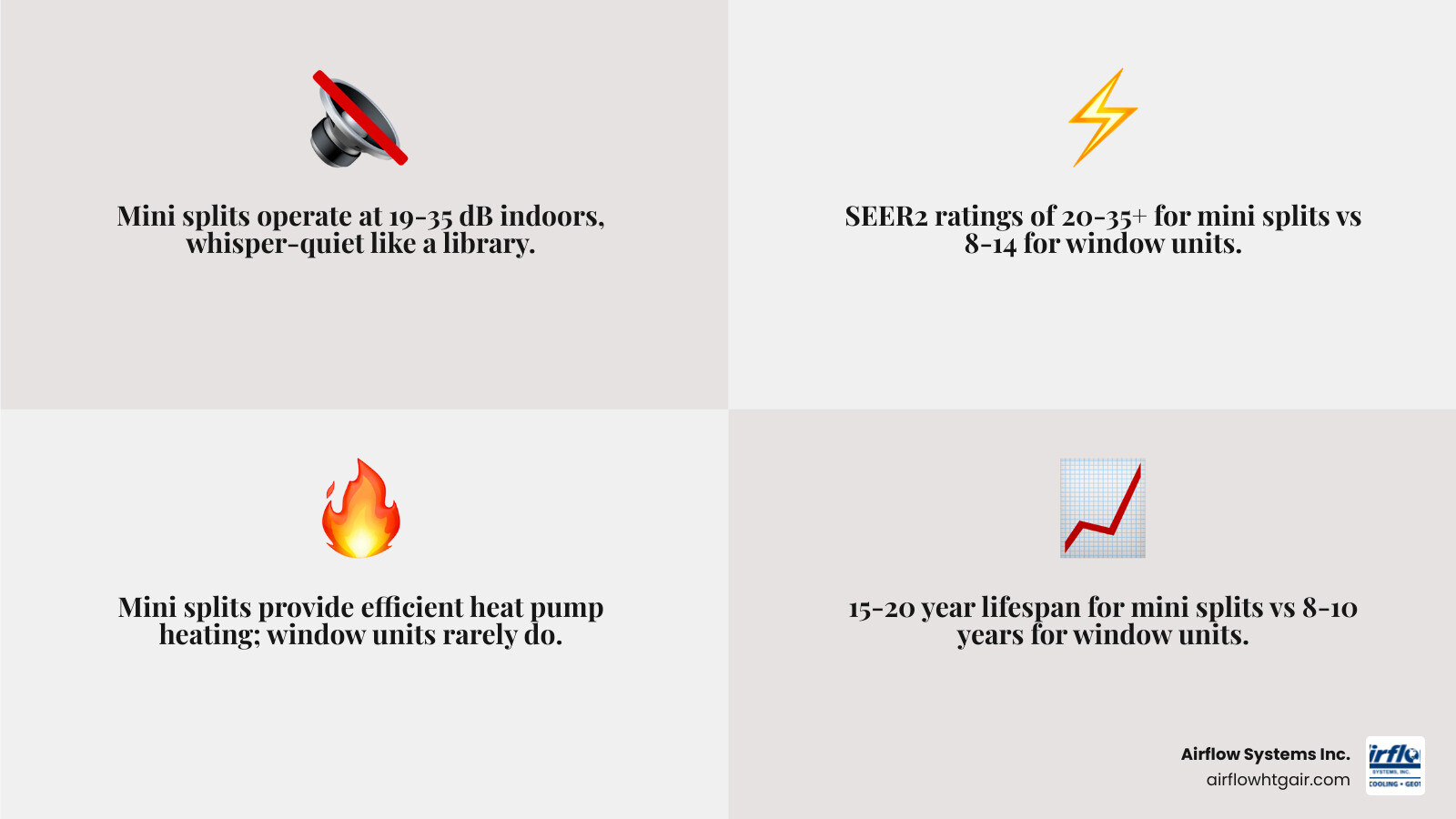
• Efficiency (SEER2) — Mini Split: 20-35+ — Window Unit: 8-14
• Noise Level (Indoor) — Mini Split: 19-35 dB (whisper-quiet) — Window Unit: 50-65 dB (conversation level)
• Heating Capability — Mini Split: Yes (heat pump) — Window Unit: Rarely, and inefficient
• Lifespan — Mini Split: 15-20 years — Window Unit: 8-10 years
• Installation — Mini Split: Professional, permanent — Window Unit: DIY, seasonal
• Blocks Window — Mini Split: No — Window Unit: Yes
• Energy Use — Mini Split: 40-55% less than window units — Window Unit: Higher per hour of runtime
• Best For — Mini Split: Long-term homeowners — Window Unit: Renters, temporary use
Right now, millions of homes rely on window AC units simply out of habit. You drag them out of storage each spring, wrestle them into the frame, and lose your view until October. It works - but it is far from the best option available to Central Virginia homeowners today.
Ductless mini-split systems offer a fundamentally different experience. They are quieter, more efficient, and capable of both heating and cooling your home year-round. But they also cost more upfront and require a professional installation.
So which one actually makes sense for your home and your budget? That is exactly what this guide answers - without the jargon.
Fundamental Differences in Design and Operation
To understand the mini split vs window unit comparison, we first have to look at how these machines are built. A window unit is a "self-contained" appliance. Everything—the compressor, the fan, and the coils—is crammed into a single box that sits in your window frame. Because the noisy parts are right there in the room with you, it often sounds like a freight train is running in your bedroom.
A mini-split uses a "split-system" architecture. We install a sleek indoor air handler on your wall and place the noisy compressor outside. These two pieces are connected by a small conduit housing refrigerant lines and power cables. This design allows for true ductless technology, moving heat out of your home through thermal transfer without the need for bulky metal ducts.
One of the biggest hidden issues with window units is air leakage. No matter how much foam or accordion plastic you use, a window unit never perfectly seals. This allows hot Virginia summer air to seep back in, forcing the unit to work harder. Furthermore, window units are a security vulnerability; they effectively leave a window "open" 24/7, making it easier for intruders to gain entry. Mini-splits only require a small, three-inch hole in the wall that is completely sealed, preserving your home's structural integrity and safety. For those looking for a permanent solution, More info about AC installations can help you visualize how these systems integrate into your home.
Mini Split vs Window Unit Comparison: Efficiency and Performance
When we talk about performance, we look at SEER2 (Seasonal Energy Efficiency Ratio). Think of this like MPG for your air conditioner. Most window units struggle to hit a rating of 12 or 14. In contrast, many mini-split systems boast SEER2 ratings of 20 to 35.
• SEER2 Rating — Window AC Unit: 8 - 14 — Ductless Mini-Split: 20 - 35+
• Indoor Noise — Window AC Unit: 50 - 65 dB — Ductless Mini-Split: 19 - 35 dB
• Lifespan — Window AC Unit: 8 - 10 Years — Ductless Mini-Split: 15 - 20 Years
• Energy Savings — Window AC Unit: Baseline — Ductless Mini-Split: 40% - 60% Savings
The secret sauce is inverter technology. A standard window unit is either "all the way on" or "all the way off." It blasts cold air until the thermostat is satisfied, then shuts down. When the room warms up, it kicks back on with a loud hum and a huge spike in power. Mini-splits use variable-speed compressors that "idle" down. They stay on at a very low power level to maintain a perfectly steady temperature.
Research shows that most homes with traditional central air lose 20-30% of their cooling capability through leaky or uninsulated ducts. Since mini-splits are ductless, you avoid that loss entirely. If you're curious about how much energy your home is currently wasting, More info about home energy diagnostics can provide a clearer picture of your efficiency gaps.
Energy Efficiency and Long-Term Operating Benefits in a Mini Split vs Window Unit Comparison
In real-world testing, a high-efficiency mini-split can run at a remarkably low power draw. While a window unit might pull 1,000 watts or more whenever it is running, a 24 SEER2 mini-split can idle down to about 300W DC once the room is cool. Some units have even been observed drawing less than 100W on mild days.
This efficiency translates directly to reduced utility bills. Because the system isn't constantly stopping and starting, it uses 40-55% less electricity than a window unit to provide the same amount of cooling. Over a decade of hot Charlottesville summers, those monthly savings add up to a significant amount of money staying in your pocket. To keep these systems running at peak efficiency, More info about HVAC services is essential for routine check-ups.
Temperature Control and Dehumidification in a Mini Split vs Window Unit Comparison
Have you ever noticed how a window unit leaves the room feeling "clammy"? That’s because they often cool the air so quickly that they don't have time to remove the humidity. Mini-splits offer superior independent dehumidification. Because they run for longer cycles at lower speeds, they are much better at pulling moisture out of the air.
The precision is also unmatched. While a window unit might allow the temperature to swing 3 or 4 degrees before kicking back on, a mini-split maintains comfort within ±1°F. This is especially helpful during the "shoulder seasons"—those weeks in spring and fall when you need just a little bit of cooling or heating to stay comfortable without freezing or roasting. For families sensitive to allergens, these systems also feature multi-stage filtration that outperforms the simple mesh filters found in window boxes. Check out More info about indoor air quality systems to see how we can help you breathe easier.
Comfort, Noise Levels, and Aesthetics
If you’ve ever had to turn up the TV because the window AC kicked on, you know the struggle. Window units typically operate at 50 to 65 decibels—roughly the volume of a normal conversation. It’s hard to ignore.
Mini-splits are designed for whisper-quiet performance. Indoors, they run between 19 and 35 dB. To put that in perspective, 20 dB is the sound of rustling leaves. You can sleep, work, or watch a movie without the constant rhythmic thumping of a compressor.
Then there is the "view" factor. Window units are, frankly, an eyesore. They block 40-70% of the natural light coming through a window and ruin the curb appeal of your home. A mini-split preserves your windows and your light. The indoor units are sleek and can be mounted high on a wall or even recessed into the ceiling, allowing them to blend seamlessly into your interior design.
Installation Complexity and Home Impact
The biggest hurdle for many is that a mini-split is a permanent modification. We have to drill a three-inch hole through your exterior wall to connect the units. While this sounds daunting, our professional mounting process ensures the hole is perfectly sealed and the unit is structurally sound. You can learn More info about mini-split systems on our dedicated service page.
Window units are technically "portable," but "seasonal ritual" is a better description. They are heavy (often 60-100 lbs), awkward to install, and can damage your window frames over time. Because they prevent you from locking your window, they create a major security vulnerability. If you've had a window unit fail or cause damage, More info about AC repairs can help you get things back in order.
Choosing the Right System for Your Home Layout: A Mini Split vs Window Unit Comparison
Mini-splits shine in specific scenarios where traditional cooling fails. They are the gold standard for:
• Home Additions: No need to resize your entire central HVAC system; just add a zone.
• Converted Garages or Basements: Spaces that were never connected to the main ductwork.
• Historic Properties: Homes in Central Virginia where cutting into plaster walls for ducts is impossible.
• Zoned Cooling: If you spend all day in a home office, why cool the whole house? You can run just the office mini-split.
For whole-home solutions without ducts, More info about heat pump installations shows how we can link multiple indoor units to one outdoor condenser.
Heating Capabilities and System Longevity
One of the most significant parts of a mini split vs window unit comparison is year-round utility. Most window units are cooling-only. If they do have heat, it’s usually "electric resistance" heat, which is incredibly expensive to run—like trying to heat your house with a giant toaster.
Mini-splits are true heat pumps. They move heat from the outside air into your home (even when it's cold out!). This is about three times more efficient than electric or gas furnaces. Modern cold-climate mini-splits can keep you toasty even when Charlottesville temperatures dip well below freezing.
In terms of longevity, mini-splits are the clear winner. A window unit is generally considered "disposable" and lasts about 8 to 10 years. A well-maintained mini-split system can easily last 15 to 20 years. If your current heat pump is struggling, you might need More info about heat pump repairs, or if you're looking to protect your investment, More info about maintenance will help you keep that 20-year lifespan on track.
Frequently Asked Questions about Mini Splits and Window Units
Can a mini-split system replace multiple window units?
Yes! This is called a "multi-zone" system. We can connect up to eight indoor air handlers to a single outdoor condenser. Each room gets its own thermostat, allowing for independent control. This is much more efficient than running three or four separate window units. While we're looking at your home's heating and cooling layout, you might also want More info about furnace installations if you're considering a total system overhaul.
Are there rebates or incentives available for mini-split systems?
Absolutely. Because mini-splits are so energy-efficient, they often qualify for significant federal tax credits under the Inflation Reduction Act—sometimes up to 30% of the project cost (capped at $2,000). There are also often local utility incentives available for homeowners in Central Virginia who upgrade to heat pump technology. If you're currently dealing with an old, broken heater, More info about furnace repairs can help you limp through until you're ready to make the efficient switch.
How does the maintenance differ between these two systems?
Window units require you to pull the mesh filter and wash it, but they also tend to grow mold in the "drip tray" because they don't drain well. Mini-splits have permanent, washable filters that should be cleaned once a month. However, because they are complex machines, they require a professional inspection once a year to clear the condensate drains and check refrigerant levels.
Conclusion
When you look at the cold hard truth of the mini split vs window unit comparison, the window unit is a short-term fix, while the mini-split is a long-term investment. If you are a renter or on a very tight budget, a window unit gets the job done. But for homeowners in Charlottesville and Central Virginia who want lower bills, whisper-quiet sleep, and year-round comfort, the mini-split is the undisputed champion.
At Airflow Systems Inc., we are your local HVAC experts. We’ve helped countless neighbors move away from the "seasonal ritual" of window units and into the modern age of high-efficiency comfort. If you’re ready to see the difference for yourself, More info about HVAC services is just a click away. Let us help you find the perfect, permanent solution for your home comfort needs.
Book Expert Service Or Contact Us
Our Service Process
A Hassle-Free Service Experience
01
Consultation & Diagnosis
We start by listening to your needs and performing a thorough diagnosis of your system to recommend the best solution.
02
Transparent Quoting
We provide a clear, upfront estimate with no hidden fees, so you know exactly what to expect.
03
Expert Service & Follow-Up
Our factory-trained technicians complete the work to the highest standards, and we follow up to ensure your complete satisfaction.
testimonials
What Our Customers Are Saying
Our customers consistently praise our exceptional service and attention to detail, making us a trusted choice for all your HVAC needs.
where we operate
Service areas