

Choose an option to see quick actions and get help faster.
.svg)
The August Operational Shift: Why Your Home Feels Stuffy
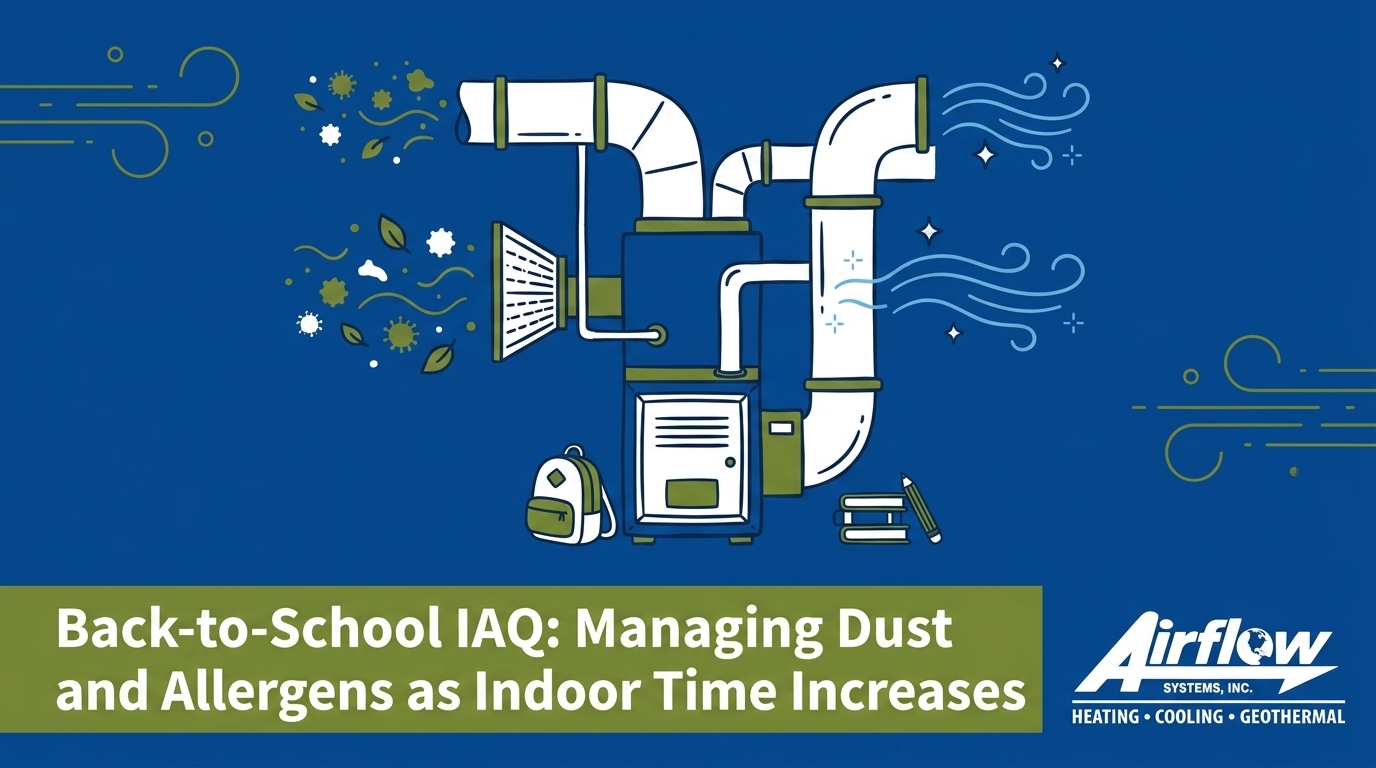
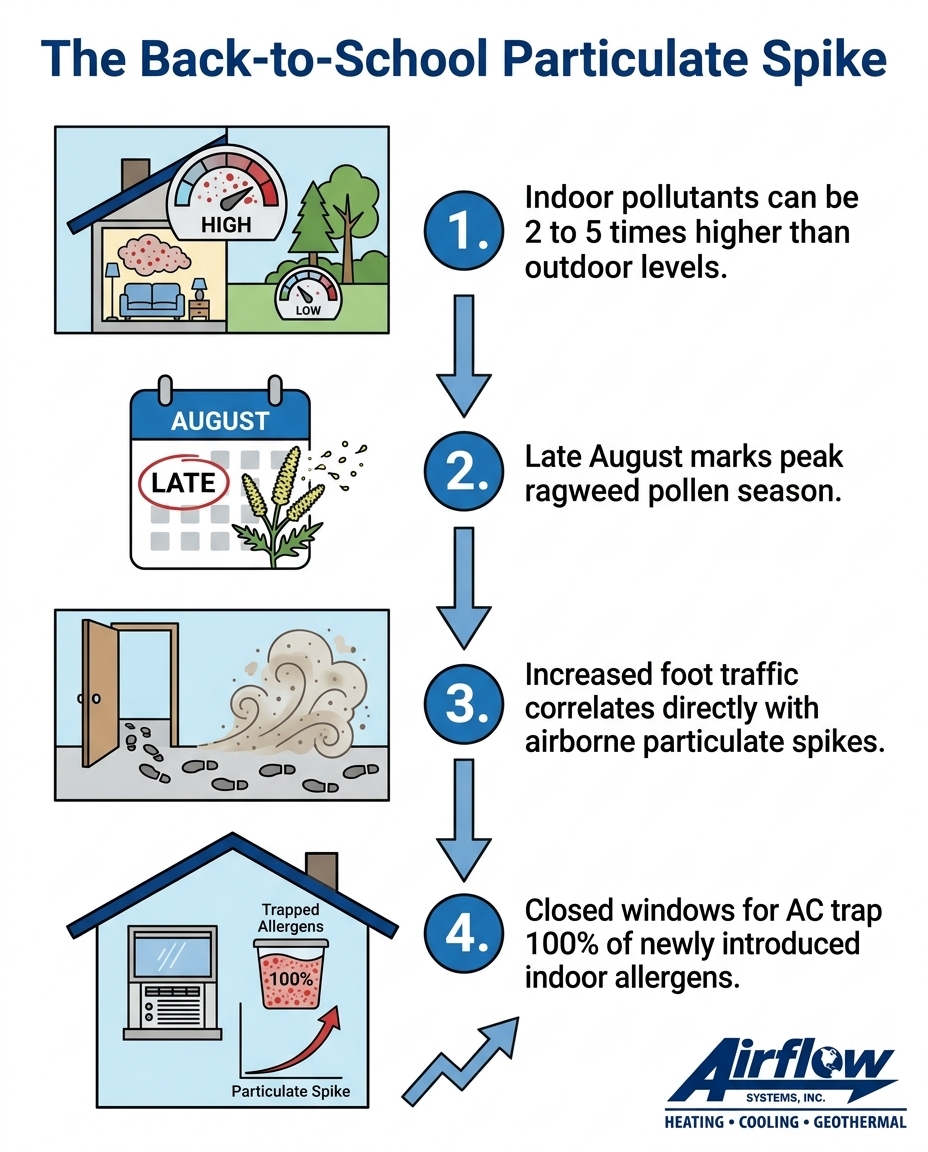
The final weeks of summer bring a distinct shift to household routines, making Back-to-School IAQ: Managing Dust and Allergens as Indoor Time Increases a sudden priority for families. As the lazy days of July give way to rigid school schedules, foot traffic in and out of the house multiplies. Backpacks, sports equipment, and shoes drag in a fresh daily load of outdoor contaminants just as the local ragweed pollen count reaches its peak. At the same time, lingering late-summer heat forces homeowners to keep their windows tightly shut, effectively sealing those newly introduced pollutants inside the living space. If you are looking to improve your home's environment during this transition, exploring professional indoor air quality solutions and scheduling comprehensive indoor air quality testing with our team at Airflow Systems is the best place to start.
At Airflow Systems, we often see how this August back-to-school transition creates a perfect storm for poor indoor air quality. Most homeowners assume that stuffy air is just a byproduct of the heat, but the reality is much more mechanical. When household traffic increases, the HVAC system must process significantly more airborne particulates. Without a proactive strategy to filter and dilute this stale air, families often experience increased allergy symptoms, persistent dust on furniture, and a general feeling of heaviness in the home's atmosphere. Addressing this requires moving beyond temporary fixes and evaluating professional interventions.
The Perfect Storm for Indoor Pollutants
Environmental Protection Agency (EPA) data consistently shows that indoor levels of airborne pollutants can be two to five times higher than outdoor levels. During the back-to-school season in Charlottesville, our technicians notice this multiplier effect becomes highly visible. The direct correlation between increased occupant activity and airborne particulate matter is undeniable. Every time a door opens, a rush of unconditioned, pollen-heavy air enters. Every time a child drops a dusty backpack on the floor, microscopic allergens are launched into the breathing zone.
Common late-summer indoor pollutants we encounter include:
• Ragweed pollen: Peaks in late August and easily travels on clothing and pet fur.
• Schoolyard dust: Tracked in daily on shoes and sports cleats.
• Biological aerosols: New germs and bacteria introduced from crowded classrooms.
• Volatile Organic Compounds (VOCs): Emitted by new school supplies, markers, and fresh clothing.
Establishing a Baseline for Your Air
Guessing isn't enough when it comes to managing airborne contaminants. You cannot effectively filter what you haven't identified. This is where the value of a professional assessment from our IAQ experts becomes clear. An expert evaluation identifies the specific particulate loads burdening your HVAC system. By establishing a baseline, our technicians can pinpoint whether your primary issue is biological (germs and mold), particulate (dust and pollen), or chemical (VOCs and odors), allowing for a targeted, highly effective filtration strategy.
Understanding the Mechanical Strain on Your Cooling System
The sudden influx of dust and allergens does more than trigger sneezing; it fundamentally alters how your air conditioner operates. In our experience servicing Charlottesville VA homes, the humid late August climate features average highs in the mid-80s. This necessitates continuous, closed-window air conditioning right as the indoor particulate load spikes. The HVAC system is forced to process this heavy, contaminated air continuously, leading to significant mechanical strain—a pattern we see often when responding to late-summer AC breakdowns.
Here is the step-by-step process of how this seasonal transition impacts your cooling equipment:
1. The Particulate Influx: As kids return to school, the volume of dust, dirt, and pollen entering the home doubles or triples. The return vents pull this contaminated air directly into the ductwork.
2. Rapid Filter Loading: Standard one-inch fiberglass filters are designed to protect the equipment, not clean the air. Under this heavy new load, they clog rapidly. We frequently pull out completely saturated filters just three weeks into the busy August back-to-school transition.
3. Airflow Restriction: Once the filter is clogged, the system starves for air. The blower motor has to work significantly harder to pull the same volume of air through the restricted barrier, increasing energy consumption and accelerating wear and tear on the motor's bearings.
4. System Freezing: The most severe consequence of restricted airflow is a drop in the temperature of the evaporator coil. Without enough warm indoor air blowing over the cold coils, the condensation on them freezes into a solid block of ice. Understanding how dirty filters impact your system is crucial, as a frozen coil completely halts the cooling process and can cause liquid refrigerant to flow backward into the compressor, potentially destroying it.
This mechanical sequence highlights why indoor air quality is not just a health concern, but an operational requirement for your home's infrastructure. When the system breathes easier, it cools more efficiently.
Beyond the Bedroom: Whole-Home Filtration Solutions
When allergy symptoms flare up during the August back-to-school transition, the immediate reaction for many homeowners is to purchase a standalone HEPA room purifier. While these units are excellent for localized relief in a single bedroom, they fall drastically short of addressing the root problem. A room purifier only cleans the air in its immediate vicinity. Meanwhile, the home's central HVAC system continues to circulate contaminated air through the ductwork, effectively undoing the room purifier's work the moment the bedroom door opens.
System-level whole-home air cleaners capture particulates before they can circulate through the ductwork. These advanced media cabinets are installed directly into the return air plenum of your HVAC system. Because all the air in your home cycles through the HVAC system multiple times an hour, a whole-home filter treats the entire living space simultaneously. We recommend upgrading to a thick media filter with a high MERV (Minimum Efficiency Reporting Value) rating to ensure that microscopic threats—like ragweed pollen, pet dander, and school germs—are trapped before they reach the blower motor.
As a local, trusted expert, our team at Airflow Systems understands the specific seasonal air quality challenges of Central Virginia homes, ensuring that whole-home solutions are sized correctly for your specific equipment. Proper sizing is critical; installing a highly restrictive filter on an underpowered blower will cause the exact mechanical failures you are trying to avoid.
Integrating Air Cleaners with Existing Equipment
Professional installation guarantees that advanced air cleaners are properly matched to your current heat pump or air handler. Recently, our installation team at Airflow Systems helped a local homeowner who needed to replace a heat pump in a relatively close-quarters setup. Our skilled installers arrived, replaced the unit with a quieter Bosch heat pump, and seamlessly connected an existing whole-home air cleaner to the new system. The result was a highly efficient, quiet setup that effectively managed indoor particulates without straining the new blower motor.
• Coverage Area — Standalone Room Purifier: Single room (typically 150-400 sq. ft.) — Whole-Home Filtration System: Entire house (every room with a supply register)
• Maintenance — Standalone Room Purifier: Frequent filter changes; multiple units to maintain — Whole-Home Filtration System: Single media filter changed every 6-12 months
• Acoustics — Standalone Room Purifier: Can be noisy on high settings in living spaces — Whole-Home Filtration System: Silent operation (integrated into existing ductwork)
• HVAC Protection — Standalone Room Purifier: Offers zero protection to the central AC equipment — Whole-Home Filtration System: Keeps coils and blowers pristine, extending lifespan
Breaking the Seal: The Role of Mechanical Ventilation
One of the biggest dilemmas we see Charlottesville VA homeowners face in late summer is the need for fresh air versus the need for climate control. Opening a window in late August might let out stale air, but it immediately lets in oppressive humidity, heat, and a fresh wave of pollen. The house becomes a sealed box, continuously recirculating the same tired, germ-laden air that the kids brought home from school.
The solution we frequently recommend to break this seal without compromising comfort is mechanical ventilation—specifically, Energy Recovery Ventilators (ERVs) and Heat Recovery Ventilators (HRVs). These ingenious devices exchange stale indoor air for fresh outdoor air, but they do so while preserving your cooling energy.
Here is how mechanical ventilation transforms a stuffy home:
• Energy Transfer: An ERV pulls fresh outdoor air into the system while simultaneously exhausting stale indoor air. As the two airstreams pass each other inside the unit's core (without physically mixing), the cooling energy from the outgoing air is transferred to the incoming hot air.
• Moisture Control: ERVs also transfer moisture. In a humid climate, the system strips excess humidity from the incoming outdoor air and sends it back outside with the exhaust air, keeping your indoor humidity levels balanced.
• Dilution of Contaminants: Continuous mechanical ventilation dilutes the concentration of back-to-school germs, VOCs, and carbon dioxide. Instead of recirculating the same pollutants, the house constantly breathes fresh, filtered air.
• Odor Reduction: Lingering smells from cooking, pets, and sweaty sports gear are exhausted mechanically rather than masked with artificial air fresheners.
By integrating mechanical ventilation, you achieve the freshness of an open window with the security and comfort of a closed, air-conditioned home.
Duct Inspections and Mitigating Contaminant Spikes
Your home's ductwork acts as the respiratory system of the house. No matter how advanced your filtration system is, if the ducts delivering the air are coated in years of settled dust, your indoor air quality will suffer. During the August back-to-school transition, the sudden spike in particulates can easily bypass cheap, ill-fitting filters and settle directly into the duct runs—something our duct inspection teams encounter almost daily.
When this happens, every time the AC cycles on, it kicks up a minor dust storm inside the vents, blowing microscopic debris into your living spaces. Identifying these hidden contaminant spikes requires professional intervention. A comprehensive duct and system inspection involves evaluating the integrity of the ductwork, checking for leaks where unconditioned attic or crawlspace air might be pulled in, and assessing the cleanliness of the blower wheel and evaporator coil.
To mitigate these seasonal contaminant spikes, we recommend the following seasonal steps:
1. Schedule a visual duct inspection: Have one of our professionals check the return and supply plenums for heavy dust accumulation or signs of biological growth.
2. Have a professional seal duct leaks: Ensure that all joints and seams are sealed with mastic by a qualified technician. Leaky return ducts in a dusty attic will pull fiberglass insulation and dirt directly into your airstream.
3. Upgrade the filter housing: Ensure the filter cabinet has a tight seal. Even a half-inch gap allows heavily contaminated air to bypass the filter entirely.
4. Commit to routine care: Enroll in a comprehensive HVAC maintenance plan to ensure your system is cleaned and calibrated before the seasonal load overwhelms it.
The Value of Proactive System Care
Attention to detail during routine maintenance is the strongest defense against poor indoor air quality. During a recent routine general HVAC system service, one of our technicians performed a thorough inspection, demonstrating our high standard of care in cleaning and verifying the system's components. The homeowner noted it was the best HVAC service they had experienced, which underscores for us how proactive attention prevents minor dust issues from becoming major air quality hazards. Keeping coils and blowers free of seasonal particulate buildup ensures the system operates cleanly and efficiently year-round.
Transitioning Smoothly: Preparing for the Cooler Months
As late summer fades, we help homeowners in Charlottesville VA prepare for the next major operational shift: the transition from continuous air conditioning to intermittent heating. This seasonal bridge presents its own unique indoor air quality challenges. Throughout the summer, dust, pet hair, and pollen inevitably settle on the heat exchanger and furnace burners.
When the temperature eventually drops and the furnace kicks on for the first time, all that settled debris is instantly subjected to high heat. This creates the infamous "burning dust" smell that permeates the house during the first cold snap. While this smell usually dissipates after a few hours, the particulates are actively circulating through your newly sealed home.
Preparing the system mechanically for the temperature drop requires a proactive approach. It involves cleaning the burners, inspecting the heat exchanger, and ensuring the blower assembly is free of summer debris. Proper heating system preparation guarantees that when the system switches modes, it delivers clean, safe warmth rather than a cloud of burnt summer dust. Managing indoor air quality is not a task you complete once and forget; it is a continuous, year-round operational requirement that shifts with the seasons.
Frequently Asked Questions
Why is my house suddenly so dusty in late summer?
The late-summer dust spike is usually caused by a combination of increased household foot traffic and closed windows. As kids return to school and sports, they track in outdoor dirt and pollen, which gets trapped indoors and recirculated by the AC system.
How does indoor air quality affect students returning to school?
Poor indoor air quality can lead to increased allergy symptoms, headaches, and fatigue. When homes have high levels of dust and stagnant air, it can disrupt sleep quality and make it harder for students to concentrate on homework and recovery.
How do I reduce dust in my house during the fall transition?
The most effective way to reduce airborne dust is to upgrade your HVAC system's filtration to a higher MERV-rated media filter. Pairing this with professional duct sealing ensures that attic or crawlspace dust isn't being pulled into your living areas.
What causes poor indoor air quality when the AC is running constantly?
Running the AC constantly with closed windows prevents fresh outdoor air from diluting indoor contaminants. Over time, VOCs from household products, pet dander, and biological aerosols build up, creating stale, heavy air.
Why are whole-home IAQ solutions better than standalone room purifiers?
Whole-home solutions integrate directly into your central HVAC system, filtering the air for the entire house simultaneously. Standalone units only clean the air in a single room and offer no protection for your HVAC equipment's internal components.
The transition back to school shouldn't mean sacrificing the comfort and cleanliness of your home's air. If you are noticing increased dust or allergy symptoms as the season shifts, now is the time to take action before the heavy heating season begins. Reach out to our team at Airflow Systems to establish a clear explanation of why your indoor air quality is dropping and let us implement proven, non-DIY solutions to improve your household filtration and ventilation.
Book Expert Service Or Contact Us
Our Service Process
A Hassle-Free Service Experience
01
Consultation & Diagnosis
We start by listening to your needs and performing a thorough diagnosis of your system to recommend the best solution.
02
Transparent Quoting
We provide a clear, upfront estimate with no hidden fees, so you know exactly what to expect.
03
Expert Service & Follow-Up
Our factory-trained technicians complete the work to the highest standards, and we follow up to ensure your complete satisfaction.
testimonials
What Our Customers Are Saying
Our customers consistently praise our exceptional service and attention to detail, making us a trusted choice for all your HVAC needs.
where we operate
Service areas