

Choose an option to see quick actions and get help faster.
.svg)
That First Fall Heating Cycle: Why Your Vents Smell Like Burning
The first crisp evening of the season arrives, prompting you to switch the thermostat from cooling to heating. Within minutes, a distinct, harsh odor fills the hallways. Experiencing the burnt dust smell: what happens when you turn your heat on can be alarming for any homeowner. You might immediately wonder if you need to shut the system down in a panic or if it is safe to let it run its course. If you have questions about the safety of your heating systems, our Airflow Systems team is always ready to provide guidance.
For the vast majority of homes, this sudden odor during the early fall (September) first heating cycle is a completely normal seasonal phenomenon. Your heating equipment has been sitting idle for months, and the sudden introduction of high temperatures causes a brief, predictable reaction. Understanding the mechanical causes behind this odor helps you make informed decisions about your home's safety and comfort.
Before you reach for the phone to call for emergency service, it helps to know exactly what is happening inside your ductwork. The burning smell is a direct result of how your system operates, how airborne particles behave in your home, and how long it takes for the equipment to clear itself out.
The Science of the Scent: Dust Accumulation on Heat Exchangers
To understand why your vents emit that hot, dusty odor, you have to look at the internal components of your furnace or heat pump. Heating systems are designed to transfer thermal energy into the air circulating through your home. Because these internal heating elements sit completely dormant for five to six months out of the year, they become a resting place for airborne debris.
Normal household dust, pet dander, skin cells, and other microscopic particulates naturally circulate through your home. Over the summer, a portion of these particles bypasses your air filters and settles directly onto the internal heating components. When the early fall (September) first heating cycle initiates, the burners ignite or the electric coils heat up. This caked-on layer of summer dust is instantly incinerated, pushing the resulting odor through the ductwork and into your living spaces.
The Role of the Heat Exchanger
The heat exchanger is a critical metal component that safely transfers heat from the combustion chamber to the breathable air in your home. It acts as a sealed barrier, ensuring that harmful combustion gases exit through the flue while only clean, warmed air enters your ductwork.
Because the heat exchanger must reach extremely high operating temperatures to warm your home efficiently, any foreign material resting on its surface will burn away. Dust burn-off is physically unavoidable if the surface is not completely clean before the system turns on. The sudden spike in temperature vaporizes the microscopic debris, creating that familiar hot-iron smell.
Summer Dormancy and Particulate Settling
During the long summer cooling season, your heating components are bypassed entirely or remain inactive. This extended idle period allows microscopic debris to settle deep within the system. Even if you use high-quality air filters, extremely fine particulates will eventually find their way into the cabinet.
Because the blower motor is pushing air across the dormant heat exchanger or heating coils all summer long, the metal surfaces act like a passive filter, collecting a thin film of dust over several months. By the time autumn arrives, that thin film has accumulated enough mass to produce a noticeable odor when exposed to sudden heat.
How Summer Humidity Makes the Dust Burn-Off Worse
The severity of the burning smell is not just about how much dust is in your home; it is also heavily influenced by the local climate. In dry regions, loose dust rests lightly on HVAC components and is often blown away by the fan before it can burn. However, in our years of servicing HVAC systems across Charlottesville, our team has seen firsthand how our humid summer air creates a very different environment inside your ductwork.
Airborne dust is naturally hygroscopic, meaning it absorbs moisture from the surrounding air. When humid summer air circulates through your home, the dust particles become heavy and sticky. Instead of resting lightly on the heat exchanger, these moist particles stick and cake firmly onto the metal surfaces of your HVAC components.
As the summer progresses, this caking effect creates a stubborn, bonded layer of debris. When the crisp autumn air finally arrives and the heat is engaged for the early fall (September) first heating cycle, the system has to burn through a much denser, baked-on layer of particulates. This is why the early fall burn-off is often more pronounced and stubborn in humid climates compared to arid ones. The moisture has essentially glued the dust to the heat source, requiring higher temperatures and more time to completely incinerate the buildup.
The 30 to 60 Minute Rule: Monitoring the Odor
While the smell of burning dust is generally harmless, homeowners need a reliable way to gauge whether the system is functioning normally. Based on what our technicians observe in the field every fall, the most effective way to monitor the situation is by tracking the timeline of the odor. As a general rule, normal dust burn-off requires a specific window of time to clear out completely.
1. Note the start time: The moment you notice the smell, check the clock. The strongest odor will always occur within the first 5 to 10 minutes of the heating cycle.
2. Ventilate the space: Open a few windows or doors to help ventilate the initial smell. This allows the harmless but unpleasant odor to escape the house quickly.
3. Monitor the dissipation: Track the scent over the next hour. You should experience complete odor dissipation within 30 to 60 minutes of continuous operation.
4. Take action if necessary: State clearly to yourself that odors persisting beyond this 60-minute window require further investigation and a potential system shutdown.
The Initial Ignition Phase
During the first 10 minutes of operation, the heat exchanger reaches its peak temperature for the first time in months. This is when the vast majority of the caked-on dust is incinerated. Because your blower motor is actively pushing air across these hot components, the smell travels incredibly quickly through the home's ductwork, often reaching every room simultaneously.
This rapid distribution is why the smell feels so overwhelming at first. The concentrated burst of incinerated dust is being forcefully distributed into smaller, enclosed living spaces.
When to Expect Clear Air
As the heating cycle continues, the layer of dust is fully burned away, leaving the metal surfaces clean. By the 30-minute mark, the intense smell should fade into a faint, lingering background scent. By 60 minutes, the air coming from your vents should smell completely neutral.
If the system operates correctly, the second heating cycle of the season should be completely odor-free. The fuel for the smell—the summer dust—has already been eliminated. If the smell returns strongly during subsequent cycles, it indicates a different mechanical issue rather than normal seasonal burn-off.
Harmless Burn-Off vs. Genuine Heating Emergencies
At Airflow Systems, our team focuses heavily on community safety and education, which means providing you with clear, panic-free criteria to protect your home. It is vital to distinguish between a harmless seasonal nuisance and a genuine mechanical failure that requires immediate attention.
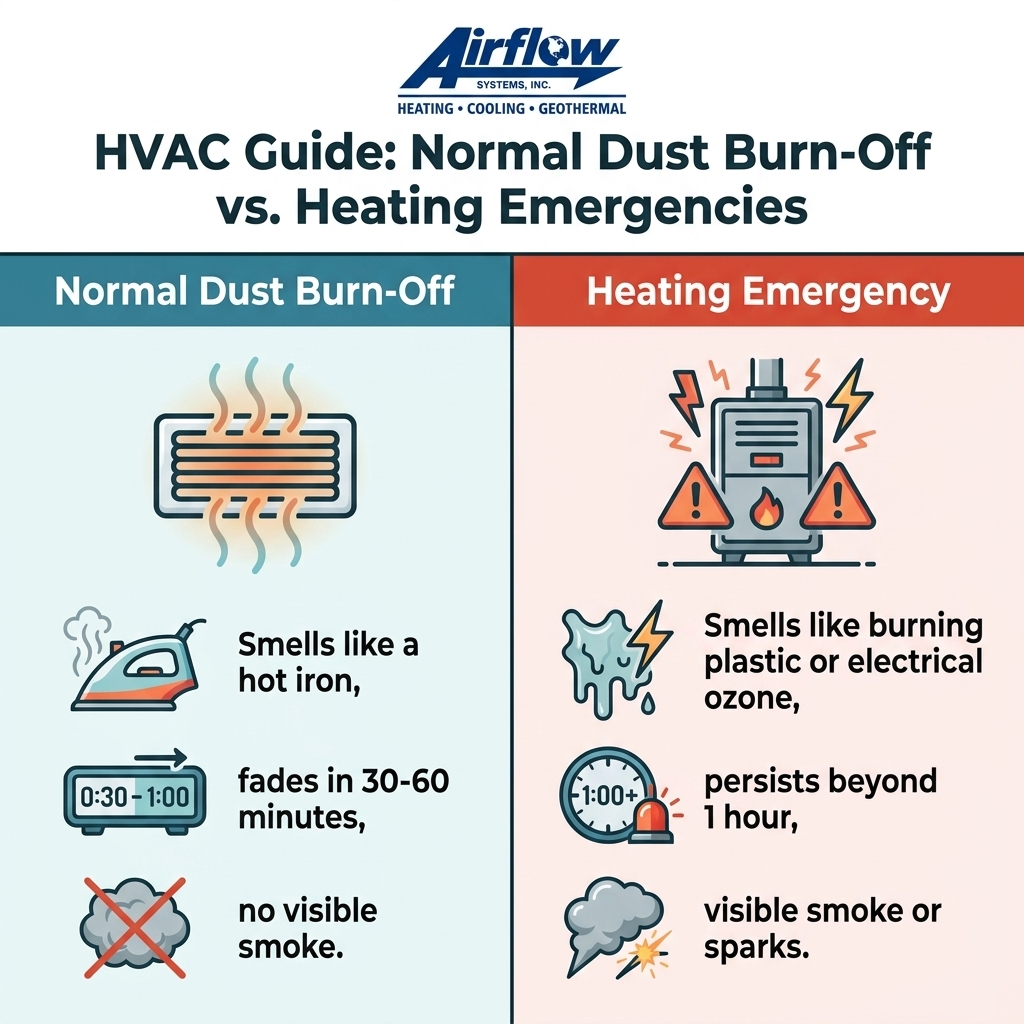
The specific smell of burnt dust is often compared to a hot clothes iron, a warm radiator, or a dusty space heater. This is vastly different from the dangerous smells of melting plastic, burning rubber, or electrical ozone. If you experience these severe warning signs, shut the system off immediately at the thermostat and contact a professional for furnace repair.
• Type of Odor — Normal Dust Burn-Off: Hot dusty smell, similar to a warm clothes iron or a space heater. — Genuine Heating Emergency: Acrid melting plastic, burning rubber, or sharp electrical ozone.
• Duration — Normal Dust Burn-Off: Odor dissipation within 30 to 60 minutes. — Genuine Heating Emergency: Persists continuously; grows stronger the longer the system runs.
• Visual Signs — Normal Dust Burn-Off: None. Air remains completely clear. — Genuine Heating Emergency: Visible smoke, haze, or sparks coming from the vents or the unit.
• Auditory Signs — Normal Dust Burn-Off: Normal blower motor and airflow sounds. — Genuine Heating Emergency: Loud grinding, screeching, or persistent clicking noises.
• Required Action — Normal Dust Burn-Off: Allow the system to run; ventilate the home if desired. — Genuine Heating Emergency: Shut off at the thermostat immediately and call a professional.
Identifying Electrical and Plastic Odors
Electrical failures produce a very distinct, sharp, and acrid smell. This occurs when wire insulation overheats, a blower motor begins to fail, or a capacitor burns out. Unlike dust, electrical components do not "burn off" safely. If a wire is melting, it will continue to melt as long as the system is drawing power.
These smells do not fade over time. They will persist and often worsen, posing a significant fire hazard. An electrical ozone smell—often described as smelling like a lightning storm or burning metallic plastic—requires an immediate system shutdown and a professional assessment.
Reducing the Burn-Off Effect Through Indoor Air Quality
The severity of the seasonal smell is directly connected to your home's overall air quality and filtration habits. Homes with higher airborne particulate counts will naturally experience stronger burn-off odors during that early fall (September) first heating cycle.
If you have multiple pets, recent construction projects, or high levels of volatile organic compounds (VOCs) in your home, there is simply more debris available to settle on the heat exchanger. Managing this requires a proactive approach to indoor air quality.
The role of air filters: Changing your air filters regularly, even during the summer cooling season, is one of the most effective ways to protect your heating components from buildup. A clogged filter forces the system to pull air through tiny gaps in the ductwork, often drawing in unfiltered dust from attics or crawlspaces. By maintaining clean filters and utilizing advanced air purifiers, you drastically reduce the volume of dust that reaches the heat exchanger in the first place, minimizing the autumn burn-off effect.
Proactive Prevention: The Value of a Pre-Season Tune-Up
While the burning dust smell is usually harmless, you do not have to endure it every year. The most effective way to eliminate the odor entirely is through professional maintenance before turning the heat on for the winter.
A professional tune-up involves physically cleaning the heat exchanger and burners before they ever get hot. By removing the caked-on dust manually, the technician eliminates the source of the smell. We see the benefits of this firsthand; one of our long-time Charlottesville customers, for instance, relies on our regular twice-a-year check-ups every spring and fall. Because an Airflow Systems technician performs bi-annual maintenance checks on their HVAC system, the equipment is kept in pristine working order, completely bypassing the harsh odors of the early fall (September) first heating cycle.
Cleaning Internal Components
During an inspection, our technicians safely remove caked-on dust from sensitive heating elements. This work requires a licensed professional rather than DIY methods, as the heat exchanger is a delicate component. Scratching or damaging the metal surface can compromise the barrier between the combustion chamber and your home's air supply, leading to dangerous carbon monoxide leaks.
By investing in an HVAC maintenance plan, you ensure that these internal components are handled safely, cleaned thoroughly, and prepared for heavy winter use without any unpleasant odors.
Safety and Efficiency Checks
Beyond simply cleaning the dust, routine maintenance ensures safe operation and catches potential electrical issues before they become mid-winter emergencies. Technicians verify proper airflow, inspect electrical connections, and calibrate the thermostat.
The National Fire Protection Association (NFPA) recommends annual heating system inspections to prevent fire hazards. Catching a frayed wire or a failing motor during the fall prevents a catastrophic breakdown in January. This makes early autumn a strategic time to book a heating tune-up, ensuring your system runs efficiently and safely all season long.
Enjoy a Safe, Odor-Free Start to the Heating Season
Transitioning from cooling to heating should bring comfort, not anxiety. A brief, 30-to-60-minute burning dust smell is a normal rite of passage for early fall, caused simply by summer dust settling on dormant heating components. As long as you experience complete odor dissipation within 30 to 60 minutes, your system is functioning exactly as intended.
However, lingering odors, electrical smells, or unusual noises should never be ignored. Prioritize your safety and comfort by monitoring the first heating cycle closely. If you have any doubts about your system's safety, or if you want to eliminate the dust burn-off entirely, scheduling a professional inspection provides lasting reassurance for the cold months ahead.
Frequently Asked Questions
Is it normal for a heater to smell like burning?
Yes, it is completely normal for a heater to emit a burning odor during the first few uses of the season. This smell is caused by the system incinerating dust, pet dander, and debris that settled on the heat exchanger over the summer. As long as the smell resembles a hot clothes iron and fades relatively quickly, it is a harmless part of the seasonal transition.
How long does the burning dust smell last when you turn on the heater?
The most intense odor occurs within the first 10 minutes of operation. You should expect complete odor dissipation within 30 to 60 minutes of continuous running. If the smell persists for several hours or returns strongly on subsequent days, it warrants a professional inspection.
Can the burning dust smell make you sick?
For the average person, the brief burning dust smell is entirely harmless and will not cause illness. However, individuals with severe asthma, allergies, or respiratory sensitivities might experience mild, temporary irritation. Opening a few windows to ventilate the home during the first heating cycle can easily mitigate any discomfort.
What does a bad furnace smell like?
A dangerous furnace issue typically smells like melting plastic, burning rubber, or sharp electrical ozone. Unlike the dull, dusty smell of normal burn-off, these acrid odors are harsh and do not fade over time. If you detect these smells, or if you notice an odor similar to rotten eggs (indicating a gas leak), shut the system off immediately and call a professional.
Should I open my windows during the first heating cycle?
Opening your windows is a great way to manage the initial burst of burning dust. Ventilating the house for 15 to 20 minutes allows the concentrated odor to escape quickly without significantly dropping the indoor temperature. Once the smell begins to fade, you can close the windows and let the system run normally.
Why does my heat pump smell like burning when it gets cold?
Heat pumps often emit a burning smell when the auxiliary or emergency heating strips activate for the first time. These electric resistance coils sit dormant until the outdoor temperature drops significantly, allowing dust to accumulate on them. When the cold weather finally forces these strips to turn on, the sudden heat burns off the accumulated dust, creating a temporary odor identical to a furnace burn-off.
Book Expert Service Or Contact Us
Our Service Process
A Hassle-Free Service Experience
01
Consultation & Diagnosis
We start by listening to your needs and performing a thorough diagnosis of your system to recommend the best solution.
02
Transparent Quoting
We provide a clear, upfront estimate with no hidden fees, so you know exactly what to expect.
03
Expert Service & Follow-Up
Our factory-trained technicians complete the work to the highest standards, and we follow up to ensure your complete satisfaction.
testimonials
What Our Customers Are Saying
Our customers consistently praise our exceptional service and attention to detail, making us a trusted choice for all your HVAC needs.
where we operate
Service areas