


Choose an option to see quick actions and get help faster.
.svg)
Will a Ductless System Actually Keep You Warm This Winter?
If you find yourself asking, "Can a Mini Split Really Heat a Whole House in Virginia?" as the temperatures begin to drop, you are not alone. Our team at Airflow Systems, Inc. hears this question frequently, especially from homeowners looking to upgrade their home comfort systems during the early fall transition before the first freeze arrives. For decades, traditional heat pumps struggled to keep up with severe cold, leaving many residents skeptical about relying on anything other than a furnace or boiler for primary warmth. If you are doubting whether a sleek unit mounted on your wall can actually hold its own against sub-freezing winter temperatures, it is a completely understandable hesitation.
However, heating technology has evolved dramatically in recent years. Modern ductless systems are no longer just supplemental cooling units for a garage or a sunroom. Today's advanced cold-climate models are engineered to be robust, primary heating sources capable of warming every room in your home. By understanding how these systems work, you can make an informed decision about upgrading your mini split systems before the severe winter weather sets in.
The shift in performance: Older systems relied on technology that lost efficiency as the outdoor air grew colder. This meant they blew lukewarm air when you needed intense heat the most. Today, a properly configured multi-zone ductless system can provide comprehensive, reliable warmth across an entire home, entirely changing the way Virginia homeowners approach winter comfort.
Why You Can't Compare a Mini Split to a Standard Window Unit
When discussing ductless heating, a frequent point of confusion is the mini split vs window unit debate. It is easy to look at an indoor air handler and mistakenly equate it to the noisy, drafty box sitting in a window frame. However, these two systems operate on completely different principles and offer vastly different levels of comfort.
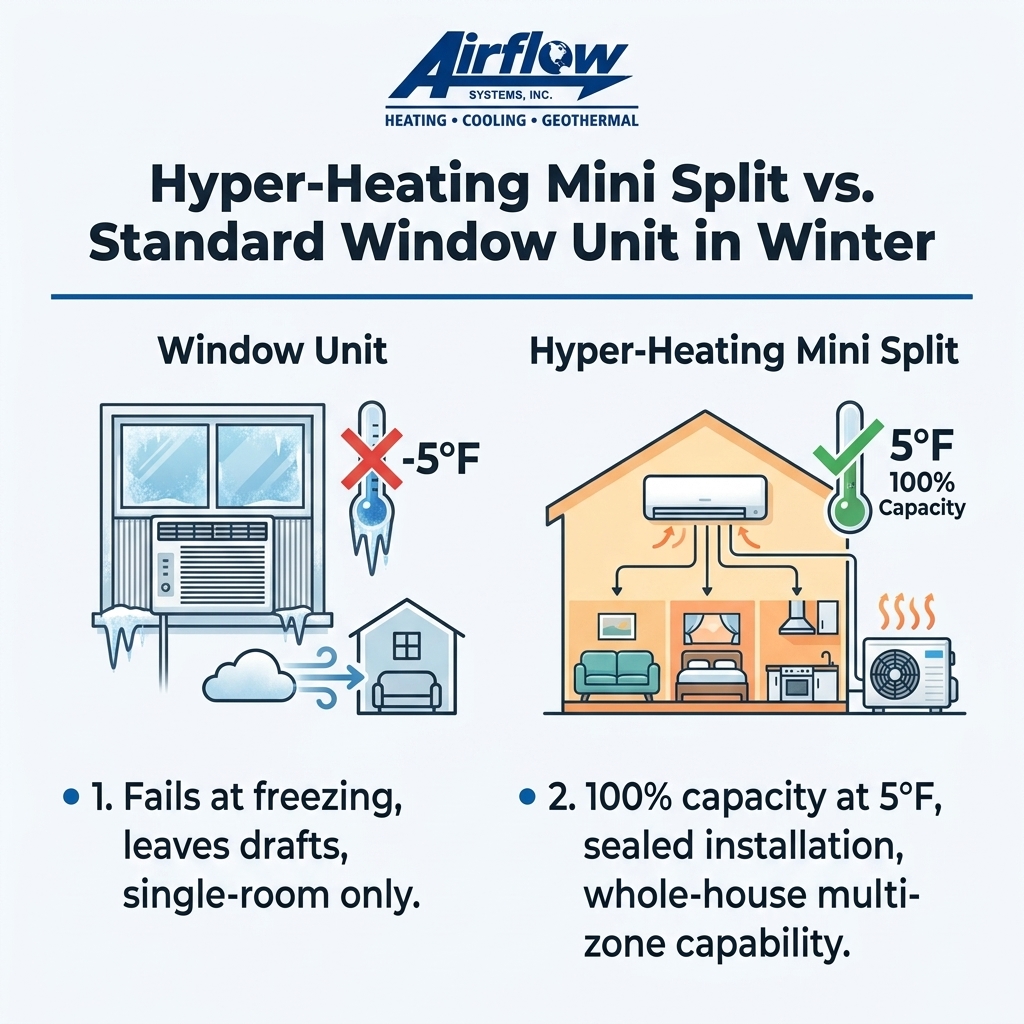
Window units are primarily designed for localized, single-room cooling. While some models include a heating function, they typically rely on simple, inefficient electrical resistance strips. When the temperature drops across Charlottesville and Central Virginia, these units struggle to produce meaningful heat. Furthermore, installing a standard unit directly in a window creates massive gaps in your home's thermal envelope, allowing freezing drafts to seep inside.
In stark contrast, a ductless system is a permanent, professionally installed solution that seals your home from the elements. It uses a sophisticated heat transfer process, moving heat energy rather than generating it from scratch. The outdoor compressor connects to the indoor air handlers through a small, sealed hole in the wall, eliminating the drafts and security risks associated with window installations.
• Heating Method — Standard Window Unit: Inefficient electrical resistance heating. — Modern Mini Split System: Advanced heat transfer via refrigerant.
• Cold Weather Performance — Standard Window Unit: Fails rapidly as temperatures approach freezing. — Modern Mini Split System: Maintains high capacity even in extreme cold.
• Installation Impact — Standard Window Unit: Leaves gaps, invites drafts, blocks natural light. — Modern Mini Split System: Requires only a small 3-inch hole, completely sealed.
• Coverage Area — Standard Window Unit: Limited to a single small room or immediate area. — Modern Mini Split System: Multi-zone capability for whole-house comfort.
• Noise Levels — Standard Window Unit: Loud compressor operates directly inside the room. — Modern Mini Split System: Whisper-quiet; compressor is located outdoors.
The takeaway: Ductless systems are highly engineered, permanent climate control solutions. Comparing them to a temporary window box drastically underestimates their ability to keep a whole house comfortable throughout the winter.
The Secret to Winter Warmth: Hyper-Heating Technology Explained
To understand how a mini split can heat an entire home during sub-freezing winter temperatures, you have to look at the engineering inside the outdoor compressor. The secret lies in hyper-heating technology, which is specifically designed for cold-climate operation.
Even when the air outside feels freezing to the human touch, there is still a significant amount of ambient heat energy present in the atmosphere. Modern cold-climate heat pumps use advanced refrigerants and specialized compressors to extract this latent heat, compress it to a higher temperature, and transfer it inside your home. According to Department of Energy data, these advanced systems can maintain 100% of their heating capacity at 5°F, and continue operating efficiently at temperatures well below zero.
To put this into local perspective, average January low temperatures in Charlottesville drop into the upper 20s. This climate profile falls well within the optimal, high-efficiency operating range of a hyper-heating system. Because the technology is so robust, the inefficient, expensive backup heating strips that older heat pumps relied on are rarely necessary.
How Inverter Technology Defeats the Cold
The backbone of hyper-heating performance is the inverter-driven compressor. Traditional furnaces and older heat pumps operate on a single-speed basis—they turn on at full blast until the thermostat is satisfied, then shut off completely. This constant on-and-off cycling creates noticeable temperature swings and cold drafts.
• Dynamic adjustments: An inverter compressor acts more like the accelerator pedal in a car. It continuously adjusts its operating speed to match the exact heating demand of your home.
• Consistent temperatures: By running continuously at lower, optimized speeds, the system maintains a strictly consistent indoor temperature without the massive fluctuations of older equipment.
• Elimination of drafts: Because the system does not constantly shut down and restart, the cold drafts associated with traditional system cycling are effectively eliminated.
This variable-speed operation ensures that your living spaces remain consistently warm, even when the thermometer outside dips deep into the freezing zone.
Mapping Out a Multi-Zone System for True Whole-House Comfort
A single indoor air handler is perfect for a bonus room, but heating an entire home requires a multi-zone configuration. In a multi-zone setup, a single, powerful outdoor compressor connects to multiple indoor air handlers distributed throughout the house. This architecture allows for customized temperature control, ensuring that every corner of the property receives adequate warmth.
Properly mapping out a multi-zone system is a strategic process that requires professional insight:
1. Evaluating the layout: The process begins by assessing the home's square footage, floor plan, and natural airflow barriers. Open-concept living areas require different treatment than partitioned bedrooms or multi-story layouts.
2. Selecting indoor unit styles: While high-wall mounts are the most common, indoor units also come in floor-mounted, ceiling-cassette, and concealed ducted styles. Choosing the right style for each room ensures optimal air distribution.
3. Strategic placement: Air handlers must be positioned where they can throw heated air across the room without obstruction. Placing them in corners or behind large furniture will result in localized hot spots and cold zones elsewhere.
4. Establishing individual zones: Each indoor unit operates on its own thermostat. This zoning capability allows you to keep the living room warm and cozy while maintaining a cooler temperature in unused guest bedrooms, significantly reducing energy waste.
This flexibility is especially valuable when dealing with unique architectural challenges or tight spaces across Charlottesville and Central Virginia. For example, our installation team at Airflow Systems, Inc. recently worked with a local customer who was pressed for time due to a real estate contract on a small apartment with limited space. By discussing the pros and cons of a ductless setup, our technicians quickly mapped out and installed a multi-zone system tailored to their layout. The outcome was a system that works better than expected, fitting perfectly into the tight deadline while operating ultra-efficiently.
When mapped correctly, this targeted approach to whole house heating eliminates the cold spots that central ductwork often leaves behind.
Efficiency Benefits and Pre-Winter Preparation
Beyond the comfort factor, upgrading to a ductless system offers substantial efficiency benefits. Modern mini splits boast exceptionally high SEER (Seasonal Energy Efficiency Ratio) ratings for cooling and high HSPF (Heating Seasonal Performance Factor) ratings for winter operation. Because they do not rely on ductwork—which can lose up to 30% of conditioned air through leaks and poor insulation—nearly all the energy consumed goes directly into heating your living space.
Financial incentives to upgrade: Because of their high efficiency, installing a cold-climate heat pump may qualify you for generic federal tax credits and various energy rebates. Homeowners are always advised to consult with a tax professional or their local utility provider to verify current programs, as these incentives can help offset the initial installation investment.
The importance of timing: The most strategic time to upgrade your home's heating infrastructure is during the early fall transition before the first freeze. Waiting until your current system fails on a freezing January night forces you into an emergency replacement scenario. By exploring heat pump options in September or October, you ensure your home is fully prepared, allowing you to schedule the installation at your convenience before the winter rush begins.
The Critical Role of Proper Sizing in Central Virginia Homes
The success of any whole-house ductless heating system depends entirely on professional sizing and strategic placement. You cannot simply guess the required capacity based on square footage alone. If a system is improperly sized, it will fail to keep your home comfortable, regardless of how advanced the technology is.
An oversized system will short-cycle, turning on and off rapidly. This prevents the inverter technology from running at its optimal, steady speed, leading to uneven temperatures, poor humidity control, and premature wear on the compressor. Conversely, an undersized system will run constantly at maximum capacity, struggling to reach the set temperature and driving up your energy consumption in the process.
To avoid these pitfalls, a professional must perform a Manual J load calculation. This calculation factors in your home's insulation levels, window quality, ceiling height, and sun exposure to determine the exact BTU requirements for each specific zone. At Airflow Systems, Inc., our team has spent years bridging the gap between generic manufacturer specifications and actual Virginia climate reality. By understanding the specific environmental demands of Charlottesville and Central Virginia, our local experts ensure that your multi-zone system is precisely sized to deliver reliable, efficient warmth all winter long.
Treating a ductless system like a simple plug-and-play appliance is a recipe for cold spots and frustration. Trusting a professional for your mini split installation guarantees that the equipment is matched perfectly to your home's unique thermal profile.
Frequently Asked Questions About Virginia Mini Split Heating
Can a mini split heat a 2000 sq ft house?
Yes, a multi-zone mini split system can effectively heat a 2000 square foot house. A single outdoor compressor can connect to multiple indoor air handlers, allowing you to create customized heating zones throughout the entire floor plan. The key to success is having a professional perform a load calculation to ensure the system has the correct total BTU capacity for a home of that size.
At what temperature does a mini split stop heating?
Modern hyper-heating mini splits continue to extract heat efficiently even when temperatures drop to -13°F. Furthermore, many advanced models maintain 100% of their rated heating capacity at 5°F. Because sub-freezing winter temperatures in Virginia rarely dip below these thresholds, a cold-climate heat pump remains highly effective throughout the season.
Is a mini split better than a window unit for heating?
Yes, a mini split is significantly better than a window unit for heating. Window units rely on inefficient electrical resistance strips and leave gaps in your window that invite freezing drafts indoors. A mini split uses advanced heat transfer technology, requires only a tiny, sealed hole in the wall, and provides superior, whisper-quiet warmth across much larger living spaces.
Do you need backup heat with a mini split in Virginia?
In most cases, you do not need backup heat when using a modern cold-climate mini split in Virginia. Older traditional heat pumps often required supplemental electric heat strips to handle deep freezes, but today's hyper-heating technology is specifically engineered to operate efficiently in extreme cold on its own. Proper sizing by a local professional ensures the system can handle the local climate independently.
How many indoor air handlers do I need for whole-house coverage?
The number of indoor air handlers you need depends entirely on your home's layout, square footage, and airflow patterns. An open-concept living space might only require one large unit, while a home with multiple enclosed bedrooms may need a dedicated unit for each distinct zone. A professional assessment is required to map out the exact number of units needed to eliminate cold spots.
Are there tax credits available for installing a cold-climate heat pump?
Yes, general federal tax credits and utility-based energy rebates often apply to qualifying high-efficiency heat pump installations. Because modern ductless systems operate with exceptional energy efficiency, they frequently meet the criteria for these incentive programs. Homeowners should always verify current available programs with their utility provider or a tax professional prior to installation.
Get Your Home Winter-Ready with Local Heating Experts
The short answer to whether a mini split can really heat a whole house in Virginia is a resounding yes. Modern hyper-heating technology, driven by variable-speed inverter compressors, is more than capable of keeping your living spaces consistently warm without relying on inefficient backup heating methods. By mapping out a multi-zone system tailored specifically to your floor plan, you can eliminate cold spots and enjoy customized comfort in every room.
The key is to take action during the early fall transition before the first freeze hits. Waiting for sub-freezing winter temperatures to arrive limits your options and forces rushed decisions. Now is the time to evaluate your home's heating needs and explore the benefits of high-efficiency ductless technology. Schedule a consultation with your local experts today to ensure your home is perfectly prepared for whatever the Virginia winter brings.
Book Expert Service Or Contact Us
Our Service Process
A Hassle-Free Service Experience
01
Consultation & Diagnosis
We start by listening to your needs and performing a thorough diagnosis of your system to recommend the best solution.
02
Transparent Quoting
We provide a clear, upfront estimate with no hidden fees, so you know exactly what to expect.
03
Expert Service & Follow-Up
Our factory-trained technicians complete the work to the highest standards, and we follow up to ensure your complete satisfaction.
testimonials
What Our Customers Are Saying
Our customers consistently praise our exceptional service and attention to detail, making us a trusted choice for all your HVAC needs.
where we operate
Service areas