


Choose an option to see quick actions and get help faster.
.svg)
Why the Right AC Filter Matters for Your Home's Efficiency
Understanding how the right filter improves your AC efficiency is one of the simplest — and most overlooked — ways homeowners in Charlottesville, VA can lower energy bills and keep their cooling system running strong all summer long.
Here is a quick breakdown of how the right filter helps your AC:
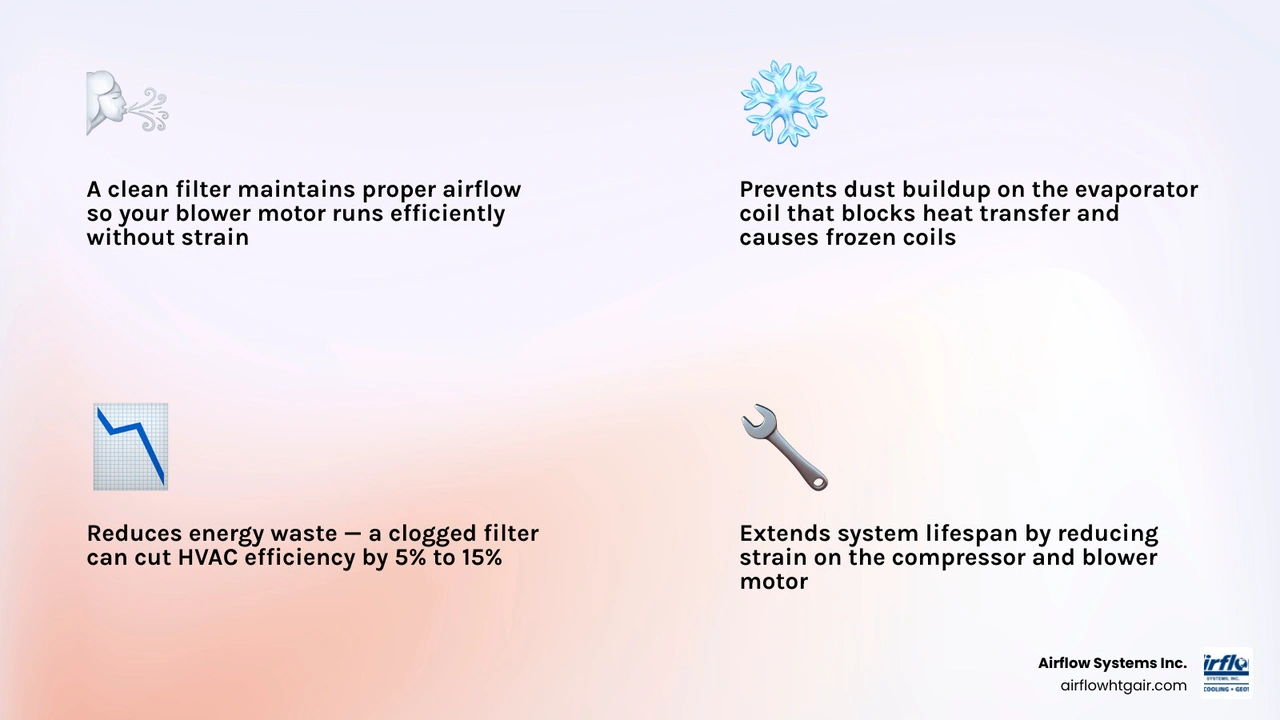
• Maintains proper airflow so your blower motor does not have to work overtime
• Protects the evaporator coil from dust buildup that blocks heat transfer
• Reduces energy waste — a clogged filter can cut HVAC efficiency by 5% to 15%
• Prevents frozen coils caused by restricted airflow over the evaporator
• Extends system lifespan by reducing strain on key components like the compressor and blower motor
Most homeowners in Central Virginia focus on thermostat settings or equipment age when their AC struggles to keep up. But one of the biggest efficiency drains is sitting right behind your return air grille. A dirty or mismatched filter forces your system to work harder, run longer cycles, and consume more electricity — all without cooling your home any better.
During Charlottesville's hot, humid summers, your AC runs far more hours than systems in milder climates. That means filters clog faster, and the consequences of neglecting them show up quickly — on your energy bill and in your comfort level.
How the right filter improves your ac efficiency word roundup:
• best ac filter options for central virginia homes
• how dirty air filters destroy your ac performance
• how often to change your ac filter in humid climates
How the Right Filter Improves Your AC Efficiency
To truly understand how a simple mesh or pleated barrier can make or break your air conditioning system, we need to pull back the curtain on how your AC actually works. Your air conditioner does not actually "create" cold air. Instead, it absorbs heat from the air inside your home and transfers it outdoors.
This heat exchange process relies entirely on two critical factors: consistent airflow and clean internal components.
When you choose the correct filter for your system, you are establishing the perfect balance between keeping the air clean and letting it flow freely. This balance directly prevents the system from wasting energy. In fact, a clean, appropriate filter keeps your utility bills predictable and your home comfortable.
To see the alternative, you can read about How Dirty Air Filters Destroy Your AC Performance and learn how quickly a neglected filter can lead to system breakdowns.
Why Airflow is the Foundation of Cooling Efficiency
Central air conditioners are precision-engineered machines designed to move a very specific volume of air—typically about 400 cubic feet per minute (CFM) per ton of cooling capacity—across the indoor evaporator coil.
When your air filter is clean and correctly matched to your system, air glides through the return ductwork with minimal resistance. This resistance is known in the HVAC world as "static pressure."
Think of static pressure like blood pressure in the human body. If the pressure is too high because of a thick, clogged, or overly restrictive filter, the blower motor has to work twice as hard to push air through the system. This restriction forces the blower motor to pull more electrical current, directly raising your monthly utility bills.
Furthermore, restricted airflow means your home cools down much slower. Your AC will have to run longer cooling cycles to meet the temperature set on your thermostat. Instead of a standard 15-to-20-minute cycle, a system with choked airflow might run for 30 to 45 minutes straight. This constant running accelerates wear and tear on your blower motor, control boards, and compressor, bringing you much closer to an unexpected breakdown during a summer heatwave.
Protecting the Evaporator Coil from Efficiency Loss
While maintaining airflow is crucial, the air filter has an equally important second job: keeping your indoor evaporator coil clean.
Your indoor evaporator coil is filled with freezing-cold refrigerant. As warm, humid air from your Charlottesville home is blown across this coil, the refrigerant absorbs the heat, and the moisture in the air condenses onto the cold metal (much like condensation forming on a cold glass of sweet tea on a July afternoon).
If your air filter is dirty, damaged, or fits poorly, dust, pet hair, and airborne debris will bypass the filter and settle directly onto the wet surfaces of the evaporator coil. Over time, this dust and moisture combine to create a layer of grime.
This grime acts as a literal layer of insulation on your coil. Because dust is a terrible conductor of heat, the cold refrigerant inside the coil cannot effectively absorb the heat from the air passing over it.
As a result:
• Your AC runs continuously because it cannot remove heat fast enough to cool the house.
• The temperature of the evaporator coil drops below freezing.
• The condensation on the coil turns to ice, completely blocking airflow and eventually causing the system to shut down entirely or suffer severe compressor damage.
By preventing this dust buildup, how the right filter improves your AC efficiency is by ensuring that heat exchange happens as quickly and easily as possible.
Navigating MERV Ratings and Filter Types
When you walk down the home improvement aisle or browse online, the sheer variety of air filters can be overwhelming. To find your efficiency sweet spot, you need to understand MERV ratings and how different filter designs affect your system.
• Fiberglass (Flat) — MERV Rating: MERV 1 - 4 — Particle Capture Capabilities: Captures only large particles like lint and heavy dust. — Recommended Use Case: Basic equipment protection only; not recommended for indoor air quality.
• Standard Pleated — MERV Rating: MERV 5 - 8 — Particle Capture Capabilities: Captures dust mites, mold spores, and pollen. — Recommended Use Case: Great baseline for standard residential homes without pets or allergies.
• Advanced Pleated — MERV Rating: MERV 11 - 12 — Particle Capture Capabilities: Captures pet dander, fine dust, car emissions, and smoke. — Recommended Use Case: The Sweet Spot: Ideal for homes with pets, allergies, or mild asthma.
• Premium Pleated — MERV Rating: MERV 13 — Particle Capture Capabilities: Captures bacteria, microscopic allergens, and tobacco smoke. — Recommended Use Case: Excellent for superior air quality, but requires a system rated for high resistance.
• HEPA Filters — MERV Rating: MERV 17 - 20 — Particle Capture Capabilities: Captures 99.97% of particles down to 0.3 microns. — Recommended Use Case: Hospitals and cleanrooms; not suitable for standard residential HVAC systems.
How the Right Filter Improves Your AC Efficiency by Balancing MERV Ratings
MERV stands for Minimum Efficiency Reporting Value. Developed by the American Society of Heating, Refrigerating and Air-Conditioning Engineers (ASHRAE), this scale ranges from 1 to 20 and measures how effectively a filter captures particles of various sizes.
For residential cooling systems in Central Virginia, the sweet spot is almost always between MERV 8 and MERV 11.
Filters in this range are designed with pleated media. The pleats vastly increase the surface area of the filter material compared to flat fiberglass filters. This extra surface area allows the filter to trap a high percentage of common household allergens—such as pollen, pet dander, and dust mite debris—without creating excessive resistance to the airflow.
By utilizing a pleated MERV 8 or MERV 11 filter, you protect your indoor air quality and keep your evaporator coil pristine, ensuring your system runs at peak energy efficiency.
Can Too High a MERV Rating Harm Your System?
It is easy to assume that a higher MERV rating is always better. After all, wouldn't a MERV 13 or a medical-grade HEPA filter keep your air the cleanest?
While it is true that these tightly woven filters capture microscopic particles, they also act like a solid wall to your AC's blower motor. Standard residential HVAC systems are simply not designed to push air through the extremely dense fibers of a high-MERV or HEPA filter.
Installing a filter with too high a MERV rating consumes too much of your system's "static pressure budget." The restricted airflow causes the temperature of your evaporator coil to plummet, which can lead to frozen coils and water damage when the ice melts.
Moreover, the strain on your blower motor can cause it to burn out prematurely, turning a simple filter upgrade into an expensive repair. Unless your system was specifically designed or modified by a professional to handle a MERV 13+ filter, sticking to a high-quality MERV 8 or 11 is the safest way to maintain high efficiency.
Signs Your Current Filter is Hurting Your AC Performance
How do you know if your air filter is currently working against your comfort and your wallet? Your air conditioning system will usually drop several hints when its filter is clogged or poorly matched.
Keep an eye out for these common warning signs:
1. Weak Airflow from Your Registers: If you hold your hand up to your supply vents and the breeze feels more like a gentle whisper than a strong current, your filter is likely choked with dust.
2. Rising Utility Bills: If your electric bills are 10% to 15% higher than they were during the same month last year, but the outdoor temperatures have been similar, your AC is likely running longer cycles due to restricted airflow.
3. The AC Runs Constantly: A clean filter allows your home to reach its target temperature quickly. If your system is running almost continuously without a break, a dirty filter is a prime suspect.
4. Increased Dust on Furniture: When a filter becomes completely loaded, the air pressure can force dust and debris around the edges of the filter frame or straight through the worn media, recirculating it back into your living spaces.
5. Musty "Dirty Sock" Smells: If you notice a damp, musty odor coming from your vents when the AC kicks on, it often means moisture and organic dust have built up on your evaporator coil, creating a breeding ground for mold.
If you are noticing any of these issues, it is time to run through our AC Maintenance Checklist for Virginia Homeowners to ensure your system is fully prepared to handle the peak of summer.
Best Practices for Filter Maintenance and Replacement Schedules
To keep your air conditioner running at maximum efficiency, you should establish a consistent routine for checking and replacing your filters.
While filter manufacturers often print "lasts up to 90 days" on their packaging, this is a maximum limit under perfect conditions, not a guarantee. During heavy cooling seasons in Charlottesville, your AC runs frequently, meaning filters load up with debris much faster.
For a standard 1-inch pleated filter, we recommend checking it every 30 days. Simply slide the filter out and hold it up to a bright light source. If you cannot see light passing through the pleats, the filter is dirty and should be replaced immediately.
If you have pets, live in a high-pollen area, or have family members with asthma, you will likely need to replace your filter every 30 to 45 days during the summer. For homes without pets or high dust levels, a high-quality pleated filter can comfortably last 60 to 90 days in the milder spring and fall months.
If your home is equipped with a deeper 4-inch or 5-inch media cabinet, these filters have significantly more surface area and can often last 6 to 9 months before needing a swap. However, they should still be visually inspected every few months to ensure they are clean.
Regularly replacing your filter is just one part of keeping your system healthy. To find out what else goes into keeping your system running perfectly, take a look at our guide on What Does a Professional AC Tune-Up Include.
How the Right Filter Improves Your AC Efficiency Through Proper Installation
Even the best filter on the market will fail to protect your AC's efficiency if it is installed incorrectly.
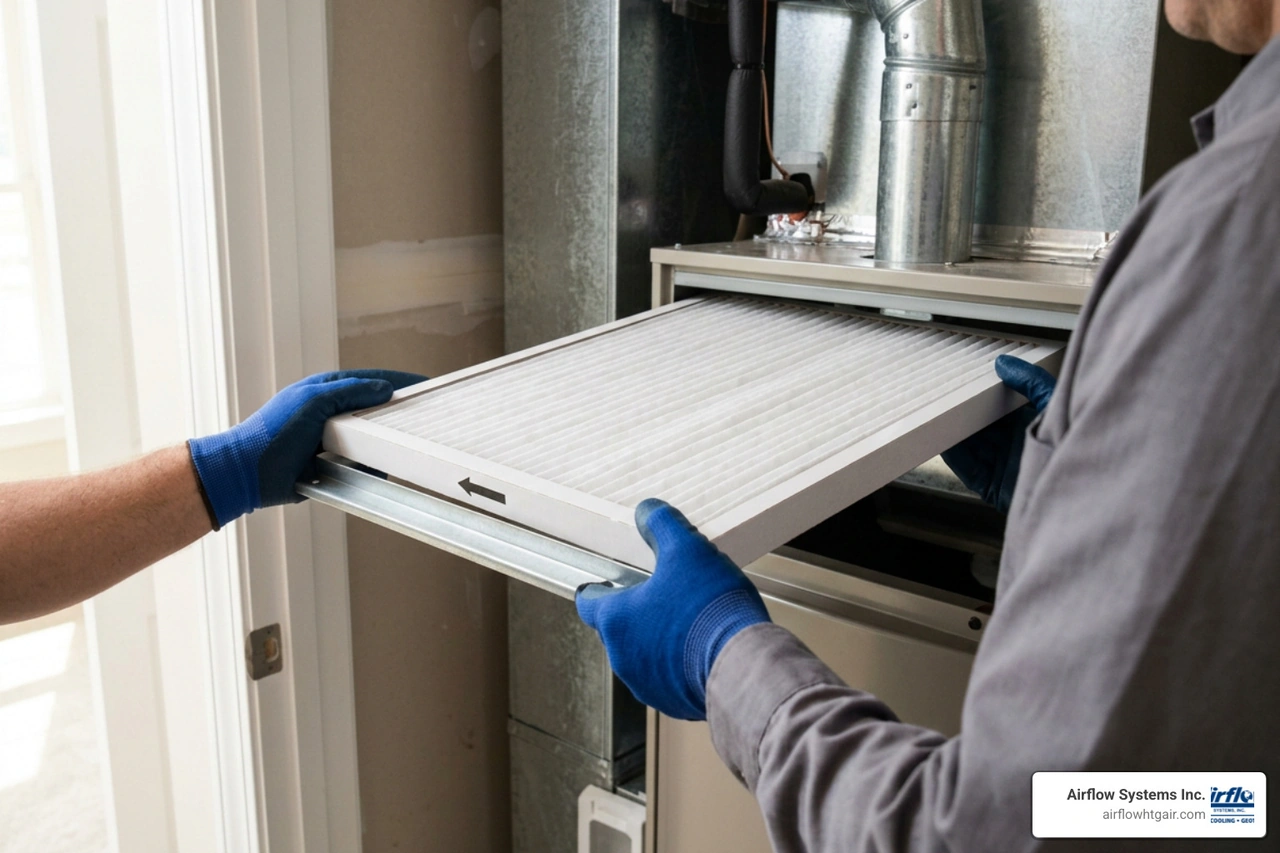
When replacing your filter, pay close attention to the airflow arrows printed on the cardboard frame. These arrows must point in the direction that the air flows—which is always toward the blower motor or air handler, not away from it.
Installing a filter backward reduces its efficiency because pleated filters are designed with a graduated density; the larger fibers on the outer side catch big particles first, while the denser inner fibers catch the smaller ones. Running it backward causes the filter to clog almost instantly, severely restricting airflow.
Additionally, make sure you are using the correct size. Air filters have both a "nominal" size (the rounded numbers printed in bold on the packaging, like 16x25x1) and an "actual" size (the precise physical measurements).
If your filter slot has gaps around the edges, air will take the path of least resistance, bypassing the filter entirely. This "air bypass" allows dust to coat your evaporator coil, leading to the exact efficiency losses we want to avoid.
Frequently Asked Questions About AC Filters and Efficiency
Can I run my AC without a filter temporarily?
While your air conditioner will technically run without a filter, we strongly advise against doing so, even for a single day.
Without a filter, the blower fan will pull raw, unfiltered household dust, hair, and airborne debris directly into your air handler. This debris will quickly coat the wet surfaces of your evaporator coil, turning into a sticky mud that is incredibly difficult and expensive to clean.
Running your AC without a filter can ruin your system's efficiency and lead to frozen coils or a clogged condensate drain line within a matter of hours.
Do high-efficiency filters cause frozen coils?
Yes, they absolutely can if they are not properly matched to your HVAC system's capabilities.
High-efficiency filters (such as those rated MERV 13 or higher) have very dense fibers that restrict airflow. If your blower motor is not powerful enough to push air through that dense material, the volume of air passing over your evaporator coil will drop.
When airflow drops too low, the refrigerant inside the coil cannot absorb enough heat, causing the coil's temperature to drop below freezing. The condensation on the coil will quickly turn to ice, blocking all remaining airflow and potentially causing liquid refrigerant to flood back into your compressor, leading to a catastrophic system failure.
How often should I change my filter if I have pets in Charlottesville, VA?
If you have dogs or cats in your Central Virginia home, you should check your air filter every 20 to 30 days during the peak summer cooling season.
Pet hair and dander are highly effective at clogging the pleats of an air filter, wrapping around the fibers and creating a thick blanket that chokes off airflow much faster than standard household dust.
Additionally, during our local spring and summer pollen seasons, outdoor allergens hitch a ride indoors on your pets' fur, further loading up your filter. Keeping a close eye on your filter during these high-use periods is the easiest way to protect your AC's blower motor and maintain low energy bills.
Conclusion
Understanding how the right filter improves your AC efficiency is the first step toward a more comfortable, energy-efficient home. By selecting the correct MERV rating, checking your filter monthly, and installing it with care, you can prevent frozen coils, lower your monthly energy bills, and extend the lifespan of your cooling system.
However, even the most diligent filter maintenance cannot replace the value of professional care. Over time, dust can still find its way onto your system's internal components, and electrical connections can loosen. That is where we come in.
At Airflow Systems Heating & Air, we have been providing trusted, honest, and professional HVAC services to homeowners in Charlottesville, VA and the surrounding Central Virginia region since 1988. As a premier, family-owned contractor, our certified technicians use the latest diagnostic tools to ensure your system's airflow, static pressure, and overall efficiency are perfectly optimized.
Don't let a simple maintenance oversight lead to high energy bills or an unexpected breakdown. Let us help you keep your home cool and comfortable all year long.
Explore our professional cooling services and schedule your next visit today:
• Ensure your system is running at peak performance with a professional AC Tune-Up Charlottesville VA.
• Prevent unexpected breakdowns and protect your equipment with regular AC Maintenance Charlottesville VA.
• If your system is struggling to keep up with the summer heat, get fast, reliable help with our expert AC Service Charlottesville VA.
• To learn more about how we can keep your home comfortable, check out our comprehensive Airflow Systems Air Conditioning Services.
Book Expert Service Or Contact Us
Our Service Process
A Hassle-Free Service Experience
01
Consultation & Diagnosis
We start by listening to your needs and performing a thorough diagnosis of your system to recommend the best solution.
02
Transparent Quoting
We provide a clear, upfront estimate with no hidden fees, so you know exactly what to expect.
03
Expert Service & Follow-Up
Our factory-trained technicians complete the work to the highest standards, and we follow up to ensure your complete satisfaction.
testimonials
What Our Customers Are Saying
Our customers consistently praise our exceptional service and attention to detail, making us a trusted choice for all your HVAC needs.
where we operate
Service areas