

Choose an option to see quick actions and get help faster.
.svg)
When a Neglected Filter Becomes a Mechanical Threat
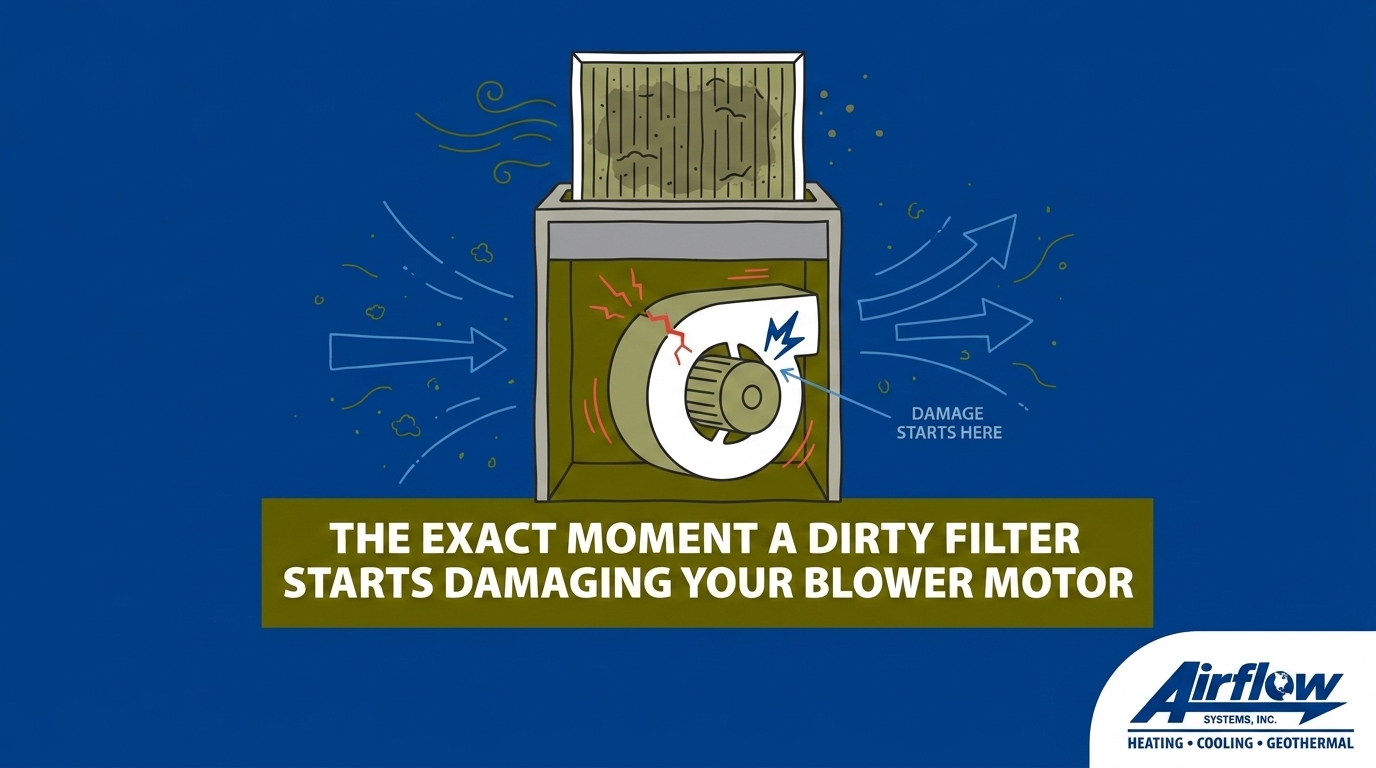
Your air conditioner is running constantly, but the vents are barely pushing out a weak, lukewarm breeze. The house still feels warm, and that strained humming noise from your utility closet isn't going away on its own. The exact moment a dirty filter starts damaging your blower motor is entirely silent, leaving most homeowners completely unaware of the mechanical stress building up inside their ductwork. Here at Airflow Systems, Inc., our team sees this exact scenario play out every year as Charlottesville families transition back to school. While many people view swapping out a dusty filter as a minor efficiency tip, the reality is far more serious. By the time you notice a decline in comfort during heavy August late-summer cooling wear, your system may have already crossed an invisible threshold—shifting from merely wasting energy to actively destroying its own internal components.
If your equipment is currently struggling to keep up with the heat, ensuring your air conditioning system is evaluated by a professional is the safest way to prevent a catastrophic breakdown.
To understand why a simple piece of pleated fabric holds so much power over your equipment, we have to look past the thermostat and examine the physics inside the air handler. Homeowners often assume that a clogged filter simply means the air isn't being cleaned as well. In truth, a neglected filter fundamentally alters the operating conditions of the blower motor. It forces a delicate mechanical ecosystem to operate under extreme duress, transforming a routine maintenance task into a high-stakes mechanical threat.
Understanding the Physics of Airflow and Static Pressure
Every heating and cooling system is designed to operate within a highly specific set of physical parameters. The most critical of these is static pressure. In the HVAC world, static pressure is the resistance to airflow within your ductwork and equipment. Our technicians often explain this to homeowners by comparing it to blood pressure in the human body; a certain amount of resistance is necessary for the system to function, but when that resistance spikes, the heart—or in this case, the blower motor—has to work dangerously hard to keep things moving.
The Mechanics of Air Resistance
When an HVAC system is installed, engineers calculate the exact amount of air volume (measured in cubic feet per minute, or CFM) required to heat or cool your home efficiently. The blower motor is calibrated to push and pull this specific volume of air against a normal, expected level of resistance. When you introduce a clean filter, it provides a very small, calculated amount of resistance that the motor easily overcomes.
However, as the filter traps dust, pet dander, pollen, and debris, that resistance grows. The physics of this airflow restriction follow a predictable, destructive sequence:
1. The initial capture: A clean filter allows air to pass freely while trapping microscopic particles in its fibers. The motor operates smoothly within its designed static pressure range.
2. The gradual restriction: As the fibers fill with debris, the open pathways for air become narrower. The static pressure inside the return duct begins to rise, creating a vacuum effect.
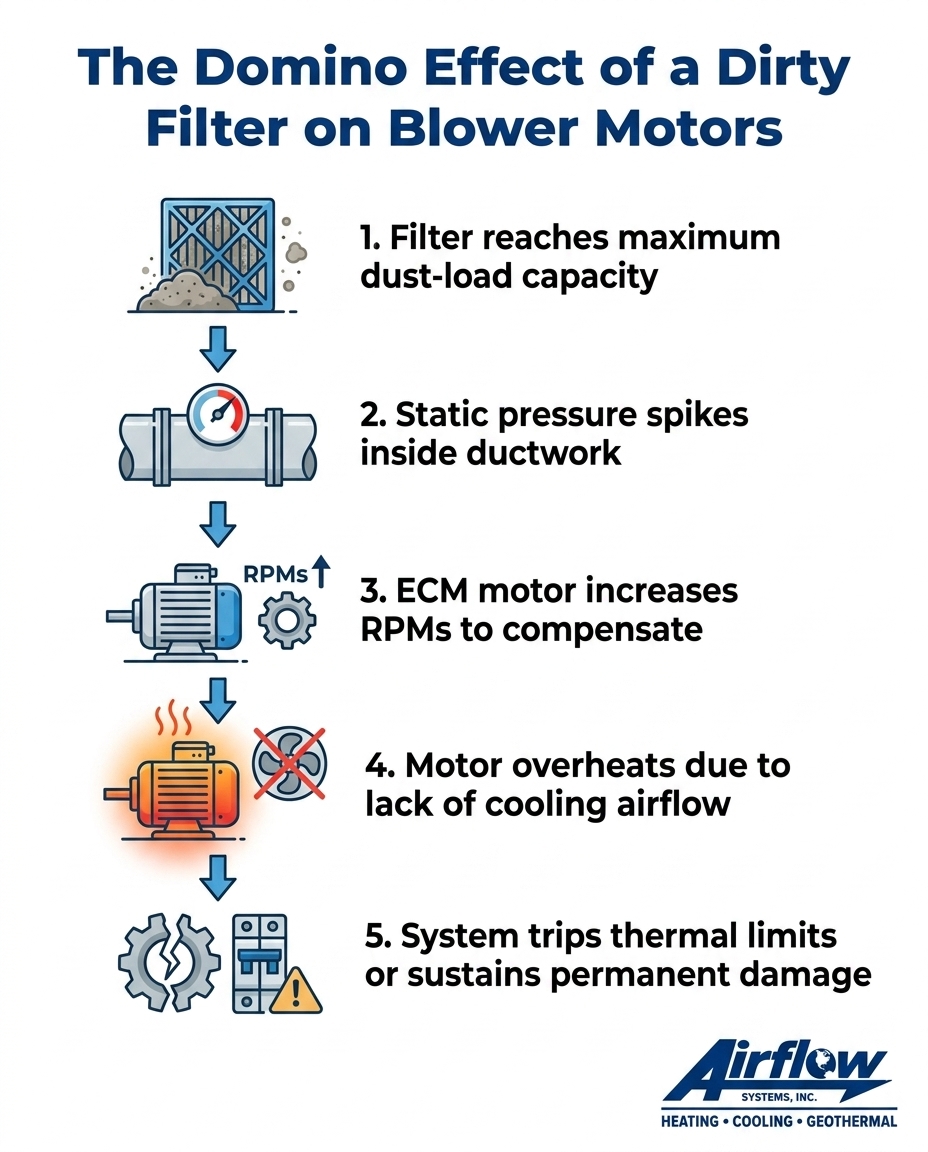
3. The physical wall: Once a filter reaches its maximum dust-load capacity, it ceases to be a filter and becomes a physical barrier. Excessive static pressure builds up behind the filter, starving the blower motor of the air it needs to function.
Why Blower Motors Need a Specific Range
Poor airflow doesn't just make your living room feel stuffy; it fundamentally alters the operating conditions inside the air handler. Blower motors are engineered to run at a specific RPM (revolutions per minute) and draw a specific amount of electrical current. When static pressure spikes due to a clogged filter, the motor is thrown out of its operational sweet spot. If you have been considering indoor air quality testing, it is important to realize that the same airborne particulates degrading your indoor air are also the culprits clogging your filter and driving up static pressure.
The Invisible Threshold: From Efficiency Loss to Motor Strain
The progression from a slightly dirty filter to a full-blown mechanical crisis does not happen overnight. It happens in phases, and the most dangerous phase is entirely invisible to the homeowner. The exact mechanical moment the damage begins is a specific threshold where efficiency loss transitions into physical motor strain.
The Initial Phase: Hiding in Plain Sight
In the early stages of filter restriction, your system simply becomes inefficient. The blower motor has to run longer cycles to push the required amount of conditioned air into your home. During this phase, you might notice your energy consumption creeping up—typically consuming 5% to 15% more energy to cool the home. However, despite the longer run times, the motor is still functioning within safe temperature limits. It is working harder, but it is not yet dying.
Crossing the Threshold: Heat Accumulation
The invisible threshold is crossed when airflow restriction reaches a point where the motor can no longer pull enough air across itself to dissipate its own operating heat. This is the critical mechanism most homeowners misunderstand: blower motors rely on the very air they move to stay cool. The constant stream of air passing over the motor's casing acts as a cooling mechanism, carrying away the heat generated by the electrical components and friction.
When a filter reaches maximum dust-load capacity, it starves the motor of this cooling air. The exact moment the damage starts is when the internal temperature of the motor exceeds its design limits. Starving a motor of air causes internal temperatures to spike rapidly. The insulation around the copper windings begins to break down, and the internal bearings start to degrade under the thermal stress.
This transition is silent. You will not hear a warning alarm. You will only know the threshold was crossed when the system completely shuts down or requires major intervention. If your system has been running constantly but failing to cool your home, scheduling an AC repair diagnostic is critical to determining if your motor has sustained thermal damage.
ECM vs. PSC Motors: Why Modern Systems Fight Back (and Lose)
Not all blower motors react to excessive static pressure in the same way. The age and technology of your HVAC system play a massive role in how quickly a neglected filter will cause catastrophic damage. Understanding the difference between older PSC motors and modern ECMs highlights a critical vulnerability in high-efficiency systems.
The Passive Reaction of PSC Motors
Older HVAC systems typically utilize PSC (Permanent Split Capacitor) motors. These are single-speed workhorses that operate on a very simple principle: they spin at a constant speed regardless of the conditions. When a PSC motor encounters a clogged filter and high static pressure, it simply moves less air. It lacks the technology to "know" that the airflow is restricted.
Because it moves less air, the home becomes uncomfortable, and efficiency plummets. However, because the motor doesn't try to fight the restriction, it often experiences less immediate mechanical strain. It will still overheat eventually due to the lack of cooling airflow, but the progression is generally slower.
The Fatal Flaw of ECM Technology
Modern, high-efficiency HVAC systems utilize ECM (Electronically Commutated Motors) or variable-speed motors. These motors are essentially computers. They are programmed to maintain a specific airflow volume (CFM) at all times, adjusting their speed and torque dynamically to ensure optimal comfort and efficiency.
Here is how the two technologies compare when faced with a clogged filter:
• PSC (Older) — Reaction to Clogged Filter: Continues spinning at the same speed, unable to overcome resistance. — Impact on Airflow: Airflow drops significantly; home feels warm and stuffy. — Risk of Rapid Overheating: Moderate. Overheats slowly due to lack of cooling air.
• ECM (Modern) — Reaction to Clogged Filter: Senses resistance and commands the motor to spin faster and harder. — Impact on Airflow: Maintains airflow temporarily, masking the problem from the homeowner. — Risk of Rapid Overheating: Severe. Rapidly overheats and burns out sensitive electronic modules.
The fatal flaw of the ECM under high resistance is its own intelligence. Our repair crews at Airflow Systems, Inc. frequently see the aftermath of this: the motor's computer senses the restriction caused by the dirty filter and commands the motor to ramp up its RPMs to push through the blockage. This "smart" overcompensation causes the motor to draw significantly more electrical current. The combination of drawing higher current and being starved of cooling air causes the ECM to rapidly overheat, often burning out its expensive electronic control modules when forced to fight a clogged filter.
The Compounding Effect of Late-Summer Humidity
The mechanical strain caused by excessive static pressure does not exist in a vacuum. It is heavily influenced by the environment and the season. By the time late summer arrives, HVAC systems have been running heavily for months, meaning filters are likely already heavily loaded with dust and debris. This seasonal timing is precisely when most catastrophic motor failures occur.
Latent Heat and Dehumidification
With summer temperatures soaring, Charlottesville's heavy August humidity requires optimal airflow for proper dehumidification. An air conditioner does two things: it lowers the temperature of the air (sensible cooling) and it removes moisture from the air (latent cooling). After years of servicing AC units across Central Virginia, our team knows firsthand that removing moisture requires the system to work incredibly hard, pulling warm, humid indoor air across the cold evaporator coil.
High humidity forces the system to work overtime to remove this latent heat. When you combine this heavy moisture load with restricted airflow from a dirty filter, you create a worst-case scenario for the blower motor. The motor is forced to run continuously under maximum strain, fighting both the physical blockage of the filter and the heavy, moisture-laden air.
The Worst-Case Scenario for Motor Health
Because the system is running almost non-stop to combat the August late-summer cooling wear, the blower motor never gets a chance to rest and cool down. The compounding effect of high ambient temperatures, heavy humidity, and a choked filter accelerates the breakdown of the motor's internal insulation. What might have been a slow degradation in mild weather becomes a rapid, catastrophic failure during the peak of summer heat.
Cascading Failures: The Domino Effect of Restricted Air
The blower motor is rarely the only component to suffer when static pressure spikes. An HVAC system is a closed loop, meaning a failure in one area quickly cascades into failures across the entire system. When a dirty filter chokes off the air supply, it sets off a domino effect that threatens the most critical components of your air conditioner.
The Freezing Evaporator Coil
The most common secondary failure is a frozen evaporator coil. The indoor coil relies on a steady stream of warm return air passing over it to absorb heat. When restricted airflow prevents sufficient warm air from reaching the coil, the temperature of the refrigerant inside the coil drops rapidly.
As the coil temperature plummets below freezing, the condensation that naturally forms on the outside of the coil during the dehumidification process begins to turn to ice. Understanding how dirty filters cause frozen evaporator coils is crucial, because this ice creates a dangerous feedback loop.
The Feedback Loop of Destruction
Once a thin layer of ice forms on the coil, it acts as an additional physical barrier to airflow. The static pressure spikes even higher. The blower motor (especially an ECM) ramps up even faster to push air through the ice block, generating even more heat. Eventually, the coil becomes a solid block of ice, completely stopping airflow. At this point, the blower motor is practically guaranteed to overheat, and liquid refrigerant may flow backward into the outdoor compressor, risking total system failure.
Why Professional Diagnostics Are Crucial for Overheated Motors
If you suspect your system has been operating with a severely clogged filter for an extended period, simply sliding a clean filter into the rack may not be enough to save the equipment. While changing the filter removes the physical restriction, it cannot reverse the internal electronic or thermal damage already done to the blower motor.
One local customer recently reached out to our team at Airflow Systems, Inc. for a thorough HVAC system service after noticing a sharp drop in airflow. The technician performed a comprehensive diagnostic, uncovering high static pressure that had already begun stressing the blower motor, and was able to intervene before permanent damage occurred—providing what the homeowner called the best HVAC service they had experienced. This proactive approach is exactly why professional assessment is so vital.
The Dangers of Guesswork
At Airflow Systems, Inc., our team prioritizes honest maintenance advice—helping homeowners protect their investments through proactive care rather than waiting for failure. Testing static pressure, diagnosing ECM module health, and evaluating electrical draw are not DIY projects.
Professional technicians use specialized tools, such as digital manometers, to measure static pressure directly inside the ductwork. They use multimeters to test the motor's electrical draw and verify that the internal thermal limits haven't been permanently compromised. Having an expert evaluate the system ensures no lingering issues remain, which is why enrolling in a routine HVAC maintenance plan is the most effective way to monitor static pressure before it destroys your equipment.
Frequently Asked Questions About Filter Maintenance and Motor Health
Can a dirty air filter actually break the blower motor?
Yes. It creates high static pressure, forcing the motor to overwork, overheat, and eventually fail mechanically or electronically. When the motor is starved of the air it needs to cool itself, the internal insulation degrades rapidly, leading to a complete burnout that requires professional replacement.
How does high static pressure affect an HVAC system?
It acts like a blocked artery, reducing airflow, decreasing efficiency, causing components to freeze, and accelerating wear and tear on the blower. High static pressure forces every component to operate outside of its designed parameters, turning routine cooling cycles into highly stressful events for the machinery.
How do you know if your blower motor is overheating?
Signs include the system shutting down unexpectedly (tripping internal thermal limits), a burning electrical smell from the vents, or the motor running loudly but moving very little air. If you notice any of these symptoms, turn the system off immediately at the thermostat to prevent further thermal damage.
What happens if I don't change my AC filter during the summer?
The filter reaches its dust capacity rapidly, choking the system just when cooling demands are highest, leading to frozen coils and motor burnout. During peak summer months, the system runs longer cycles, meaning the filter traps debris much faster than it does during the mild spring or fall seasons.
Do variable-speed (ECM) motors burn out faster with dirty filters?
Yes, because their programming forces them to ramp up their RPMs to overcome the restriction, generating excessive heat that damages their sensitive electronics. While older motors simply move less air, ECMs fight the blockage, drawing high electrical current until their control modules fail.
Protecting Your Cooling System from Preventable Wear
Understanding the physics of airflow restriction validates the urgency of routine filter maintenance. A filter does far more than capture dust; it dictates the static pressure of your entire ductwork system. The exact moment a dirty filter starts damaging your blower motor is the moment that static pressure prevents the motor from cooling itself.
A simple, routine filter change is your best defense against catastrophic motor failure and cascading system issues. If your equipment has been struggling through the August late-summer cooling wear, or if you suspect it has been running with restricted airflow for too long, do not wait for the motor to burn out completely. Reach out to a professional to inspect the system, measure the static pressure, and ensure your blower motor is operating safely and efficiently.
Book Expert Service Or Contact Us
Our Service Process
A Hassle-Free Service Experience
01
Consultation & Diagnosis
We start by listening to your needs and performing a thorough diagnosis of your system to recommend the best solution.
02
Transparent Quoting
We provide a clear, upfront estimate with no hidden fees, so you know exactly what to expect.
03
Expert Service & Follow-Up
Our factory-trained technicians complete the work to the highest standards, and we follow up to ensure your complete satisfaction.
testimonials
What Our Customers Are Saying
Our customers consistently praise our exceptional service and attention to detail, making us a trusted choice for all your HVAC needs.
where we operate
Service areas