

Choose an option to see quick actions and get help faster.
.svg)
The Challenge of Unpredictable Fall Weather on Your Home Comfort
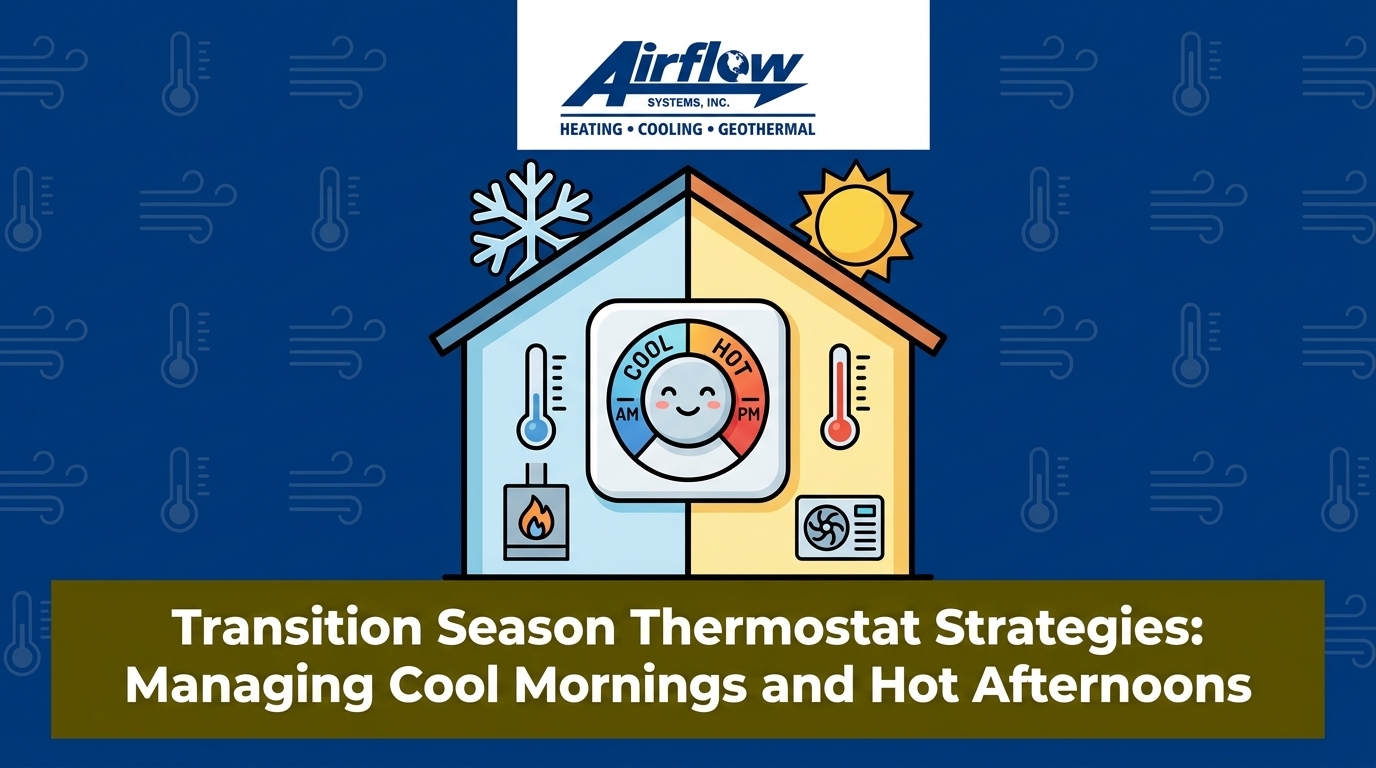
September is just around the corner, bringing crisp morning air that rapidly gives way to sweltering afternoon heat. Implementing proper transition season thermostat strategies: managing cool mornings and hot afternoons is essential when your indoor environment swings between extremes. When the weather fluctuates wildly, your heating and cooling equipment can end up fighting itself if the auto-changeover settings are too tight. Understanding how to adjust these parameters protects your entire HVAC system from unnecessary strain while keeping your home consistently comfortable. Upgrading to smart thermostats offers features specifically designed to handle these exact transition periods.
The reality of September temperature swings: Here in Charlottesville, our team at Airflow Systems, Inc. sees this daily tug-of-war firsthand. Early fall forces your home's thermal mass to endure a massive shift. Overnight, the structure loses heat to the cool outside air, leaving your living room chilly by dawn. Just a few hours later, the sun beats down on the roof and windows, trapping heat inside. This rapid shift creates a highly specific challenge for your indoor climate control. If your thermostat is not configured correctly, it will rapidly cycle the furnace to warm the house, only to trigger the air conditioner moments later when the sun warms the rooms.
Navigating these daily extremes requires more than just picking a comfortable number on the dial. It demands a strategic approach to how your system reads and reacts to ambient temperature changes. By mastering your thermostat's advanced settings, you can establish a comfortable indoor environment that adapts seamlessly to the shifting seasons without driving up your energy consumption.
Understanding Auto-Changeover Features During Early Fall
Auto-changeover is a specialized thermostat feature that allows your system to automatically switch between heating and cooling modes based on the indoor temperature. During the peak of winter or the dead of summer, you typically lock your system into a single mode. However, the extreme 20 to 30-degree daily swings of Charlottesville's specific early fall climate make auto-changeover an essential tool rather than an optional luxury.
When configured correctly, this feature acts as the brain of your climate control strategy. Here is how the auto-changeover process functions during unpredictable weather:
1. Monitoring ambient conditions: The thermostat continuously reads the indoor temperature, comparing it to your programmed preferences.
2. Triggering morning warmth: As overnight temperatures drop, the indoor ambient temperature falls below your heating setpoint, prompting the system to engage your heating solutions.
3. Entering the neutral zone: As the sun rises and naturally warms the home, the indoor temperature climbs above the heating setpoint, and the furnace shuts off.
4. Activating afternoon cooling: If the indoor temperature continues to rise and crosses the cooling setpoint, the air conditioner engages to remove the excess heat.
The primary risk during September temperature swings lies in setting these trigger points too close together. If the heating and cooling targets overlap or sit just a degree apart, the system becomes confused. The furnace will heat the house, slightly overshooting the target, which immediately triggers the air conditioner to cool it back down. This creates a wasteful, continuous loop of energy consumption.
What is a Thermostat Deadband and Why Does It Matter?
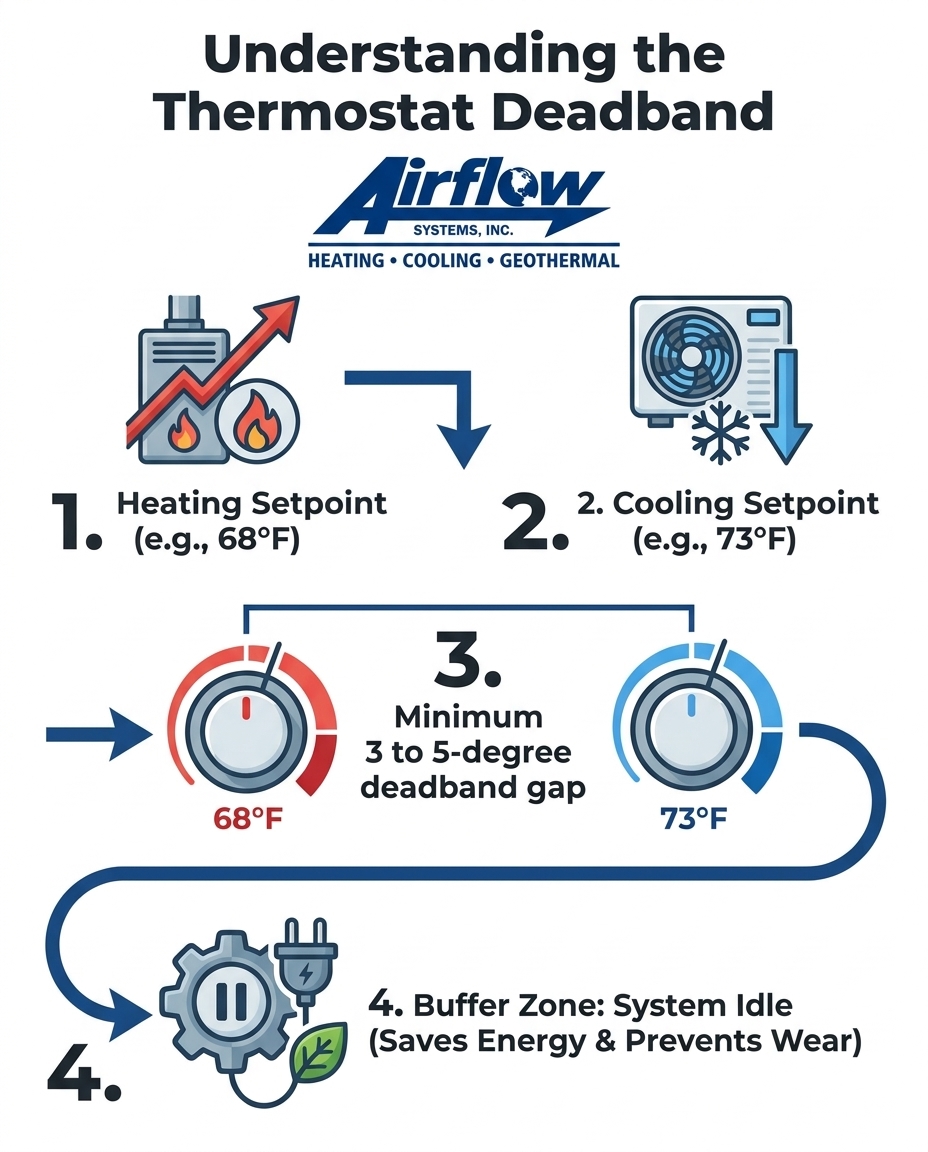
To prevent your heating and cooling systems from battling each other, you must utilize a concept known as a thermostat deadband. A deadband is the required temperature gap between your heating setpoint and your cooling setpoint. It acts as a neutral buffer zone where neither the furnace nor the air conditioner is running, allowing your home to coast on its current temperature.
The Department of Energy strongly recommends maintaining a minimum 3 to 5-degree deadband gap to ensure system efficiency. For example, if you want your home to be warm in the morning and cool in the afternoon, you might set your heating target to 68°F and your cooling target to 73°F. The 5-degree space between 68°F and 73°F is the deadband.
When the indoor temperature floats between 69°F and 72°F, the system remains completely idle. This buffer allows the natural warmth of the afternoon sun to raise the indoor temperature without immediately triggering the air conditioner, and it allows the evening chill to cool the house without immediately firing up the furnace.
Setting the Optimal Temperature Buffer
Establishing a minimum 3 to 5-degree deadband gap is a straightforward process on most modern interfaces. First, select the "Auto" mode on your thermostat, which activates the auto-changeover feature. You will then be prompted to enter two separate temperatures: one for heating and one for cooling. Ensure that the cooling number is at least three to five degrees higher than the heating number. If you attempt to set them too close together, many modern devices will automatically adjust the secondary number to force a safe buffer, protecting the equipment from rapid cycling.
The Hidden Mechanical Costs of Short-Cycling
Failing to establish a proper buffer zone does more than just inflate your monthly utility bills; it inflicts severe mechanical wear on your equipment. When the deadband is too narrow, the system experiences a phenomenon known as short-cycling.
The Problem: Short-cycling occurs when the HVAC system rapidly turns on and off in short bursts. During transition seasons, a tight deadband forces the system to bounce erratically between heating and cooling modes. The furnace fires up, runs for a few minutes, shuts down, and then the air conditioner immediately kicks on to combat the newly generated heat.
The Cause: This erratic behavior is directly caused by the thermostat's triggers overlapping or sitting too close together. Without a minimum 3 to 5-degree deadband gap, the system has no room to breathe. It constantly chases a highly specific, impossible-to-maintain target temperature.
The Solution: Widening the gap stops the mechanical battle. Every time a compressor or blower motor starts up, it draws a massive surge of electricity and endures intense physical friction. Forcing these heavy-duty components to start and stop dozens of times an hour degrades the motor windings, burns out capacitors, and stresses the heat exchanger. By setting a proper deadband, you allow the system to run in longer, more efficient cycles, which drastically improves the longevity and reliability of the equipment.
Managing Afternoon Humidity and Latent Heat
Temperature is only half of the comfort equation during the early fall. To truly master your indoor climate, you must understand the difference between sensible heat and latent heat. Sensible heat is the actual temperature you can feel and measure with a thermometer. Latent heat is the moisture suspended in the air, commonly known as humidity.
Crisp, cool September mornings often mask the impending high humidity of the afternoon. Central Virginia's tendency for high afternoon humidity in September necessitates the use of air conditioning services for comfort, even on milder days. When the afternoon sun warms the damp ground, that moisture evaporates, making a 75°F day feel suffocatingly thick inside your home.
To combat this, your cooling setpoint must prioritize humidity removal without triggering a heating cycle at night. Air conditioners dehumidify the air by passing it over a freezing cold evaporator coil, which pulls the moisture out of the air like condensation on a cold glass. If your deadband is configured correctly, the AC will run long enough in the afternoon to extract this latent heat, leaving the indoor air crisp and comfortable. At Airflow Systems, Inc., our team understands Central Virginia's unique microclimate quirks firsthand. We've spent years helping Charlottesville homeowners balance sensible and latent heat during these massive September temperature swings far more effectively than generic, out-of-the-box thermostat algorithms.
Optimizing Your System for Daily Fluctuations
Homeowners often wonder if it is better to manually switch their thermostat from heat to cool twice a day rather than relying on automated features. While manual operation provides direct control, it is highly inefficient for managing unpredictable weather patterns.
Manually switching the system requires you to constantly monitor the indoor temperature and remember to turn the AC off before the evening chill sets in. If you forget, you may wake up freezing. Modern automated interfaces utilize advanced algorithms to handle this transition seamlessly, factoring in the current temperature, the setpoints, and the historical performance of your specific equipment.
• Energy Efficiency — Manual Switching: Low. Often results in over-heating or over-cooling before manual intervention. — Automated Deadband Management: High. The minimum 3 to 5-degree deadband gap prevents unnecessary energy use.
• Component Wear — Manual Switching: Moderate. Risk of user error causing rapid cycling. — Automated Deadband Management: Low. Built-in delays and buffers protect the compressor and motors.
• Comfort Consistency — Manual Switching: Poor. Temperature swings widely until adjusted by the user. — Automated Deadband Management: Excellent. System coasts naturally within the comfortable buffer zone.
• Humidity Control — Manual Switching: Inconsistent. AC may not run long enough to remove latent heat. — Automated Deadband Management: Optimized. Algorithms ensure cycles run long enough for dehumidification.
By letting the system manage the deadband automatically, you gain significant energy efficiency benefits. You can also review your device's daily energy reports to ensure it isn't overworking. For a deeper dive into the differences between these approaches, explore our guide on Smart Thermostats vs. Manual Programming for Unpredictable Weather.
Preparing Your Equipment for the Seasonal Shift
Transition seasons are the most demanding time of year for your HVAC system's electrical and mechanical controls. Because the equipment is rapidly switching between heating and cooling, components like the reversing valve, auto-changeover relays, and contactors are under constant stress. This makes professional, bi-annual checks absolutely critical.
A pattern we see often at Airflow Systems, Inc. is that the most comfortable homes in Charlottesville rely on our bi-annual HVAC system check-ups to navigate these extreme shifts. By having our experienced technicians perform maintenance before the seasons fully change, your system stays in top working order, preventing unexpected breakdowns when the weather turns unpredictable.
During a pre-season inspection, a professional will calibrate the thermostat to ensure it reads the ambient temperature accurately. If the sensor is off by even two degrees, your carefully planned deadband will fail to operate correctly. The technician will also test the reversing valve to ensure it shifts smoothly between modes, guaranteeing that your equipment responds precisely to the settings you input to combat those massive September temperature swings.
Secure Your Comfort Before the Next Temperature Drop
Establishing the correct auto-changeover settings is the most effective way to protect your equipment and maintain consistent comfort during unpredictable weather. By verifying your settings today and ensuring you have a minimum 3 to 5-degree deadband gap, you prevent your heating and cooling systems from fighting each other.
Now is the time to review your transition season thermostat strategies: managing cool mornings and hot afternoons requires proactive preparation. Take a moment to check your interface, widen the buffer zone, and schedule a pre-season inspection to ensure your equipment is fully calibrated for the unpredictable weeks ahead.
Frequently Asked Questions
What is a thermostat deadband?
A thermostat deadband is the required temperature gap between your heating setpoint and your cooling setpoint. This buffer zone ensures that your furnace and air conditioner do not run at the same time or rapidly cycle back and forth. By maintaining a proper deadband, your system can coast efficiently when the indoor temperature is comfortable, saving energy and reducing mechanical wear.
How to stop a thermostat from switching between heat and cool?
To stop a thermostat from constantly switching between heat and cool, you must widen the temperature gap between your settings. Ensure there is a minimum three to five-degree difference between your heating target and cooling target. If the switching persists, you can manually change the system from "Auto" to "Heat" or "Cool" to lock it into a single mode until the weather stabilizes.
What is auto-changeover on a thermostat?
Auto-changeover is a feature that allows your climate control system to automatically switch between heating and cooling based on the ambient indoor temperature. It is highly useful during transition seasons when mornings are cold and afternoons are hot. The system reads the room temperature and decides whether to engage the furnace or the air conditioner to maintain your desired comfort range.
Why does my AC and heat keep switching in the fall?
Your AC and heat keep switching because the auto-changeover triggers are set too close together, leaving no neutral buffer zone. When the furnace warms the house to the exact temperature the AC is set to activate, the systems end up battling each other. Widening the deadband gap resolves this issue by giving the home a safe temperature range where neither unit needs to run.
How do I set my thermostat for fall weather fluctuations?
Set your thermostat for fall weather fluctuations by using the auto-changeover mode with a wide buffer zone. Program your heating setpoint to a comfortable morning temperature, such as 68°F, and your cooling setpoint to a comfortable afternoon temperature, such as 73°F. This allows the house to warm up naturally during the day without immediately triggering the air conditioner, managing daily temperature swings efficiently.
Can a narrow deadband damage my HVAC compressor?
Yes, a narrow deadband can severely damage your HVAC compressor by causing short-cycling. When the system rapidly turns on and off to chase conflicting temperature targets, the compressor endures immense electrical and physical stress. Over time, this constant starting and stopping degrades the motor windings, burns out capacitors, and significantly shortens the lifespan of the entire unit.
Book Expert Service Or Contact Us
Our Service Process
A Hassle-Free Service Experience
01
Consultation & Diagnosis
We start by listening to your needs and performing a thorough diagnosis of your system to recommend the best solution.
02
Transparent Quoting
We provide a clear, upfront estimate with no hidden fees, so you know exactly what to expect.
03
Expert Service & Follow-Up
Our factory-trained technicians complete the work to the highest standards, and we follow up to ensure your complete satisfaction.
testimonials
What Our Customers Are Saying
Our customers consistently praise our exceptional service and attention to detail, making us a trusted choice for all your HVAC needs.
where we operate
Service areas