

Choose an option to see quick actions and get help faster.
.svg)
The Myth of the Perfect Schedule: When Static Settings Fail
A common misconception about indoor comfort is that setting your dial to a static 72 degrees will keep your home perfectly balanced, but when evaluating Smart Thermostats vs. Manual Programming for Unpredictable Weather, the flaws of a rigid schedule quickly become obvious. The traditional advice has always been to pick a comfortable temperature, set a time block, and let the system run. However, weather does not follow a strict timetable. If you rely on a basic schedule, you often find yourself freezing in the evening or sweating in the afternoon when outdoor conditions shift unexpectedly. If you are looking for reliable air conditioning services, upgrading how your system reads the room is the most critical first step our team at Airflow Systems recommends you take.
The Late-Summer Climate Challenge
The core problem becomes glaringly apparent during late-summer and August in Virginia. In our years of servicing Charlottesville homes, we see that during this back-to-school transitional time, daytime high temperatures routinely push well into the upper 80s or 90s, demanding maximum cooling output from your air conditioner. But as the sun sets, the temperature can plummet rapidly into the 60s. This creates a massive 20-degree swing in a very short window.
A static thermostat schedule does not know that a cold front just rolled in. It only knows that it is 6:00 PM, and the program dictates heavy cooling for the evening rush hour. As a result, the air conditioner continues blasting cold air into a house that is already losing heat naturally to the outdoors. This overcooling creates a deeply uncomfortable, chilly indoor environment. It forces homeowners to constantly walk over to the wall and manually override the settings, defeating the entire purpose of having a programmable device in the first place.
How Manual Programming Responds to Sudden Temperature Swings
To understand why traditional setups fail during erratic weather, you have to look at the mechanical limitations of the device itself. A standard programmable thermostat is essentially a digital clock attached to a basic thermometer. It lacks the situational awareness required to adapt to sudden changes in the environment, especially in our Charlottesville service area where our technicians navigate distinct microclimates and rapid weather fronts daily.
Before our team performs a professional smart thermostat installation, we often help our customers understand exactly how their current manual schedule operates during a temperature swing. The process usually follows a predictable, inefficient pattern:
1. Reading ambient dry-bulb temperature only: Manual thermostats only measure the exact air temperature immediately surrounding the wall casing. They do not account for humidity, sunlight, or outdoor weather patterns.
2. Executing strict time blocks: The device follows a rigid "if/then" command based on the clock. If the schedule says to cool to 70 degrees at 5:00 PM, the system will run until the wall sensor hits 70 degrees, regardless of what the weather is doing outside.
3. Overcooling during sudden drops: If a sudden rainstorm drops the outdoor temperature by 15 degrees, the house naturally cools down. The manual thermostat, still following its time block, continues to push conditioned air into the space, driving the indoor temperature down to uncomfortable levels.
4. Increasing system wear and tear: Because the manual thermostat is entirely reactive, it waits until the house is already too hot or too cold before taking action. This forces the HVAC system to work much harder to catch up, placing unnecessary mechanical stress on the compressor and blower motor.
The Frustration of Constant Overrides
The ultimate failure of manual programming is user fatigue. We frequently hear from customers who find themselves constantly adjusting the dial up and down to match the reality of the day when the weather is unpredictable. Every time you manually override a schedule, you disrupt the system's efficiency cycle. Over time, this constant tinkering leads to higher utility bills and a home that never quite feels balanced.
The Predictive Power of Smart Algorithms
The fundamental difference between a basic schedule and an advanced system lies in predictive capability. Modern technology shifts the burden of temperature management from the homeowner to a highly advanced computer processor. Instead of reacting after the house is already uncomfortable, intelligent systems anticipate the change before it happens.
Advanced devices powered by Nest or Ecobee learning algorithms do not just read the air in the hallway; they pull real-time data from local weather stations via Wi-Fi. This allows the system to "see" a cold front moving in hours before it arrives. If you are wondering what to check first when your AC is not cooling properly, our technicians always suggest checking whether your thermostat is actively fighting the outdoor weather as a great place to start.
Comparing the Two Approaches
When you break down the operational differences, the contrast between manual and smart systems becomes clear:
• Weather Awareness — Manual Programmable Thermostat: None. Operates blindly based on the indoor wall sensor. — Smart Learning Thermostat: High. Pulls live local weather data to anticipate fronts.
• Cooling Strategy — Manual Programmable Thermostat: Reactive. Waits for the room to get hot before turning on. — Smart Learning Thermostat: Proactive. Adjusts output preemptively based on forecasts.
• Schedule Adjustments — Manual Programmable Thermostat: Strict. Requires manual overrides when weather changes. — Smart Learning Thermostat: Adaptive. Learns your habits and adjusts automatically.
• System Strain — Manual Programmable Thermostat: High. Frequent hard starts and stops to catch up. — Smart Learning Thermostat: Low. Smooth, gradual adjustments that protect equipment.
During the initial learning phase, a smart algorithm memorizes exactly how long your specific home takes to heat up or cool down. It learns the thermal envelope of your house. If the algorithm sees that the outdoor temperature is going to drop rapidly at 7:00 PM, it will preemptively scale back the air conditioning at 6:30 PM. This prevents the system from working harder than necessary and ensures the house glides naturally into a comfortable evening temperature.
Managing High Humidity During Seasonal Transitions
Temperature is only one half of the comfort equation. The other half, which traditional thermostats completely ignore, is relative humidity. When the air is saturated with moisture, your body cannot evaporate sweat efficiently, making a 75-degree room feel like a swamp. Understanding this dynamic is crucial for surviving our Charlottesville seasonal transitions.
The "Feels Like" Factor: During late-summer in Virginia, outdoor humidity levels frequently exceed 70 percent. As we tell our customers, this heavy moisture infiltrates your home, fundamentally changing how the air feels. A manual thermostat only measures the dry-bulb temperature. If it reads 72 degrees, it shuts the air conditioner off, completely unaware that the high indoor humidity is making the house feel clammy, sticky, and uncomfortable.
How Advanced Algorithms Process Moisture
Smart thermostats feature built-in hygrometers that measure indoor relative humidity in real time. Advanced learning algorithms take this moisture data and calculate a true "feels like" temperature for the home. If the humidity spikes during a late-summer afternoon thunderstorm, the smart thermostat communicates directly with your air conditioning system to adjust its operation.
Dehumidification cycles: Instead of blasting cold air quickly and shutting off, a smart system can instruct a multi-stage AC unit to run longer, low-speed cycles. This extended run time pulls more moisture out of the air without drastically dropping the ambient temperature. By actively managing the humidity, the smart system eliminates that cold, clammy feeling and delivers true, balanced comfort, regardless of the muggy weather outside.
Preventing Short-Cycling When Evening Temperatures Drop
One of the most damaging mechanical issues an HVAC system can experience is short-cycling. This occurs when the air conditioner turns on, runs for a very brief period, and shuts off, only to turn right back on a few minutes later. It is incredibly hard on the compressor and drastically reduces the lifespan of the equipment.
The Problem: Rapid Weather Shifts
Short-cycling is frequently triggered by sudden weather shifts when a home is controlled by a manual thermostat. Imagine a typical evening in Charlottesville where a late-summer storm causes the outdoor temperature to plummet by 30 degrees in an hour. The house cools rapidly. The manual thermostat, still programmed for daytime heat, senses the indoor temperature drop quickly and shuts the AC off. However, the residual heat trapped in the attic and walls slowly seeps back into the living space, causing the thermostat to quickly click the AC back on. This rapid on-and-off stuttering is a pattern we see often, and it wreaks havoc on the system.
The Cause: Rigid Differentials
Manual thermostats operate on a very tight, unyielding temperature differential—usually within one degree of the set point. They do not have the intelligence to recognize that the outdoor environment is in a state of rapid flux. Because they cannot see the weather front, they blindly follow their narrow parameters, forcing the AC to start and stop violently as the indoor temperature wavers.
The Solution: Algorithmic Adaptability
Intelligent thermostats solve this problem by automatically widening the temperature differential during periods of rapid outdoor cooling. When the algorithm detects a massive temperature drop outside, it temporarily allows the indoor temperature to fluctuate by an extra degree or two before engaging the compressor. This prevents the system from turning on for useless, two-minute cooling bursts. By protecting the compressor from these aggressive short cycles, smart thermostats actively extend the life of your equipment and improve your overall heating efficiency as our region transitions into the colder months.
Real-World Efficiency: Do Smart Thermostats Actually Save Energy?
The technological features of intelligent thermostats are impressive, but homeowners ultimately want to know if the upgrade provides a tangible return on investment. The short answer is yes. By eliminating the blind spots of manual programming, these systems deliver measurable, real-world efficiency gains.
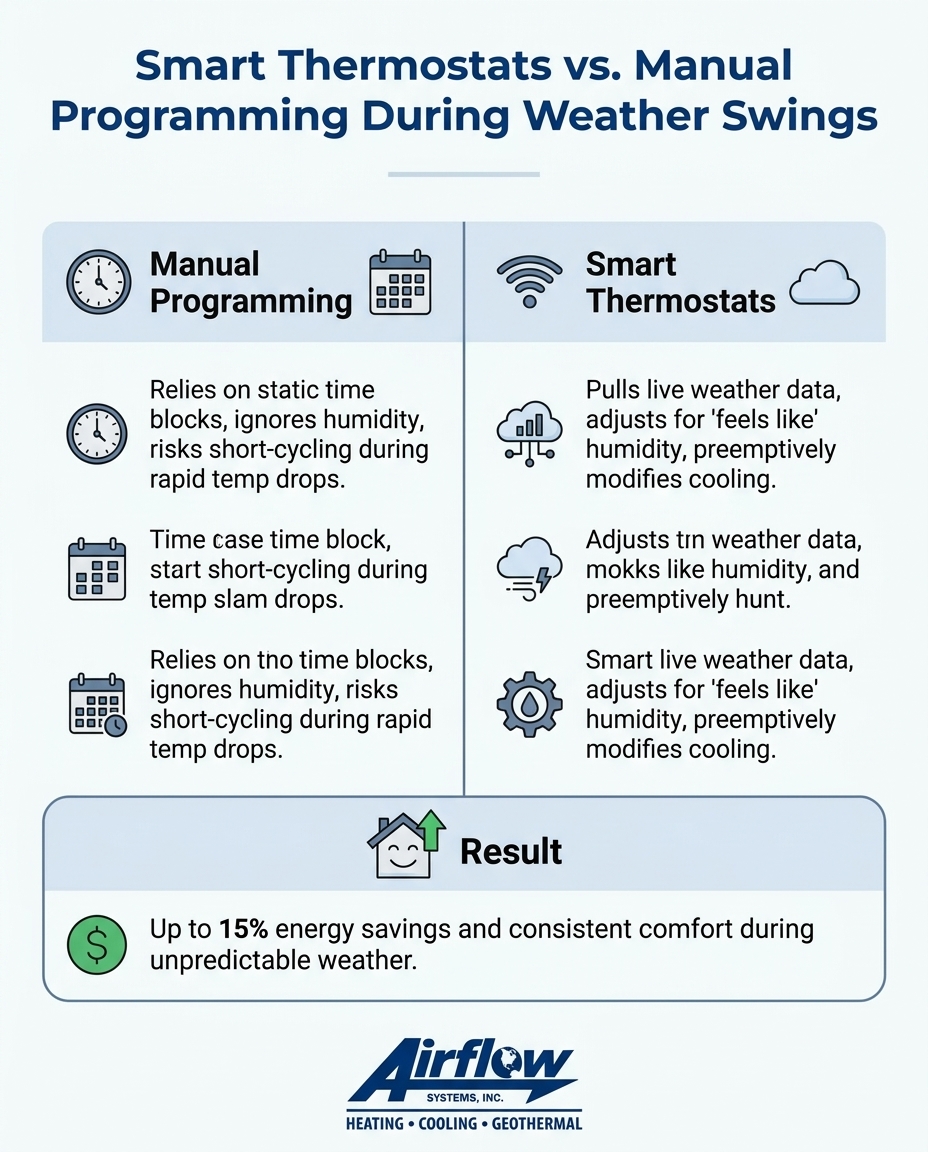
Data-backed savings: Industry studies consistently show that upgrading from a static manual schedule to a system driven by real-time conditions can save homeowners up to 15% on their annual cooling costs. These savings do not come from magically making the air conditioner run better; they come from eliminating unnecessary run times. When your thermostat stops blasting the AC during a sudden cool front, you stop wasting electricity.
Identifying Energy Waste
When our professionals at Airflow Systems conduct comprehensive home energy audits, we frequently identify outdated, manually programmed thermostats as a primary source of energy waste. A schedule that forces a system to heat an empty house, or cool a home that is already benefiting from a drop in outdoor temperature, is simply burning money. The predictive nature of Nest or Ecobee learning algorithms ensures that you only pay for the exact amount of cooling your home actually needs at any given moment.
Incentives and Rebates: Because these devices are proven to reduce grid strain during peak weather events, general energy rebates or utility incentive programs may apply to smart home efficiency upgrades. While programs vary by location and season, we advise checking with your local utility provider, which can often uncover generic rebates that make the upgrade even more cost-effective.
Why Out-of-the-Box Algorithms Need Local Calibration
While the hardware is incredibly advanced, a smart thermostat is only as effective as its initial configuration. A common mistake homeowners make is assuming that these devices work perfectly straight out of the box. Factory default settings are designed to accommodate national averages, not specific regional microclimates.
The limits of DIY installation: When a homeowner installs a smart thermostat themselves, they typically skip the deep-level configuration menus. If the device's humidity thresholds, staging delays, and baseline algorithms are not calibrated to the local environment, the system learns the wrong behaviors. It might over-dehumidify, run the fan too long, or fail to utilize the multi-stage capabilities of a high-efficiency air conditioner.
The Value of Local Expertise
This is where professional installation becomes vital. As local experts in Charlottesville, our team at Airflow Systems understands exactly how to calibrate these advanced systems specifically for Central Virginia's unique microclimate. We adjust the algorithm's baseline parameters to account for local humidity trends and rapid evening temperature drops, ensuring the computer works for the home, not against it.
Real-world results: Proper calibration pays off immediately. During a recent late-summer service call, our technicians discovered and corrected an underlying AC problem for a Charlottesville homeowner. Because our team found and corrected the AC problem while also addressing other minor airflow issues and calibrating the new thermostat settings properly, the home's comfort was fully restored. The system stopped fighting the weather, the indoor humidity was finally controlled, and the final invoice remained completely reasonable. This holistic approach—pairing mechanical repairs with expert algorithm calibration—is what truly unlocks a home's comfort potential.
Frequently Asked Questions About Thermostats and Weather
Even with a clear understanding of the technology, homeowners often have specific questions about how these systems operate on a daily basis. Here are answers to the most common queries regarding intelligent climate control.
How do smart thermostats adjust to outside weather?
Intelligent systems pull real-time meteorological data through your home's Wi-Fi connection. Instead of just measuring the air in your hallway, they track incoming cold fronts, heat waves, and humidity spikes, allowing the system to adjust your cooling output proactively before the weather fully impacts your home.
Is a smart thermostat better than a programmable one?
Yes, because it eliminates the need for constant manual overrides. While a programmable unit strictly follows a clock regardless of the actual weather, systems utilizing Nest or Ecobee learning algorithms adapt to real-world conditions, providing better comfort and preventing unnecessary system strain.
Do smart thermostats control humidity?
Advanced models absolutely factor humidity into their comfort algorithms. They use built-in hygrometers to measure indoor moisture and calculate a "feels like" temperature, often instructing the AC to run longer, low-speed cycles specifically designed to pull heavy moisture out of the air.
Why is my AC short-cycling in late summer?
Short-cycling often happens when a sudden outdoor temperature drop confuses a manual thermostat with a tight temperature differential. The system rapidly turns on and off as it struggles to balance the residual indoor heat against the rapidly cooling outdoor air, a problem that we find intelligent algorithms solve by widening their parameters during weather shifts.
Can a learning algorithm prevent overcooling during rapid evening temperature drops?
Yes, this is one of their primary benefits. By seeing the temperature drop coming via weather data, the algorithm preemptively scales back the air conditioning, allowing the home to cool down naturally and preventing the icy, over-conditioned feeling that manual schedules often create.
Upgrade Your Comfort for Late-Summer Weather Swings
Surviving unpredictable weather without constantly fighting your HVAC system requires a control unit that actually understands its environment. The myth that a rigid, static schedule can handle the erratic shifts of late-summer and August in Virginia has been thoroughly debunked. Relying on manual programming during rapid temperature drops only leads to overcooling, high humidity, and unnecessary wear and tear on your compressor.
Take control of your climate: It is time to stop manually overriding your thermostat every time a weather front moves through. By upgrading to a system that adapts in real-time, you protect your equipment, lower your energy waste, and finally achieve balanced, consistent comfort. Reach out to our team at Airflow Systems to schedule a professional installation and get your new system perfectly calibrated for our local climate today.
Book Expert Service Or Contact Us
Our Service Process
A Hassle-Free Service Experience
01
Consultation & Diagnosis
We start by listening to your needs and performing a thorough diagnosis of your system to recommend the best solution.
02
Transparent Quoting
We provide a clear, upfront estimate with no hidden fees, so you know exactly what to expect.
03
Expert Service & Follow-Up
Our factory-trained technicians complete the work to the highest standards, and we follow up to ensure your complete satisfaction.
testimonials
What Our Customers Are Saying
Our customers consistently praise our exceptional service and attention to detail, making us a trusted choice for all your HVAC needs.
where we operate
Service areas