

Choose an option to see quick actions and get help faster.
.svg)

What to Do When Your AC Stops Cooling Your Home

If ac not cooling properly what to check first is your question right now, here is the short answer:
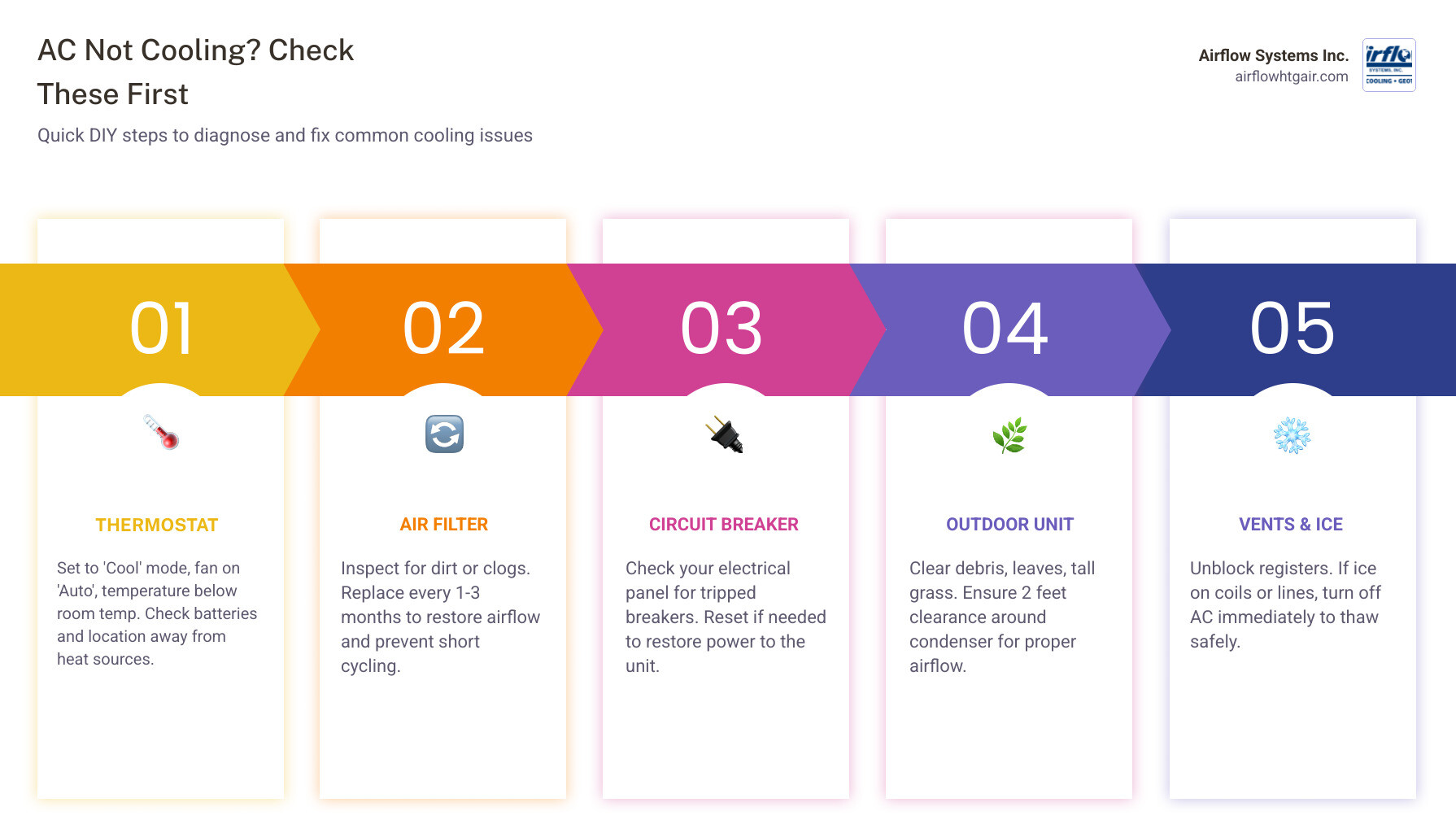
1. Check your thermostat - Make sure it is set to "Cool" mode with the fan on "Auto" and the temperature below the current room temperature.
2. Inspect your air filter - A clogged filter is the single most common cause of poor cooling. Replace it if it looks dirty.
3. Check your circuit breaker - Look for a tripped breaker in your electrical panel and reset it if needed.
4. Look at your outdoor condenser unit - Clear any leaves, grass, or debris blocking airflow around the unit.
5. Check all vents and registers - Make sure none are blocked by furniture, rugs, or curtains.
6. Look for ice on the indoor unit - Ice buildup on the coil or refrigerant lines means you should turn the system off immediately.
7. Call a professional - If none of the above fixes the problem, there may be a refrigerant leak, a failing compressor, or another issue that needs expert diagnosis.
There is nothing quite as miserable as cranking up your AC on a hot summer day and feeling warm air blow back at you. A properly working central air conditioner should begin cooling your home within 15 to 30 minutes. If your system runs for more than an hour with no noticeable change, something is wrong.
The good news? Many of the most common causes are simple to spot and easy to fix yourself. Others will need a trained technician. This guide walks you through both, so you know exactly where to start and when to get help.
AC Not Cooling Properly? Start With This Checklist
When the Virginia humidity starts climbing in Charlottesville, your air conditioner becomes the most important appliance in your home. If it starts underperforming, don't panic. Before you pick up the phone to schedule maintenance services, there is a systematic DIY checklist you should follow.
The first thing to understand is that your AC is a closed-loop system designed to move heat, not "create" cold. If that movement of heat is interrupted—whether by an electrical glitch, a physical blockage, or a settings error—the system will run but won't cool.
Start by checking your electrical panel. Sometimes, a power surge during a summer thunderstorm can trip the circuit breaker for the outdoor condenser unit. If the indoor blower is running but the outdoor unit is off, you’ll just be circulating room-temperature air. Flip the breaker fully to "Off" and then back to "On" to reset it. If it trips again immediately, stop and call for HVAC services right away, as this indicates a serious electrical fault or a failing capacitor.
Why Your AC Not Cooling Properly What to Check First Includes the Thermostat
It sounds almost too simple, but the thermostat is the "brain" of your cooling system, and even brains have bad days. If you find your ac not cooling properly what to check first should always be these settings:
• Mode Verification: Ensure the system is actually set to "Cool." It’s surprisingly common for a family member to accidentally switch it to "Heat" or "Fan Only" while dusting or adjusting the temperature.
• Fan Settings: Always set your fan to "Auto" rather than "On." When the fan is "On," it blows air 24/7, even when the cooling cycle isn't running. This can blow unconditioned, humid air into your rooms, making the house feel warmer.
• Battery Replacement: If your thermostat has a blank screen or a "low battery" warning, it may not be able to send the signal to your AC to kick into high gear.
• Sensor Misalignment and Heat Sources: Is your thermostat located right next to a lamp, a sunny window, or a kitchen appliance? The heat from these sources can trick the sensor into thinking the house is hotter than it is, or conversely, if it's in a drafty spot, it might shut off too early.
Air Filter Maintenance: AC Not Cooling Properly What to Check First
If your thermostat is fine but the air feels weak or lukewarm, look at your air filter. In our experience in Central Virginia, a dirty filter is the culprit in nine out of ten service calls.
When a filter is clogged with dust, pet hair, and pollen, it creates massive airflow restriction. This forces your blower motor to work harder, which can lead to overheating and "short cycling"—where the AC turns on and off rapidly without ever cooling the house. Even worse, low airflow causes the temperature of your evaporator coil to drop below freezing, leading to a literal block of ice forming inside your unit.
We recommend checking your filter every month during the peak of summer. While some high-efficiency pleated filters claim to last six months, homes with pets or high dust levels may need a fresh one every 30 to 60 days to maintain peak indoor air quality.
Investigating Airflow Obstructions and Ductwork Issues
Sometimes the AC is working perfectly, but the cold air simply isn't reaching you. This is where we look at the "delivery system"—your ducts and vents.
Walk through every room in your house and check the registers (the vents that blow air out) and the return grilles (the larger vents that suck air in). A common mistake is closing vents in unused rooms to "save energy." In reality, this increases pressure in the ductwork, which can cause leaks or even damage your compressor. Make sure all vents are open and unobstructed by furniture, rugs, or heavy curtains.
If you notice that some rooms are freezing while others are sweltering, you might have leaky ducts. Over time, duct tape (which, ironically, isn't great for ducts) can dry out and peel away, allowing cold air to escape into your attic or crawlspace instead of your living room. This is where home energy diagnostics become invaluable. We can help identify if your "missing" cooling is actually just cooling your attic.
Maintaining the Outdoor Condenser Unit for Better Cooling
The outdoor unit, known as the condenser, has a tough job. It has to take the heat collected from inside your home and release it into the outdoor air. If the unit is "suffocating," it can't release that heat, and your house stays hot.
For your ac not cooling properly what to check first outdoors, look for:
• Debris Removal: Ensure there is at least two feet of clear space around the unit. Tall grass, weeds, mulch, and fallen leaves can block the delicate fins of the condenser coil.
• Dirty Coils: Over time, the outdoor coils get coated in "cottonwood" seeds, dust, and dirt. You can gently rinse these off with a garden hose (never use a pressure washer, as it will flatten the fins).
• Bent Fins: If the aluminum fins are crushed or bent, airflow is blocked. A technician can use a "fin comb" to straighten them out during AC repairs.
If the outdoor fan isn't spinning but you hear a humming sound, the motor or capacitor might be failing. This is a common issue with heat pump repairs and standard AC units alike.
Identifying Frozen Coils and Refrigerant Leaks
One of the most confusing sights for a homeowner is seeing ice on an air conditioner when it's 95°F outside. If you see frost on the copper refrigerant lines or the indoor evaporator coil, your system has "frozen up."
This happens for two main reasons:
1. Restricted Airflow: As mentioned, a dirty filter or blocked vents keep warm air from reaching the coil.
2. Low Refrigerant: If your system is low on refrigerant, the pressure drops, and the coil becomes too cold, causing moisture in the air to freeze instantly on contact.
Refrigerant does not "wear out" or get "used up" like gasoline in a car. It circulates in a closed-loop system. If it is low, you have a leak. Signs of a leak include hissing or bubbling sounds and oily residue near the refrigerant lines. Because handling refrigerant requires specialized certification, this is a job for the pros. If you suspect a leak, turn the unit off to prevent the compressor from burning out and call us for AC installations or repairs.
When to Call a Professional for Complex Cooling Failures
While we love a good DIY fix, some problems are beyond a simple filter change. If you've checked the thermostat, the filter, and the breakers, and you're still sweating, it’s time to call in the experts at Airflow Systems Inc.
IssueDIY Fix?Professional Fix RequiredDirty Air FilterYes, replace every 1-3 monthsNoTripped BreakerYes, reset onceIf it trips again, YesThermostat SettingsYes, verify Cool/Auto modeIf the sensor is faulty, YesRefrigerant LeakNoYes, requires EPA certificationFailing CapacitorNoYes, high voltage riskFrozen CoilsTurn unit off to thawYes, to find the root causeCompressor FailureNoYes, major component repair
Sometimes, the issue isn't a broken part, but an undersized unit. If you've recently added an addition to your home or if your insulation is poor, your old AC might not be able to keep up with the square footage. In these cases, we might recommend mini-split systems to supplement cooling in specific rooms, or even geothermal systems for the ultimate in energy-efficient home comfort.
Frequently Asked Questions About AC Troubleshooting
Why is my AC running but not cooling the house?
If the air is blowing but it isn't cold, you likely have a dirty condenser coil, a clogged air filter, or low refrigerant. It could also be a thermostat error where the fan is set to "On" instead of "Auto," causing the blower to run even when the cooling cycle is off.
How do I know if my AC unit is undersized?
An undersized unit will run constantly without ever reaching the set temperature on the thermostat. You’ll notice uneven temperatures between rooms, and the system will especially struggle during extreme Virginia heat waves. If you’ve added square footage to your home recently, your original unit may no longer be sufficient.
What are the signs of a frozen evaporator coil?
The most obvious sign is visible ice on the indoor unit or the copper pipes leading outside. Other signs include warm air coming from the vents, restricted airflow, and moisture or puddles forming around the furnace or air handler as the ice melts.
Conclusion
When your ac not cooling properly what to check first is a question that leads to a hot, uncomfortable house, most issues start with the basics: the thermostat, the air filter, and the outdoor unit's cleanliness. Regular preventative maintenance is the best way to ensure your system’s longevity and prevent these mid-summer meltdowns before they happen.
At Airflow Systems Inc., we’ve been keeping Charlottesville and Central Virginia cool for years. Whether you need a simple tune-up or a complex repair, our family-owned team is here to help.
Book Expert Service Or Contact Us
Our Service Process
A Hassle-Free Service Experience
01
Consultation & Diagnosis
We start by listening to your needs and performing a thorough diagnosis of your system to recommend the best solution.
02
Transparent Quoting
We provide a clear, upfront estimate with no hidden fees, so you know exactly what to expect.
03
Expert Service & Follow-Up
Our factory-trained technicians complete the work to the highest standards, and we follow up to ensure your complete satisfaction.
testimonials
What Our Customers Are Saying
Our customers consistently praise our exceptional service and attention to detail, making us a trusted choice for all your HVAC needs.
where we operate
Service areas