

Choose an option to see quick actions and get help faster.
.svg)
How Many Zones Do I Need for My Mini Split? A Charlottesville Homeowner's Quick Guide
How many zones do I need for my mini split is one of the most common questions homeowners in Charlottesville, VA ask before investing in a ductless system — and getting it wrong can mean wasted energy, uneven comfort, and a system that works harder than it should.
Here is a quick answer based on home size and layout:
• Under 1,200 sq ft — Typical Zones Needed: 1-3 zones
• 1,200-1,800 sq ft — Typical Zones Needed: 2-4 zones
• 1,800-2,500 sq ft — Typical Zones Needed: 3-5 zones
• 2,500-3,500 sq ft — Typical Zones Needed: 4-6 zones
• 3,500+ sq ft — Typical Zones Needed: 6-8 zones
Key rules of thumb:
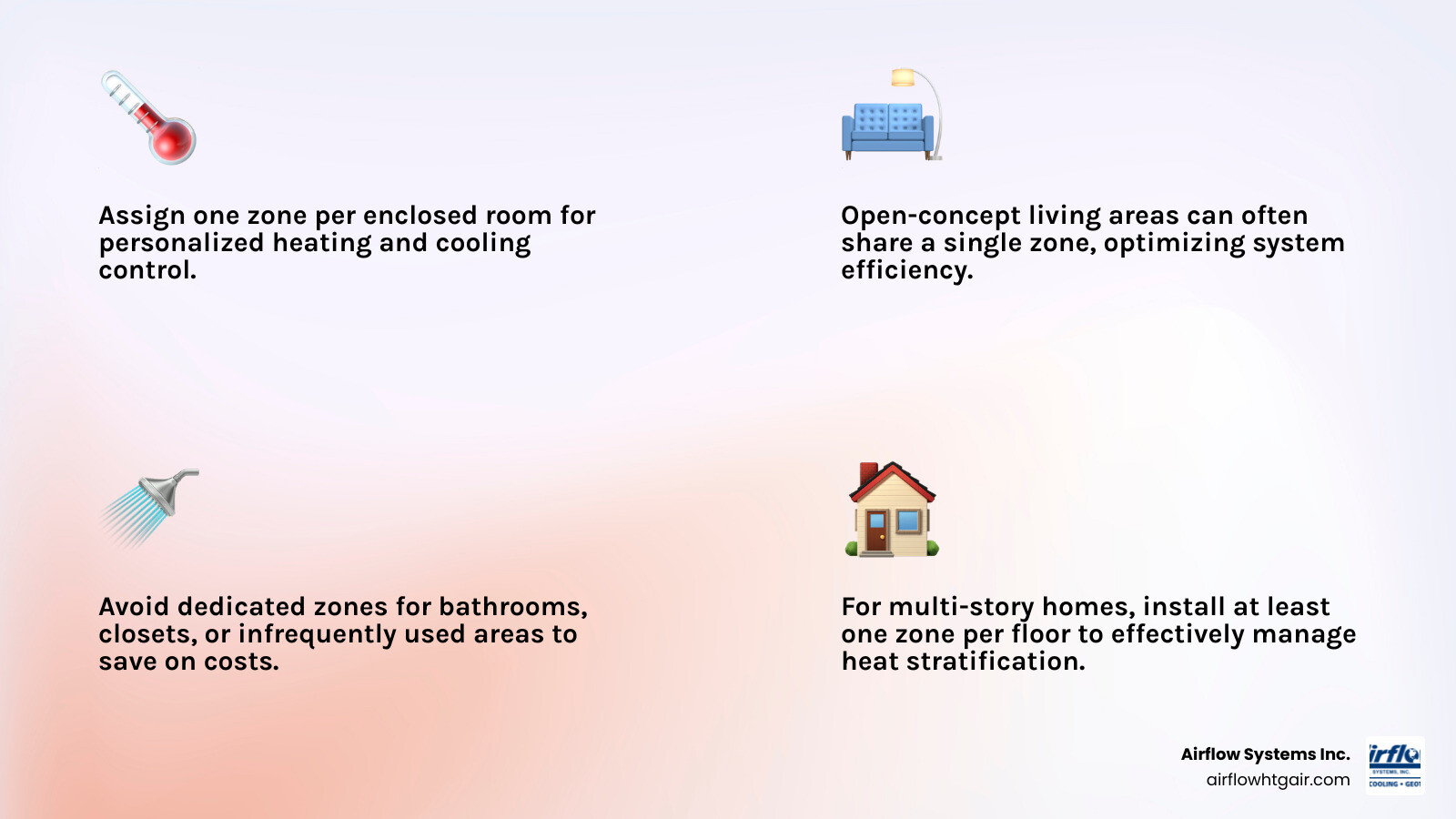
• Plan for one zone per enclosed room you want to heat or cool independently
• Open-concept living areas can often share a single zone
• Bathrooms, closets, and rarely used spaces usually don't need their own zone
• Multi-story homes typically need at least one zone per floor to account for heat stratification
• Most residential systems support 2 to 8 zones from one outdoor unit
The exact number depends on more than just square footage. Your floor plan, insulation quality, window placement, room usage, and Central Virginia's climate zone 4 conditions all play a role. Pick too few zones and some rooms stay uncomfortable. Pick too many and you overspend on equipment you don't need.
In the sections below, we walk through every factor so you can make a confident, informed decision before installation day.
Understanding Mini Split Zones and System Capacity
To answer the question of how many zones you need, we first have to define what a "zone" actually is. In ductless heating and cooling, a zone is a designated area or room that has its own indoor air handler. Each of these indoor units is connected to a single outdoor condenser via copper refrigerant lines and electrical wiring.
The beauty of a multi-zone system lies in its independence. Each indoor unit has its own thermostat, allowing you to keep the master bedroom at a crisp 68 degrees while the living room stays at 72. This is made possible by modern inverter technology, which allows the outdoor unit to vary its speed based on the specific demand of the indoor heads currently running.
When considering capacity, we talk in terms of BTUs (British Thermal Units). A single residential outdoor unit can typically support anywhere from 2 to 8 indoor zones. However, there is a limit to the total "muscle" the outdoor unit has. For example, a 36,000 BTU outdoor unit might handle four 9,000 BTU indoor units perfectly. If you are looking for Mini Split Service Somerset VA, our team can help you evaluate if your current outdoor unit has the headroom to support additional zones or if a higher-capacity system is required.
As of April 2026, the technology has advanced to the point where "load diversity" allows for some flexibility. You can often connect indoor units whose combined BTU ratings slightly exceed the outdoor unit's capacity, based on the fact that you rarely run every single unit at maximum power simultaneously.
How Many Zones Do I Need for My Mini Split in Charlottesville?
Charlottesville homes are as diverse as the Blue Ridge Mountains. From historic properties near the University to brand-new builds in North Garden, the layout of your home is the biggest driver of your zone count.
The most effective way to start your planning is by using "The Door Rule." Generally, if a room has a door that you plan to keep closed—like a bedroom, nursery, or home office—it needs its own dedicated zone. Without an air handler inside that closed room, the conditioned air from the hallway or living room simply won't reach it, leading to "hot pockets" or "cold spots."
Conversely, open-concept areas are the best candidates for sharing a zone. If your kitchen, dining area, and living room all flow together without walls, one or two high-capacity units can often handle the entire space. For those planning a Mini Split Installation North Garden VA, we often look at how air naturally circulates through these large spaces to ensure optimal placement.
Don't forget about vertical space. Heat rises, a phenomenon known as stratification. In a multi-story Central Virginia home, the upstairs will naturally be warmer than the basement. We recommend at least one zone per floor to manage these temperature differences effectively.
How many zones do i need for my mini split for a 1,500 sq. ft. house?
For a typical 1,500 sq. ft. home in our area, you are usually looking at 3 to 5 zones. A common setup includes one large unit for the main living area and kitchen, and individual smaller units for each of the three bedrooms. If your home has a split-level design or a finished basement, you might lean toward the 5-zone mark. The quality of your insulation also matters; older homes with original insulation may require more targeted zoning to maintain comfort during a humid Virginia summer. If you are in the western part of the county, getting a professional Mini Split Service Crozet VA can help determine if your 1,500 sq. ft. layout is better served by a quad-zone or a series of single-zone units.
Determining how many zones do i need for my mini split based on room usage
Think about how you use your home daily. High-traffic areas like the kitchen and living room are non-negotiable for zoning. However, you might decide a rarely used guest room doesn't need its own dedicated head if the door stays open most of the time. On the other hand, with more of us working from home, a dedicated zone for a home office is often a lifesaver, ensuring you stay productive without cooling the entire house. For specialized installations, such as Mini Split Service Radiant VA, we focus on these lifestyle patterns to design a system that fits your actual routine.
Key Factors Influencing Your Total Zone Count
Beyond the number of rooms, several environmental factors can push your zone count up or down:
• Sun Exposure and Window Orientation: A room with large, south-facing windows will act like a greenhouse in July. These rooms often require more BTU capacity or a dedicated zone to combat the solar heat gain.
• Ceiling Height: Standard calculations assume 8-foot ceilings. If you have vaulted ceilings or a grand foyer, you need to add about 10% more cooling capacity for every two feet of extra height.
• Heat-Generating Appliances: Kitchens are high-heat zones. Between the oven, dishwasher, and refrigerator, these spaces often need a slightly oversized unit compared to a bedroom of the same size.
• Insulation and Airtightness: Charlottesville has many beautiful older homes. If your attic insulation is thin or your windows are drafty, your system has to work harder. Keeping up with Mini Split Maintenance Dyke VA is crucial in these scenarios to ensure the system remains efficient despite the home's "leaks."
• Occupancy Patterns: A living room where the whole family gathers for movie night generates more body heat than a solo home office.
In Central Virginia, we fall into Climate Zone 4, which means we deal with both freezing winters and sweltering, humid summers. Your mini split needs to be sized to handle both extremes.
Single-Zone vs. Multi-Zone: Which Setup is Better?
It’s a common misconception that one big multi-zone system is always better than several single-zone units. Both have their place.
• Efficiency — Single-Zone System: Generally higher SEER2 ratings — Multi-Zone System: Slightly lower due to shared compressor
• Redundancy — Single-Zone System: If one unit fails, others still work — Multi-Zone System: If the outdoor unit fails, all zones go down
• Aesthetics — Single-Zone System: Multiple outdoor units required — Multi-Zone System: One outdoor unit (cleaner look)
• Installation — Single-Zone System: Simpler, shorter line sets — Multi-Zone System: More complex, longer refrigerant runs
• Electrical — Single-Zone System: Dedicated circuit per unit — Multi-Zone System: One large dedicated circuit
If you only need to cool a new sunroom or a garage conversion, a single-zone system is the way to go. However, for whole-home comfort, a multi-zone system saves significant yard space and simplifies your electrical needs. One constraint to keep in mind with multi-zone systems is mode synchronization. Because they share one compressor, all indoor units must be in the same mode—either all heating or all cooling. You cannot have one person heating their bedroom while another cools the living room. If you run into issues with your current configuration, seeking Mini Split Repair Orange VA can help diagnose if a mode conflict is causing a system shutdown.
Professional Sizing to Avoid the "Danger Zone"
This is where many homeowners (and some less-experienced contractors) get into trouble. There is a "Danger Zone" in HVAC sizing:
1. Oversizing: You might think "bigger is better," but an oversized mini split will "short-cycle." It reaches the set temperature so fast that it doesn't have time to remove humidity from the air. You'll end up with a room that is cold but clammy, and the constant on-and-off switching will wear out the compressor prematurely.
2. Undersizing: A system that is too small will run non-stop, struggling to hit the setpoint on a 95-degree Charlottesville afternoon. This leads to high energy bills and a shortened system lifespan.
To avoid these traps, we perform a Manual J Load Calculation. This is an engineering-based method that considers every factor we’ve discussed—square footage, windows, insulation, and even the direction your house faces. With the new SEER2 efficiency standards of 2026, precision is more important than ever. Whether you need Mini Split Service Fork Union VA for an existing system or a brand-new installation, a professional load calc is the only way to guarantee comfort.
Frequently Asked Questions about Mini Split Zoning
What is the maximum number of zones for a residential system?
Most residential multi-zone condensers top out at 8 zones. While commercial systems can go higher, 8 is the practical limit for a single home. If your property requires 10 or 12 zones, we would typically install two separate outdoor units to manage the load. If you are in a larger home and need Mini Split Service Locust Grove VA, we can help design a dual-condenser layout that covers every corner of your house.
Can I add more zones to my system later?
Yes, but only if you plan for it on day one. If you buy a 3-zone outdoor unit and install 3 heads, you are "maxed out." However, if you buy a 5-zone outdoor unit but only install 3 heads initially, you have "available ports" and BTU headroom to add two more zones later. This is a great strategy for homeowners finishing a basement in stages. For those in more rural areas, such as Mini Split Replacement Syria VA, planning for future expansion can save you from having to replace the entire outdoor unit down the road.
Do I need a separate zone for my bathroom?
Generally, no. Bathrooms are small, and the airflow from an adjacent bedroom or hallway is usually sufficient. In fact, placing a mini split head directly in a bathroom can be tricky because the high humidity from showers can mess with the unit's sensors. A high-quality exhaust fan is a much better investment for your bathroom's climate. If you have questions about airflow in specific rooms, our team providing Mini Split Service Free Union VA can offer tailored advice for your floor plan.
Conclusion
Choosing the right number of zones for your mini split doesn't have to be a guessing game. By considering your home's layout, the "door rule," and the unique climate of Central Virginia, you can create a sanctuary of comfort that is also incredibly energy-efficient.
At Airflow Systems Inc., we’ve been helping Charlottesville families stay comfortable since 1988. As a family-owned business, we pride ourselves on honesty, local expertise, and using the latest HVAC technologies to solve your toughest heating and cooling challenges. Don't leave your comfort to chance or "rules of thumb" that don't account for your specific home.
Ready to ditch the dusty ductwork and experience the quiet, personalized comfort of a modern ductless system? Schedule your consultation for a custom mini-split system with Airflow Systems Inc. today, and let us help you find the perfect zone configuration for your Charlottesville home.
Book Expert Service Or Contact Us
Our Service Process
A Hassle-Free Service Experience
01
Consultation & Diagnosis
We start by listening to your needs and performing a thorough diagnosis of your system to recommend the best solution.
02
Transparent Quoting
We provide a clear, upfront estimate with no hidden fees, so you know exactly what to expect.
03
Expert Service & Follow-Up
Our factory-trained technicians complete the work to the highest standards, and we follow up to ensure your complete satisfaction.
testimonials
What Our Customers Are Saying
Our customers consistently praise our exceptional service and attention to detail, making us a trusted choice for all your HVAC needs.
where we operate
Service areas