

Choose an option to see quick actions and get help faster.
.svg)
Why the Best Thermostat Strategies for Summer AC Savings Matter More Than You Think
The best thermostat strategies for summer AC savings come down to a few core habits that most homeowners in Charlottesville, VA overlook — and they can make a real dent in your summer energy bills.
Quick answer: Top thermostat strategies for summer AC savings
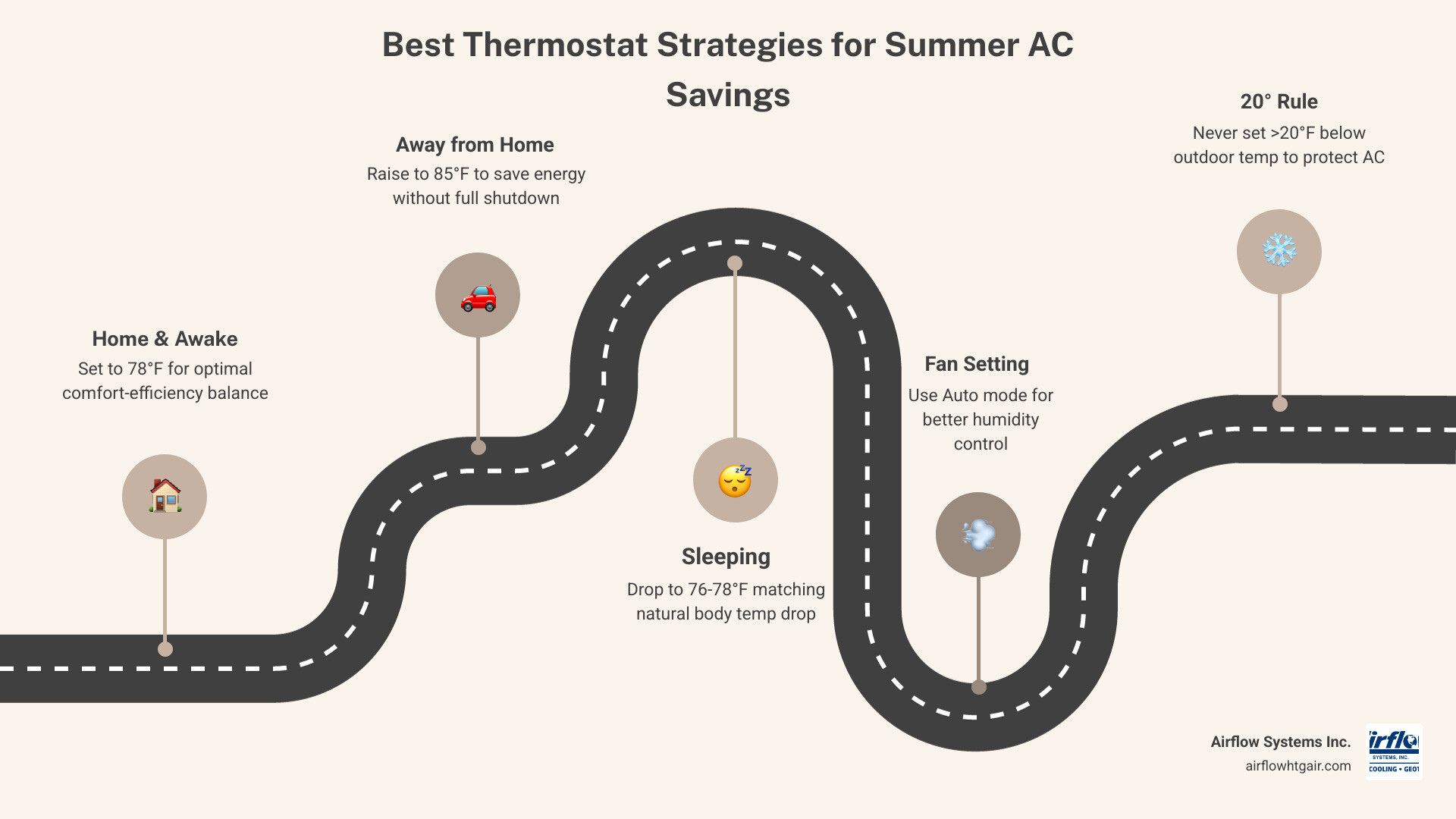
• When home: Set your thermostat to 78°F for the best balance of comfort and efficiency
• When away: Raise it to 85°F — don't turn it off completely
• When sleeping: Drop it to 76-78°F to support natural body temperature changes
• Use Auto fan mode: Not "On" — it removes humidity better and uses less energy
• Follow the 20-degree rule: Never set your AC more than 20°F below the outdoor temperature
• Use a programmable or smart thermostat: Automate setbacks to save up to 10% annually
• Pair with ceiling fans: Set counter-clockwise to make 78°F feel like 74°F
Here's the thing — heating and cooling account for nearly half of the average home's energy use during peak summer months. In Central Virginia, where summer humidity regularly piles on top of the heat, your AC is working harder than it does almost anywhere else. A few small changes to how you program and manage your thermostat can cut your cooling costs meaningfully without making your home uncomfortable.
Most homeowners set the thermostat based on how hot they feel in the moment. That's understandable. But reacting to comfort one degree at a time — instead of setting a smart schedule and sticking to it — is one of the most common reasons summer energy bills run higher than they need to.
The good news? You don't need a major system upgrade to start saving. The strategies in this guide are practical, backed by U.S. Department of Energy guidance, and tailored for the heat and humidity that Central Virginia summers bring.
Finding the Sweet Spot: Ideal Temperature Settings for Your Home
When we talk to our neighbors in Charlottesville, the most common question is: "What should I actually set the dial to?" While everyone has a different internal thermometer, the U.S. Department of Energy (DOE) and Consumer Reports have landed on a "magic number" for Air Conditioning efficiency: 78°F.
Setting your thermostat to 78°F while you are at home and awake provides the optimal balance between cooling your home and keeping your energy bills manageable. We know what you’re thinking—78°F sounds a bit warm for a Virginia July. However, the goal is to minimize the difference between the outdoor temperature and your indoor setting. The smaller that gap, the lower your overall cooling bill will be.
If 78°F feels like a stretch, we recommend a "staircase" approach. Try raising your thermostat by one or two degrees every few days. This allows your body to acclimate gradually. When you combine this setting with other home cooling hacks, like closing the blinds during the heat of the day, you’ll find that 78°F is surprisingly comfortable. For more tips on getting your home ready for the peak heat, check out our guide on Preparing Your AC for a Virginia Summer.
Best thermostat strategies for summer AC savings while you sleep
Sleep quality is heavily tied to your environment. Research shows that our body temperatures naturally drop as we drift off, and a room that is too hot can interfere with deep REM cycles. For the best rest, many experts suggest a range between 60°F and 67°F, but in the height of a humid Virginia summer, maintaining that can be incredibly expensive.
A more energy-efficient compromise for summer is to set the thermostat between 76°F and 78°F at night. Because the sun isn't beating down on your roof, your AC won't have to work nearly as hard to maintain this temperature as it does during the day. If you find this range too warm, using a ceiling fan can create a wind-chill effect that makes the room feel several degrees cooler without the high cost of a lower AC setting. You can find more about the science of home comfort in our Learning Center.
Managing temperatures when you are away from home
One of the biggest mistakes homeowners make is leaving the AC at 72°F while the house is empty. By raising your thermostat 7 to 10 degrees for eight hours a day (like when you are at work), you can save up to 10% on your annual cooling costs.
For most Central Virginia homes, an "away" setting of 85°F is ideal. This prevents the house from becoming a literal oven while ensuring the AC still runs occasionally to manage humidity levels. It is a myth that your AC has to "work harder" to cool the house back down from 85°F in a way that negates the savings. In reality, a warmer home actually slows down the flow of heat into the house, making the eventual cooling cycle more efficient. Integrating Smart Thermostats into your home is the easiest way to ensure these "away" settings happen automatically.
Maximizing Efficiency with Smart Technology and Proper Placement

In April 2026, we have more tools than ever to manage home energy. Modern technology has moved far beyond the old "set it and forget it" dial. Today’s systems use geofencing, which detects when your smartphone leaves a certain radius (like 500 meters from your house) and automatically shifts the AC into "Away" mode.
Learning algorithms are another game-changer. These thermostats "watch" your habits for a week and then build a schedule for you. If you always turn the AC down at 10:00 PM, the thermostat will start doing it for you. This level of automation ensures you never miss out on savings because you forgot to change the setting before leaving for work. For those looking to dive deeper into tech-driven comfort, our post on Home Comfort: Indoor Air Quality & Energy Upgrades explores how these systems integrate with your overall home health.
Where is the best location for your thermostat?
Even the smartest thermostat will fail if it's in the wrong spot. We often see thermostats installed in hallways, but that isn't always best. The ideal location is on an interior wall, near the center of the house, in a room you use frequently.
To ensure your best thermostat strategies for summer AC savings actually work, avoid these "accuracy killers":
• Direct Sunlight: If the sun hits the sensor, it will think the house is 90°F and run the AC non-stop.
• Drafts: Placing it near windows or doors can give false readings.
• Heat Sources: Keep it away from the kitchen, lamps, or electronics that put off heat.
• Vents: If a supply vent is blowing cold air directly onto the thermostat, it will shut off before the rest of the house is actually cool.
Best thermostat strategies for summer AC savings using programmable schedules
If you aren't ready for a full smart-home setup, a standard programmable thermostat is still a powerful tool, potentially saving you 8% to 10% annually. We recommend the "4-by-4 rule": raise the temperature by 4 degrees when you’ll be away for 4 hours or more.
A sample 7-day schedule for a Charlottesville family might look like this:
• 6:00 AM (Waking up): 76°F
• 8:00 AM (Leaving for work): 85°F
• 4:30 PM (Returning home): 78°F
• 10:30 PM (Bedtime): 77°F
By using a 7-day differential, you can program different schedules for weekends when you might be home more often. This prevents the AC from running needlessly on Monday morning when the house is empty. If you're curious how much air you might be losing through other means, consider looking into Home Energy Audits to complement your scheduling.
Beyond the Dial: Humidity, Fans, and System Protection
Your thermostat is only one part of the comfort equation. In Central Virginia, the "feels like" temperature is often driven by moisture in the air. This is where your AC's secondary job—dehumidification—becomes vital.
• Fan AUTO — Efficiency: High — Humidity Control: Excellent — Best Use Case: Standard summer use; allows moisture to drain.
• Fan ON — Efficiency: Low — Humidity Control: Poor — Best Use Case: Filtering air; but can blow moisture back into the house.
When the fan is set to "Auto," it only runs when the cooling system is actively chilling the air. This allows the condensation on the coils to drip away into the drain pan. If the fan is set to "On," it continues to blow air over those wet coils even when the compressor is off, actually pushing that humidity back into your living space. This makes the air feel "sticky," often tempting you to lower the thermostat even further. Keep your system in "Auto" to maximize your HVAC efficiency.
Understanding the 20-degree rule for AC protection
One of the most important technical rules we teach our clients is the 20-degree rule. Most residential air conditioning systems are designed to drop the indoor temperature by a maximum of about 20 degrees compared to the temperature outside.
If it is a sweltering 98°F day in Charlottesville, your AC is going to struggle to get the house down to 70°F. In fact, trying to force it to do so can lead to "short-cycling" or even a frozen evaporator coil. During extreme heat waves, it is safer and more efficient to set your thermostat to 78°F or 80°F. This protects the compressor from overexertion and prevents a 300% increase in system wear and tear.
How humidity impacts your thermostat settings
Humidity is the silent enemy of summer savings. High indoor humidity (above 60%) prevents your sweat from evaporating, which is how your body naturally cools itself. This is why 78°F at 45% humidity feels great, but 78°F at 70% humidity feels like a sauna.
To keep your home comfortable at higher thermostat settings, focus on moisture control. Use bathroom exhaust fans during showers and kitchen fans while cooking. If your home consistently feels "muggy," it might be a sign that your AC is oversized—meaning it cools the air so fast it doesn't stay on long enough to remove the moisture. For more on managing these seasonal shifts, see our guide on How to Prepare Your AC for Summer.
Maintaining Your System for Peak Summer Performance
You can have the best programming in the world, but if your system is clogged with dirt, you won't see the savings. Maintenance is the engine that drives efficiency.
1. Filter Replacement: This is the easiest win. A dirty filter restricts airflow, forcing the motor to work harder and increasing your bill by up to 15%. Check them monthly and replace them every 30-90 days.
2. Clean the Coils: Your outdoor condenser unit needs to "breathe" to release the heat it gathered from inside. Keep it clear of grass clippings, leaves, and debris.
3. Professional Tune-ups: We recommend a professional inspection at least once a year. This includes checking refrigerant levels (low refrigerant can cause your system to run constantly) and calibrating the thermostat.
Joining a Maintenance Plan is often the most cost-effective way to ensure your system stays in peak condition for the long haul.
Frequently Asked Questions about Summer AC Savings
Should I turn my AC off completely when I leave the house?
Generally, no. While it seems like turning it off would save the most energy, it often backfires in Virginia. Without the AC, indoor humidity can skyrocket, which can lead to mold issues or damage to wood flooring and musical instruments. Furthermore, when you return home, the AC has to work for hours to remove the massive "heat load" stored in your walls and furniture. It is much more efficient to raise the setting to 85°F.
How much can I save by raising the thermostat a few degrees?
The math is in your favor here. You can save roughly 3% on your cooling costs for every degree you raise the thermostat above 72°F. If you move from 72°F to 78°F, that’s an 18% reduction in your cooling bill! Over a long Central Virginia summer, that adds up to a significant amount of money that stays in your pocket. These same principles apply to your Heating costs in the winter, just in reverse.
What is the best fan setting for AC efficiency in summer?
As mentioned earlier, "Auto" is the clear winner. The "On" setting keeps the fan running 24/7, which not only uses more electricity but also prevents proper dehumidification. Only use the "On" setting for short periods if you are specifically trying to filter the air after cleaning or if you have a high-end variable-speed system designed for constant circulation.
Conclusion
Implementing the best thermostat strategies for summer AC savings doesn't mean you have to suffer through the heat. By using a baseline of 78°F, automating your "away" settings, and keeping your system well-maintained, you can enjoy a cool, comfortable home in Charlottesville without the dread of a massive electric bill.
At Airflow Systems Inc., we’ve been helping our neighbors in Central Virginia stay comfortable since 1988. We are a family-owned business that prides itself on honesty, local expertise, and energy-efficient solutions. Whether you need a smart thermostat installation, a quick repair, or a full system upgrade, we are here to help you navigate the summer heat.
Ready to optimize your home's efficiency? Contact us today to learn more about our Air Conditioning services and how we can help you stay cool for less.
Book Expert Service Or Contact Us
Our Service Process
A Hassle-Free Service Experience
01
Consultation & Diagnosis
We start by listening to your needs and performing a thorough diagnosis of your system to recommend the best solution.
02
Transparent Quoting
We provide a clear, upfront estimate with no hidden fees, so you know exactly what to expect.
03
Expert Service & Follow-Up
Our factory-trained technicians complete the work to the highest standards, and we follow up to ensure your complete satisfaction.
testimonials
What Our Customers Are Saying
Our customers consistently praise our exceptional service and attention to detail, making us a trusted choice for all your HVAC needs.
where we operate
Service areas