


Choose an option to see quick actions and get help faster.
.svg)
Why Every Charlottesville Homeowner Should Know How to Clean Your Outdoor AC Unit Safely
Knowing how to clean your outdoor AC unit safely can make a real difference in how well your system performs — especially heading into a hot Central Virginia summer. Over time, your outdoor condenser collects leaves, pollen, grass clippings, and grime that quietly choke your system's ability to release heat. The result? Your AC works harder, runs longer, and costs more to operate. According to industry data, dirty condenser coils can reduce efficiency by up to 30%.
The good news is that basic outdoor unit cleaning is something most homeowners can handle themselves with the right steps and a few simple tools. Here's a quick overview before we dive deeper:
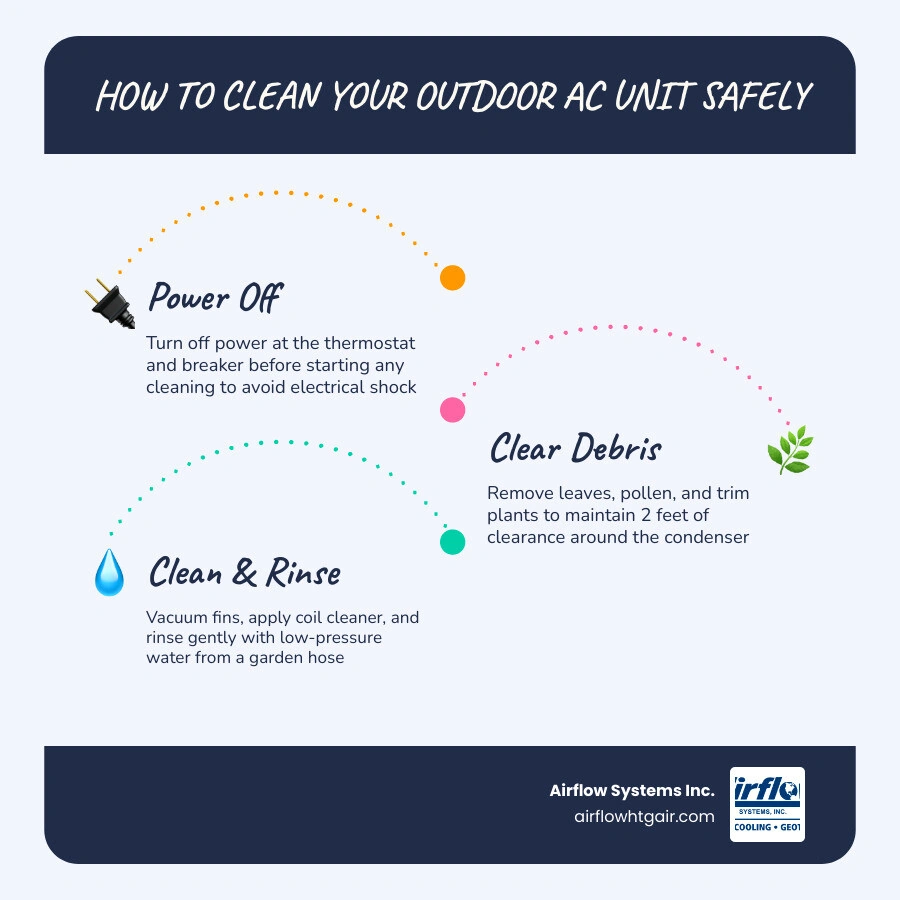
How to clean your outdoor AC unit safely — quick steps:
1. Turn off power at the thermostat and breaker (or disconnect box)
2. Remove leaves and debris from around and on top of the unit
3. Trim any plants or shrubs to at least 2 feet of clearance
4. Vacuum exterior fins gently with a soft brush attachment
5. Apply an AC-approved coil cleaner and let it dwell
6. Rinse coils with a garden hose using low pressure (never a pressure washer)
7. Let the unit dry fully before restoring power and testing
That's the core process. But doing it safely — without bending fins, damaging wiring, or voiding your warranty — takes a little more know-how. The sections below walk you through everything step by step.
Why Cleaning Your Outdoor AC Unit Matters
Your outdoor unit, known as the condenser, is the "heat release" center of your home. While the indoor unit absorbs heat from your rooms, the outdoor unit is responsible for dumping that heat into the atmosphere. To do this effectively, air must flow freely through the aluminum fins and across the copper coils. When these pathways are blocked, the entire cooling cycle suffers.
How to clean your outdoor ac unit safely starts with understanding the risks of dirt buildup
When we visit homes in Charlottesville and Central Virginia, we often see units that have become magnets for seasonal debris. In May 2026, as the local flora is in full bloom, pollen and cottonwood seeds can create a literal blanket over your condenser fins.
This buildup leads to restricted airflow. When air can't pass through the unit, the refrigerant inside the coils can't cool down properly. This forces your compressor to work under extreme pressure and high temperatures. Over time, this strain leads to "short cycling," where the unit turns on and off too frequently, and can even cause the indoor evaporator coils to freeze over. A dirty unit is a stressed unit, and a stressed unit is prone to premature failure.
Benefits of a clean condenser for comfort and efficiency
Maintaining a clean outdoor unit isn't just about preventing a breakdown; it's about optimizing your home's comfort and your monthly budget. A clean unit operates much more quietly because the fan doesn't have to fight against resistance. More importantly, it lowers energy waste.
When your coils are clean, the heat transfer process is seamless. This means your home reaches its target temperature faster, leading to shorter run times and lower utility bills. By taking the time to learn how to clean your outdoor ac unit safely, you are essentially giving your system a performance boost. For more ways to help your system out, you can read about How Shade Insulation and Sealing Reduce Your AC Workload and understand How Heat and Humidity Drive Up Your Cooling Costs during our humid Virginia summers.

When and How Often to Clean Your Outdoor Unit
Timing is everything when it comes to HVAC maintenance. You don't want to wait until the first 90-degree day in July to realize your unit is struggling under a layer of last year's leaves.
How often should homeowners clean the outdoor AC unit?
For most homes in the Charlottesville area, a deep clean once a year is the minimum requirement. The best time for this is in the spring, during your Preparing Your AC for a Virginia Summer checklist.
However, if your home is surrounded by heavy foliage, pine trees, or if you have cottonwood trees nearby, you should consider a twice-yearly cleaning—once in the spring and once in the late fall. Additionally, you should be checking your indoor air filters every 1–3 months, as a clogged indoor filter can be just as damaging to the system as a dirty outdoor coil.
Signs your condenser needs cleaning sooner
Sometimes, your AC will tell you it needs help before your scheduled cleaning date. Keep an eye (and ear) out for these warning signs:
• Weak Cooling: If the air coming from your vents feels lukewarm, the outdoor unit might be struggling to release heat.
• Higher Bills: An unexplained spike in your energy bill often points to an inefficient, dirty condenser.
• Visible Grime: If you can see a "matted" look on the metal fins, it’s definitely time for a wash.
• Ice Formation: Believe it or not, a dirty outdoor unit can lead to Ice Forming on Your AC Unit Causes and What to Do.
• Frequent Cycling: If the unit turns on and off every few minutes, it may be overheating.
If you notice these issues, check out our guide on AC Not Cooling Properly What to Check First to see if a simple cleaning is the fix you need.
Tools, Materials, and Safety Precautions Before You Start
Before you grab the hose, you need to gather the right supplies. Using the wrong tools can do more harm than good, potentially flattening the delicate aluminum fins that are vital for airflow.
The DIY AC Cleaning Toolkit:
• Garden Hose: With a standard spray nozzle (no pressure washers!).
• Soft Brush: A soft-bristled paint brush or a specialized coil brush.
• Shop Vacuum: With a soft brush attachment for removing loose debris.
• Screwdriver/Nut Driver: To remove the top grille or side panels (usually 5/16").
• Work Gloves and Eye Protection: The fins are sharp, and coil cleaner can be caustic.
• Fin Comb: A small tool used to straighten any bent metal fins.
• AC Coil Cleaner: Look for a non-acidic, "no-rinse" or "self-rinsing" foaming cleaner specifically for outdoor condensers.
Safety steps to take before cleaning any outdoor AC unit
Safety is the most important part of learning how to clean your outdoor ac unit safely. You are dealing with a machine that uses high-voltage electricity and has a rapidly spinning fan.
1. Turn off the Thermostat: Ensure the system isn't trying to call for cooling while you work.
2. Cut the Power at the Disconnect: Locate the metal box mounted on the wall near your outdoor unit. Open it and pull out the "disconnect" plug or flip the switch to the "OFF" position.
3. Turn off the Breaker: For extra safety, find the AC circuit breaker in your main electrical panel and flip it off as well.
4. Wait for the Fan: Ensure the fan has completely stopped spinning before you attempt to remove any panels.
What not to use on condenser coils and fins
We cannot stress this enough: Never use a pressure washer on your AC unit. The high-pressure stream will instantly flatten the delicate aluminum fins, permanently blocking airflow and requiring a professional (and often expensive) repair.
Avoid using bleach or harsh household degreasers, as these can corrode the copper coils or the aluminum fins. Stick to cleaners specifically labeled for HVAC use. Finally, never poke screwdrivers or metal wires into the fins to "dig out" dirt; you risk puncturing the refrigerant lines.
Step-by-Step: How to Clean Your Outdoor AC Unit Safely
Now that you're prepared and the power is off, it’s time to get to work. Follow these steps to ensure a thorough, safe cleaning.
How to clean your outdoor ac unit safely in 7 simple steps
1. Clear the Perimeter: Start by removing large debris like sticks, leaves, and "helicopter" seeds from the top and base of the unit. Trim back any bushes or weeds to ensure at least 2 feet of clear space around the entire condenser.
2. Vacuum the Exterior: Using your shop vac and the soft brush attachment, gently vacuum the outside of the fins. Move in the direction of the fins (usually up and down) to avoid bending them. This removes the loose "blanket" of dust before you get the unit wet.
3. Remove the Top Grille (Optional but Recommended): If you feel comfortable, unscrew the top of the unit. Be careful, as the fan motor is often attached to this grille. Lift it slightly and set it aside without straining the wires. This allows you to clean out the "floor" of the unit where leaves often rot.
4. Clean the Interior Base: Use your vacuum or hands (with gloves!) to remove any muck, dead leaves, or debris from the bottom of the unit pan. Ensure the drain holes are clear.
5. Apply Coil Cleaner: Spray your foaming coil cleaner onto the fins. Start from the bottom and work your way up. Let it sit for the time recommended on the bottle (usually 5–10 minutes). You’ll see it foam up as it lifts the deep-seated grime.
6. The Gentle Rinse: Using your garden hose with a gentle spray, rinse the coils. The best technique is to spray from the inside out. This pushes the dirt out the way it came in. If you didn't remove the top, spray from the outside at a 45-degree angle.
7. Straighten the Fins: If you see any areas where the fins are smashed or bent, use your fin comb to gently "comb" them back into a straight, parallel position.
Cleaning the fins and coils without causing damage
The goal is to be thorough but gentle. When rinsing, move the hose in a steady side-to-side motion from top to bottom. If you are rinsing from the outside, avoid spraying directly into the electrical cabinet (the box where the wires go into the unit). While outdoor units are designed to handle rain, a concentrated stream of water from a hose is much more intense. For a more detailed breakdown of this specific task, see our article on How to Clean Your AC Condenser Unit Safely.
What to check after cleaning and before turning the system back on
Before you restore power, take a moment to inspect your work:
• Is it level? Ensure the concrete or plastic pad the unit sits on hasn't shifted or tilted. A tilted unit can cause the compressor to wear out prematurely.
• Check the Insulation: Look at the thick copper pipe (the suction line). The black foam insulation should be intact. If it’s rotted or missing, your system is losing efficiency.
• Secure the Panels: Make sure all screws are back in place and the top grille is secure.
• Let it Dry: Give the unit about 30 to 60 minutes to air dry before flipping the power back on.
Common Mistakes to Avoid and When to Call a Professional
Even with the best intentions, DIY maintenance can sometimes go wrong. Being aware of common pitfalls will help you stay on the right track.
Common outdoor AC cleaning mistakes homeowners make
The most frequent mistake we see is skipping the power shutoff. It sounds simple, but many people forget, leading to a dangerous surprise if the fan kicks on while they are working.
Another mistake is neglecting the clearance. You can have the cleanest coils in Charlottesville, but if you have a dense hedge six inches away from the unit, the AC still won't be able to "breathe." Finally, don't forget the indoor side of the equation. A clean outdoor unit can't save a system that has a clogged, month-old air filter inside the house.
When DIY cleaning is not enough
Sometimes, a simple hose-down isn't enough to fix the underlying issues. You should stop what you’re doing and call us at Airflow Systems Inc. if you encounter any of the following:
• Bent Fins Everywhere: If a large portion of your fins are crushed (perhaps from a hail storm or a previous high-pressure washing), a professional may need to assess if the coil needs replacement.
• Refrigerant Leaks: If you see oily residue on the coils or smell something chemically, you may have a leak. This is a job for a certified technician.
• Electrical Issues: If your AC Circuit Breaker Keeps Tripping What It Means, it’s often a sign of a failing motor or compressor, not just a dirty unit.
• Strange Noises: Grinding, shrieking, or heavy rattling sounds indicate mechanical failure. Learn How to Tell if Your AC Compressor is Failing to stay ahead of a total breakdown.
• System Won't Start: If the unit won't turn back on after cleaning, consult our AC Not Turning On Complete Guide.
• Clearing leaves and debris — DIY Safe?: Yes — Professional Recommended?: No
• Trimming bushes (2ft clearance) — DIY Safe?: Yes — Professional Recommended?: No
• Gentle hose rinsing — DIY Safe?: Yes — Professional Recommended?: No
• Straightening minor fin damage — DIY Safe?: Yes — Professional Recommended?: No
• Cleaning internal fan motor — DIY Safe?: No — Professional Recommended?: Yes
• Checking refrigerant levels — DIY Safe?: No — Professional Recommended?: Yes
• Repairing electrical wiring — DIY Safe?: No — Professional Recommended?: Yes
• Deep cleaning double-row coils — DIY Safe?: No — Professional Recommended?: Yes
If your system is very old and the repairs are mounting, it may be time to consider if AC Repairs That Are Not Worth Doing on an Old Unit apply to your situation.
Conclusion
Learning how to clean your outdoor ac unit safely is one of the most productive things you can do as a homeowner to protect your investment. By spending an hour once or twice a year on this simple maintenance, you can enjoy lower energy bills, a more comfortable home, and the peace of mind that comes with a well-cared-for HVAC system.
At Airflow Systems Inc., we’ve been helping our neighbors in Charlottesville and Central Virginia stay cool since 1988. While we encourage homeowners to handle basic cleaning, we also know that nothing replaces a professional annual tune-up. Our technicians can check the things you can’t—like refrigerant pressures, electrical draw, and internal component wear—to ensure you’re ready for whatever the Virginia summer throws your way.
If you’ve cleaned your unit and it’s still not performing the way it should, or if you’d rather have a certified pro handle the deep maintenance for you, we’re here to help. Contact Airflow Systems Inc. today for trusted AC maintenance and repairs. Let’s make sure your home stays a sanctuary of cool comfort all season long!
Book Expert Service Or Contact Us
Our Service Process
A Hassle-Free Service Experience
01
Consultation & Diagnosis
We start by listening to your needs and performing a thorough diagnosis of your system to recommend the best solution.
02
Transparent Quoting
We provide a clear, upfront estimate with no hidden fees, so you know exactly what to expect.
03
Expert Service & Follow-Up
Our factory-trained technicians complete the work to the highest standards, and we follow up to ensure your complete satisfaction.
testimonials
What Our Customers Are Saying
Our customers consistently praise our exceptional service and attention to detail, making us a trusted choice for all your HVAC needs.
where we operate
Service areas