

Choose an option to see quick actions and get help faster.
.svg)
Why Finding the Best AC Filter for Your Central Virginia Home Matters
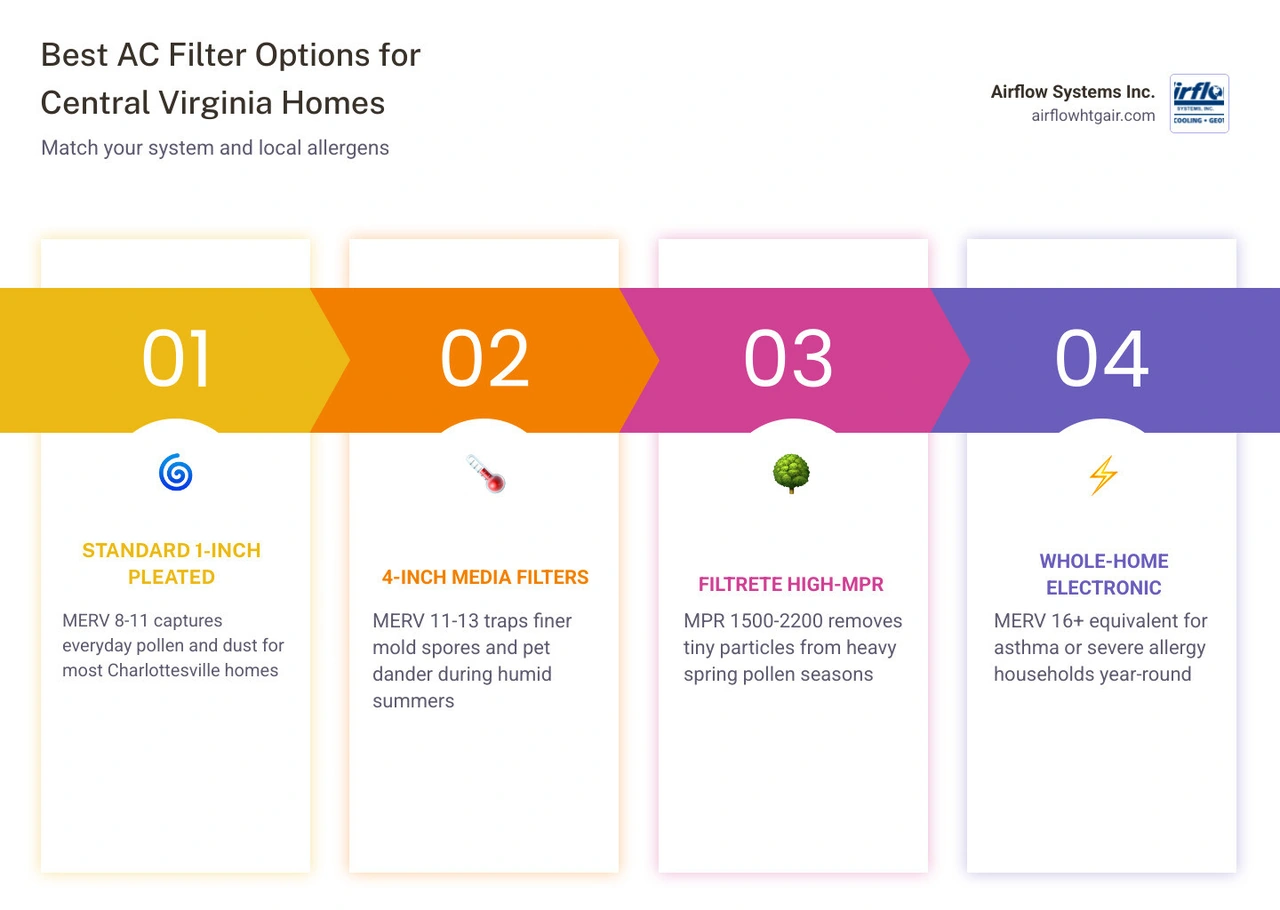
The best ac filter options for central virginia homes are ones that match your HVAC system, handle the region's heavy pollen seasons and summer humidity, and keep your family breathing clean air year-round. Here's a quick look at the top choices:
• Pleated disposable (1-inch) — MERV Rating: MERV 8-11 — Best For: Most standard Central Virginia homes
• Pleated disposable (4-inch media) — MERV Rating: MERV 11-13 — Best For: Allergy sufferers, pet owners
• Filtrete MPR 1500-2200 — MERV Rating: ~MERV 12-13 — Best For: Pollen, mold spores, fine dust
• Electronic/whole-home air cleaner — MERV Rating: Equivalent MERV 16+ — Best For: Maximum IAQ, asthma or severe allergies
• Washable electrostatic — MERV Rating: MERV 6-8 — Best For: Budget-conscious, low-allergen households
Central Virginia is a beautiful place to live, but it puts real demands on your HVAC system. Charlottesville and the surrounding region experience some of the highest spring pollen counts on the East Coast, long humid summers that encourage mold growth, and cool-to-cold winters that keep systems running hard for months on end. That combination means your air filter is working overtime — and choosing the wrong one can cost you in comfort, energy bills, and equipment wear.
Most homeowners don't think much about their filter until the air feels stuffy or the system starts struggling. But the right filter choice from the start protects both the air your family breathes and the HVAC equipment keeping your home comfortable.
This guide breaks down everything Central Virginia homeowners need to know — from MERV ratings to filter depth, replacement schedules to local buying options — so you can make a confident, informed decision.
Choosing the Best AC Filter Options for Central Virginia Homes
Selecting the right filter for your home in Charlottesville or the surrounding counties isn't just about grabbing the first option you see on the retail shelf. Our local climate brings a unique cocktail of seasonal challenges. In the spring, a heavy blanket of yellow pine and oak pollen settles over Albemarle County. As summer heats up, high outdoor humidity levels can creep indoors, creating an environment where mold spores thrive. For households with indoor pets, pet dander remains a constant, year-round challenge.
To keep these microscopic intruders out of your living spaces, you need a filter capable of trapping fine particles without choking your air conditioner. If you select a filter that is too restrictive, your system will struggle to pull in air, leading to higher utility bills and unnecessary wear on the blower motor. Conversely, choosing a cheap fiberglass filter means most of these allergens will pass straight through the filter and recirculate back into your home.
To help navigate these seasonal transitions, we recommend checking out our Spring Air Filter Replacement Guide to prepare your system for the heavy pollen onslaught before the summer heat truly arrives.
Understanding the Best AC Filter Options for Central Virginia Homes by MERV Rating
When shopping for an air filter, you will run into several different rating systems. The most common standard is the MERV (Minimum Efficiency Reporting Value) rating, which ranges from 1 to 20. However, if you shop at major retail stores, you'll also see FPR (Filter Performance Rating, used by Home Depot) and MPR (Microparticle Performance Rating, used by 3M/Filtrete).
Here is how these rating systems translate and what they mean for your home's air quality:
• MERV 1 to 4 (FPR 1-3 / MPR <300): These are basic fiberglass filters. They are designed primarily to catch large dust bunnies and protect the physical components of your HVAC system from major debris. They do almost nothing to improve indoor air quality or capture allergens like pollen and mold spores.
• MERV 5 to 8 (FPR 4-6 / MPR 300-600): These basic pleated filters are a step up. They can trap larger mold spores, pet dander, and household dust. For homes in Central Virginia without pets or severe allergy sufferers, a MERV 8 filter represents a solid baseline option.
• MERV 11 to 13 (FPR 7-10 / MPR 1000-2200): This is the "sweet spot" for most families in our region. A MERV 13 filter can capture up to 98% of airborne particles, including fine pollen, mold spores, pet dander, and even some bacteria and virus-carrying droplets. If you suffer from seasonal allergies during Virginia’s intense spring and fall pollen seasons, upgrading to a MERV 11 or MERV 13 filter will provide noticeable relief.
• MERV 14 to 20 (FPR N/A / MPR >2200): These are hospital-grade filters, including HEPA filters. While they are highly effective at removing microscopic pollutants, standard residential HVAC systems cannot handle the extreme airflow restriction they create. Using a true HEPA filter in a standard 1-inch return slot can restrict airflow so severely that it may freeze your evaporator coil or burn out your blower motor.
If you are unsure whether your current indoor air quality is where it should be, or if you want to see exactly what particles are lingering in your home, scheduling a professional Indoor Air Quality Testing Charlottesville VA session is a great place to start. We can analyze your air and recommend the exact level of filtration your system can safely handle.
Comparing the Best AC Filter Options for Central Virginia Homes: 1-Inch vs. 4-Inch Filters
The thickness of your air filter plays a massive role in both how well it cleans the air and how long it lasts. Most older homes in Charlottesville are built with standard 1-inch filter slots, while many modern builds or upgraded systems feature 4-inch or 5-inch media cabinets.
Let's look at how these two depths compare:
• Surface Area — 1-Inch Pleated Filter: Standard surface area; pleats are shallow. — 4-Inch Media Filter: Massive surface area; deep pleats allow for more material.
• Airflow Resistance — 1-Inch Pleated Filter: Higher resistance at higher MERV ratings because air must pass through a smaller physical area. — 4-Inch Media Filter: Lower resistance even at high MERV ratings (MERV 11-13) because the surface area is vastly larger.
• Lifespan — 1-Inch Pleated Filter: Typically lasts 30 to 90 days depending on household factors. — 4-Inch Media Filter: Typically lasts 6 to 12 months before needing replacement.
• Filtration Efficiency — 1-Inch Pleated Filter: Good for basic dust and moderate allergens up to MERV 11. — 4-Inch Media Filter: Exceptional; easily handles MERV 11 to 15 without choking the system.
• System Compatibility — 1-Inch Pleated Filter: Fits standard return air grilles and basic furnace slots. — 4-Inch Media Filter: Requires a dedicated media filter cabinet installed next to the indoor unit.
If your home currently uses a 1-inch slot, you should be cautious about choosing a high-MERV filter. Because 1-inch filters have limited surface area, a MERV 13 rating in this thickness can act like a brick wall to your system's blower motor, restricting crucial airflow. A 4-inch media filter, on the other hand, unfolds like an accordion, providing a massive surface area that allows air to glide through easily while trapping a far higher volume of microscopic particles.
If you are interested in upgrading your system to accommodate a high-efficiency media cabinet, or if you want to ensure your current system is operating at peak performance with your filter of choice, scheduling regular AC Maintenance Charlottesville VA is key to protecting your investment.
How Central Virginia Climate and Seasons Affect Filter Lifespan
Our local climate in Central Virginia dictates how hard your HVAC system has to work, which directly impacts how quickly your air filter gets dirty. We experience distinct, dramatic seasonal shifts that require a proactive approach to filter maintenance.
In the spring, the outdoor air is thick with pollen. Every time you open your exterior doors, or when your home's natural ventilation draws outdoor air inside, pollen enters your living spaces. Your AC filter is your primary line of defense against these particles. If you leave your windows open on a beautiful spring day, your filter will load up with pollen much faster than it would in the dead of winter.
Summer brings heavy, sustained humidity. When indoor humidity levels rise above 50%, mold spores can begin to colonize on surfaces, including inside your ductwork and on the filter media itself. A damp, dust-laden filter is the perfect breeding ground for musty odors. Additionally, during the hottest weeks of July and August, your air conditioner runs almost continuously. This increased run-time means a higher volume of air is cycled through the filter, accelerating dust accumulation.
To ensure your system is ready to handle these intense demands, it's always wise to take steps for Preparing Your AC for a Virginia Summer before the first heatwave hits.
Recommended Filter Replacement Schedule for Local Homeowners
Because every home is different, a one-size-fits-all replacement schedule doesn't work. The lifespan of your filter depends on the size of your home, whether you have pets, and if anyone in your household suffers from respiratory conditions.
Here is our recommended replacement schedule for standard 1-inch pleated filters in Central Virginia:
• Single Resident, No Pets, Low Allergies: Replace every 90 days. This is the absolute minimum standard for a clean, low-activity household.
• Standard Family Home, No Pets: Replace every 60 to 90 days. Normal foot traffic, cooking, and daily activity generate enough dust to warrant a bi-monthly check.
• Pet-Friendly Home (One Dog or Cat): Replace every 60 days. Pet dander and hair quickly accumulate on the filter surface, reducing airflow.
• Multiple Pets or Severe Allergy Sufferers: Replace every 20 to 45 days. During peak pollen seasons or in homes with multiple furry family members, filters can clog surprisingly fast.
• High-Efficiency 4-to-5-Inch Media Filters: Replace every 6 to 12 months, though we highly recommend checking them visually at the 6-month mark if you have pets.
Neglecting your filter can lead to a cascade of expensive system issues, including frozen evaporator coils, weak airflow, and even blower motor failure. Incorporating filter checks into your routine HVAC Maintenance Charlottesville VA is one of the simplest and most effective ways to avoid these preventable breakdowns.
Common Filter Sizes, Brands, and Local Buying Options
When it comes to buying replacement filters, you have plenty of local and online options. In Central Virginia, most homes built between the 1970s and today use a few standard sizes. The most common dimensions you will find in our local homes include:
• 20 x 20 x 1
• 20 x 25 x 1
• 16 x 25 x 1
• 14 x 14 x 1 (often used in multi-return systems)
• 12 x 12 x 1
If you prefer to buy your filters in person, local retailers like Home Depot and Lowe's in the Charlottesville area carry a wide range of options. Home Depot features brands like Filtrete (rated as the #1 most trusted air filter brand in America according to a 2020 TNS Brand Health Study) and their store brand, HDX. Lowe’s carries Filtrete alongside their budget-friendly house brand, Project Source.
Both major retailers offer bulk pricing discounts if you buy packs of 4 to 12 filters, which is a highly cost-effective option for local homeowners. They also offer subscription programs (like Lowe's "Subscribe & Save") that deliver filters directly to your door on a set schedule, ensuring you never forget a replacement.
Disposable Pleated vs. Washable Reusable Filters
For homeowners looking to reduce waste, washable or reusable electrostatic filters can seem like an attractive option. However, in our humid Central Virginia climate, they come with significant drawbacks that you should carefully consider.
• Disposable Pleated Filters: These filters are made of synthetic fibers that are electrostatically charged to attract and trap small particles. They are incredibly efficient at capturing fine dust, pollen, and mold spores. Once dirty, you simply throw them away and slide in a clean one. The main drawback is the ongoing cost and the waste generated by discarding them.
• Washable/Reusable Filters: These typically feature a metal frame with layers of woven plastic or foam. You clean them by spraying them down with a hose, letting them dry completely, and reinstalling them. While they save money over time, they generally have a lower filtration efficiency (usually equivalent to a MERV 6 or 8).
The biggest risk with washable filters in Virginia is our high summer humidity. If you do not let a washable filter dry 100% completely before sliding it back into your dark, warm HVAC cabinet, it will quickly grow mold and mildew. This can spread musty odors and mold spores throughout your entire home. For this reason, we generally recommend high-quality disposable pleated filters for most local homes.
For more tips on how to balance your indoor environment, you can read about How Shade, Insulation and Sealing Reduce Your AC Workload to keep your home comfortable and efficient.
Beyond the Filter: Advanced Indoor Air Quality Solutions
While standard air filters are excellent for protecting your HVAC system and catching larger airborne particles, they have their limitations. If you have family members with asthma, severe seasonal allergies, or compromised immune systems, a standard 1-inch filter may not be enough.
Fortunately, there are several advanced whole-home indoor air quality upgrades available that integrate seamlessly with your existing ductwork:
1. Whole-Home HEPA Filtration Systems: Unlike standard filters, true HEPA filters capture 99.97% of particles down to 0.3 microns. Because they are so thick, they require their own dedicated bypass cabinet with an integrated blower fan so they don't restrict your main system's airflow.
2. Electronic Air Cleaners: Systems like the Trane CleanEffects use patented electrostatic technology to charge incoming particles and trap them on collection cells. These systems can remove an incredible 99.98% of airborne pollutants — including viruses, bacteria, and microscopic allergens — without restricting airflow like a traditional high-MERV paper filter.
3. Whole-Home Dehumidifiers: High humidity makes the air feel heavy and encourages dust mites and mold to multiply. Installing a whole-home dehumidifier works alongside your air conditioner to keep indoor humidity levels in the ideal 30% to 50% range, making your home feel cooler at higher temperatures and dramatically improving air quality.
To explore how these advanced systems can transform your living space, take a look at our guide on Home Comfort, Indoor Air Quality & Energy Upgrades.
The Role of Professional HVAC Maintenance in IAQ
No matter how high-quality your air filter is, it cannot do its job if your HVAC system is dirty or neglected. Over time, dust can bypass even the best filters, settling on your air conditioner's indoor evaporator coil. When dust mixes with the natural condensation on the cold coil, it creates a grimy barrier that restricts heat transfer, reduces system efficiency, and can emit a musty "dirty sock" odor.
Additionally, leaking or unsealed ductwork in your attic, crawlspace, or basement can pull dusty, unconditioned air directly into your home, bypassing your filter entirely.
Regular professional maintenance is essential to keep these issues at bay. During a professional visit, certified technicians will clean your system's coils, inspect the blower motor, verify that your filter fits tightly without any air bypass, and check your ductwork for leaks.
To learn more about what our team does during a routine check, read our article on Spring AC Tune-Up: What to Expect.
Frequently Asked Questions about Central Virginia AC Filters
Can a high-MERV filter damage my Central Virginia HVAC system?
Yes, it absolutely can if your system isn't designed to handle it. High-MERV filters (especially MERV 13 and above in a 1-inch thickness) are dense and require more force for the blower motor to push air through them. This increases the "static pressure" in your ductwork.
If the static pressure gets too high, airflow drops significantly. This can cause your indoor evaporator coil to drop below freezing, turning condensation into solid ice and blocking airflow entirely. It also forces your blower motor to work much harder, leading to overheating, premature motor failure, and skyrocketing energy bills. If you notice your home isn't staying cool, check out our guide on AC Not Cooling Properly: What to Check First to troubleshoot the issue.
How do I find the exact filter size my system needs?
The easiest way is to look at your existing filter. The size is printed in bold numbers on the cardboard frame (for example, "20 x 25 x 1").
However, be aware of the difference between nominal size and actual size. The nominal size is the rounded-up number printed on the box used for retail labeling. The actual size is the precise physical measurement of the filter, which is usually about a half-inch smaller in each direction (e.g., an actual size of 19.5 x 24.5 x 0.75 inches).
If there is no filter currently installed, or if the printed size is missing, do not guess. Measure the length, width, and depth of the physical filter slot or return grille using a tape measure. A filter that is too small will allow dirty air to bypass the filter entirely, while a filter that is too large will bend, buckle, and create gaps. For more help diagnosing system issues related to airflow, read our Why Is My AC Blowing Warm Air? Troubleshooting Steps guide.
What are the signs that my AC filter needs to be replaced immediately?
While following a calendar schedule is great, you should also keep an eye out for physical warning signs that your filter is completely full:
• Weak airflow coming from your supply vents.
• A visible layer of gray dust and lint on the surface of the filter.
• An unusual buildup of dust on your furniture and around your return vents shortly after cleaning.
• A musty, dusty, or stale odor when your air conditioner kicks on.
• Your system running longer cooling cycles than usual to reach your thermostat's set temperature.
If your system is completely neglected and stops running altogether, don't panic. Take a look at our AC Not Turning On: Complete Guide to understand the potential causes and when it's time to call in the professionals.
Conclusion
Finding the best ac filter options for central virginia homes is a simple yet powerful way to protect your family's health and ensure your heating and cooling system runs efficiently for years to come. By understanding MERV ratings, choosing the right filter thickness for your system, and staying on top of a seasonal replacement schedule, you can easily conquer Charlottesville's heavy pollen and high summer humidity.
Since 1988, Airflow Systems Heating & Air has been proud to serve homeowners across Charlottesville, VA, and the surrounding Central Virginia region. As a premier, family-owned contractor, we combine certified professionals with the latest indoor air quality technologies to keep your home healthy, comfortable, and energy-efficient.
Whether you need a hand selecting the perfect filter, want to upgrade to a high-efficiency media cabinet, or need professional system maintenance, we are here to help. Contact us today to schedule your service or explore our premier Air Conditioning Services to keep your home cool and comfortable all summer long!
Book Expert Service Or Contact Us
Our Service Process
A Hassle-Free Service Experience
01
Consultation & Diagnosis
We start by listening to your needs and performing a thorough diagnosis of your system to recommend the best solution.
02
Transparent Quoting
We provide a clear, upfront estimate with no hidden fees, so you know exactly what to expect.
03
Expert Service & Follow-Up
Our factory-trained technicians complete the work to the highest standards, and we follow up to ensure your complete satisfaction.
testimonials
What Our Customers Are Saying
Our customers consistently praise our exceptional service and attention to detail, making us a trusted choice for all your HVAC needs.
where we operate
Service areas