

Choose an option to see quick actions and get help faster.
.svg)

Escaping the Late-Summer Heat Without Wasting Electricity
That window AC in your sunroom is rattling at full blast, but the space still feels like a sauna, leaving you wondering: Are Window Units Actually Cheaper to Run Than a Single-Zone Mini Split? It is a common frustration our team at Airflow Systems hears from Charlottesville homeowners trying to cool a bonus space or a recent addition during the peak heat and back-to-school transition of late August. You know that you need supplemental cooling to make the room usable, but the constant, aggressive hum of a 110v window shaker brings a lingering anxiety about exactly how much electricity it takes to keep the temperature bearable.
In our experience, most homeowners initially choose a window unit because it seems like a straightforward, temporary fix. However, the core decision point eventually shifts. You have to evaluate whether the long-term energy efficiency and superior cooling performance of a permanent solution justifies replacing that existing, inefficient unit. Making this choice requires looking past the surface and understanding the strictly mechanical, transparent comparison of utility draw and operational efficiency.
Upgrading to modern Mini Split Systems changes the equation entirely. Instead of relying on outdated technology that constantly fights against the elements, you can implement a solution designed for continuous, low-impact operation. To see why this matters for your monthly utility consumption, we have to look under the hood at how these two very different cooling technologies actually consume electricity.
The Mechanical Reality of Amperage Draw and Inverter Technology
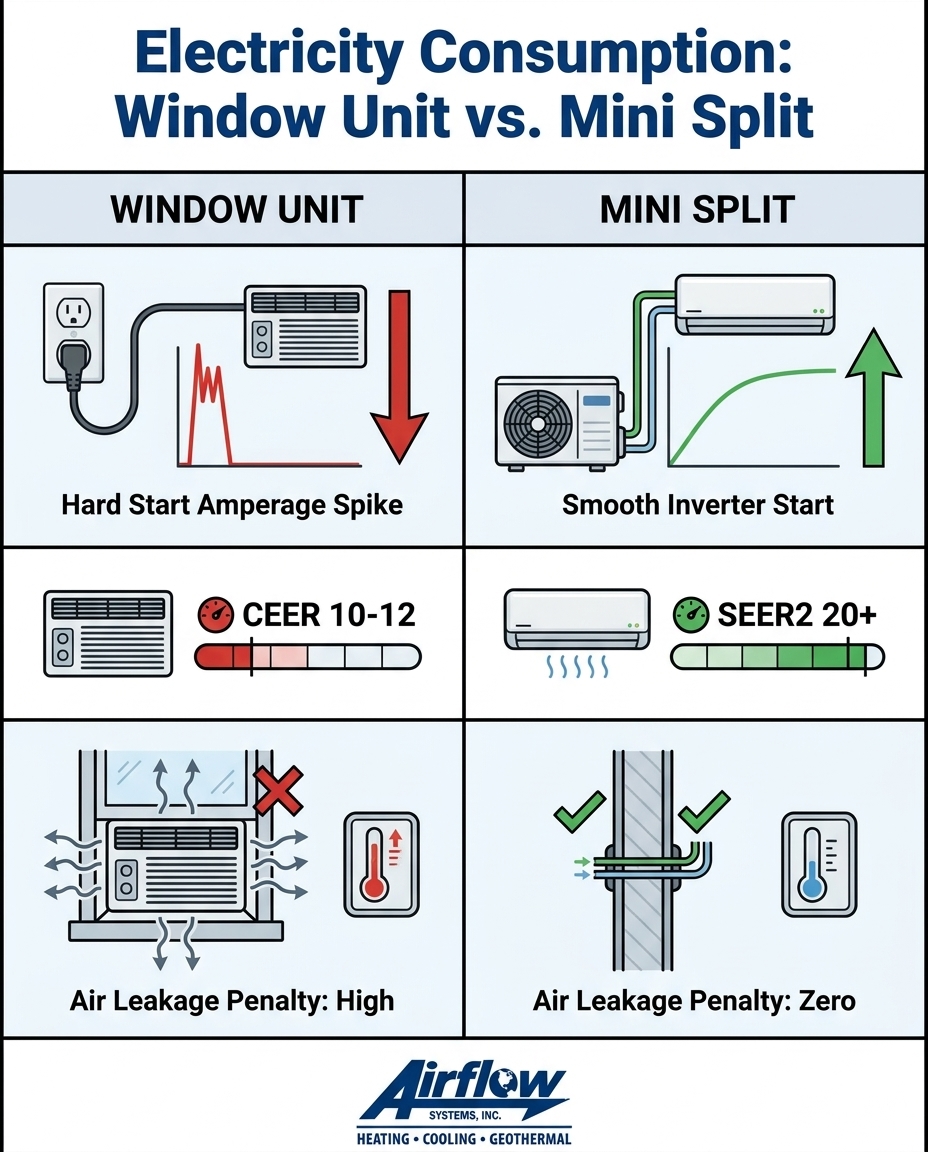
When our technicians diagnose high summer utility bills, we often point to how a compressor starts and runs. Traditional 110v window units operate on a simple, single-speed mechanism. When the thermostat detects that the room has grown too warm, the unit slams on at 100% capacity. This requires a massive surge of electricity known as Locked-Rotor Amps (LRA). This hard-starting amperage spike demands a heavy electrical draw every single time the unit cycles on. Once the room reaches the target temperature, the unit shuts off completely, only to repeat that massive energy spike a few minutes later when the room inevitably warms up again.
In stark contrast, a dedicated Mini Split utilizes variable-speed inverter technology. Instead of hard-cycling on and off, an inverter-driven compressor operates much like the accelerator pedal in a car. It ramps up smoothly to reach the desired temperature, and then it modulates its capacity down to a slow, steady hum to maintain that comfort level. This continuous low-amperage draw uses significantly less electricity over a month than the constant high-amperage starting and stopping of a window unit.
The quick fix: Stop looking at just the wattage on the box and start looking at the continuous amperage draw versus variable-speed inverter modulation.
• Compressor Operation — 110v Window Unit: Single-speed (100% ON or completely OFF) — Single-Zone Mini Split: Variable-speed (Modulates from 10% to 100%)
• Amperage Draw — 110v Window Unit: High Locked-Rotor Amps (LRA) at every startup — Single-Zone Mini Split: Smooth, low-amperage continuous operation
• Temperature Control — 110v Window Unit: Wide temperature swings between cycles — Single-Zone Mini Split: Precise, consistent temperature maintenance
• Energy Waste — 110v Window Unit: High waste due to constant hard-cycling — Single-Zone Mini Split: Minimal waste due to inverter efficiency
The Latent Cooling Penalty: Why Window Units Struggle with Humidity
In our years of installing cooling systems across Central Virginia, we constantly remind homeowners that cooling a room is only half the battle; removing humidity is just as important. In the HVAC industry, dropping the actual temperature is called sensible cooling, while removing moisture from the air is known as latent cooling. When you are dealing with late August heat and high humidity in Charlottesville, your air conditioner has to work incredibly hard to manage that latent heat load. High dew points make the air feel heavy and sticky, and if your system cannot effectively dehumidify the space, you will never feel truly comfortable, no matter how low you set the thermostat.
This is where the physical installation of a window unit creates a massive energy penalty. Standard window units rely on flimsy accordion panels and basic foam weatherstripping to fill the gap in your open window. These poor air seals allow humid, unconditioned outside air to constantly infiltrate the room. Your window unit is essentially trying to dehumidify the entire neighborhood. Because the humid air never stops leaking in, the unit's compressor is forced to run longer and harder, drastically increasing your electricity draw.
When comparing mini splits and window units, the difference in air sealing is night and day. A ductless system requires only a small, sealed hole through the wall for the refrigerant lines. The window remains completely closed and locked. This completely sealed nature allows the system to efficiently dehumidify the space without letting unconditioned air inside. By eliminating the constant infiltration of Charlottesville's late-summer humidity, the inverter compressor can easily manage the latent cooling load while drawing a fraction of the power.
Efficiently Cooling Additions and Hard-to-Reach Spaces
Central HVAC systems often struggle to adequately cool specific architectural features common in older homes. Over-garage spaces, sunrooms, and home expansions are notoriously difficult to keep comfortable. Because these rooms are often situated far from the main air handler, or because they lack adequate ductwork and insulation, the central system simply cannot push enough conditioned air into the space to combat the heat gain from the roof and windows.
To solve this problem, homeowners frequently turn to supplemental window units. However, relying on these temporary fixes leads to disproportionate electricity consumption. You end up running a highly inefficient, noisy appliance at full capacity just to make a single room usable. Furthermore, an open window on the ground floor presents a significant security risk, and the loud rattling of the compressor makes it difficult to enjoy the space for a home office or a quiet evening.
A dedicated single-zone system provides continuous comfort without the noise, the high energy draw, or the security risks of an open window. Recently, our installation crew at Airflow Systems helped a local homeowner upgrade their 30-plus-year-old HVAC system, which had been struggling to keep their entire property comfortable. They converted to a highly efficient dual-fuel system, and the immediate result was that their home climate improved so dramatically they no longer needed the supplemental window units they had relied on for years. This is the power of a proper Heat Pump Installation: it resolves the root cause of the discomfort rather than just applying a noisy, inefficient band-aid.
Measuring True Efficiency: SEER2 vs. CEER Ratings
To independently verify the performance gap between these two technologies, you need to understand the industry metrics used to measure cooling efficiency. When we sit down with customers to discuss system replacements, we explain that manufacturers do not just guess how much electricity an appliance uses; they are rigorously tested and assigned specific efficiency ratings. Understanding these ratings translates directly into understanding your long-term utility draw.
Here is a breakdown of the metrics that define real-world mechanical performance:
• CEER (Combined Energy Efficiency Ratio): This is the standard measurement for window air conditioners. It calculates the cooling capacity divided by the electrical input, factoring in the standby power the unit consumes when it is plugged in but not running. Most modern window units typically max out around a CEER rating of 10 to 12.
• SEER2 (Seasonal Energy Efficiency Ratio 2): This is the updated, highly rigorous standard used for central air conditioners and ductless heat pumps. It measures the total cooling output over an entire cooling season divided by the total electrical energy input during that same period. Modern ductless systems frequently achieve SEER2 ratings of 20 or higher.
• The Mechanical Translation: When you compare a CEER of 10 against a SEER2 of 20+, the mechanical reality becomes clear. The ductless system requires significantly less electrical input to produce the exact same amount of cooling output (BTUs).
These metrics matter because they prove that the continuous running of a window unit is fundamentally more wasteful. The advanced compressor technology and superior coil designs of a permanent system allow it to extract heat from your home using a fraction of the wattage.
Long-Term Utility Draw and Upgrading Smartly
It is important to acknowledge the mechanical reality of upgrading your home's cooling infrastructure. Permanent installations require a larger initial equipment investment than picking up a temporary window shaker from a big-box hardware store. A permanent system requires professional installation, dedicated electrical circuits, and specialized refrigerant handling. However, stopping the calculation at the initial equipment phase ignores the ongoing operational burden.
The drastic reduction in monthly utility draw helps offset that initial investment over the lifespan of the equipment. Because an inverter-driven system modulates its power consumption and eliminates the massive amperage spikes of hard starting, it draws significantly less electricity hour by hour, day by day. Over the course of a long, hot summer, that efficiency translates into a much lower operational footprint.
At Airflow Systems, our goal is to provide honest, transparent breakdowns of mechanical reality so homeowners can make informed decisions without corporate upselling. We want you to understand exactly how your equipment operates and where your electricity is going. Upgrading smartly also means taking advantage of available incentives. Generic energy rebates and federal tax credits may apply to qualifying high-efficiency heat pump installations. We always advise our clients to consult their tax professional or local utility provider to verify which current efficiency programs they qualify for when making the switch to a permanent solution.
Frequently Asked Questions About Ductless Efficiency vs. Window ACs
Does a mini split use less electricity than a window unit?
Yes, a mini split uses significantly less electricity than a standard window unit to cool the exact same amount of square footage. This efficiency comes down to the variable-speed inverter compressor, which uses continuous low power to maintain the temperature. Instead of the high-energy bursts required by window units every time they cycle on, the inverter smoothly modulates its output, drastically reducing the overall utility draw.
Why are mini splits more efficient than window ACs?
They feature superior compressor technology, larger heat exchange coils, and they completely eliminate the air leaks associated with window installations. Because a window unit relies on accordion panels that let hot, humid air inside, the system has to work constantly just to keep up with the infiltration. Additionally, the difference in efficiency is reflected in their ratings, with window units maxing out at low CEER numbers while permanent systems achieve SEER2 ratings of 20 or higher.
How much power does a mini split use compared to a window AC?
A mini split typically consumes a fraction of the wattage to produce the same cooling capacity (BTUs) as a window shaker. The most critical difference is the elimination of locked-rotor amp spikes. Because the inverter system never hard-starts at 100% capacity, it avoids the massive surges of electricity that a window unit demands multiple times an hour.
Is a mini split worth it for cooling just one room?
Yes, single-zone systems are specifically designed for isolated spaces like sunrooms, over-garage bonus rooms, or home additions. They provide long-term utility efficiency and superior comfort without blocking a window or creating a security vulnerability. The quiet operation and precise temperature control make them an ideal permanent solution for rooms that a central HVAC system struggles to reach.
Do window units let out conditioned air?
Yes, the accordion panels and poor foam seals around window units allow conditioned air to escape and humid outdoor air to enter. This constant air exchange forces the unit to run longer and harder to maintain the set temperature. This is known as a latent cooling penalty, where the system wastes significant energy trying to dehumidify outside air that is constantly leaking into your home.
Make the Switch to Smarter Single-Zone Cooling
The mechanical reality clearly favors the inverter-driven system for long-term utility efficiency. Relying on an outdated 110v window unit means accepting high amperage spikes, constant air infiltration, and a system that struggles to manage heavy summer humidity. Escaping the late-summer heat shouldn't mean wasting electricity on technology that was never designed for optimal efficiency.
You deserve a clear, mechanical explanation of why inverter-driven systems outperform temporary fixes, and you deserve a definitive efficiency comparison for your home. If you are tired of the noise, the poor air sealing, and the constant utility draw of a window shaker, it is time to look at a permanent solution. Schedule an inspection with our team at Airflow Systems today to discuss the best high-efficiency cooling options tailored specifically for your hard-to-cool spaces.
Book Expert Service Or Contact Us
Our Service Process
A Hassle-Free Service Experience
01
Consultation & Diagnosis
We start by listening to your needs and performing a thorough diagnosis of your system to recommend the best solution.
02
Transparent Quoting
We provide a clear, upfront estimate with no hidden fees, so you know exactly what to expect.
03
Expert Service & Follow-Up
Our factory-trained technicians complete the work to the highest standards, and we follow up to ensure your complete satisfaction.
testimonials
What Our Customers Are Saying
Our customers consistently praise our exceptional service and attention to detail, making us a trusted choice for all your HVAC needs.
where we operate
Service areas