

Choose an option to see quick actions and get help faster.
.svg)
The Late-Summer Challenge of Loud AC Units in Dense Neighborhoods
Addressing HVAC noise complaints in tight Charlottesville subdivisions often becomes a pressing priority when the peak heat of the season arrives. The constant roar of an aging compressor outside your window is hard enough to ignore, but when it starts bothering the neighbors, the situation takes on a new level of urgency. Central Virginia's hot, humid August forces older air conditioning units into maximum duty cycles. What might be a minor, tolerable hum during a mild spring afternoon quickly transforms into a constant, disruptive overnight nuisance during late-summer August cooling periods.
For homeowners living in communities where houses are built close together, this sustained mechanical noise frequently leads to neighbor disputes and potential homeowners association (HOA) or city code violations. The core decision point becomes clear: you must determine whether to invest in sound-dampening retrofits, like acoustic blankets and barriers, or to permanently relocate or replace the unit to comply with strict lot line noise restrictions. In our experience at Airflow Systems, if you are dealing with an overwhelmingly loud system, exploring professional air conditioning services is the first step toward restoring peace to your property. A thorough evaluation by our team can help you decide if prompt AC repair will solve the issue, or if a more comprehensive upgrade is necessary to keep your home comfortable and neighbor-friendly.
Understanding Charlottesville Setback Rules and Noise Ordinances
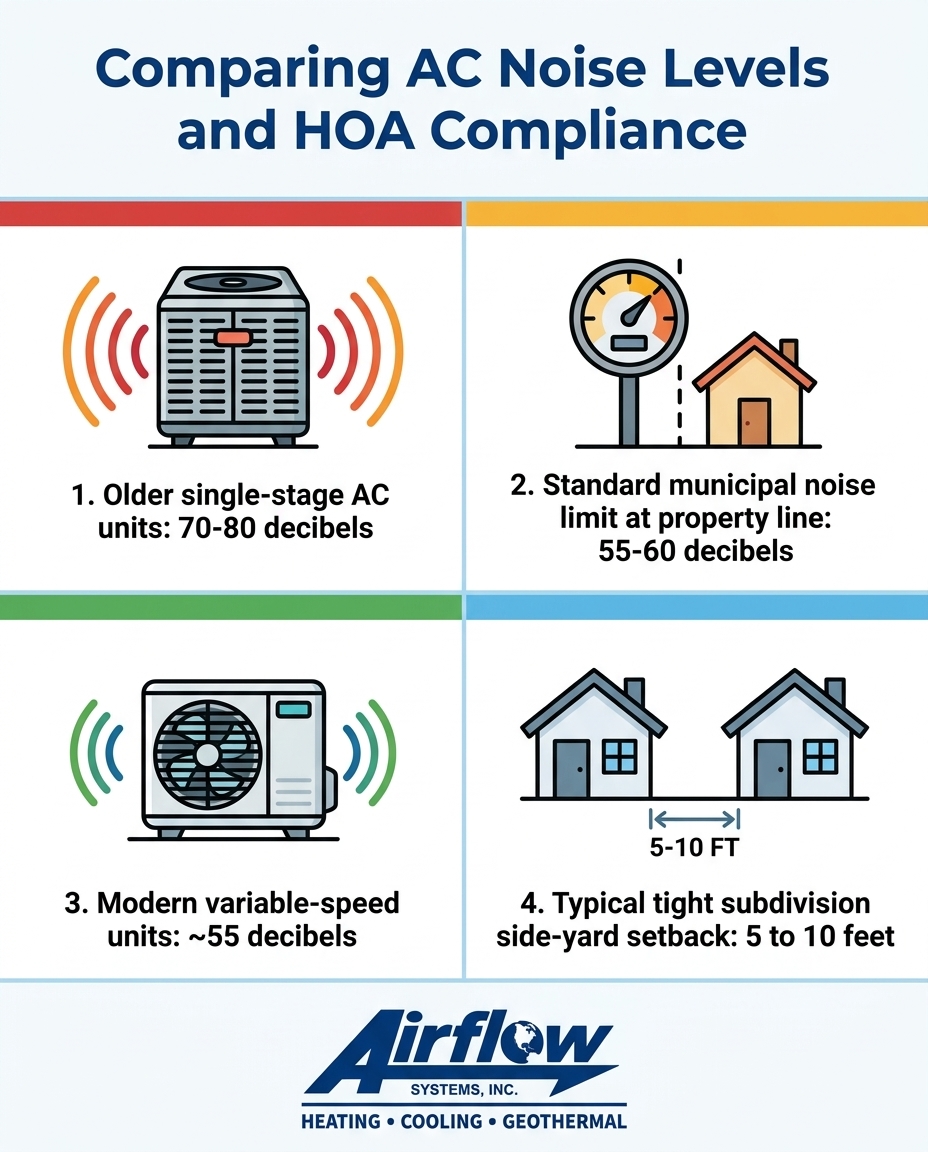
Modern residential development often maximizes land use, which means densely packed Charlottesville subdivisions frequently feature narrow 5-to-10 foot side-yard setbacks. Our technicians frequently see how these tight property lines leave a minimal buffer zone for acoustic dissipation between homes. When an air conditioner fires up in a narrow side yard, the sound waves bounce back and forth between the brick or siding of adjacent houses, amplifying the perceived volume and making the noise feel much louder than it actually is.
Standard municipal residential noise guidelines typically restrict continuous mechanical noise from exceeding 55 to 60 decibels at the property line. This presents an immediate compliance issue for homeowners with older equipment. Traditional, single-stage AC units can easily operate at 70 to 80 decibels. When your unit sits just a few feet from your neighbor's property line—which acts as the strict legal boundary for noise complaints—we find that an aging compressor operating at 75 decibels is virtually guaranteed to violate local ordinances.
Navigating these regulations requires specific local knowledge. Unlike generic advice from national franchises, our team at Airflow Systems understands the distinct nuances of Charlottesville HOA bylaws and city codes. Knowing exactly how setback rules interact with municipal noise limits is critical for finding a legally compliant solution.
• Modern Variable-Speed AC — Estimated Decibel Level (dB): 55 dB — Impact in Tight Subdivisions: Easily passes municipal property line ordinances.
• Normal Conversation — Estimated Decibel Level (dB): 60 dB — Impact in Tight Subdivisions: Generally acceptable daytime noise level.
• Older Single-Stage AC — Estimated Decibel Level (dB): 70 - 80 dB — Impact in Tight Subdivisions: Highly likely to trigger neighbor complaints and HOA fines.
• Lawnmower — Estimated Decibel Level (dB): 90+ dB — Impact in Tight Subdivisions: Restricted to daytime use; unacceptable for continuous overnight operation.
Is It Normal Compressor Hum or a Mechanical Failure?
Before assuming that your outdoor unit is inherently too big or poorly placed for your lot, it is important to determine the source of the sound. Not all loud noises indicate that a system violates noise ordinances by design; sometimes, an elevated volume simply points to a failing internal component that needs immediate attention during the heavy strain of late-summer August cooling.
Our service crews constantly remind homeowners that there is a distinct difference between the steady, loud hum of an aging single-stage compressor and the aggressive sounds of mechanical failure. While an old compressor might just be naturally loud, specific noises should serve as immediate warning signs:
• Grinding sounds: Usually indicate a failing fan motor bearing that requires immediate replacement before the motor seizes entirely.
• Rattling or banging: Often points to a loose internal component, a failing compressor spring, or debris trapped in the outdoor fan enclosure.
• Screeching or squealing: Typically signals a degraded fan belt or a serious pressure issue within the compressor itself.
If you notice any of these symptoms, learning what strange AC noises mean can help you identify the urgency of the problem. A professional inspection is always the necessary first step. Resolving a worn fan bearing or securing a loose panel might drop the decibel level enough to satisfy your neighbors, saving you from investing in a costly unit relocation or a complex acoustic fence.
Evaluating Sound-Dampening Retrofits and Acoustic Barriers
The Role of Compressor Sound Blankets
When homeowners in densely packed Charlottesville subdivisions face noise complaints, their first instinct is often to look for a quick retrofit. In our day-to-day service calls, we see compressor sound blankets used as a common starting point. These heavy-duty, insulated wraps are designed to fit snugly over the compressor inside the outdoor cabinet. When installed correctly, they can reduce operational noise by a few decibels, softening the harsh mechanical clatter.
The underlying problem: While blankets reduce noise, they also trap heat. If a blanket is installed incorrectly or used on an incompatible unit, it can prevent the compressor from dissipating heat properly, leading to severe overheating and premature system failure. We always advise relying on a professional to ensure the blanket is manufacturer-approved for your specific model.
Acoustic Fences and Strategic Landscaping
Another common solution involves building physical barriers between the unit and the property line. Acoustic fences made of dense materials can deflect sound waves, while strategically planted, thick shrubbery can help absorb excess noise.
The limiting factor: In tight side yards, space is already at a premium. Strict HOA setback rules often prohibit the construction of new fences or permanent structures within a few feet of the property line. Furthermore, placing a fence or dense bushes too close to the HVAC unit restricts essential airflow, drastically reducing the system's efficiency and lifespan. Ultimately, our team finds that retrofits and barriers are often just temporary band-aids for inherently loud, aging equipment that will eventually need to be replaced.
Upgrading to Whisper-Quiet Heat Pumps in Tight Spaces
When retrofits fall short and property lines leave no room for acoustic barriers, upgrading to modern variable-speed equipment is often the ultimate neighbor-friendly solution for dense lots. Unlike older systems that blast on at full capacity, modern variable-speed heat pumps operate at incredibly low sound levels—often as low as 55 decibels. This allows them to easily pass local municipal noise ordinances without the need for additional soundproofing.
The secret to their quiet operation lies in their continuous, low-capacity running cycles. Instead of turning on and off with loud, abrupt startup noises that wake neighbors in the middle of the night, variable-speed compressors ramp up gently and run longer at lower speeds. This not only maintains a much more consistent indoor temperature but also keeps outdoor noise to an absolute minimum.
Our team recently helped a local homeowner who needed to replace an aging heat pump located in relatively close quarters near the property line. Despite the tight space, our skilled installation crew was able to seamlessly fit a new, high-efficiency Bosch unit into the existing footprint. The new system is running exceptionally well, and more importantly, it is noticeably quieter, completely eliminating the previous noise concerns. If you are facing a similar lot-line dilemma, exploring professional heat pump installation is the most reliable upgrade path for long-term peace and comfort.
Ductless Solutions for Zero-Lot-Line Cooling
In some densely packed Charlottesville subdivisions, traditional central air conditioning footprints are simply too large to comply with strict HOA or municipal setbacks. When a standard outdoor unit violates the property line rules, we frequently recommend ductless mini-split systems as a highly effective alternative.
Ductless systems feature significantly smaller outdoor condenser units. Their compact, slim-profile design allows them to be mounted on exterior walls or tucked into narrow side yards where traditional square cabinets could never fit. Beyond their space-saving footprint, ductless units are renowned for their ultra-quiet operation. The advanced inverter technology used in these systems virtually eliminates the loud mechanical hum associated with central AC, making noise complaints from next-door neighbors a thing of the past.
This flexibility is especially valuable when time is of the essence. For example, our team recently assisted a local resident who faced a severe HVAC challenge in a small, tight apartment space and was pressed for time due to a pending real estate contract. After discussing the tight spatial constraints, we promptly installed a modern minisplit. The new system works better than imagined and operates with ultra-efficient, whisper-quiet performance. For homeowners dealing with zero-lot-line restrictions, investing in quiet mini split systems is often the smartest way to bypass setback violations entirely.
Professional Assessment for Legal and Safe Unit Relocation
If upgrading your equipment isn't currently an option, and your existing unit must be moved to comply with strict property line restrictions, a professional assessment is absolutely mandatory. Relocating an air conditioner is an incredibly complex process that goes far beyond simply sliding a metal box a few feet to the left.
The dangers of DIY: Moving an HVAC unit requires pumping down and rerouting pressurized refrigerant lines, extending high-voltage electrical whips, and grading the soil to pour a perfectly level new concrete pad. Attempting this as a DIY project is not only dangerous but illegal in many jurisdictions. Handling refrigerant requires specialized EPA certification, and altering high-voltage electrical connections without a license poses severe safety and fire risks.
Our licensed professionals will take the time to evaluate your specific HOA guidelines and municipal codes before any work begins, ensuring the new location is fully compliant with all local setback rules during the heavy demand of late-summer August cooling. Furthermore, if you decide that relocating an old unit isn't worth the labor cost, we can guide you toward upgrading to a high-efficiency system in a new location. When upgrading, generally applicable energy rebates or federal tax credits may apply to qualifying installations, helping to offset the investment. Always verify current incentive programs with your utility provider or a tax professional to see what generic benefits you might qualify for.
Frequently Asked Questions About HVAC Noise and HOA Rules
How to reduce outdoor AC noise for neighbors?
The most effective way to reduce outdoor AC noise is to start with a professional inspection to rule out mechanical failures. From there, our technicians can clear debris away from the fan, perform routine maintenance, or install a manufacturer-approved sound blanket. For a permanent fix in tight spaces, upgrading to variable-speed equipment is the best solution.
What is the legal noise limit for AC units in residential areas?
While rules vary by municipality, standard residential noise limits typically restrict continuous mechanical noise to 55-60 decibels at the property line. Because densely packed Charlottesville subdivisions amplify sound, it is always crucial to verify the exact decibel limits with your local city code office and your HOA bylaws.
Can an HOA force you to move your AC unit?
Yes, if your unit violates specific setback rules or documented noise bylaws, an HOA can require you to relocate it. However, older units are sometimes protected by grandfather clauses if they were installed before the current rules were enacted. Always consult your HOA architectural committee before making any changes.
How many decibels is a normal AC unit?
The decibel level depends entirely on the age and technology of the system. Older, single-stage units typically run at a loud 70 to 80 decibels. In contrast, modern high-efficiency variable-speed units operate much more quietly, often running as low as 55 decibels.
Are sound blankets safe for older air conditioners?
Sound blankets are safe only if they are specifically approved by the manufacturer for your exact unit model. They must be professionally installed to ensure they do not block essential airflow, which could cause the aging compressor to overheat and fail prematurely.
How do modern variable-speed compressors reduce neighborhood noise?
Variable-speed compressors use advanced inverter technology to run continuously at lower, quieter capacities. Rather than turning on and off with loud, abrupt starts that startle neighbors, they gently adjust their speed to maintain the temperature, significantly reducing overall operational noise.
Restore the Peace with Charlottesville's Local HVAC Experts
Addressing HVAC noise complaints in tight Charlottesville subdivisions doesn't have to end in an ongoing feud with your neighbors. Whether you need to evaluate the safety of a compressor sound blanket, diagnose a mechanical rattle during late-summer August cooling, or upgrade to a whisper-quiet variable-speed heat pump, you have legal, neighbor-friendly options. Our team at Airflow Systems understands local subdivision dynamics, strict HOA rules, and the exact setback constraints you are facing. Talk to our experts about your property line restrictions and schedule an inspection today. A professional assessment for AC repair or replacement will give you a clear understanding of your options for reducing compressor noise legally, safely, and permanently.
Book Expert Service Or Contact Us
Our Service Process
A Hassle-Free Service Experience
01
Consultation & Diagnosis
We start by listening to your needs and performing a thorough diagnosis of your system to recommend the best solution.
02
Transparent Quoting
We provide a clear, upfront estimate with no hidden fees, so you know exactly what to expect.
03
Expert Service & Follow-Up
Our factory-trained technicians complete the work to the highest standards, and we follow up to ensure your complete satisfaction.
testimonials
What Our Customers Are Saying
Our customers consistently praise our exceptional service and attention to detail, making us a trusted choice for all your HVAC needs.
where we operate
Service areas