

Choose an option to see quick actions and get help faster.
.svg)
What AC Making Strange Noises What They Mean for Your Home's Comfort
If your ac making strange noises what they mean is the question keeping you up at night, here is a quick answer before we dig deeper:
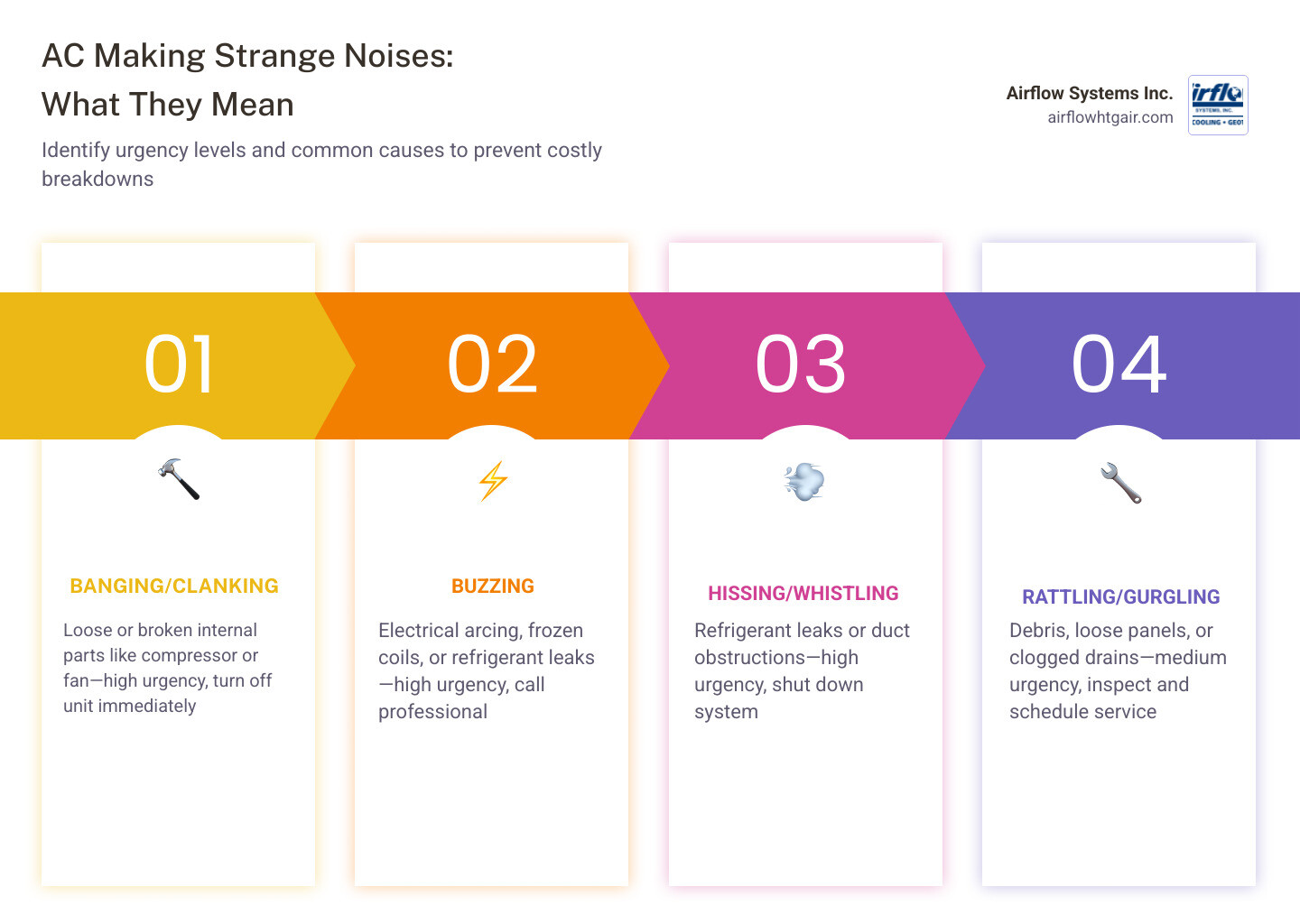
• Banging / Clanking — Most Likely Cause: Loose or broken internal parts — Urgency: High - turn off unit
• Buzzing — Most Likely Cause: Electrical issue or frozen coils — Urgency: High - call a pro
• Hissing / Whistling — Most Likely Cause: Refrigerant leak or duct problem — Urgency: High - turn off unit
• Screeching / Squealing — Most Likely Cause: Worn motor bearings or high pressure — Urgency: High - turn off unit
• Rattling — Most Likely Cause: Loose panels or debris in unit — Urgency: Medium - inspect soon
• Clicking (persistent) — Most Likely Cause: Faulty thermostat or relay — Urgency: Medium - schedule service
• Gurgling / Bubbling — Most Likely Cause: Clogged drain line or refrigerant flow — Urgency: Medium - schedule service
• Soft hum / air whoosh — Most Likely Cause: Normal operation — Urgency: No action needed
Your air conditioner is designed to run quietly in the background. Modern systems typically operate between 25 and 55 decibels - about as loud as a quiet conversation at most. When something changes in that sound, your system is sending you a signal worth paying attention to.
Strange AC noises are rarely just annoying. They are often early warning signs of a problem that is getting worse with every hour the unit runs. Catching these sounds early - and knowing what they mean - can be the difference between a simple repair and a full system replacement.
At Airflow Systems Inc., we hear from Central Virginia homeowners every season who ignored a noise for a few weeks, only to find themselves without cooling in the middle of a humid July. That is a situation no family should have to deal with.
The good news is that most AC noises have clear causes, and many can be addressed quickly once you know what you are listening for.
Understanding Normal vs. Abnormal AC Sounds
Before we panic about a new sound, it is helpful to know what a healthy air conditioner actually sounds like. A perfectly tuned system should emit a steady, uniform hum from the indoor blower and a consistent whir from the outdoor condenser fan. You should also hear a gentle whoosh of air moving through your vents—this is simply the sound of comfort being delivered to your rooms.
When your system cycles on or off, a brief startup click is perfectly normal. This is the sound of the contactor relay engaging to send power to the compressor and fan. Similarly, you might hear slight popping or creaking in your ductwork due to thermal contraction and expansion as the metal changes temperature.
However, modern technology has made "quiet" the new standard. High-efficiency variable-speed motors are engineered to run so smoothly that they are often compared to a whisper. In fact, some of the latest indoor units operate at decibel levels as low as 19dB—quieter than a library! If your system used to be a silent partner in your home’s comfort but has suddenly become a noisy roommate, it is time to investigate.
AC Making Strange Noises What They Mean: A Diagnostic Guide
When we talk about an ac making strange noises what they mean, we are essentially translating the "language" of your HVAC system. Think of these sounds as audio clues. Some are minor hiccups, while others are emergency sirens.
If the noise is loud enough to be heard over the TV or from another room, your system is likely struggling with a mechanical failure. Ignoring these sounds can lead to a "domino effect," where one loose part damages several others. For more complex issues, you can always look into our AC repair services to get a professional diagnosis.
Banging and Clanking: Loose Internal Components
Banging or clanking is usually a sign that something has come loose or broken inside the system. These are heavy, metallic sounds that often indicate a serious problem with the compressor or the blower assembly.
Inside your outdoor unit, the compressor has internal parts like connecting rods, pistons, and crankshafts. If one of these fails or becomes detached, it will hit the interior framing of the compressor. Because compressors are sealed units, a loud banging usually signals that the compressor is nearing the end of its life.
In the indoor unit, clanking often points to an unbalanced fan or a blower motor that has jumped its mounts. If a fan blade is bent or loose, it will strike other components as it spins, creating a repetitive, harsh clanking sound. If you hear this, turn the system off immediately to prevent the fan from shattering or damaging the motor housing.
Buzzing and Humming: Deciphering AC Making Strange Noises What They Mean
Buzzing is one of the most common sounds homeowners report, and it can stem from several different issues. Because it often involves electrical components, it is a noise that deserves immediate attention.
• Electrical Arcing — Sound Profile: Sharp, erratic buzzing — Common Origin: Contactor or wiring
• Frozen Coils — Sound Profile: Heavy, vibrating buzz — Common Origin: Indoor evaporator unit
• Loose Parts — Sound Profile: Light, consistent buzzing — Common Origin: Panels or fan motor
• Failing Capacitor — Sound Profile: Stuttering hum — Common Origin: Outdoor unit at startup
Electrical arcing occurs when a wire is loose or a contactor relay is failing, creating a "sparking" sound. This is a fire hazard and should be handled by a professional. Buzzing can also be caused by frozen evaporator coils. When ice builds up on the coils due to a refrigerant leak or a dirty filter, it restricts airflow and causes the motor to vibrate and buzz under the strain.
Hissing and Whistling: AC Making Strange Noises What They Mean in Your Vents
If your AC sounds like a tea kettle or a snake, you are likely dealing with air or gas escaping where it shouldn't.
• Hissing: This is almost always a sign of a refrigerant leak. Refrigerant is under high pressure, so when a tiny hole develops in the copper lines, the gas makes a distinct hissing sound as it escapes. This is bad for your system's efficiency and harmful to the environment.
• Whistling: A high-pitched whistling usually indicates an airflow restriction. If your air filter is clogged, the blower motor has to work harder to pull air through the tiny remaining gaps, creating a "whistling" effect. It can also mean you have a leak in your ductwork or that your return vents are blocked. Keeping your ducts clear is essential for indoor air quality.
Screeching and Grinding: Motor and Bearing Issues
Screeching is perhaps the most "alarming" noise an AC can make. It sounds like metal-on-metal friction, and that is usually exactly what it is.
In older, belt-driven systems, a screeching sound often means the fan belt has slipped or worn down. In modern systems, screeching usually points to the fan motor bearings. These bearings are lubricated to keep the fan spinning smoothly; when that lubrication dries up or the bearings wear out, the friction creates a high-pitched scream.
Grinding is the "big brother" to screeching. It typically means the motor bearings have failed completely. If you hear grinding, the motor is likely moments away from seizing up entirely. High internal pressure in the compressor can also cause a brief, high-pitched screeching at startup—if this lasts more than 15 seconds, shut the system down.
Identifying the Source: Indoor vs. Outdoor Unit Noises
To figure out ac making strange noises what they mean, you first need to play detective and find the source. Is the sound coming from the "closet" (indoor unit), the "box" outside (condenser), or the vents in the ceiling?
Sometimes, a noise from the outdoor unit can travel through the refrigerant lines and sound like it is coming from inside. By walking around your home and listening closely to both units, you can provide much better information when you call for an AC installation or repair.
Rattling and Clicking: Debris and Electrical Relays
Rattling is often a "surface-level" problem. In the outdoor unit, it is common for twigs, leaves, or even small stones to fall through the top grille and get caught in the fan blades. As the fan spins, it bats the debris around, creating a rhythmic rattling. Loose panels or screws on the exterior housing can also vibrate against each other.
Clicking, as mentioned, is normal at startup. However, persistent, rapid clicking while the unit is running is a red flag. This often indicates a thermostat malfunction or a failing capacitor that is trying (and failing) to "kickstart" the compressor. If the clicking is coming from the outdoor unit but the fan won't spin, the capacitor likely needs replacement.
Bubbling and Gurgling: Drainage and Refrigerant Flow
If your AC sounds like it is drinking through a straw, you are hearing liquid movement.
• Gurgling: This usually points to the condensate drain line. As your AC removes humidity from the air, that water has to go somewhere. If the drain line or the "P-trap" is partially blocked by algae or debris, the water will gurgle as it struggles to flow past the obstruction.
• Bubbling: This can be a sign of a refrigerant leak that has allowed air into the lines, or it could simply be the refrigerant equalizing after the system shuts off. If the bubbling is constant, it is worth a professional look.
DIY Troubleshooting and Professional Intervention
While many AC issues require a certified technician, there are a few things you can check yourself. Safety first: always turn off the power at the thermostat and the circuit breaker before inspecting your unit.
1. Check the Filter: A dirty filter is the root of many noises, including whistling and buzzing. If it looks like a "dust bunny convention," replace it immediately.
2. Clear Debris: If your outdoor unit is rattling, check for leaves or sticks caught in the fan. Ensure there is at least two feet of clearance around the unit.
3. Tighten Screws: Use a screwdriver to ensure all exterior panels are snug. This often solves "mystery" rattling.
4. Inspect the Vents: Make sure furniture or curtains aren't blocking your return or supply vents.
For deeper mechanical issues, such as heat pump repairs, you should always rely on experts. Attempting to fix refrigerant leaks or electrical components yourself can be dangerous and may void your warranty. Knowing the signs your AC needs repair before the summer heat hits is the best way to stay ahead of the curve.
Frequently Asked Questions
Is it safe to run a noisy AC?It depends on the noise. A light rattle from a loose screw is usually safe for a day or two, but banging, screeching, grinding, or hissing are "red flag" noises. Running the system with these sounds can cause catastrophic failure or electrical fires. When in doubt, turn it off.
Why does my AC click when it turns off?A single click is normal—it’s the relay opening to cut power. However, if you hear a series of loud bangs or a long buzzing sound after it shuts down, you may have a compressor mounting issue or a failing capacitor discharging.
Can weather cause strange noises?Yes. Heavy rain or hail hitting the outdoor unit can be loud. In extremely hot weather, your system works harder and may hum more loudly than usual. However, the weather should never cause screeching or banging.
Conclusion
Your air conditioner is one of the most hardworking systems in your home. While it is easy to ignore it when it’s working well, an ac making strange noises what they mean is a conversation you need to have with your HVAC system. By listening to these "audio clues" early, you can protect your investment and ensure your family stays cool all summer long.
At Airflow Systems Inc., we are proud to be the Charlottesville HVAC experts that Central Virginia families trust. Whether you need a quick maintenance tune-up to silence a rattle or a full system upgrade, our team is here to help. Don't let a small noise turn into a big headache—give us a call and let us bring the quiet comfort back to your home.
Book Expert Service Or Contact Us
Our Service Process
A Hassle-Free Service Experience
01
Consultation & Diagnosis
We start by listening to your needs and performing a thorough diagnosis of your system to recommend the best solution.
02
Transparent Quoting
We provide a clear, upfront estimate with no hidden fees, so you know exactly what to expect.
03
Expert Service & Follow-Up
Our factory-trained technicians complete the work to the highest standards, and we follow up to ensure your complete satisfaction.
testimonials
What Our Customers Are Saying
Our customers consistently praise our exceptional service and attention to detail, making us a trusted choice for all your HVAC needs.
where we operate
Service areas