

Choose an option to see quick actions and get help faster.
.svg)
Why Bad AC Installation in Charlottesville, VA Costs You More Every Year
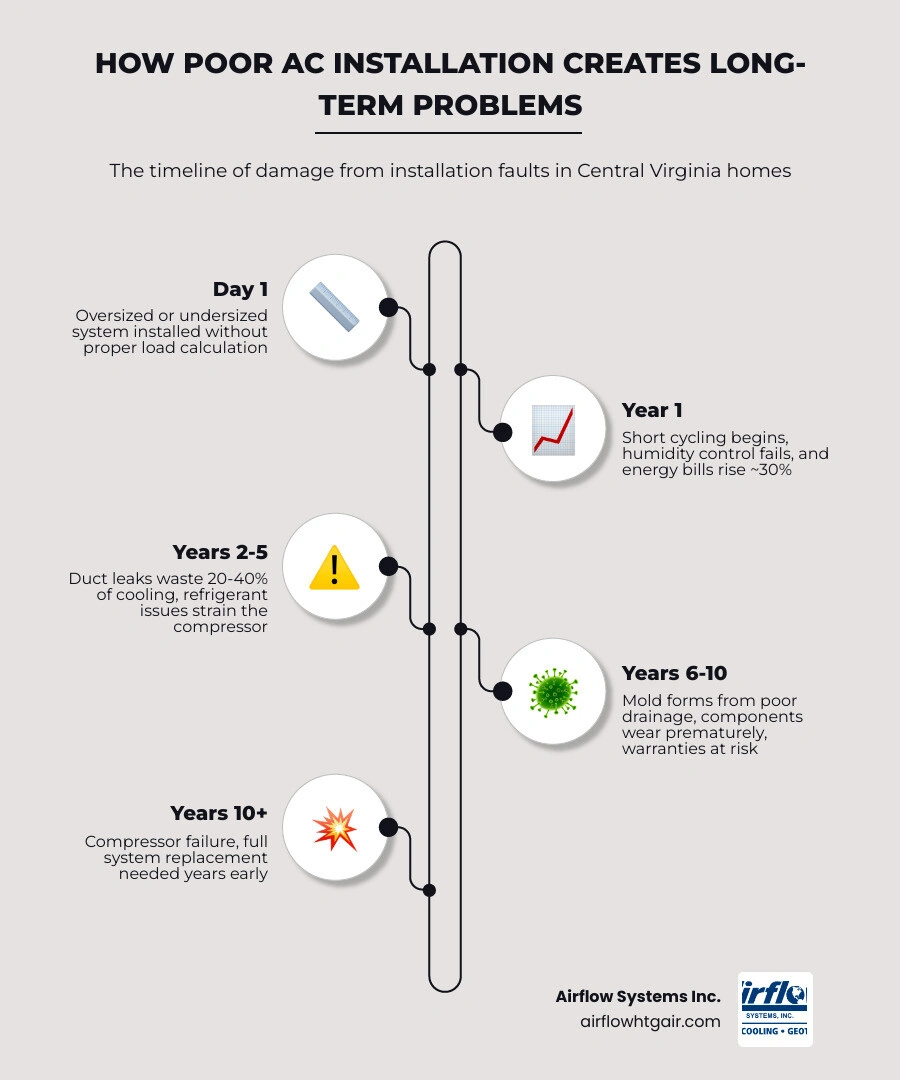
How bad AC installation causes problems for years is something many Central Virginia homeowners discover the hard way — not on day one, but slowly, through rising energy bills, uneven cooling, and repairs that seem to never stop.
Here is a quick summary of the most common long-term consequences:
• Higher energy bills — Installation faults can increase cooling energy use by around 30% on average
• Short cycling — Oversized systems turn on and off too frequently, wearing out components fast
• Poor humidity control — Systems that are too large cool too quickly to remove moisture from the air
• Refrigerant problems — Between 29% and 78% of systems operate undercharged, straining the compressor
• Duct energy loss — Leaky ductwork wastes 20% to 40% of the cooling your system produces
• Mold and water damage — Improper drainage creates conditions for mold growth inside your home
• Shortened lifespan — A properly installed AC should last 15 to 20 years; poor installation can cut that in half
• Voided warranties — Manufacturers can deny claims when installation does not meet their standards
Charlottesville summers are hot and humid, and your AC works hard from May through September. The last thing you want is a system that was set up to fail from day one. The problem is that bad installation rarely announces itself right away. Modern AC units are resilient enough to keep running — just inefficiently and under stress — for years before anything obviously breaks. By the time the compressor fails or the mold shows up in the ductwork, the damage has already been building quietly for a long time.
This guide walks through every major way a poor installation can haunt your home, how to spot the warning signs, and what you can do about it.
The Core Mistakes: How Bad AC Installation Causes Problems for Years
When we discuss how bad ac installation causes problems for years, we are looking at fundamental engineering and physical oversights. A modern central air conditioner is not a plug-and-play appliance. It is a highly complex split system that relies on balanced physics, precise electrical connections, and absolute calibration to deliver the comfort and efficiency promised on its box.
When an installer takes shortcuts, skips essential commissioning steps, or relies on outdated rules of thumb, they introduce installation faults. These faults force your brand-new system to work significantly harder than designed. In fact, industry data shows that common installation faults can increase a household’s cooling energy use by about 30% on average.
This added strain directly degrades the system’s lifespan. Instead of enjoying a reliable, worry-free 15 to 20 years of cooling, homeowners with a poorly installed unit often watch their system decline after just 5 to 8 years. To prevent these long-term headaches, it is crucial to understand what correct, high-quality setup looks like by reviewing a trusted AC Installation Guide before purchasing a new unit.
Sizing Blunders: The Pitfalls of Oversized and Undersized Systems
One of the most frequent and damaging installation errors is improper system sizing. Too many contractors skip the essential step of performing an accurate Manual J load calculation. Instead, they use outdated "rules of thumb" based solely on square footage. This lazy approach commonly results in systems that are 20% to 40% oversized for the homes they are meant to cool.
An oversized air conditioner is a major liability. Because it has too much cooling capacity, it cools your home incredibly fast and then shuts off. This rapid cycle repeats constantly, a phenomenon known as short cycling.
Short cycling causes two massive problems:
1. Severe Humidity Issues: An air conditioner must run continuously for a certain period to lower the temperature of the indoor coils enough to condense and drain moisture from the air. When a system short-cycles, it turns off before it can dehumidify. This leaves your home feeling cold and clammy, creating a prime breeding ground for mold.
2. Premature Component Failure: The startup phase is the most mechanically and electrically demanding part of an AC's operation. Constant starting and stopping places immense wear on the compressor and fan motors, leading to early failure.
Conversely, an undersized system will run continuously without ever reaching your desired thermostat setting during a hot Central Virginia summer afternoon. This constant operation spikes your energy bills and burns out the compressor through sheer exhaustion. If your system is already suffering from these sizing issues, you may need to evaluate When Should You Replace Your Air Conditioner to stop wasting money on constant repairs.
Refrigerant Charging Errors: Undercharged vs. Overcharged Systems
Refrigerant is the lifeblood of your air conditioner. It does not get "used up" like fuel; it circulates in a closed loop, absorbing heat from inside your home and releasing it outdoors. Getting the refrigerant charge exactly right requires precise measurements of temperature and pressure, known as calculating subcooling and superheat.
Unfortunately, many budget installers guess the charge. Industry surveys reveal that between 29% and 78% of systems operate undercharged, while 4% to 50% are overcharged.
• Undercharged Systems: When a system is low on refrigerant from day one, it has to work twice as hard to remove heat. The evaporator coil inside your home will often drop below freezing, causing condensation to turn to ice. This ice blocks airflow, chokes the system, and can lead to a frozen coil. If you notice weak cooling or ice buildup, read about why your AC Not Cooling Properly to diagnose the issue.
• Overcharged Systems: Too much refrigerant is just as dangerous. It leads to incredibly high operating pressures within the system. This can cause liquid slugging, where liquid refrigerant enters the compressor instead of vapor. Since liquids cannot be compressed, this instantly destroys the internal valves of your compressor—the most expensive component in the system.
Hidden Infrastructure Failures: Ductwork and Drainage Issues

While the outdoor condenser and indoor air handler get all the attention, the infrastructure supporting them is just as critical. Poorly designed ductwork and improper drainage are silent killers that can quietly destroy your home and your comfort for years.
When new equipment is connected to old, leaky, or undersized ducts, the system’s static pressure spikes. High static pressure is the HVAC equivalent of high blood pressure; it strains every component, limits airflow, and forces the blower motor to run hot and consume far more electricity.
How bad ac installation causes problems for years through duct leakage
The quality of duct installation is often shockingly low. Research shows that 90% to 100% of homes tested had significant duct leaks needing sealing due to poor installation. When ducts are run through unconditioned spaces like attics or crawlspaces, these leaks are devastating.
A system with leaky ducts can easily suffer from 20% to 40% energy waste. Instead of cooling your living room, your expensive conditioned air is dumped directly into your attic. This massive loss of cooling capacity forces the system to run much longer to keep your home comfortable, compounding wear and tear on the entire unit.
Furthermore, leaky return ducts in crawlspaces or attics will pull dusty, humid, and mold-ridden air directly into your breathing air, bypassing your filters. To understand how restricted airflow and dirt can accelerate this cycle of damage, check out How Dirty Filters Affect AC Performance.
How bad ac installation causes problems for years with poor drainage
During a humid Charlottesville summer, an air conditioner can pull gallons of water out of your indoor air every single day. This moisture collects on the evaporator coil and drips into a condensate drain pan, which must carry the water safely outside via a sloped drain line.
If the installer fails to mount the indoor unit perfectly level, or if they run the condensate drain line with an improper downward slope, water will pool in the pan. This standing water quickly leads to:
• Algae and Mold Growth: Slime builds up and clogs the line, causing the pan to overflow.
• Severe Water Damage: Overflows can ruin drywall, ceilings, and flooring, leading to expensive home repairs.
• Formicary Corrosion: The prolonged presence of moisture and volatile organic compounds (VOCs) in the indoor air can cause microscopic, pinhole leaks in the copper coils of your new AC, letting refrigerant escape over time.
Mechanical and Electrical Stresses That Shorten System Lifespan
A bad installation sets off a chain reaction of physical wear. Because the system is operating outside its designed parameters, individual components are subjected to constant mechanical and electrical stress.
• System Sizing — Properly Installed System: Perfectly matched to home load — Poorly Installed System: Oversized or undersized — Long-Term Consequence: Constant short cycling or non-stop running
• Electrical Connections — Properly Installed System: Torqued to spec; correct wire gauge — Poorly Installed System: Loose terminals; undersized wiring — Long-Term Consequence: Voltage drops, tripped breakers, fire hazards
• Refrigerant Level — Properly Installed System: Exactly matches manufacturer spec — Poorly Installed System: Undercharged or overcharged — Long-Term Consequence: Frozen coils, liquid slugging, compressor failure
• Vibration Control — Properly Installed System: Mounted on level, isolated pads — Poorly Installed System: Unlevel; no vibration isolation — Long-Term Consequence: Cracked copper lines, refrigerant leaks, loose wiring
Electrical hazards are incredibly common when installations are rushed. If wire sizes are mismatched to the circuit breakers, or if electrical connections are not torqued correctly, the system will experience voltage drops. This places extreme stress on the run capacitor and start capacitor, leading to premature capacitor failure and frequent breaker tripping.
Additionally, if the outdoor unit is not mounted on a level, solid pad with proper vibration-isolation mounts, the constant shaking of the compressor will take a toll. Over time, these vibrations can crack the copper refrigerant lines, loosen electrical terminals, and cause annoying structural noises. If you start hearing strange sounds from your system, refer to this guide on an AC Making Strange Noises to find out what they mean.
How Homeowners Can Identify Signs of a Poor Installation
You do not need to be an HVAC expert to spot the red flags of a bad installation. If your system was recently installed—or even if it is a few years old—keep an eye out for these warning signs:
• Uneven Temperatures: One bedroom is freezing while the kitchen remains hot and humid.
• Unusually High Utility Bills: Your energy bills are significantly higher than they were with your old, inefficient system.
• Frequent Short Cycling: The outdoor unit kicks on, runs for 3 to 5 minutes, shuts off, and repeats this loop multiple times an hour.
• Weak Airflow: You can barely feel air coming out of the registers, even when the fan is running on high.
• Rattling, Whistling, or Screaming Noises: These indicate loose ductwork, static pressure issues, or mechanical strain.
• Standing Water: Moisture pooling around the indoor air handler or water dripping from your ceiling.
Recognizing these signs early can save you from a catastrophic system failure down the road. If you suspect your system is underperforming, read about the top Signs Your AC Needs Repair to address the issue before the peak of summer.
Correcting the Damage: Prevention, Repairs, and Replacement
If you are currently living with a poorly installed system, you are not necessarily stuck with a ticking time bomb. In many cases, a team of certified professionals can perform "surgical repairs" to correct the original installer's mistakes.
We can often resolve these issues without replacing the entire system by carrying out:
• Professional Commissioning: Re-evaluating the system's airflow and static pressure.
• Duct Sealing and Modification: Sealing leaks in unconditioned spaces with professional-grade mastic sealant.
• Refrigerant Calibration: Recovering improper refrigerant, vacuuming the lines to 500 microns, and charging the system precisely by weight according to manufacturer specifications.
To prevent these issues from developing in the first place, or to get your current system in the best possible shape for the hot months ahead, follow our guide on How to Prepare Your AC for Summer. Taking proactive steps and consulting a professional AC Tune-Up Guide will help you catch installation errors before they turn into expensive breakdowns. For long-term peace of mind, make sure to read up on How to Extend the Life of Your AC.
Frequently Asked Questions About Poor AC Installation
Can a poorly installed AC unit be fixed without replacing the whole system?
Yes, in many cases. If the system is sized correctly but suffers from leaky ducts, incorrect refrigerant charge, or poor drainage, these can all be fixed through targeted repairs. However, if the unit is severely oversized or undersized, or if the compressor has already suffered major liquid slugging damage, a full replacement is often the only reliable and cost-effective option.
How does improper sizing affect my monthly energy bills?
Improper sizing leads to massive energy waste. An oversized unit draws a huge surge of electricity every time it short-cycles on and off, never reaching its rated efficiency. An undersized unit runs continuously for hours on end, consuming constant power without ever cooling your home. Both scenarios can easily add 20% to 40% to your monthly utility bills.
Why do installation problems often go unnoticed for years?
Modern air conditioners are incredibly resilient machines. They are designed to fight through unfavorable conditions—like high static pressure or low refrigerant—to keep your home cool. The compressor will run hotter and work harder to compensate, masking the underlying installation defects. However, this constant overwork silently degrades the internal components, leading to a sudden, catastrophic failure years before the system should naturally reach the end of its lifespan.
Conclusion
The day your new air conditioner is installed is the most important day in its lifespan. If it is done right, you will enjoy up to two decades of quiet, efficient, and reliable comfort. If it is done wrong, you are signing up for years of high utility bills, persistent humidity issues, and premature system breakdowns.
At Airflow Systems Heating & Air, we bring family-owned values and decades of local expertise to every single home we serve in Charlottesville, VA, and the surrounding Central Virginia areas. We do not believe in shortcuts or rules of thumb. Our certified professionals use precise Manual J calculations, advanced static pressure testing, and meticulous commissioning to ensure your system is set up for a long, highly efficient life.
Keep your system running smoothly year-round by downloading our comprehensive AC Maintenance Checklist.
Ready to experience the difference that a precise, professional installation makes? Schedule professional service with our friendly team today!
Book Expert Service Or Contact Us
Our Service Process
A Hassle-Free Service Experience
01
Consultation & Diagnosis
We start by listening to your needs and performing a thorough diagnosis of your system to recommend the best solution.
02
Transparent Quoting
We provide a clear, upfront estimate with no hidden fees, so you know exactly what to expect.
03
Expert Service & Follow-Up
Our factory-trained technicians complete the work to the highest standards, and we follow up to ensure your complete satisfaction.
testimonials
What Our Customers Are Saying
Our customers consistently praise our exceptional service and attention to detail, making us a trusted choice for all your HVAC needs.
where we operate
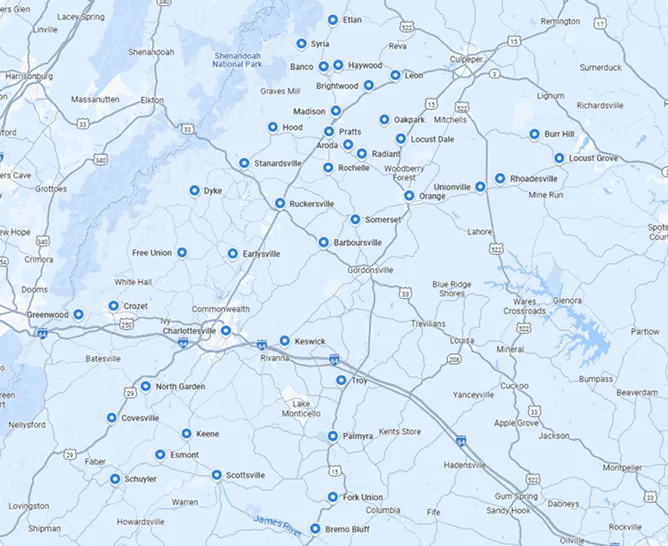
Service areas