

Choose an option to see quick actions and get help faster.

The High Cost of Invisible Air Leaks in the Fall
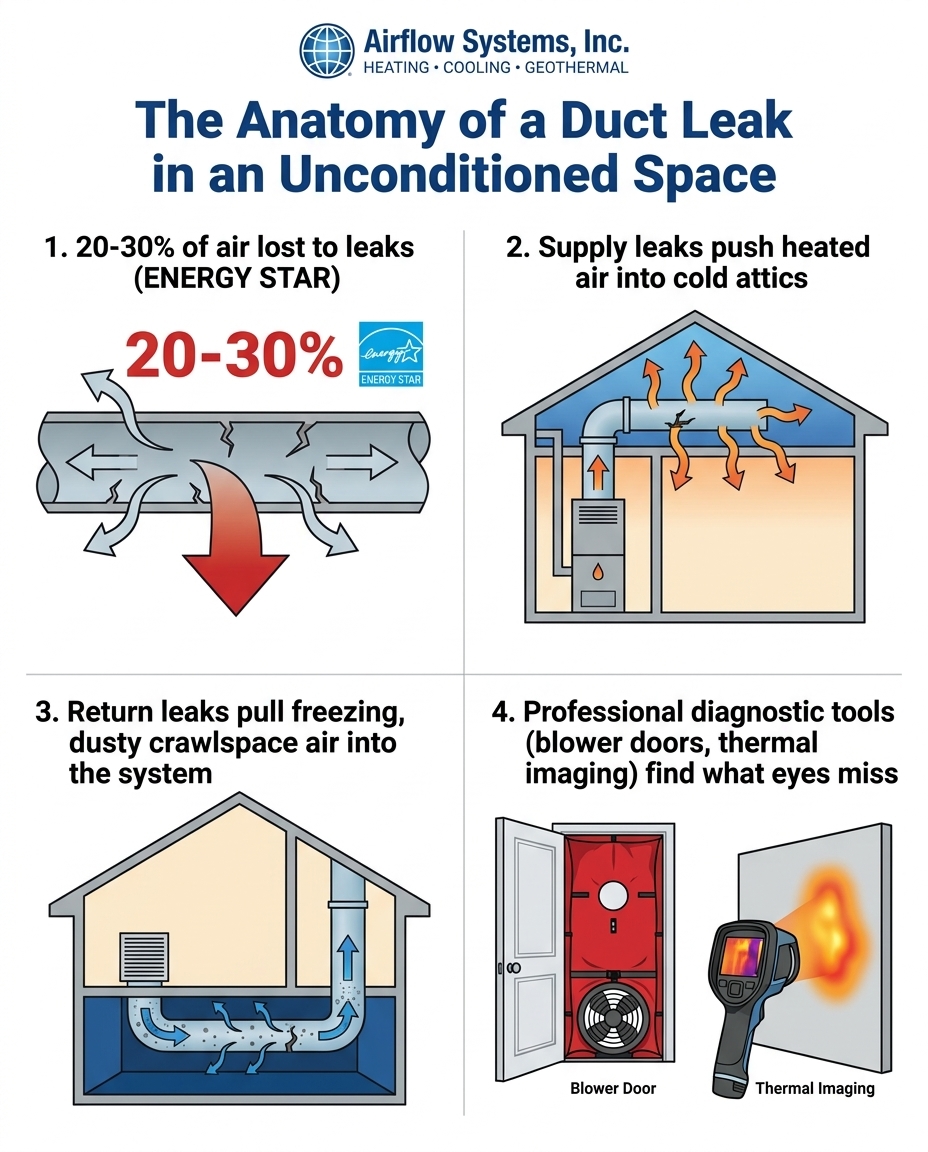
According to ENERGY STAR, up to 20 to 30 percent of the air moving through a typical duct system is lost to leaks, holes, and poor connections. Because of this massive hidden drain on efficiency, checking your ductwork for leaks before the heating season begins is one of the most critical steps a homeowner can take during the September pre-heating transition. At Airflow Systems, Inc., our team sees this hidden efficiency drain firsthand in Charlottesville homes every fall. While you might focus on the furnace itself, the delivery system carrying that warm air is often compromised by unsealed joints, disconnected segments, and degraded materials hidden entirely out of sight.
These unseen vulnerabilities mean your heating system will spend the entire winter working overtime just to maintain basic comfort levels. Unsealed duct joints located in unconditioned attics and crawlspaces allow expensive, newly heated air to escape into the atmosphere before it ever reaches your living room. The decision facing homeowners right now is whether to ignore these invisible energy drains or proactively schedule professional diagnostic testing before switching the thermostat over to heat for the season.
If you want to stop paying to heat your attic, exploring comprehensive heating services and scheduling home energy audits are the most effective ways to secure your home's thermal boundary.
The true cost of neglected ductwork:
• Wasted energy: Your furnace runs longer cycles to compensate for the heated air lost along the way.
• Uneven temperatures: Rooms at the end of the duct run never receive adequate airflow, leaving them perpetually cold.
• System strain: Forcing a blower motor to push air through a compromised system accelerates mechanical wear and tear.
• Drafty conditions: Pressure imbalances caused by leaks actively pull cold outside air into the house through gaps around windows and doors.
The Physics of Heat Loss in Unconditioned Spaces
To understand why duct leaks are so devastating to your comfort, you have to look at where the majority of your ductwork actually lives. In most residential architecture, the metal trunks and flexible tubes carrying your conditioned air run through unconditioned spaces. These are areas like attics, crawlspaces, and unfinished basements that sit outside the home's protective thermal envelope. They are not climate-controlled, meaning their temperatures fluctuate wildly based on the weather outside.
This structural reality turns minor duct flaws into major efficiency disasters. In our years of servicing local HVAC systems, we've seen how Charlottesville's chilly falls and cold winters drastically amplify thermal loss when ducts run through frigid, unconditioned crawlspaces. When the temperature in a crawlspace drops toward freezing, any heated air traveling through a thin, unsealed metal pipe is subjected to intense thermal transfer. The physics of thermodynamics dictate that heat always moves toward cold. Without a perfectly sealed and heavily insulated barrier, your heating system is constantly fighting a losing battle against the freezing environment surrounding the ducts.
For Charlottesville homes with unconditioned crawlspaces, the impact of this heat loss is immediate. The air leaving the furnace might be 120 degrees, but by the time it travels through thirty feet of leaky, poorly insulated ductwork in a freezing environment, it might only be 85 degrees when it reaches the bedroom register. You are essentially paying full price to generate heat that is immediately stolen by the cold air under your floorboards.
Supply Leaks vs. Return Leaks
Not all duct leaks behave the same way. The impact on your home depends entirely on whether the breach is on the supply side (pushing air out) or the return side (pulling air in).
• Supply Side Leaks — Thermodynamic Action: Forces pressurized, newly heated air out of the ductwork and directly into the freezing unconditioned space. — Primary Consequence: Direct energy waste. The furnace heats the outdoors while living spaces remain cold and drafty.
• Return Side Leaks — Thermodynamic Action: Acts like a vacuum, pulling unconditioned, freezing air from the attic or crawlspace into the HVAC system. — Primary Consequence: Drastically lowers the temperature of the air entering the furnace, forcing the heat exchanger to work much harder.
Why Visual DIY Inspections Miss the Biggest Leaks
Homeowners often attempt to inspect their own ductwork with a flashlight, looking for obvious disconnected joints or torn flexible tubing. While spotting a massive, gaping hole is certainly helpful, visual DIY inspections are severely limited. The vast majority of a home's duct system is entirely inaccessible. It is hidden behind finished drywall, routed under heavy flooring, or buried deep beneath thick layers of blown-in fiberglass insulation.
Even when ductwork is fully exposed, the human eye is not equipped to spot the most common culprits of pressure loss. Microscopic gaps, hairline cracks along longitudinal seams, and degraded tape at the connection collars cannot be seen from a few feet away. However, under the intense pressure of a multi-ton blower motor, these tiny imperfections act like high-speed air nozzles, bleeding off massive amounts of heated air.
The limitations of DIY duct inspections:
1. Hidden infrastructure: You cannot seal what you cannot reach, and most critical junctions sit behind framing and drywall.
2. Microscopic pressure drops: Hairline fractures in mastic or tape create severe pressure imbalances that are invisible to the naked eye.
3. Insulation interference: Removing and replacing heavy attic insulation to inspect duct seams often causes more damage to the thermal barrier than it solves.
4. Safety hazards: Crawling through tight, unconditioned spaces exposes homeowners to exposed nails, electrical wiring, pest droppings, and extreme temperatures.
Because these issues are so difficult to detect manually, our technicians at Airflow Systems, Inc. recommend using the September pre-heating transition as a strategic time to book a heating tune-up. Catching these hidden pressure drops before the deep cold sets in ensures your system is evaluated safely and scientifically, rather than relying on guesswork in a dark crawlspace.
The Impact of Leaky Return Ducts on Winter Air Quality
Energy loss is only half the story when it comes to compromised ductwork. The other half involves the air you actually breathe. When return ducts leak in an unconditioned space, they do not push air out; they pull air in. The return side of your HVAC system is under negative pressure, acting like a giant vacuum cleaner for your home. If there is a hole in a return duct running through a crawlspace, that vacuum aggressively pulls the surrounding air directly into your central air stream.
Consider what actually lives in the air of a typical unconditioned space. In our experience servicing Charlottesville homes with unconditioned crawlspaces, we frequently find these environments filled with fine dirt, dormant mold spores, fiberglass insulation particles, and pest dander. When a leaky return duct pulls these contaminants inside, the HVAC blower motor distributes them forcefully through every supply register in the living space. Every single time the heater cycles on, a new wave of crawlspace debris is pumped into your bedrooms and living areas.
The Problem-Cause-Solution cycle of poor winter IAQ:
• The Problem: Homeowners frequently notice a "dusty house" phenomenon or experience an uptick in allergy symptoms as soon as they turn on the heater for the first time in the fall.
• The Cause: Negative pressure from unsealed return joints in the attic or crawlspace is bypassing the air filter and pulling raw, unfiltered debris straight into the ductwork.
• The Solution: Professional indoor air quality testing acts as a critical diagnostic step. By identifying specific particulate matter in the home, our technicians can trace the contamination back to hidden return-side breaches that visual inspections missed.
Professional Diagnostic Testing: Beyond the Basics
Because you cannot fix what you cannot find, professional diagnostic testing is the only reliable way to ensure a fully sealed system. The industry has moved far beyond shining a flashlight at duct seams. Today, securing a home's thermal boundary requires technical expertise and specialized equipment designed to measure exact leakage rates and pinpoint invisible flaws.
One of the primary tools our team uses in this process is a duct blaster test. This diagnostic procedure involves temporarily sealing all the supply and return registers in the home. A calibrated fan is then attached to the central return grille, pressurizing the entire duct system. Connected manometers measure exactly how much air is escaping through hidden leaks. This provides a precise, scientific baseline for system performance, telling our technicians exactly how much efficiency is being lost before they ever crawl under the house.
A consistent pattern of proactive care makes a tremendous difference in catching these issues early. When our technicians maintain a heating system year after year, we track performance baselines, provide valuable advice on duct integrity, and ensure the entire HVAC system is maintained in good working order long before the cold sets in. During the September pre-heating transition, this level of professional diagnostics separates a struggling system from a high-performing one.
The Role of Home Energy Audits
During a comprehensive evaluation, our technicians often deploy thermal imaging cameras to "see" the invisible movement of air. By scanning the walls and ceilings while the system is running, professionals can identify cold air pulling in or warm air escaping behind the drywall. Energy audits evaluate the whole home as a complete, interconnected system. They pinpoint exactly where the thermal envelope is failing, specifically focusing on the ductwork's integrity and how it interacts with the home's insulation and ventilation.
Protecting Your Heating Equipment from Overwork
Duct leakage does not just waste energy; it actively destroys your heating equipment. Your furnace or heat pump is sized to heat a specific volume of air based on the square footage of your home. When twenty percent of that heated air is lost to the attic, the thermostat takes significantly longer to register a change in room temperature. Because the thermostat is not satisfied, it commands the heating equipment to keep running.
This forces the furnace to endure longer, much more frequent cycles. The blower motor runs hotter, the heat exchanger is subjected to prolonged thermal stress, and the internal contactors wear out at an accelerated rate. This immense strain on the mechanical components leads directly to premature wear and tear. A pattern we see often is that what starts as a simple unsealed duct joint in October turns into an unexpected furnace repair in the dead of January when the overworked system finally shuts down.
When winter temperatures drop to minus 5 degrees, an old, inefficient HVAC system forced to overwork due to duct leaks will often fail to maintain comfortable indoor temperatures. In extreme cases, resolving this level of inefficiency requires installing a new heat pump and gas furnace system, which ultimately restores consistent comfort year-round and significantly improves overall energy efficiency. Sealing ducts is not just an efficiency upgrade; it is a vital preventative measure to protect the lifespan of your heating equipment. Based on what we see in the field, for Charlottesville homes with unconditioned crawlspaces, ensuring the ductwork is airtight is the best way to guarantee the furnace survives the toughest winter months without a breakdown.
Frequently Asked Questions About Duct Diagnostics
How do professionals test for duct leaks?
Our professionals use specialized diagnostic tools like duct blasters and thermal imaging cameras to locate invisible leaks. A duct blaster pressurizes the entire system to measure the exact volume of escaping air, providing a scientific baseline of leakage. Thermal imaging then allows technicians to "see" temperature anomalies behind walls, pinpointing exactly where the conditioned air is bleeding into unconditioned spaces.
Why is my house dusty when the heater turns on?
A sudden increase in dust when the heater kicks on usually points to leaks on the return side of your ductwork. Because return ducts operate under negative pressure, gaps in the lines pull dirt, insulation, and mold spores from your attic or crawlspace directly into the air stream. The blower motor then distributes these unfiltered contaminants through the supply vents into your living areas.
Does duct sealing improve heating efficiency?
Yes, sealing your ductwork is one of the most effective ways to improve overall heating efficiency. By preventing heated air from escaping into unconditioned spaces, your furnace doesn't have to run as long to satisfy the thermostat. This reduces mechanical strain, shortens running cycles, and ensures the heat you pay for actually reaches your living room.
Can I seal my own ductwork safely?
While you can visually inspect exposed ductwork in easily accessible areas, comprehensive sealing requires professional tools and training, which is why we highly recommend leaving this to certified technicians. Most ductwork is hidden behind drywall or buried in heavy insulation, and navigating tight, unconditioned crawlspaces presents serious safety hazards. Furthermore, proper sealing requires specialized mastic and diagnostic testing to confirm the pressure drops have been fully resolved.
What are the signs of leaking ductwork in an attic?
The most common signs include uneven temperatures across different rooms, weak airflow from specific vents, and a heating system that runs constantly without warming the house. You might also notice an unusually dusty home or hear whistling sounds when the blower motor is running. If your attic feels suspiciously warm during the winter, it is highly likely that your supply ducts are bleeding heat.
Secure Your Heating Efficiency Before the Deep Cold Sets In
Invisible leaks in unconditioned spaces are the single biggest drain on your home's heating efficiency. When heated air escapes into freezing attics and crawlspaces, your furnace works harder, your indoor air quality suffers, and your living spaces remain uncomfortable. Visual checks simply cannot uncover the microscopic gaps and hidden disconnections that cause the most severe pressure drops.
At Airflow Systems, Inc., we know that a professional home energy audit is the most reliable, scientific way to find and fix these issues safely. By utilizing advanced diagnostic tools, professionals can secure your ductwork and protect your heating equipment from premature failure. Take action during this September pre-heating transition. Schedule a comprehensive inspection now to ensure your system is fully sealed, highly efficient, and ready to deliver consistent comfort before the deep winter cold arrives.
Book Expert Service Or Contact Us
Our Service Process
A Hassle-Free Service Experience
01
Consultation & Diagnosis
We start by listening to your needs and performing a thorough diagnosis of your system to recommend the best solution.
02
Transparent Quoting
We provide a clear, upfront estimate with no hidden fees, so you know exactly what to expect.
03
Expert Service & Follow-Up
Our factory-trained technicians complete the work to the highest standards, and we follow up to ensure your complete satisfaction.
testimonials
What Our Customers Are Saying
Our customers consistently praise our exceptional service and attention to detail, making us a trusted choice for all your HVAC needs.
where we operate
Service areas