

Choose an option to see quick actions and get help faster.
.svg)
The Hidden Logistics of the Fall Transition
The transition from late summer to crisp autumn weather happens fast, which is exactly why September is the strategic time to book a heating tune-up. Before the leaves fully change, you have a brief window to prepare your home's heating system without the stress of an impending cold front. The concrete problem our team at Airflow Systems sees every year is homeowners discovering a failing furnace during the first October freeze in Charlottesville, resulting in days of waiting in a freezing house due to sudden regional demand spikes. The decision point is clear: you can secure your spot now when schedules are completely flexible, or you can wait for the inevitable emergency rush to dictate your comfort.
For the most reliable heating services, enrolling in a preventative maintenance plan early in the fall is the smartest move you can make.
Homeowners often wait until they feel that first undeniable chill in the living room to walk over and switch their thermostats from cooling to heating. While this seems like a natural response to the changing seasons, it creates a massive logistical bottleneck behind the scenes. When thousands of households turn on their furnaces for the first time on the exact same morning, a predictable percentage of those systems will fail to ignite. This leads to a sudden, overwhelming regional surge in emergency calls that instantly books up every available technician in the area.
Waiting for a breakdown means entering a vicious, reactive cycle of delayed service times and cold nights. The dispatch reality is that once the first October freeze hits, HVAC companies are forced into triage mode. Routine calls are pushed back, and homeowners with completely dead systems are prioritized. Even then, wait times stretch from hours into days. A strategic September tune-up bypasses this chaos entirely, ensuring your system is optimized, tested, and proven reliable long before the weather dictates the timeline.
Proactive maintenance is the true cornerstone of reliable winter comfort. By having a professional evaluate your system while the weather is still mild, you are taking control of your home's infrastructure. Enrolling in a preventative maintenance plan in the early fall does more than just clean your equipment; it secures your priority status. When you are already on our books and your system has been cleared for winter, you avoid the panic of the peak rush and enter the colder months with absolute confidence in your equipment.
Understanding the Narrow 'Shoulder Season' Advantage
In the HVAC industry, the "shoulder season" is the brief, highly valuable period between the heavy summer air conditioning use and the demanding winter heating months. In our years serving Charlottesville and Central Virginia, we've learned firsthand that the rapid transition from late-summer heat to freezing October nights creates a remarkably narrow window for optimal servicing. This fleeting period is when our HVAC operations shift from handling emergency summer cooling repairs to executing proactive winter preparation.
During this timeframe, the daily operations of a local heating company change dramatically. Booking your service in September guarantees highly flexible scheduling. Instead of taking whatever emergency slot is left on a Tuesday afternoon, you can choose a convenient appointment time that actually fits your work and family schedule. Our technicians also experience a shift in their daily pacing. With fewer emergency calls on the board, they have more time to perform thorough, unhurried diagnostics before their daily routing becomes packed with no-heat emergencies.
The Shift in Technician Routing
To truly understand the shoulder season advantage, you have to look at how dispatch boards operate. Emergency no-heat calls automatically take precedence over routine maintenance once freezing temperatures arrive. If a family has no heat during a freeze, our dispatchers must reroute technicians to handle that immediate safety concern. By booking early, you keep your system off the emergency triage list entirely.
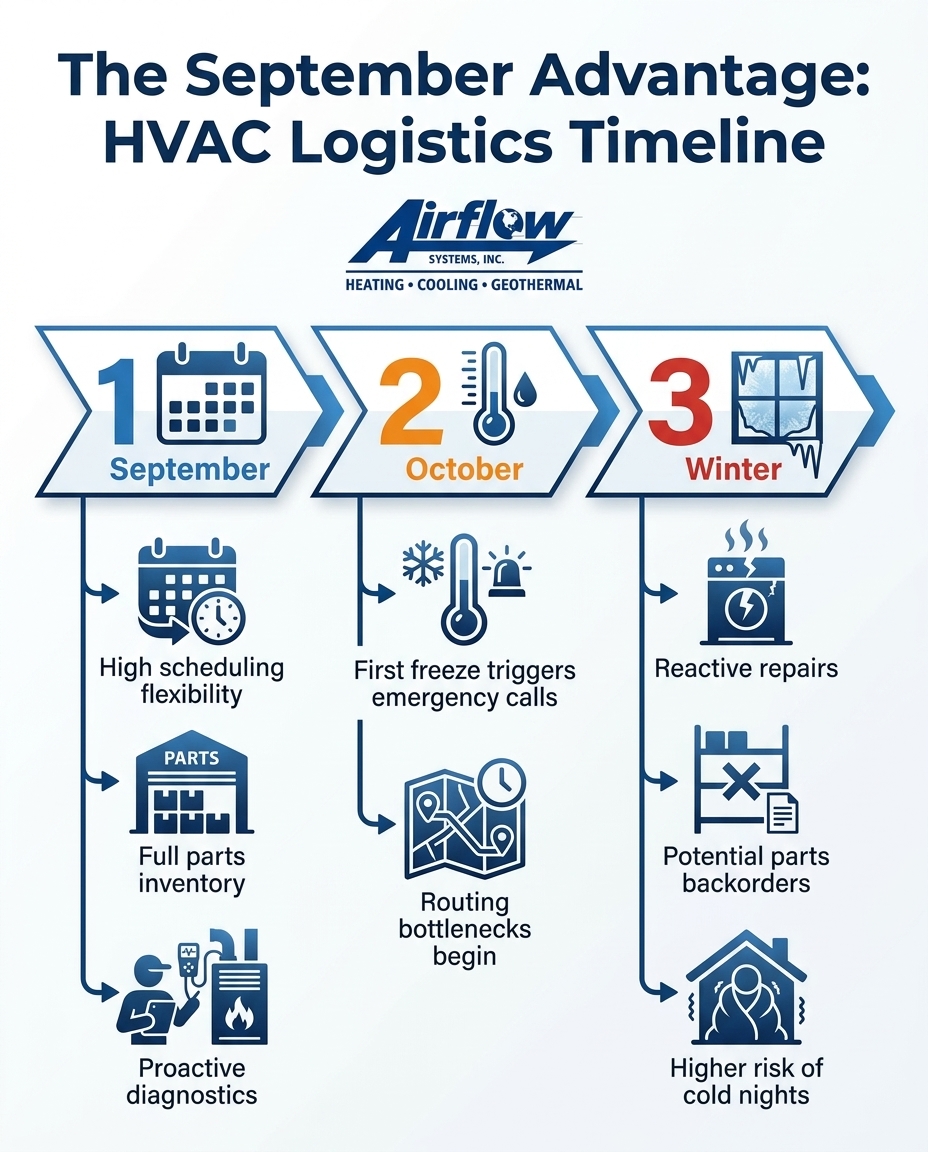
• September (Shoulder Season) — Technician Availability: High flexibility, preferred time slots available — System Focus: Proactive diagnostics, deep cleaning, and calibration — Homeowner Experience: Stress-free, convenient, and controlled
• October (First Freeze) — Technician Availability: Limited availability, triage routing begins — System Focus: Reactive repairs, fixing failed startups — Homeowner Experience: Anxious, waiting on parts, potential cold nights
• Winter (Peak Demand) — Technician Availability: Emergency scheduling only, long wait times — System Focus: Critical component replacement, system rescues — Homeowner Experience: Disruptive, uncomfortable, and urgent
Taking advantage of the shoulder season means recognizing that weather patterns in Central Virginia do not gently ease into winter. The drop in temperature is often sudden and sharp. Utilizing this brief September window ensures your equipment is fully prepared for that abrupt shift.
The Supply Chain Reality: OEM Parts and Winter Backorders
The Problem: Modern heating systems are highly sophisticated pieces of machinery that rely on specific Original Equipment Manufacturer (OEM) parts to operate safely and efficiently. Generic parts simply do not cut it for high-efficiency furnaces and advanced heat pumps. When the first October freeze hits, local supply houses experience an immediate, massive run on common replacement components. Items like ignitors, flame sensors, draft inducer motors, and control boards fly off the shelves as technicians across the region scramble to fix failing systems.
The Cause: Supply chains operate on predictable algorithms, but unpredictable weather spikes drain local inventories instantly. Waiting until a system fails mid-winter often results in days of waiting for backordered parts to arrive from regional hubs or national manufacturers. During these delays, your home remains cold, and your family remains uncomfortable. National chains often struggle with these sudden localized bottlenecks due to rigid corporate purchasing procedures.
The Solution: Discovering a failing component in September changes the entire dynamic. It allows our technicians to order and install the necessary part while regional inventory is still fully stocked. Proactive diagnostics can identify a weakening capacitor or a failing blower motor long before it requires a full emergency response.
This is where local agility makes a massive difference. One recent spring, a Charlottesville customer was pressed for time due to a strict real estate contract and needed an immediate HVAC solution for a small apartment. Because of our agile local supply chain, the Airflow Systems team was able to discuss options, recommend a minisplit system, and install it incredibly quickly to meet their deadline. That same local agility is what allows us to secure warranty parts for a furnace repair fast, navigating the supply chain long before the peak winter rush overwhelms larger national competitors.
Strategic System Diagnostics: Beyond the Basic Checklist
A true strategic tune-up is far more than a simple visual inspection or a quick filter change. It is a comprehensive operational reset designed to restore your equipment to factory specifications. This level of technical depth aligns directly with Department of Energy guidelines for reducing seasonal energy waste and preventing premature equipment failure in Charlottesville and Central Virginia.
Consistent, professional maintenance is proven to prevent major breakdowns. For instance, a local customer who recently scheduled their regular bi-annual check-up had our technicians perform a thorough diagnostic sweep, resulting in a system that is kept in excellent working order year-round based on our experienced team's advice.
Here is what our strategic diagnostic process actually entails:
1. Electrical Draw Analysis: Technicians measure the voltage and amperage of all moving parts. A blower motor drawing too many amps is working too hard, usually due to friction or dirt, indicating it may fail soon.
2. Thermostat Calibration: Ensuring the thermostat accurately reads the room temperature prevents the system from short-cycling, which wastes energy and wears down components.
3. Heat Exchanger Inspection: Professionals rigorously inspect the heat exchanger for micro-fractures. Even a hairline crack can compromise system integrity and safety.
4. Refrigerant and Defrost Checks: For homes utilizing a heat pump system, the transition from cooling to heating mode requires specific refrigerant pressure checks and testing of the electronic defrost cycle to prevent outdoor coil freeze-ups.
5. Airflow Optimization: Addressing friction in motors and replacing restrictive, clogged air filters immediately improves airflow, reducing unnecessary strain on the entire equipment profile.
Efficiency and Energy Consumption
Systems that bypass fall maintenance can lose up to 5% of their operating efficiency right out of the gate due to dirt buildup, loose electrical connections, and miscalibration. Over a long winter, that lost efficiency forces the unit to run longer cycles to achieve the same indoor temperature. Restoring factory specifications through a September tune-up ensures the unit uses the absolute minimum amount of energy required to heat your home effectively, and may even help your system qualify for generic local utility incentive programs by maintaining peak performance standards.
Pre-Season Safety and Indoor Air Quality Checks
Beyond efficiency and logistics, the most critical element of a fall tune-up is safety. Combustion safety is paramount. Gas and oil furnaces require rigorous, professional checks to ensure the heat exchanger is completely intact and that the system is venting exhaust gases properly. Carbon monoxide leaks are a primary concern during the first startup of the season after months of dormancy. Professional testing mitigates this risk entirely, ensuring that combustion gases are safely directed outside your home.
Additionally, the transition to winter means closing windows and sealing your home tightly against the cold. The sealed home effect traps whatever is circulating in your ductwork inside your living spaces. Lingering dust, pet dander, and microbial growth from summer cooling condensation can easily be blown into your rooms the moment the furnace kicks on during that first October freeze.
A comprehensive tune-up involves cleaning the internal components—such as the blower wheel, burners, and cabinet interior. Removing this accumulated debris directly supports better indoor air quality during heating season. When your system is clean on the inside, the air it pushes into your bedrooms and living areas is cleaner, healthier, and free of the burning dust smell that our technicians so often encounter in neglected furnaces.
Securing Your Spot Before the Frost Arrives: Why September is the Strategic Time to Book a Heating Tune-Up
The window for stress-free, flexible scheduling closes rapidly as September ends. Taking action now ensures your system is optimized, safe, and ready to perform flawlessly when the temperature inevitably plummets. You have the opportunity to bypass the supply chain bottlenecks, secure your preferred appointment time, and enjoy the peace of mind that comes from knowing your home is prepared.
Don't wait for the inevitable emergency rush during the first October freeze to dictate your home's comfort. Reach out to Airflow Systems today to secure your spot on the schedule. By choosing to book a heating tune-up in September, you are making a strategic decision that protects your equipment, lowers your energy waste, and guarantees a warm, comfortable winter season for your entire household.
Frequently Asked Questions
Why is fall the best time for furnace maintenance?
Fall is the ideal time because it falls in the HVAC shoulder season, offering flexible scheduling before the winter rush. Our team at Airflow Systems always recommends booking in the fall because it allows our technicians to thoroughly clean, inspect, and calibrate your system before you actually need to rely on it for daily warmth. This proactive approach catches minor wear and tear before it escalates into a major breakdown during freezing weather.
How long does it take to get furnace parts during winter?
During peak winter months, securing specific OEM parts can take anywhere from a few days to over a week depending on regional supply chain backorders. When extreme cold hits, supply houses sell out of common replacement components like ignitors and blower motors rapidly. Identifying a failing part during a fall tune-up allows your technician to source and install the component while warehouse inventories are still fully stocked.
Why are HVAC schedules so busy in October?
October schedules fill up instantly because the first regional freeze triggers a massive wave of emergency no-heat calls. Thousands of homeowners turn on their systems for the first time on the same morning, and a predictable percentage of those systems fail to start. This sudden surge forces local HVAC companies into emergency triage, pushing routine maintenance appointments further down the calendar.
What happens if I skip my annual furnace tune-up?
Skipping your annual tune-up leads to a steady decline in energy efficiency and a significantly higher risk of mid-season breakdowns. Dirt buildup on internal components forces the system to work harder, increasing wear on moving parts and raising your monthly energy consumption. Furthermore, bypassing professional safety checks leaves you vulnerable to undetected issues like cracked heat exchangers or venting failures.
Is a furnace tune up worth it?
Yes, a comprehensive furnace tune-up is one of the most cost-effective ways to protect your heating investment. The process restores lost efficiency, ensures safe combustion, and extends the overall lifespan of the equipment. Catching a small electrical issue or a failing motor early prevents the severe stress and expense of an emergency replacement in the dead of winter.
How does 'shoulder season' scheduling benefit homeowners?
Scheduling during the shoulder season gives homeowners total control over their appointment times and ensures a stress-free experience. Because our technicians are not rushing between freezing emergencies, they can take their time performing deep diagnostics and unhurried calibrations. It shifts the entire service experience from a reactive, urgent panic to a calm, proactive preparation.
Book Expert Service Or Contact Us
Our Service Process
A Hassle-Free Service Experience
01
Consultation & Diagnosis
We start by listening to your needs and performing a thorough diagnosis of your system to recommend the best solution.
02
Transparent Quoting
We provide a clear, upfront estimate with no hidden fees, so you know exactly what to expect.
03
Expert Service & Follow-Up
Our factory-trained technicians complete the work to the highest standards, and we follow up to ensure your complete satisfaction.
testimonials
What Our Customers Are Saying
Our customers consistently praise our exceptional service and attention to detail, making us a trusted choice for all your HVAC needs.
where we operate
Service areas