

Choose an option to see quick actions and get help faster.
.svg)
Surviving a Late-Summer Cooling Crisis: When Your Ductless System Fails
The late August Virginia heatwave has officially set in, leaving many homeowners asking: Why Is My Mini Split Blowing Warm Air During a Heatwave? It is 4 p.m. on the hottest day of the month, the sun is beating down on your roof, and instead of a refreshing breeze, your indoor air handler is pushing out tepid, unconditioned air. This sudden loss of cooling is incredibly frustrating, especially when you rely on your system to provide a sanctuary from the sweltering outdoor temperatures.
By the time late summer arrives, your mini split systems have likely been running at maximum capacity for several consecutive months. This prolonged, heavy usage exposes underlying wear and tear that might have gone unnoticed during the milder spring months. Components are fatigued, filters have collected weeks of dust, and the system is working harder than ever to reject heat from your home.
When this breakdown happens, you face an immediate decision point: determining whether the warm air is caused by a simple, safe homeowner fix or a complex technical failure that requires a licensed professional. Knowing the difference between the two can save you hours of discomfort and prevent accidental damage to your equipment.
While there are several safe checks you can perform right now, opening the unit to test electrical wiring or handle refrigerant is extremely dangerous. This guide will walk you through exactly what you can safely inspect and when it is time to step back and call for emergency backup.
The Impact of Intense Humidity on End-of-Season Ductless Performance
Living in the Charlottesville area means dealing with a humid subtropical climate that puts unique stress on air conditioning equipment. Your ductless system is not just lowering the temperature of your home; it is also working as a high-capacity dehumidifier. This dual responsibility takes a massive toll on the equipment by the end of the season.
To understand why your system might suddenly struggle, it helps to look at the two types of heat your mini split battles every day:
• Sensible Heat — What It Is: The actual temperature you read on a thermometer (e.g., 95°F). — How It Strains Your Mini Split: Forces the compressor to run longer cycles to reach your target indoor temperature.
• Latent Heat — What It Is: The heat energy trapped in airborne moisture (humidity). — How It Strains Your Mini Split: Forces the indoor coil to extract gallons of water, maximizing wear on the condensate drainage system.
Months of continuous moisture removal accelerate blockages in your condensate drain line. As the indoor coil sweats, dust and airborne particles mix with the moisture, creating a sludge that slowly restricts the drain. By the end of August, that drain line is often completely clogged.
Many modern ductless units are equipped with safety switches. If water backs up in the drain pan because of a clog, the switch automatically shuts down the cooling function to prevent water damage to your drywall. The fan will continue to run, which means you will suddenly feel warm air blowing from the unit. What seems like an abrupt mechanical failure is frequently just the climax of weeks of cumulative environmental stress.
Safe Homeowner Checks: Remote Settings and Airflow Restrictions
Before you panic about a major system failure during a late August Virginia heatwave, there are a few safe, immediate troubleshooting steps you should take. Often, the solution is much simpler than it appears.
1. Verify Your Remote Control Settings
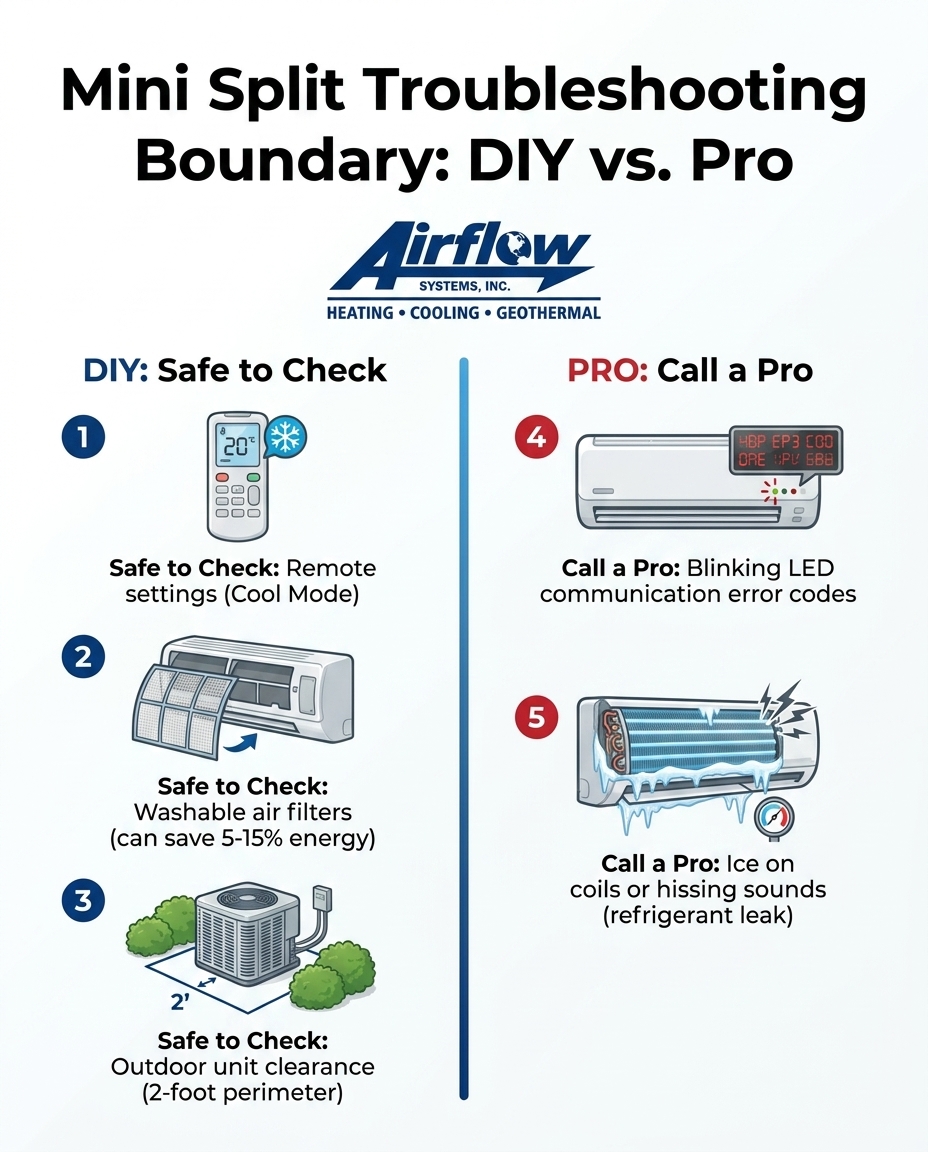
It sounds too simple to be true, but accidental remote control changes are one of the most common reasons a mini split blows warm air. Ensure your remote is actually set to "Cool" mode (usually indicated by a snowflake icon). If the system was accidentally bumped into "Fan Only" or "Heat" mode (often a sun icon), the unit will circulate air without cooling it. Additionally, check that the "Auto" mode isn't fighting against a sudden temperature spike by running the fan without engaging the compressor.
2. Inspect and Clean the Air Filters
The air filters in your indoor air handler are the primary defense against dust and debris. If they become severely clogged, they restrict airflow so drastically that the system cannot pull enough warm room air over the cold evaporator coils. The result is poor cooling performance and warm air blowing from the vents.
According to the U.S. Department of Energy, cleaning or replacing a clogged filter can lower an air conditioner's energy consumption by 5% to 15%. Here is how to safely check yours:
• Power down the unit: Always turn the system off using the remote before opening the front panel.
• Lift the cover: Gently lift the front panel of the indoor wall unit until it clicks into the open position.
• Remove the filters: Slide the reusable mesh filters out of their tracks.
• Clean gently: Wash the filters with warm water and mild soap. Let them dry completely before reinstalling them.
If you have recently checked these basic items and the system still struggles, knowing what to check when your AC isn't cooling properly can help you decide your next move.
The Hidden Culprit: Indoor and Outdoor Unit Communication Errors
Unlike traditional central air conditioning systems, ductless mini splits rely on highly advanced inverter technology. This means the indoor air handler and the outdoor compressor are in constant digital conversation. They use electrical communication cables to send signals back and forth, adjusting fan speeds and refrigerant flow in real-time to match the exact cooling demand of your room.
When communication errors between indoor and outdoor units occur, the entire cooling process halts immediately. The indoor fan may continue to push air, but because the outdoor compressor isn't receiving the signal to activate, the air blowing into your room will be warm.
Warning Signs of a Communication Failure
You can usually identify a communication error by looking at the front of your indoor unit. Watch for these indicators:
• Blinking LED lights: The indicator lights on the front panel will flash in a specific, repeating sequence (e.g., three short blinks followed by a pause).
• Error codes on the remote: Some advanced remotes or smart thermostats will display an alphanumeric error code.
• Unresponsive controls: The unit may refuse to accept new commands from the remote or beep continuously when a button is pressed.
The strict boundary: This is where DIY troubleshooting must stop. A disrupted signal can be caused by power surges, degraded wiring, or a failing control board. Homeowners must never attempt to test, splice, or repair high-voltage electrical communication lines. This work requires specialized diagnostic meters and a licensed professional to ensure the system is repaired safely and up to code.
Refrigerant Leaks and Frozen Evaporator Coils
Another major reason your ductless system might be blowing warm air is a lack of refrigerant. It is a common misconception that air conditioners "use up" refrigerant over time. In reality, mini splits operate on a closed-loop system. If the refrigerant level is low, it means there is a physical leak somewhere in the copper lines, the flare connections, or the coils.
When refrigerant levels drop, the pressure inside the system changes. This causes the temperature of the indoor evaporator coil to plummet below freezing. The ambient humidity in the room then condenses on the freezing coil and turns to solid ice. Eventually, this ice block completely suffocates the airflow. The system can no longer absorb heat from your home, and the air coming out of the vents turns warm.
One customer recently reached out to us when their air handler suddenly stopped cooling entirely. After a quick inspection, we figured out the problem was a leaking coil in the air handler. We repaired the issue as soon as the replacement part arrived, restoring their home's comfort within a couple of days.
Signs You Have a Refrigerant Leak
• Hissing or bubbling noises: Listen closely to the indoor unit and the outdoor refrigerant lines for faint sounds of escaping gas.
• Ice buildup: Check the copper lines connecting to the outdoor unit; if they are encased in ice, you likely have a leak.
• Sweet, chemical smells: Refrigerant sometimes emits a faint, sweet odor when leaking into a closed room.
Handling refrigerant is strictly regulated by the EPA. It requires specialized recovery equipment, licensing, and training. Never attempt to add refrigerant or seal a leak yourself.
Clearing the Outdoor Condenser of Summer Debris
Your mini split is a heat transfer machine. The indoor unit absorbs the heat from your living space, and the outdoor unit (the condenser) releases that heat into the outside air. If the outdoor unit cannot "breathe," it cannot release the heat. The heat remains trapped in the refrigerant cycle, and the system ends up blowing warm air right back into your house.
By late summer, the outdoor condenser has likely been exposed to months of severe weather, lawn maintenance, and overgrown vegetation. Blockages are incredibly common and severely impact performance.
Safe Outdoor Clearance Checklist:
• Establish a two-foot perimeter: Ensure there is at least 24 inches of clear space on all sides of the outdoor unit. Trim back any bushes, tall grass, or overgrown weeds.
• Remove storm debris: Clear away leaves, twigs, and branches that may have blown against the unit during heavy summer thunderstorms.
• Check for grass clippings: Lawn mowers frequently spray wet grass clippings directly onto the condenser fins, creating a dense, suffocating mat as they dry.
• Inspect the fan grille: Make sure nothing has fallen inside the top of the unit that could obstruct the fan blade.
A critical warning: Never use a high-pressure power washer to clean the outdoor unit. The aluminum fins on the condenser coil are paper-thin and highly delicate. High-pressure water will instantly flatten the fins, permanently destroying the unit's ability to transfer heat and requiring a costly coil replacement.
When to Stop Troubleshooting and Call a Local Professional
If you have verified your remote settings, washed the indoor air filters, and cleared the debris from your outdoor unit, but your system is still blowing warm air, you have reached the limit of safe homeowner troubleshooting. Persistent warm air points to complex mechanical, electrical, or chemical failures that require professional diagnostics.
Ignoring the issue or attempting to force the system to run while it is struggling can cause catastrophic damage to the compressor. During extreme heat, attempting DIY electrical or refrigerant repairs is not just risky for your equipment—it is dangerous for your personal safety.
This is where local expertise matters. As an independent Charlottesville HVAC company, Airflow Systems provides rapid response for emergency repairs when heatwaves strike. We understand that you cannot afford to wait days for a technician to arrive. During a recent summer heatwave, a homeowner called us with an AC problem that left their house sweltering. We found and corrected the issue quickly, resolving other underlying problems caused by the original installer, and had their home cooling again the very same day.
To avoid these mid-summer emergencies in the future, proactive care is essential. Enrolling in a comprehensive HVAC maintenance plan ensures that your system is professionally cleaned, calibrated, and inspected long before the peak heat of the Charlottesville area arrives.
Frequently Asked Questions About Mini Split Cooling Failures
Why is my mini split running but not cooling?
A mini split that runs but doesn't cool is typically suffering from restricted airflow or a lack of heat transfer. The fan continues to blow, but because of a severely dirty filter, a blocked outdoor condenser, or low refrigerant, the air is never actually conditioned. Always check your remote settings and clean your reusable filters first before calling a technician to investigate further.
What causes a mini split communication error?
Communication errors occur when the electrical signal between the indoor air handler and outdoor compressor is interrupted. This breakdown can be caused by severe power surges, damaged wiring between the units, or a failing electronic control board. Because this involves high-voltage components and complex digital signals, it always requires professional electrical diagnostics to repair safely.
How do you reset a mini split?
To perform a hard reset, turn off the unit via the remote, then switch off the dedicated circuit breaker in your home's electrical panel for 15 to 30 minutes. This allows the internal computer boards to fully discharge and reset. Turn the breaker back on and power up the unit; if the error code or warm air persists, professional repair is needed.
Why is my AC blowing warm air all of a sudden?
Sudden warm air usually points to a flipped reversing valve, a sudden and severe refrigerant leak, or a tripped breaker on the outdoor unit while the indoor fan continues to run. If the outdoor compressor loses power but the indoor unit stays on, it will simply circulate the warm air currently in your room. Stop running the system to prevent compressor damage and schedule a professional inspection.
Do mini splits need to be recharged?
Mini splits operate on a closed refrigerant loop and never need to be "recharged" unless there is a physical leak in the system. Refrigerant is not a fuel that gets consumed over time. Adding refrigerant without locating and permanently fixing the underlying leak is a temporary, expensive, and environmentally harmful patch.
Can extreme Virginia humidity cause my mini split to stop cooling?
Yes, excessive humidity forces the system to extract massive amounts of moisture from the air, which can easily overwhelm a clogged condensate drain line. Many modern ductless systems have internal safety switches that completely shut down the cooling function if water begins to back up in the drain pan. This prevents indoor flooding, but results in the unit blowing warm, unconditioned air.
Restore Your Home's Comfort Fast
Facing a cooling failure during a late August Virginia heatwave is incredibly stressful, but knowing what to check safely gives you immediate peace of mind. By ruling out simple issues like remote settings, clogged filters, and outdoor debris, you can take control of your home's comfort without risking your safety or your equipment.
However, if your system is suffering from a refrigerant leak or a complex communication error, ignoring the problem will only lead to more extensive damage. When you need rapid, reliable solutions, reaching out for emergency AC repair ensures that a local professional can diagnose the true cause of the warm air and get your ductless system back online safely and efficiently.
Book Expert Service Or Contact Us
Our Service Process
A Hassle-Free Service Experience
01
Consultation & Diagnosis
We start by listening to your needs and performing a thorough diagnosis of your system to recommend the best solution.
02
Transparent Quoting
We provide a clear, upfront estimate with no hidden fees, so you know exactly what to expect.
03
Expert Service & Follow-Up
Our factory-trained technicians complete the work to the highest standards, and we follow up to ensure your complete satisfaction.
testimonials
What Our Customers Are Saying
Our customers consistently praise our exceptional service and attention to detail, making us a trusted choice for all your HVAC needs.
where we operate
Service areas