

Choose an option to see quick actions and get help faster.
.svg)
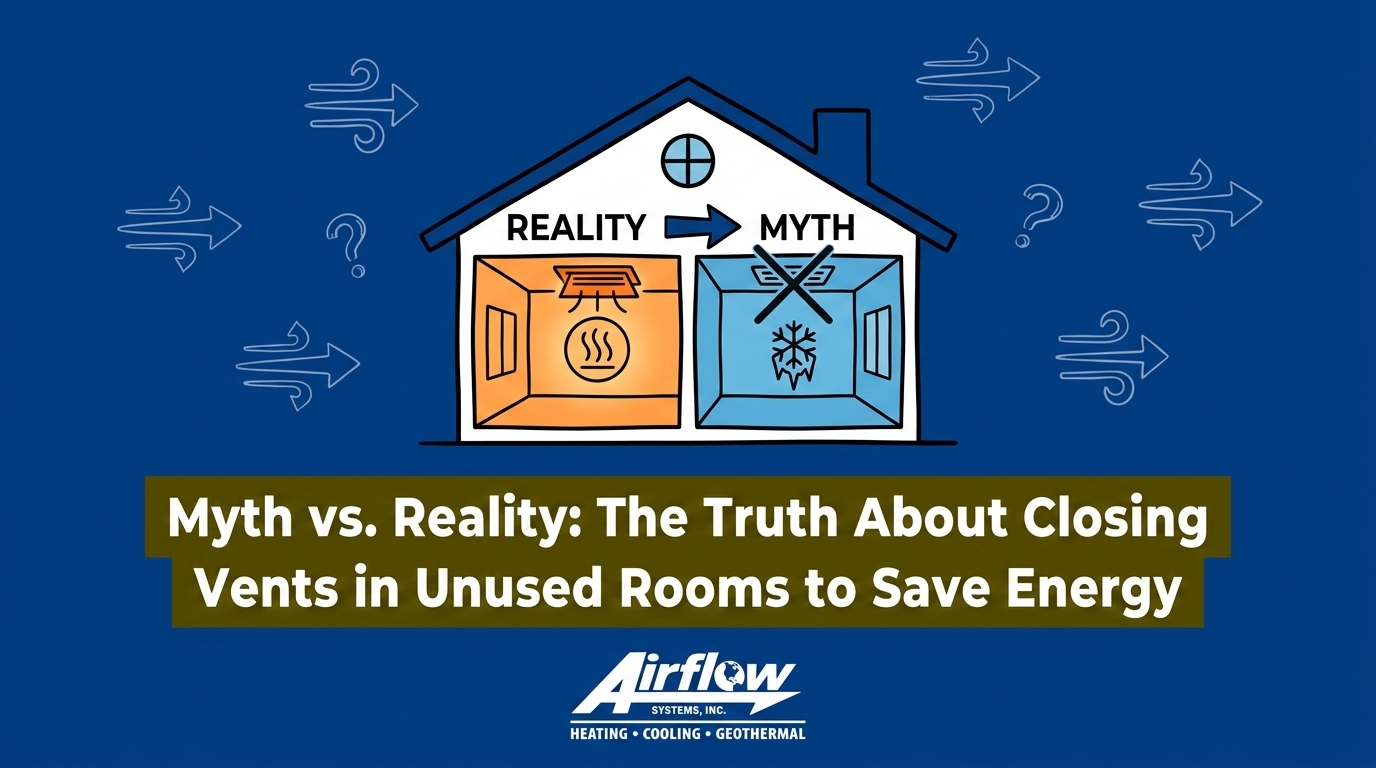
The Late-Summer Temptation to Shut AC Registers
As utility bills climb this August and the back-to-school transition begins, our technicians at Airflow Systems, Inc. frequently hear the same question from Charlottesville homeowners: why pay to push cold air into an empty guest room? The truth about closing vents in unused rooms to save energy is that this well-intentioned habit actually forces your equipment to work harder and consume more power. We see many homeowners apply basic logic to their HVAC systems: if a room is unoccupied, shutting the register should redirect that cold air to the living room and reduce the overall cooling load. Unfortunately, modern cooling systems do not operate like light switches.
Your central air conditioning functions as a precisely balanced loop. The indoor blower motor is sized to push a highly specific volume of air through a specific number of open registers. When you walk through your home and shut the louvers in the spare bedroom, the dining room, or the office, you do not reduce the amount of air the equipment produces. The system still generates the exact same volume of conditioned air, but now it has fewer avenues to deliver it.
During the peak of August late-summer cooling, this disruption creates a severe bottleneck. The trapped air pushes back against the equipment, disrupting the carefully engineered balance of the entire duct network. Instead of lowering your monthly energy statement, this restriction places immense strain on your blower motor, accelerates wear and tear on moving parts, and sets the stage for an end-of-season mechanical failure.
Understanding the Physics of System Static Pressure
The core problem: To understand why shutting registers damages your equipment, you must understand system static pressure. In simple terms, static pressure is the physical resistance to airflow within your ductwork. Every HVAC unit is designed to operate within a very narrow window of acceptable resistance.
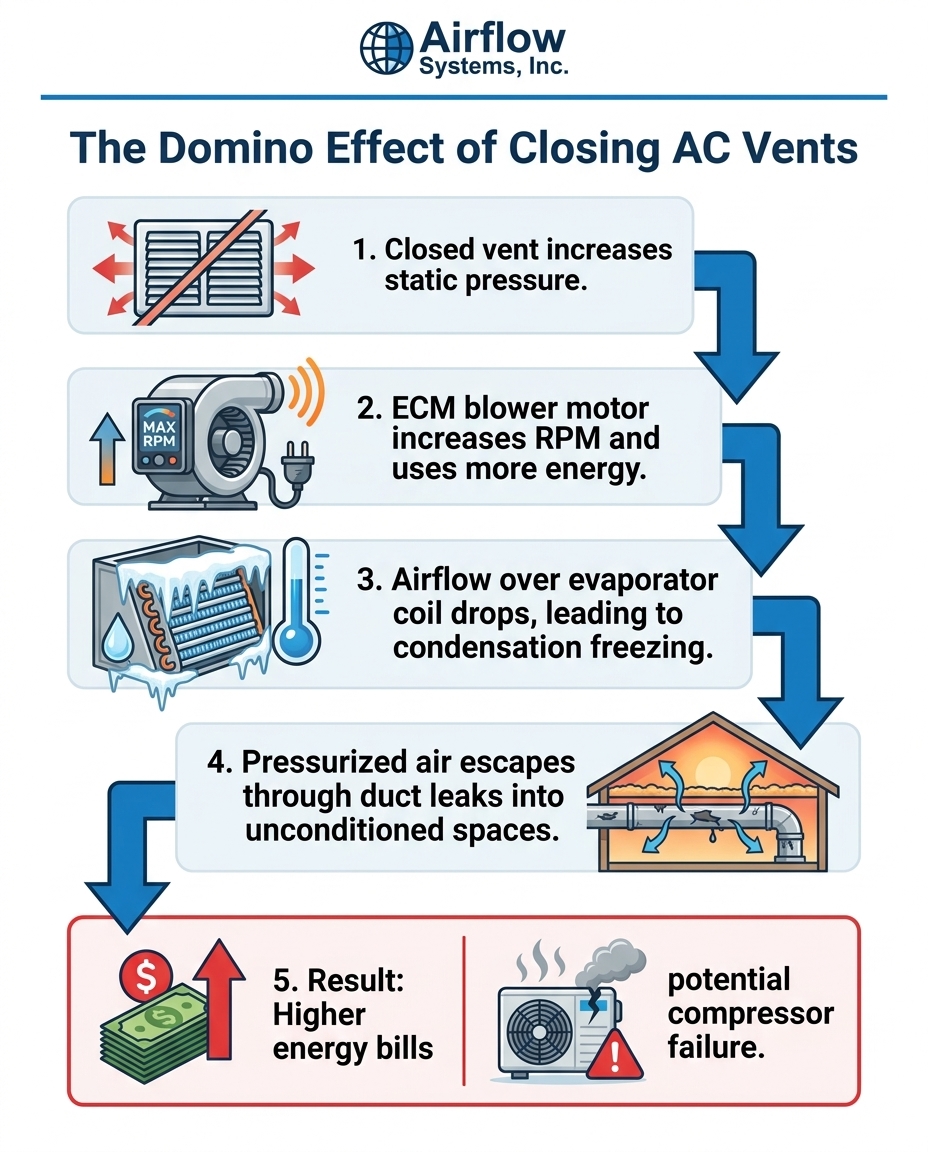
When your system was originally installed, technicians calculated the total volume of air required to cool your home and sized the ductwork and registers to handle that specific capacity. The blower motor expects a clear, unobstructed path to push the conditioned air into your living spaces and pull warm air back through the return grilles. Shutting a register immediately alters this mathematical equation. The air has nowhere to go, so it backs up inside the metal or flex ducting, causing the system static pressure to spike well beyond safe operating limits.
In our years serving the Charlottesville area, we've seen that if you ignore this rising resistance, the continuous strain will eventually compromise the blower motor, often resulting in a frantic call for our AC repair services during the hottest week of the year.
The Garden Hose Analogy
The easiest way to visualize system static pressure is to think about a standard garden hose. If you turn on the spigot, water flows freely out of the open end. The pump at the municipal water station is generating a specific amount of flow, and the open hose allows it to escape without issue.
If you place your thumb over half of the hose opening, the water does not stop flowing from the source. Instead, the pressure behind your thumb increases dramatically. The water sprays out faster and harder because the same volume is trying to escape through a much smaller exit. In your HVAC system, shutting a vent is exactly like putting your thumb over the hose. The blower motor continues to push the full volume of air, but the restricted exits cause the internal pressure to skyrocket, forcing the motor to fight against its own trapped air.
How Modern ECM Blowers React to Closed Vents
The technology shift: The negative impact of high system static pressure is even more pronounced in homes equipped with modern, high-efficiency blower motors. Historically, older HVAC systems used Permanent Split Capacitor (PSC) motors. These older motors operated at a single, fixed speed. If you closed a vent and increased the pressure, a PSC motor would simply push less air, resulting in poor cooling performance but relatively stable electricity usage.
Today, most modern systems utilize Electronically Commutated Motors (ECM). These variable-speed motors are essentially smart devices programmed to maintain a specific volume of airflow (measured in cubic feet per minute, or CFM) regardless of the conditions inside the ductwork.
• Older PSC Motor — Reaction to Closed Vents (High Static Pressure): Airflow drops significantly; home feels warmer. — Energy Consumption Impact: Remains flat, but cooling efficiency plummets.
• Modern ECM Blower — Reaction to Closed Vents (High Static Pressure): Detects resistance and automatically ramps up RPM to force air through. — Energy Consumption Impact: Spikes dramatically as the motor works harder.
When you close vents in an attempt to save energy, the ECM blower immediately senses the increased resistance. Because it is programmed to deliver a set amount of air, the motor automatically ramps up its RPM to try and push through the blockage. The irony is staggering: by trying to conserve energy in an unused room, you actually force your high-efficiency blower motor to run at maximum capacity, consuming significantly more electricity in the process.
Our team frequently finds that this continuous, high-RPM operation is a primary cause of premature motor failure. The cumulative wear and tear of fighting high static pressure all season long frequently results in blower motors burning out just as the August late-summer cooling demand reaches its peak.
The Risk of Frozen Evaporator Coils in Humid Climates
The chain reaction: High system static pressure does not just damage the blower motor; it also threatens the heart of your cooling process. Your air conditioning system relies on an indoor evaporator coil to absorb heat and extract humidity from the air inside your home. For this heat exchange to happen safely, a massive volume of warm indoor air must constantly flow over the freezing-cold refrigerant lines inside the coil.
Because hot, humid summers regularly dominate our Charlottesville climate, our team regularly responds to calls where systems have worked overtime to pull heavy moisture out of the indoor air. This dehumidification process creates a significant amount of condensation on the evaporator coil. Under normal conditions, the high volume of warm air passing over the coil keeps the metal just above the freezing point, allowing the condensation to drip safely into the drain pan.
When you close registers, you drastically reduce the volume of warm air reaching the coil. Without that constant supply of heat, the temperature of the coil drops rapidly. The condensation sitting on the metal freezes into solid ice. Within a matter of hours, this ice can encase the entire coil, blocking airflow completely and sending liquid refrigerant backward into the outdoor compressor.
Running a system with a frozen coil is incredibly dangerous for the equipment. It can cause the compressor—the most expensive component in your entire system—to permanently fail, turning a misguided attempt to save energy into a catastrophic breakdown.
Duct Leakage and the Hidden Costs of Restricted Airflow
The path of least resistance: Even if your blower motor survives the strain and your coil avoids freezing, closing vents still wastes energy by exacerbating duct leakage. According to studies conducted by the Department of Energy and the Lawrence Berkeley National Laboratory (LBNL), shutting registers significantly increases the amount of conditioned air lost to unconditioned spaces.
Air under high system static pressure will always seek the path of least resistance. Residential ductwork is rarely airtight; it contains tiny gaps, microscopic seams, and unsealed joints where sections of metal or flex duct connect. Under normal operating pressure, the amount of air lost through these minor imperfections is negligible. However, when you close vents and pressurize the ductwork, you force the trapped cold air out through every available crack.
Instead of cooling your living room, that expensive, conditioned air is pushed into your scorching attic, your humid crawlspace, or the hollow cavities inside your walls. You end up paying to air-condition areas of your home that you never even walk into. To prevent this massive energy waste, we always tell our customers that keeping your AC vents and registers clear and fully open is absolutely critical for maintaining the intended airflow paths.
Why Proper Airflow is the Foundation of Home Comfort
The balancing act: HVAC systems are engineered as complete, balanced loops. The supply side that pushes cold air out must remain in perfect equilibrium with the return side that pulls warm air back in. Ignoring these fundamental airflow principles almost always leads to complex, cascading malfunctions during the hottest months of the year.
For our team at Airflow Systems, Inc., proper airflow and system balance are not just secondary concepts—they are the absolute core of our namesake expertise and the primary key to equipment longevity. When we diagnose any cooling issue, we always start by verifying that the system can breathe properly. If the equipment is suffocating, no amount of refrigerant or new parts will solve the underlying problem.
Recently, a Charlottesville homeowner reached out to us during peak summer heat when their AC began malfunctioning. Upon inspection, our technician Shannon found that the root cause was not just a simple failed component, but severe underlying airflow and installation issues left behind by the original installer. Once those pressure imbalances were corrected and the system was allowed to move air freely, the equipment stabilized, the home cooled down evenly, and the cascading problems were permanently resolved.
Safe Alternatives to Closing Vents for Energy Efficiency
The right way to save: You do not have to choose between high energy bills and a damaged HVAC system. Our technicians recommend several actionable, safe ways to reduce your energy consumption without elevating your system static pressure or risking a mid-summer breakdown.
1. Adjust the overall thermostat: Instead of isolating specific rooms, utilize a smart thermostat to raise the temperature of the entire house by two or three degrees while you are away. This reduces the total workload on the compressor safely and evenly.
2. Upgrade your thermal envelope: The best way to use less AC is to keep the heat out in the first place. Adding insulation to your attic, sealing drafty windows, and applying weatherstripping to exterior doors will reduce the overall thermal load on your house.
3. Schedule a professional evaluation: If certain rooms are constantly too hot or too cold, the issue is likely inadequate insulation or poorly designed ductwork. Professional home energy audits can pinpoint exactly where your home is losing efficiency so you can address the root cause.
4. Invest in true zoning systems: If you truly want individual temperature control for different areas of your home, a professional zoning system is the answer. These systems use automated dampers within the ductwork, paired with bypass ducts that safely relieve excess static pressure, allowing you to direct air only where it is needed without destroying the blower motor. Local utility incentive programs or federal tax credits may even apply to qualifying high-efficiency zoning or heat pump upgrades, so it is always worth verifying current programs with your utility provider.
Maintaining HVAC System Balance Year-Round
The long-term strategy: Keeping your system's airflow and static pressure within safe parameters requires ongoing attention. Even if all your vents are wide open, a severely clogged air filter or a failing fan capacitor can restrict airflow just as dangerously as a closed register.
Regular check-ups ensure that your blower motor is operating at the correct voltage and RPM, and that your system static pressure remains balanced. Our technicians verify that return grilles are unobstructed, supply registers are properly adjusted, and the evaporator coil is clean enough to allow air to pass through freely. Long-term system health relies entirely on consistent, expert oversight to catch these minor airflow restrictions before they trigger catastrophic failures.
In fact, one of our local customers has relied on our technician Shannon for nearly eight years of bi-annual check-ups. By consistently monitoring the system's breathing capacity and performing routine HVAC maintenance, the equipment has remained in top condition, avoiding the major breakdowns that plague systems suffering from neglected airflow.
FAQ
Does closing AC vents save money?
No, closing vents does not lower your cooling costs and often increases them. Modern variable-speed blowers will actually consume more electricity as they work harder to push air against the increased resistance. Additionally, the trapped air is frequently forced out through leaks in your ductwork, wasting energy on unconditioned spaces.
Why do evaporator coils freeze when vents are closed?
Evaporator coils freeze because they require a constant, heavy flow of warm indoor air to keep the condensation on the metal from dropping below the freezing point. When you close vents, you choke off this vital supply of warm air. The temperature of the coil drops rapidly, turning the normal condensation into a solid block of ice.
What happens to system static pressure when you close registers?
System static pressure spikes dangerously high when registers are closed. The HVAC system continues to generate the exact same volume of air, but with fewer escape routes, that air backs up inside the ductwork. This high pressure forces the blower motor to strain against a wall of trapped air.
Can closing vents damage my AC compressor?
Yes, severely restricted airflow can permanently damage your compressor. If the lack of airflow causes the indoor evaporator coil to freeze over, the refrigerant cannot absorb heat properly. This can cause liquid refrigerant to flow backward into the outdoor compressor, a condition known as liquid slugging, which destroys the unit.
How do I safely redirect air to hotter rooms?
The safest method is to install a true, professionally designed HVAC zoning system. Zoning systems use automated dampers and specialized bypass ducts that safely manage internal pressure while directing air to specific rooms. Simply shutting standard vents cannot replicate this process safely.
Is it safe to close vents in a room with the door shut?
No, shutting the door and closing the vents in an isolated room is actually a worst-case scenario for your HVAC system. It severely disrupts the return air pathways and spikes static pressure simultaneously. If you must keep a door shut, ensure the vents remain fully open so the room can breathe.
Keeping Your System Breathing Easy
Restricting your system's airflow during the August late-summer cooling season is a guaranteed way to increase equipment strain and risk a major breakdown. By leaving your vents open and maintaining proper system balance, you protect your blower motor and ensure consistent comfort. When you are ready to evaluate your home's true efficiency, scheduling a professional assessment with our team is the safest first step.
Book Expert Service Or Contact Us
Our Service Process
A Hassle-Free Service Experience
01
Consultation & Diagnosis
We start by listening to your needs and performing a thorough diagnosis of your system to recommend the best solution.
02
Transparent Quoting
We provide a clear, upfront estimate with no hidden fees, so you know exactly what to expect.
03
Expert Service & Follow-Up
Our factory-trained technicians complete the work to the highest standards, and we follow up to ensure your complete satisfaction.
testimonials
What Our Customers Are Saying
Our customers consistently praise our exceptional service and attention to detail, making us a trusted choice for all your HVAC needs.
where we operate
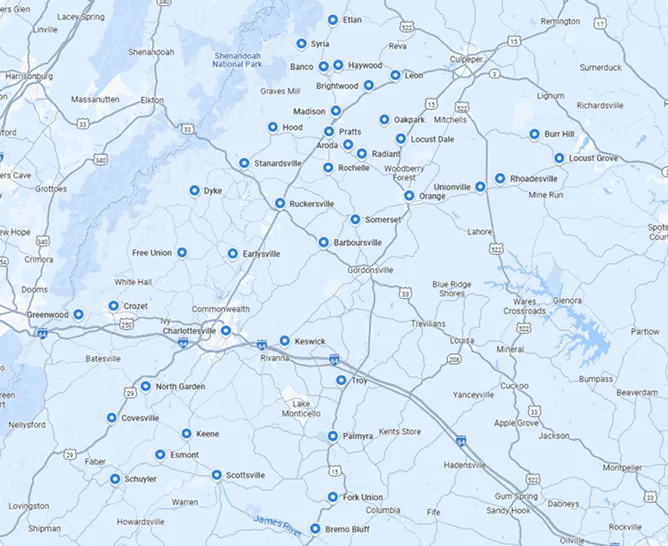
Service areas