

Choose an option to see quick actions and get help faster.

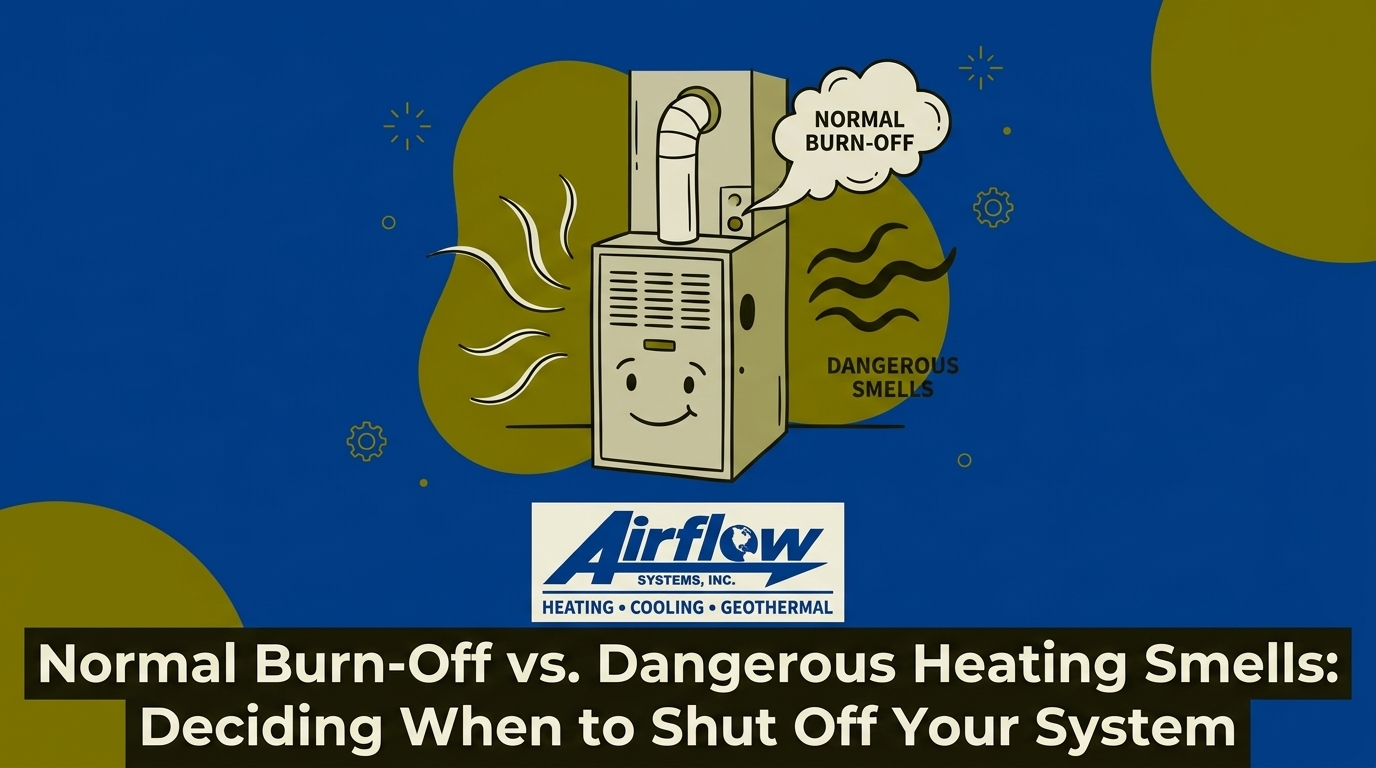
Why Does My Heater Smell Like Burning on the First Chilly Night?
Is your furnace supposed to smell like that, or is something seriously wrong? For our technicians at Airflow Systems, Inc., one of the most common homeowner questions answered during the fall season revolves around strange, alarming odors coming from the air vents. You switch your thermostat from cooling to heating, wait for the warm air to circulate, and suddenly, the distinct scent of something burning fills your living room. It is a moment that immediately triggers panic for many families.
During the typical October first-freeze heating startup, this sudden odor introduces a critical decision point. You have to determine whether this is a harmless seasonal occurrence or a dangerous electrical issue that requires you to shut off the system immediately. Making the wrong call can either lead to an unnecessary and expensive emergency service visit, or worse, put your home at risk of an electrical fire.
While traditional ducted furnaces almost always experience some level of this seasonal symptom, a pattern we see often is that homeowners who upgrade to a Mini Split avoid large-scale central dust burn-off entirely. For those still relying on central heating, understanding exactly what is happening inside your ductwork and heat exchanger is the first step to keeping your home safe and comfortable as the temperatures drop.
The Anatomy of the First-Freeze Burning Smell
To demystify that alarming odor, you need to look at what happens to your heating equipment during the long months of summer inactivity. Your furnace does not sit in a sterile vacuum. Even in the cleanest homes, the air circulating through your ductwork carries microscopic particles every single day.
The role of local climate: Here in Charlottesville and the surrounding Blue Ridge foothills, our team sees firsthand how our long, hot, and highly humid summers create a prolonged idle period for your heating elements. This high humidity makes the internal components of your furnace slightly sticky. Over the course of four to six months, household dust, pet dander, pollen, and airborne debris settle directly onto the cold furnace heat exchanger and heat strips. The moisture in the summer air acts like a light adhesive, trapping a surprisingly thick layer of dust on these vital components long before fall arrives.
When the first cold front hits and you finally switch the thermostat to heat, the furnace ignites. The heat exchanger rapidly climbs to temperatures exceeding 140 degrees Fahrenheit. This initial ignition literally incinerates the settled layer of debris. The smell filling your home is the airborne byproduct of that dust instantly burning away.
A Standard Mechanical Process
You can rest easy knowing that this initial combustion is a standard mechanical process for central heating systems. Because the heat exchanger must get extremely hot to warm the air passing over it, any organic matter resting on its surface will inevitably burn. The dust essentially turns to ash and gets pushed out through your supply vents. While the scent is unpleasant and highly noticeable, we always assure our customers that it is a normal byproduct of your system doing exactly what it was designed to do after a long summer slumber.
The 30-Minute Rule: Identifying Normal Dust Burn-Off
If you are standing in your hallway sniffing the air, you need a clear, calming timeframe to determine if your system is operating safely. When local homeowners call us in a panic, our team always shares the golden rule for harmless heating odors: they should naturally dissipate within 15 to 30 minutes (normal burn-off duration). Knowing what to look for—and smell for—can save you a lot of anxiety.
1. Evaluate the specific scent profile: Normal dust burn-off has a very distinct smell. It smells like a hot, dusty radiator or a space heater that has just been pulled out of the closet. It smells dry and stale, but it should never smell sharp, chemical, or metallic.
2. Note the exact time of ignition: Look at the clock the moment you turn the heat on and notice the smell. The 15 to 30 minutes (normal burn-off duration) starts immediately. The odor will peak in the first five minutes and then steadily decline as the dust is completely incinerated.
3. Ventilate the immediate area: To help clear the initial indoor air, temporarily open a few windows or doors. Turning on ceiling fans can also help disperse the harmless smoke and odor faster, keeping your indoor air quality comfortable while the system clears its throat.
4. Monitor the system continuously: Do not turn the heater on and leave the house to run errands. Stay nearby and monitor the vents. If the smell is steadily fading as the 30-minute mark approaches, your system is experiencing a safe, routine burn-off.
If the smell disappears completely after the first cycle or two, your heat exchanger is clean, and your system is ready for the winter workload. No further action is required on your part.
Red Flag Odors: Electrical Ozone and Melting Plastic
While burning dust is harmless, other odors demand immediate action. You must be able to clearly contrast harmless dust with dangerous odors that indicate an active mechanical failure. If you detect these red flag scents during your October first-freeze heating startup, your system is not safe to run.
Sharp, acrid smells: If your vents smell like burning plastic, melting rubber, or electrical ozone, you have a problem. Ozone often smells like a lightning storm, a model train set, or burning wires. Melting plastic has a harsh, fishy, or chemical scent that burns the back of your throat. These are not organic materials burning off; these are synthetic components physically melting or short-circuiting inside the cabinet.
Common mechanical failures: In our years of servicing local heating systems, we've found these dangerous odors usually indicate a failing blower motor, frayed wiring that is arcing against the metal casing, or a cracked heat exchanger. A cracked heat exchanger is particularly dangerous because it can allow carbon monoxide to mix with your breathing air. Furthermore, lingering electrical issues from heavy summer Air Conditioning use can sometimes compound over time. A blower motor that was overworked in August might finally burn out its bearings or wiring during the very first heating cycle of the fall.
The required action: These odors do not dissipate over time; they usually get worse the longer the system runs. If you smell electrical ozone or melting plastic, walk to your thermostat and shut off the system immediately. Do not wait for the 30-minute mark. Once the system is powered down, contact a professional to inspect the internal wiring and motors before you attempt to heat your home again.
Side-by-Side Comparison: Safe Burn-Off vs. Immediate Danger
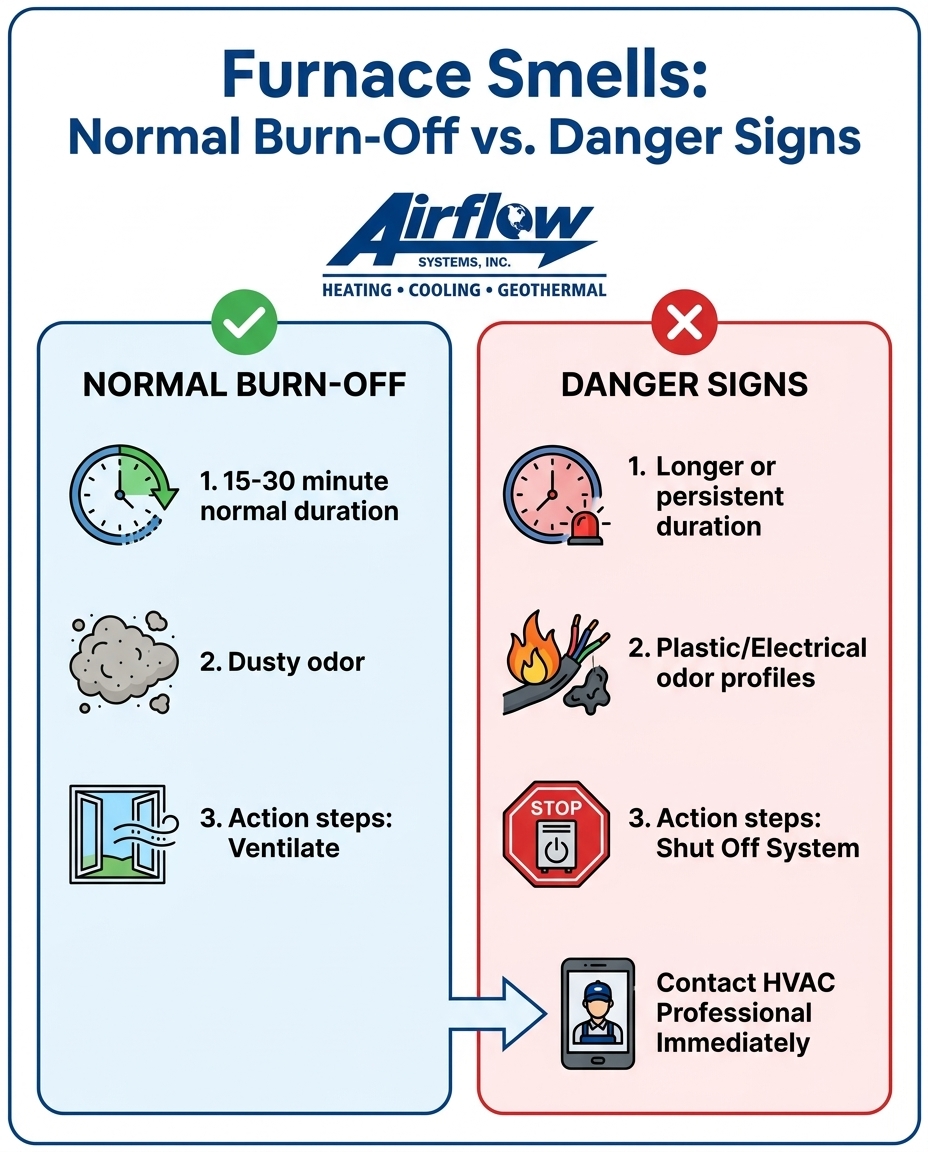
When you are worried about the safety of your home, having a quick-reference triage tool can help you make an objective decision. Use this table to rapidly assess the situation and determine your next steps.
• Odor Profile — Safe Dust Burn-Off: Dusty, dry, smells like a hot radiator or old space heater. — Dangerous Malfunction: Acrid, chemical, metallic, fishy, or smells like burning rubber/plastic.
• Duration — Safe Dust Burn-Off: Fades quickly, completely gone within 15 to 30 minutes (normal burn-off duration). — Dangerous Malfunction: Persists, intensifies, or returns every single time the system cycles on.
• Visual Signs — Safe Dust Burn-Off: None. The air remains clear despite the strong scent. — Dangerous Malfunction: Visible smoke from vents, or flickering lights when the unit kicks on.
• Required Action — Safe Dust Burn-Off: Wait it out, open a window to ventilate, and monitor the time. — Dangerous Malfunction: Shut down the system at the thermostat immediately and call for a professional inspection.
Mini Split vs. Window Unit: Safer Alternatives for Supplemental Heat
If you have rooms that your central furnace struggles to reach, you might be looking for supplemental heating options as the weather cools. When comparing temporary fixes to permanent upgrades, it is important to consider safety, indoor air quality, and the avoidance of extreme startup smells.
Why Window Units Struggle in Fall
Many homeowners turn to window units with built-in heat strips for tricky rooms. However, these units often collect massive amounts of outdoor debris, leaves, and moisture over the summer. When you turn on a window unit's heat function in the fall, the burning smell can be severe, and the unit itself can pose a safety hazard if debris has accumulated near the heating elements. Additionally, the poor sealing around window units allows cold fall drafts and pests directly into the home. The inefficient heat strips inside these units also cause sharp spikes in energy use, making them costly to run during a cold Charlottesville and surrounding Blue Ridge foothills winter.
The Ductless Advantage
Compare this to ductless heat pumps, which offer cleaner, more consistent heating without relying on a massive, dust-covered central heat exchanger or exposed window-unit heat strips. Ductless systems utilize advanced internal filtration that prevents heavy dust buildup on the internal heating coils. Because they transfer heat rather than generating it through combustion or raw electrical resistance, you enjoy smooth, quiet operation without the alarming seasonal burn-off smells.
As an independent, local HVAC company, our team at Airflow Systems provides honest, localized advice on whether it makes sense to repair a smelly, aging central unit or upgrade to a ductless system, rather than pushing one-size-fits-all fixes. Choosing a permanent ductless solution over a temporary window unit provides superior moisture control and efficiency. If you are wondering which areas of your home would benefit most from this clean heating approach, evaluating the best rooms for a mini split system can help you plan a safer, more comfortable winter layout.
Make the Right Call for Your Fall Comfort and Safety
Navigating the transition from cooling to heating does not have to be a stressful experience. By understanding the difference between harmless dust incineration and dangerous electrical warning signs, you can confidently manage your home's climate. Remember to use your senses: a dry, dusty smell that fades within 15 to 30 minutes (normal burn-off duration) is standard, while any acrid, plastic, or ozone odors require an immediate system shutdown.
If you are ever in doubt about the safety of your equipment, scheduling a professional pre-winter inspection with our technicians is always the safest choice. A thorough check can catch frayed wires and cracked heat exchangers before they become emergencies. Whether you need a standard tune-up for your central furnace or you are ready to explore clean, odor-free heating with Mini Split Systems, ensuring your equipment is clean and professionally vetted will give you total peace of mind all season long.
Frequently Asked Questions
How long does the burning smell last when you turn on the heater?
The smell should completely dissipate within 15 to 30 minutes of the first heating cycle. This brief window allows the system to incinerate any dust that settled on the heat exchanger over the summer. If the odor persists beyond this timeframe, it may indicate a mechanical issue rather than normal dust burn-off.
Why does my heater smell like burning plastic?
A burning plastic smell typically indicates a dangerous electrical failure, such as melting wire insulation, a failing capacitor, or a seized blower motor. Unlike dust, synthetic materials do not burn off harmlessly and will continue to melt as the system runs. You should shut off your heater immediately if you detect this scent.
When should I turn off my furnace due to a smell?
You should turn off your furnace immediately if the smell resembles electrical ozone, burning rubber, melting plastic, or a metallic chemical scent. You should also shut it down if a dusty burning smell lasts longer than 30 minutes or is accompanied by visible smoke. Always prioritize safety and call a professional if you suspect an electrical short.
Can a furnace catch on fire from dust?
While standard household dust burning off the heat exchanger is a normal, safe process that will not cause a fire, massive accumulations of debris inside the cabinet can be hazardous. If a furnace is severely neglected and combustible materials (like lint or pet hair) build up near the burners or electrical components, the risk of a localized fire increases. Routine maintenance prevents this dangerous buildup.
Is it normal for a heat pump to smell like burning?
Yes, it can be normal for a heat pump to produce a brief burning smell when the auxiliary or emergency heat strips activate for the first time in cold weather. These electric coils gather dust during the summer just like a gas furnace heat exchanger does. The smell should still fade within 30 minutes once the coils are clean.
What should I do if the burning smell lasts longer than an hour?
If the burning smell persists for more than an hour, turn off the heating system at your thermostat right away. A lingering odor means the source of the smell is not a finite layer of dust, but an ongoing mechanical or electrical malfunction. Keep the system off and contact a licensed HVAC technician to diagnose the problem.
Book Expert Service Or Contact Us
Our Service Process
A Hassle-Free Service Experience
01
Consultation & Diagnosis
We start by listening to your needs and performing a thorough diagnosis of your system to recommend the best solution.
02
Transparent Quoting
We provide a clear, upfront estimate with no hidden fees, so you know exactly what to expect.
03
Expert Service & Follow-Up
Our factory-trained technicians complete the work to the highest standards, and we follow up to ensure your complete satisfaction.
testimonials
What Our Customers Are Saying
Our customers consistently praise our exceptional service and attention to detail, making us a trusted choice for all your HVAC needs.
where we operate
Service areas