

Choose an option to see quick actions and get help faster.
.svg)
The Hidden Danger in the Hardware Store Aisle
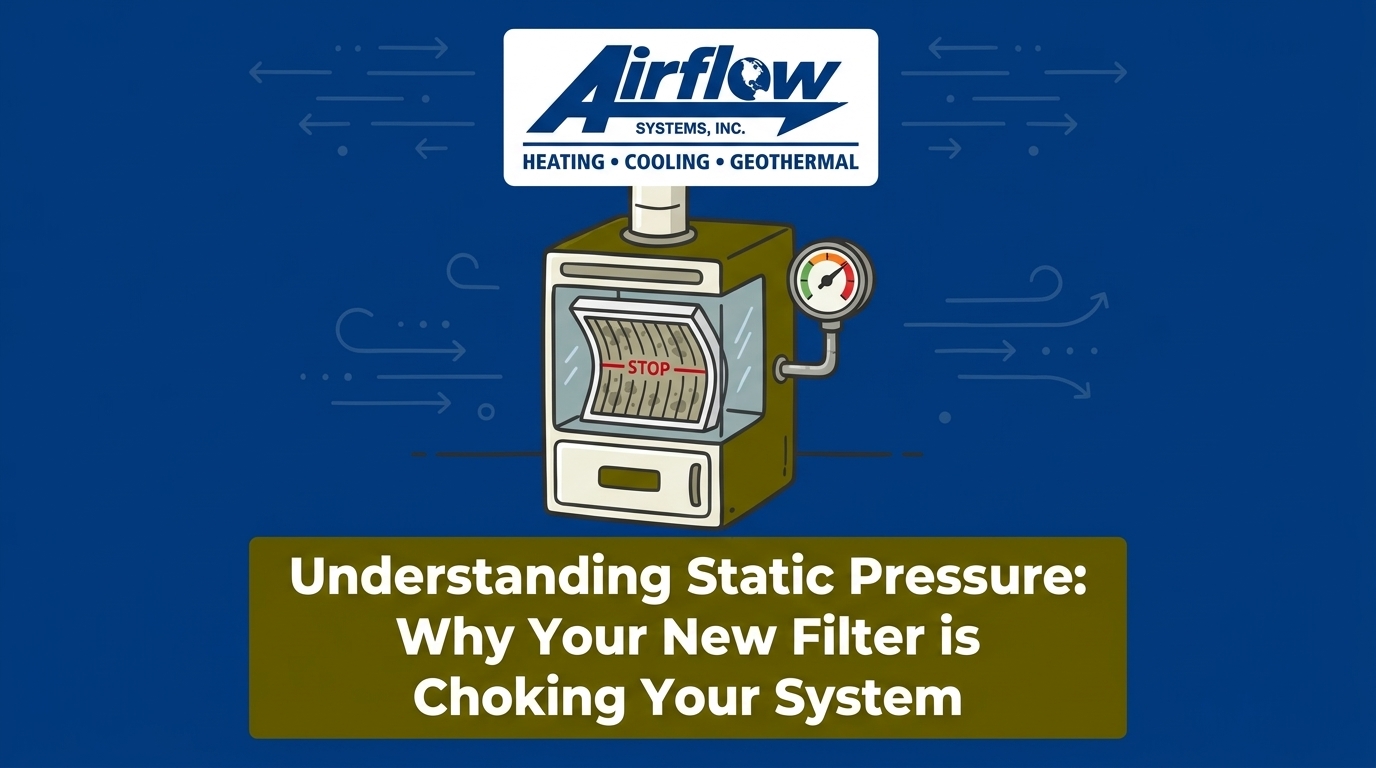
You head to the local hardware store to prepare for the early fall pre-heating season, determined to block out dust and seasonal allergens. It seems perfectly logical to grab the highest-rated pleated filter on the shelf to protect your home's air. However, understanding static pressure and why your new filter is choking your system is a vital step before you slide that dense cardboard frame into your return grille. Homeowners routinely make this well-intentioned mistake, assuming that if a filter fits the slot, the equipment can automatically handle the airflow resistance.
While prioritizing Indoor Air Quality is an excellent goal, the wrong filter acts like a brick wall in your ductwork. It severely restricts airflow and forces your equipment to work dangerously hard, eventually leading to an unexpected AC repair or premature system replacement.
The Disconnect Between Packaging and Performance
Marketing on the filter box promises "maximum allergen capture" and "hospital-grade air purification" without ever warning you about the physical toll on the HVAC system. Manufacturers design these filters to trap microscopic particles, which requires weaving the synthetic fibers incredibly tight. While this tight weave is fantastic at stopping pollen and pet dander, it is equally effective at stopping the very air your system needs to function.
Standard residential blower motors are simply not designed to push air through highly restrictive media. When you prioritize filtration without measuring the system's capacity to move air, you inadvertently sacrifice the lifespan of your heating and cooling equipment. The result is a home that might have fewer airborne allergens, but an HVAC system that is slowly suffocating behind a wall of pleated cardboard.
What is Static Pressure? The 'Blood Pressure' of Your HVAC
To understand why a thick filter causes so much damage, you first need to understand Total External Static Pressure (TESP). In layman's terms, static pressure is the measurement of resistance to airflow within your heating and cooling system. Every component that air touches as it moves through your home creates a certain amount of drag, and the blower motor must generate enough force to overcome that drag.
The Blood Pressure Analogy
The easiest way to conceptualize static pressure is to compare it to human blood pressure. Just as high blood pressure strains the heart, high static pressure strains the HVAC blower motor.
• The Pump — Human Cardiovascular System: The human heart pumping blood — Home HVAC System: The blower motor pushing conditioned air
• The Pathways — Human Cardiovascular System: Veins and arteries — Home HVAC System: Supply and return ductwork
• The Resistance — Human Cardiovascular System: Plaque buildup or narrowed arteries — Home HVAC System: Sharp duct bends, closed vents, and dense air filters
• The Consequence — Human Cardiovascular System: Heart strain, elevated blood pressure, fatigue — Home HVAC System: Motor overheating, high static pressure, system failure
Where Your Pressure Allowance Goes
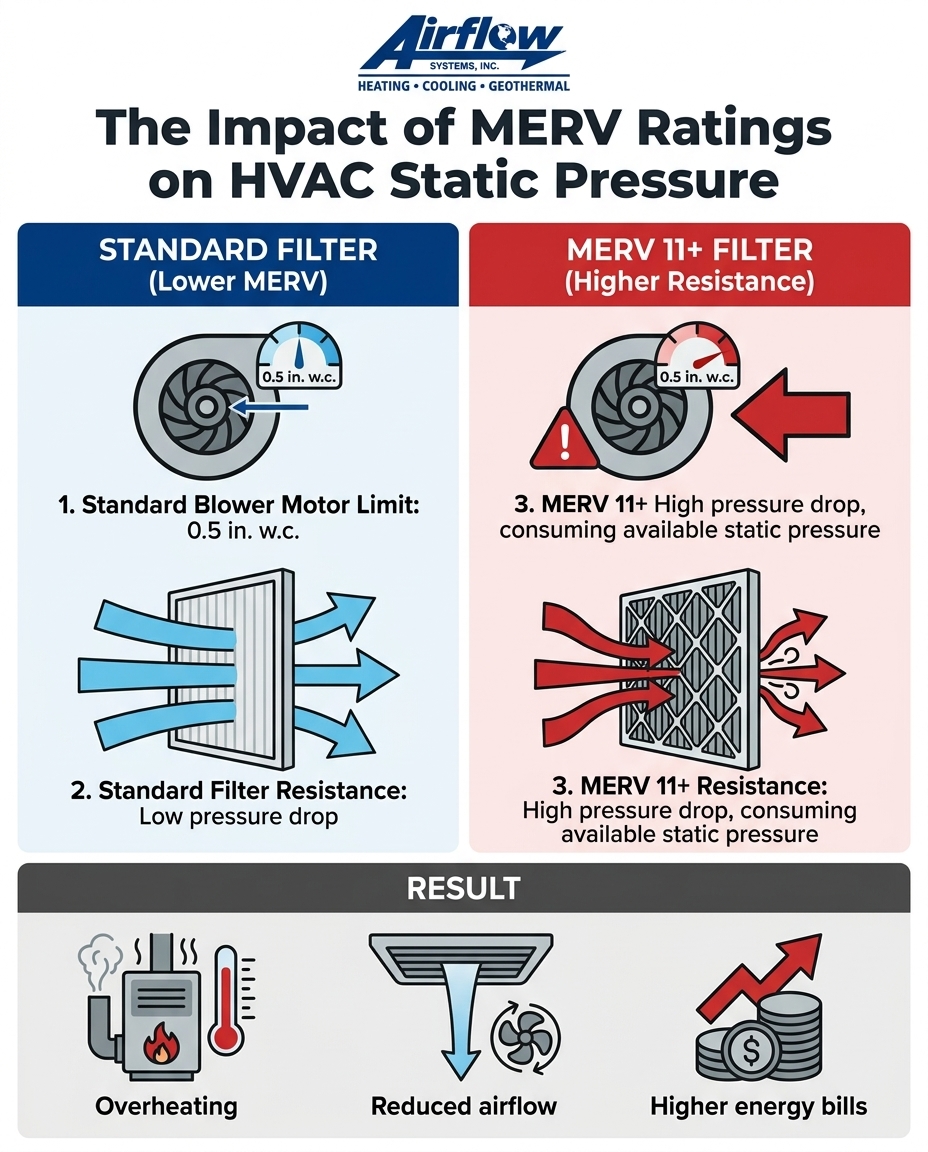
Standard residential blower motors are typically designed to handle a maximum TESP of 0.5 inches of water column (in. w.c.). This is a strict physical limit. If the resistance goes above 0.5 in. w.c., the motor begins to overwork and overheat.
The challenge is that the ductwork layout in typical Charlottesville area homes already consumes a large portion of this pressure allowance before a filter is even installed. Long duct runs, sharp 90-degree turns, corrugated flexible ducting, and decorative supply registers all create resistance. By the time the air navigates the twists and turns of an older home's duct system, you might already be sitting at 0.4 in. w.c. of resistance. Adding a highly restrictive filter pushes the system far past its safe operational limits.
Why High-Efficiency Media Creates Unsafe Resistance
When shopping for replacement filters, you will inevitably see a MERV rating on the packaging. MERV stands for Minimum Efficiency Reporting Value, and it measures the density of the filter media. The higher the MERV rating, the smaller the particles the filter can trap. While this sounds ideal for indoor air quality, it creates a massive mechanical hurdle for your blower motor.
The Mechanics of Pressure Drop
Every filter creates a "pressure drop"—a reduction in air pressure as air forces its way through the physical barrier. Pushing air through MERV 11+ ratings requires significantly more force than standard filters. Here is why high-efficiency media creates such unsafe resistance:
• Tighter Fiber Weaves: To catch microscopic allergens like smoke and smog, the synthetic fibers in a high-MERV filter are woven densely together, leaving very little open space for air to pass through.
• Increased Surface Friction: As air squeezes through these tiny gaps, friction increases dramatically. This friction slows the air down, creating a bottleneck in your return duct.
• Rapid Dust Accumulation: Because high-MERV filters catch more particles, they clog much faster than standard filters. A filter that creates a borderline-unsafe pressure drop on day one will become completely choked by week three.
This creates a severe disconnect between what hardware stores sell and what standard residential systems can safely support. A MERV 13 filter might promise a pristine indoor environment, but the pressure drop it creates will easily consume the entirety of your system's remaining static pressure allowance.
Collateral Damage: Blower Motors and Heat Pumps
Operating an HVAC system with restricted airflow and high static pressure is not just inefficient; it is physically destructive. When airflow is choked, the blower motor must work significantly harder to pull air through the return ducts. This continuous strain leads to rapid overheating, degraded motor windings, and premature mechanical failure.
Cooling Mode Consequences
In cooling mode, restricted airflow alters the temperature of the internal evaporator coils. An air conditioner relies on a steady stream of warm return air blowing over the indoor coils to prevent the refrigerant from dropping below freezing. When a restrictive filter slows that airflow to a crawl, condensation on the coils freezes solid. This lack of warm air is exactly how dirty filters cause frozen evaporator coils, potentially damaging the compressor in the process.
Furthermore, Charlottesville's humid climate makes optimal airflow critical for latent heat removal. Your air conditioner does not just cool the air; it dehumidifies it. Restricting this airflow prevents effective dehumidification during muggy transition seasons, leaving your home feeling clammy and uncomfortable even when the thermostat says the temperature is correct.
Heating Mode Consequences
The damage is equally severe during the early fall pre-heating season. When transitioning to heating mode, restricted airflow causes heat pumps and furnaces to overheat. A furnace relies on moving air to carry heat away from the heat exchanger. If the air is blocked by a dense filter, the heat exchanger overheats, triggering internal safety limits that shut the system down abruptly. This short-cycling drives up energy consumption, increases wear-and-tear on electrical relays, and leaves your home struggling to reach a comfortable temperature.
Warning Signs Your HVAC System is Gasping for Air
How do you know if your current filtration setup is pushing your static pressure to dangerous levels? Your equipment will usually display clear symptoms before a total breakdown occurs. Many older Charlottesville area homes exhibit these symptoms when homeowners upgrade to modern, high-resistance filters without making necessary ductwork adjustments.
Watch for these four warning signs:
1. Whistling noises at the return vents: If you hear a high-pitched whistle coming from your filter grille, air is being squeezed through a tight space at high velocity because the filter media is too dense.
2. A louder-than-usual blower motor: A blower motor that sounds like an airplane taking off is straining against severe resistance. The motor is ramping up its RPMs in a desperate attempt to move the required volume of air.
3. Weak airflow from supply registers: Hold your hand over a supply vent in your living room. If the air is barely trickling out despite the system running at full capacity, the air is likely trapped behind a restrictive filter in the return duct.
4. Frequent system short-cycling: If your system turns on, runs for only a few minutes, and abruptly shuts off, it is likely hitting its thermal safety limits due to overheating components.
In one instance during the summer, a homeowner experienced severe AC issues caused by an original installer's poor duct design combined with highly restrictive filtration. The system was completely starved for air, leading to repeated failures. A technician had to thoroughly correct the underlying AC problem and redesign the airflow path to restore proper function and prevent further breakdowns. Fortunately, these airflow symptoms are often caught early during a routine HVAC maintenance plan visit, allowing professionals to intervene and measure static pressure before catastrophic failure occurs.
Balancing Air Purity with System Health
Homeowners do not have to choose between breathing clean air and maintaining a functional HVAC system. The solution is proper measurement and strategic equipment upgrades. Guessing which filter to buy based on hardware store marketing is a gamble; relying on data is the key to longevity.
The Importance of Professional Measurement
Measuring actual static pressure is a highly technical diagnostic process. Technicians use a specialized tool called a manometer to read the pressure drop across the filter, the indoor coil, and the supply ductwork. This is strictly a job for a licensed professional, not a DIY task. Unlike the generic advice found at big-box hardware stores, Airflow Systems accurately measures a system's true static pressure to recommend the exact filtration balance tailored to your specific ductwork.
Alternative Solutions for High Indoor Air Quality
If your system's static pressure is already near the 0.5 in. w.c. limit, you cannot safely use a 1-inch thick MERV 13 filter. However, there are excellent alternatives:
• Deep Pleated Media Cabinets: By having a professional install a 4-inch or 5-inch media cabinet, you drastically increase the surface area of the filter. This allows you to use high-MERV media with a fraction of the pressure drop, protecting both your air quality and your blower motor.
• Dedicated Air Purifiers: Standalone HEPA purifiers or duct-mounted UV and ionization systems can neutralize allergens and pathogens without adding physical resistance to the airflow path.
If professional modifications haven't been made, it is generally safer to stick with lower MERV ratings (typically MERV 8) for standard residential units rather than risking the strain of MERV 11+ ratings. If you are concerned about allergens, investing in professional indoor air quality testing will give you safe, effective options that won't destroy your heating and cooling equipment.
Frequently Asked Questions
Can a high MERV filter damage my HVAC?
Yes, a high MERV filter can severely damage your HVAC system if your equipment is not designed to handle the increased resistance. The dense material restricts airflow, causing the blower motor to overwork and overheat. Over time, this constant strain leads to premature mechanical failure and expensive repairs.
Does a higher MERV rating reduce airflow?
A higher MERV rating generally reduces airflow because the filter media is woven much tighter to trap microscopic particles. This tight weave acts as a physical barrier, forcing the blower motor to work harder to pull the same volume of air through the return ducts. If the filter is only 1-inch thick, the airflow reduction can be drastic.
What is a good static pressure for HVAC?
For most standard residential HVAC systems, a good total external static pressure (TESP) is at or below 0.5 inches of water column (in. w.c.). Operating significantly above this threshold strains the blower motor, reduces system efficiency, and shortens the lifespan of the equipment. A licensed professional must measure this using a manometer.
Why is my new air filter whistling?
A whistling sound from your new air filter usually indicates that air is being squeezed through a space that is too restrictive. This happens when a high-efficiency filter creates too much pressure drop, forcing the system to pull air through tiny gaps around the filter frame at a very high velocity.
What MERV rating is safe for standard residential systems?
For most standard residential systems without specialized deep-media cabinets or ductwork modifications, a MERV 8 filter is typically considered safe. It provides an excellent balance of capturing common household dust, pollen, and pet dander without creating dangerous levels of airflow resistance for the blower motor.
Protect Your Equipment and Your Air
Protecting your home's indoor air shouldn't require sacrificing the health of your heating and cooling equipment. By understanding static pressure and why your new filter is choking your system, you can make informed, data-driven choices. For a clear, physics-based explanation of your ductwork's capabilities and actionable, safe guidance on the exact MERV rating your equipment can handle, schedule a professional static pressure evaluation today.
Book Expert Service Or Contact Us
Our Service Process
A Hassle-Free Service Experience
01
Consultation & Diagnosis
We start by listening to your needs and performing a thorough diagnosis of your system to recommend the best solution.
02
Transparent Quoting
We provide a clear, upfront estimate with no hidden fees, so you know exactly what to expect.
03
Expert Service & Follow-Up
Our factory-trained technicians complete the work to the highest standards, and we follow up to ensure your complete satisfaction.
testimonials
What Our Customers Are Saying
Our customers consistently praise our exceptional service and attention to detail, making us a trusted choice for all your HVAC needs.
where we operate
Service areas