


Choose an option to see quick actions and get help faster.
.svg)

Is a Late-Summer AC Tune-Up Worth It in Charlottesville?
Have you noticed your cooling system struggling to keep up as the August late-summer heat settles in? When local homeowners ask what exactly does an air conditioning service include at Airflow Systems, they usually want to know if scheduling a late-season visit is truly worth the investment, or if they should just cross their fingers and wait for fall. The short answer is that a comprehensive diagnostic is the only way to reverse the cumulative fatigue your system has suffered after running continuously since May. By late summer, moving parts have cycled thousands of times, belts may have stretched, and biological growth has likely accumulated in your drainage systems.
To keep your system running reliably, explore our air conditioning services or sign up for a comprehensive maintenance plan.
Many property owners assume a maintenance visit is just a quick filter swap and a visual once-over. While changing the filter is important, it barely scratches the surface of what a modern, high-efficiency cooling system requires. Airflow Systems takes a methodology-driven approach to diagnostics. We believe in transparency, which means showing you the exact data we pull from your equipment. When our technicians arrive at your home, they are looking at the precise electrical thresholds, pressure readings, and thermal metrics that determine whether your system will survive the rest of the season or fail when you need it most.
Signs of late-summer AC fatigue include:
• Longer cooling cycles: The system runs for hours without satisfying the thermostat.
• Uneven temperatures: Certain rooms feel significantly warmer than others.
• Increased operating noise: Grinding or buzzing sounds from the outdoor unit.
• Spiking utility bills: The system is drawing more power to produce the same amount of cooling.
Beyond the Visual Inspection: The Airflow Systems Diagnostic Checklist
There is a massive difference between a vague "multi-point inspection" and a true technical diagnostic. As an independent, locally trusted HVAC provider, Airflow Systems prioritizes total transparency over big-box marketing speak. We do not just look at your equipment and guess its condition based on age or appearance. Instead, our technicians rely on hard data, utilizing specialized field instruments to measure the exact capacitor microfarads and amp draws of your system's critical components.
If you are interested in getting your air conditioner ready for hot, humid weather, you need to know exactly what is happening inside the cabinet. A visual check might spot a frayed wire, but it will never reveal a failing motor that is silently drawing too much current.
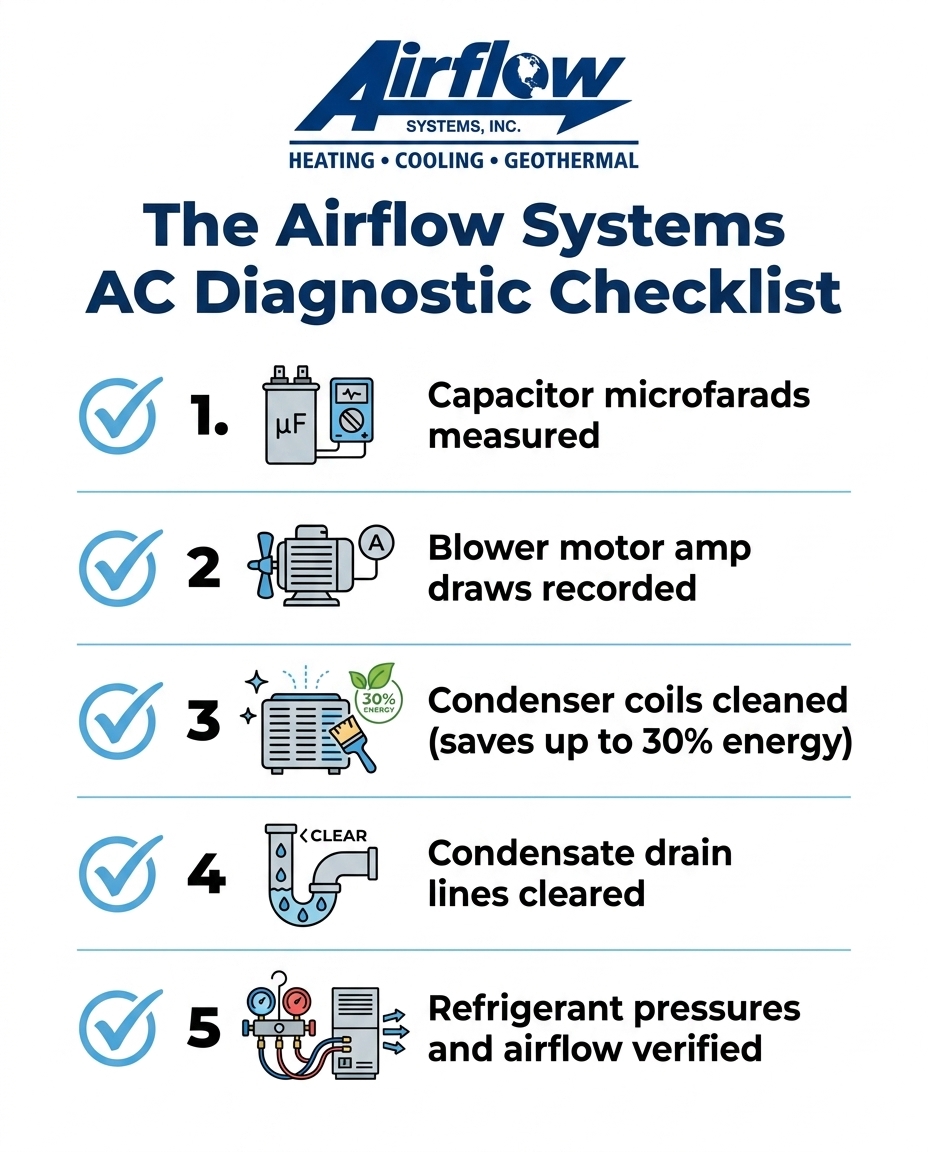
The Airflow Systems AC Service Checklist:
1. Electrical Component Testing: Measuring the exact microfarads of start and run capacitors, alongside the amp draw of the compressor and blower motors.
2. Refrigerant Pressure Verification: Calculating subcooling and superheat metrics to ensure the system holds the precise factory-specified charge.
3. Airflow and Temperature Drop Measurement: Testing the Delta-T (temperature difference) across the evaporator coil to confirm optimal heat transfer.
4. Condensate Drain Clearing: Flushing and treating the primary and secondary drain lines to prevent biological buildup and water backups.
5. Coil Cleaning and Inspection: Removing debris from the outdoor condenser coil and checking the indoor evaporator coil for airflow restrictions.
Why We Rely on Hard Data, Not Just Visuals
Visual inspections frequently miss internal component degradation. A capacitor can look perfectly normal on the outside while being completely hollowed out on the inside, ready to fail on the next hot afternoon. By using precision digital multimeters, anemometers, and digital refrigerant manifolds, we ensure highly accurate health assessments of the system.
• Basic Visual Check — What It Involves: Looking for obvious leaks, changing filters, wiping down the cabinet. — Long-Term Result: Misses internal wear; high risk of unexpected mid-season breakdowns.
• Airflow Systems Diagnostic — What It Involves: Recording exact electrical tolerances, temperature drops, and refrigerant states. — Long-Term Result: Proactive part replacement; optimized efficiency and extended equipment lifespan.
Electrical Diagnostics: Measuring Capacitor Microfarads and Amp Draws
The electrical heart of your cooling system is where most sudden breakdowns originate. During our comprehensive service, we focus heavily on the components that start and sustain the cooling cycle. The most common point of failure in any air conditioner is the capacitor. A capacitor acts like a heavy-duty battery that delivers a massive jolt of electricity to start the compressor and fan motors. Over time, heat and usage degrade its ability to hold a charge.
We test this by measuring the capacitor microfarads and amp draws. Every capacitor has a specific microfarad rating with a tight tolerance range (usually plus or minus 5%). If a capacitor is rated for 45 microfarads but our meter reads 38, we know it is failing. Replacing it proactively prevents the compressor from struggling to start—a condition that can cause catastrophic damage to the most expensive part of your system.
One local homeowner reached out to us during a summer heatwave when their system started acting up. Because our technician thoroughly diagnosed the electrical components—finding the exact problem and correcting it quickly—their AC system was back to working correctly with a reasonable invoice, avoiding a full compressor burnout.
Predicting Motor Failure Before It Happens
Motors draw more amps as they wear out. As the bearings inside your blower motor or condenser fan motor begin to lose their lubrication, the motor has to work much harder to spin. This increased physical resistance translates directly into a higher electrical amp draw.
Why tracking amp draw matters:
• Early warning system: If a motor is rated for 2.5 amps but is currently drawing 3.8 amps, failure is imminent.
• Energy savings: Motors pulling excessive amps waste electricity and drive up your utility bills.
• Preventing collateral damage: A burned-out motor can short out the control board or melt wiring harnesses.
Recording these exact readings allows our technicians to advise you on proactive part replacements, completely eliminating the surprise of a dead AC unit on a Sunday afternoon.
Managing Heavy Moisture: Condensate and Coil Servicing
The Problem: The hot and humid summers in Charlottesville VA create extreme moisture loads inside residential HVAC systems. As your air conditioner cools the air, it simultaneously acts as a massive dehumidifier, extracting gallons of water from your indoor air every single day.
The Cause: All this moisture condenses on the cold indoor evaporator coil and drips down into a drain pan, where it exits your home through a PVC condensate line. Because this environment is dark, damp, and cold, it is the perfect breeding ground for algae, mold, and biological slime. Without regular servicing, this sludge thickens and eventually clogs the drain line entirely.
The Solution: During our service visit, we proactively clear and treat the condensate drain line. We flush the system to remove existing blockages and apply treatments that inhibit future biological growth. If you ignore this step, water will eventually back up, overflow the drain pan, and potentially cause thousands of dollars in water damage to your ceilings or floors—often requiring emergency AC repair.
The Threat of Clogged Condensate Drains and Dirty Coils
Beyond the drain lines, we heavily focus on the coils themselves. The Department of Energy (DOE) notes that dirty condenser coils can increase compressor energy consumption by up to 30%. When the outdoor coil is blanketed in pollen, dirt, lawn clippings, and dust, it cannot release the heat it absorbed from your home.
What we check during coil servicing:
• Evaporator coil (indoor): We inspect for dust buildup that restricts airflow and reduces cooling capacity.
• Condenser coil (outdoor): We gently wash away debris from the aluminum fins to restore optimal heat transfer.
• Drain pan integrity: We check for rust, cracks, or pitting that could lead to future leaks.
• Safety float switches: We verify that the emergency shut-off switch activates properly if water begins to pool.
Refrigerant Levels and Airflow Testing Metrics
A common misconception is that air conditioners "use up" refrigerant over time. The truth is that your cooling system is a closed loop. If it is low on refrigerant, there is a leak that must be found and repaired. However, verifying the exact charge of the system is critical, especially when battling the August late-summer heat.
Our technicians do not just attach gauges and look for a static pressure number. We calculate the "subcooling" and "superheat" metrics. Subcooling tells us how much the liquid refrigerant has cooled below its boiling point in the condenser, while superheat tells us how much the refrigerant vapor has warmed above its boiling point in the evaporator. These exact calculations reveal whether the system is slightly undercharged, overcharged, or suffering from a restriction in the expansion valve.
Verifying Optimal Cooling Capacity
Proper refrigerant charge is vital for efficiency, but it must be paired with correct airflow. Airflow blockages force the system to work harder, severely reducing your indoor comfort. We measure the temperature drop (Delta-T) across the indoor coil.
How we verify airflow:
• Measuring return air temperature: The temperature of the warm air entering the system.
• Measuring supply air temperature: The temperature of the cold air exiting the vents.
• Calculating the difference: A healthy system typically produces a temperature drop of 16 to 22 degrees.
If the drop is too low, the system isn't absorbing enough heat (often a refrigerant issue). If the drop is too high, the air is moving too slowly across the coil (often an airflow restriction like a dirty filter or failing blower motor), which can cause the indoor coil to freeze solid.
The Long-Term Impact of Rigorous Testing
We see the results of this rigorous testing in the field every day in Charlottesville VA. One customer who relies on us for their twice-yearly HVAC maintenance recently noted how much they value our technician's advice and expertise during these semi-annual checks. By tracking the exact health of their equipment over time, we help them maintain peak performance and avoid unexpected breakdowns.
The cumulative benefits of consistent, professional HVAC services are substantial. When a technician records your system's baseline metrics year after year, they can spot a downward trend long before it becomes a catastrophic failure. A thorough diagnostic pays for itself in avoided emergency calls, extended equipment lifespan, and lower monthly energy bills. More importantly, it provides you with the peace of mind that comes from knowing the exact condition of your system as you head into the hottest weeks of the year.
Comprehensive AC Service FAQs
What is included in a full AC service?
A full AC service includes filter replacement, coil cleaning, electrical metric testing, and condensate clearing. At Airflow Systems, we go beyond basic visual checks by measuring exact electrical tolerances, verifying refrigerant pressures, and calculating the temperature drop across your coils. This comprehensive approach ensures every mechanical and electrical component is functioning efficiently to handle the August late-summer heat.
What does an HVAC technician check during a tune-up?
An HVAC technician checks refrigerant levels, capacitor health, motor amp draws, and safety controls. We use specialized digital meters to record the exact microfarads of your capacitors and the electrical current drawn by your motors. Additionally, we inspect the ductwork for airflow restrictions, clean the outdoor condenser unit, and ensure the thermostat is calibrated correctly.
How long does an AC maintenance visit take?
A thorough diagnostic and cleaning typically takes 60 to 90 minutes. The exact time depends on the accessibility of your equipment and how long it has been since your last service. Because we record precise technical metrics and actively clean the internal components rather than just looking at them, we take the time necessary to ensure the job is done right.
What is the difference between an AC inspection and a tune-up?
Inspections are often visual, while tune-ups involve active cleaning, adjustments, and precise metric recording. An inspection might simply identify that a system is running, whereas a true tune-up restores lost efficiency by clearing clogged drains, washing dirty coils, and tightening loose electrical connections. A tune-up is a proactive service designed to prevent future breakdowns.
Why is late-summer maintenance still necessary?
Systems accumulate extreme wear by August, and checking them prevents end-of-season breakdowns. After running continuously for months, moving parts are stressed, filters are loaded with dust, and drain lines are often thick with biological growth. A late-summer service catches these issues before they turn into expensive repairs, ensuring your home stays comfortable through the final heatwaves of the year.
Schedule Your Comprehensive Diagnostic Today
Understanding the exact technical checks performed during a maintenance visit makes it easy to justify scheduling an end-of-season service call. You deserve more than a quick visual sweep; you deserve a transparent, methodology-driven diagnostic that provides tangible value and protects your investment. Whether you are dealing with a system that runs non-stop or you simply want the peace of mind that comes from knowing your equipment is healthy, our team is ready to help.
Don't wait for your system to fail on the hottest day of the year in Charlottesville VA. Secure your home's comfort by enrolling in our professional maintenance plan today, and let our experts keep your system running at peak performance season after season.
Book Expert Service Or Contact Us
Our Service Process
A Hassle-Free Service Experience
01
Consultation & Diagnosis
We start by listening to your needs and performing a thorough diagnosis of your system to recommend the best solution.
02
Transparent Quoting
We provide a clear, upfront estimate with no hidden fees, so you know exactly what to expect.
03
Expert Service & Follow-Up
Our factory-trained technicians complete the work to the highest standards, and we follow up to ensure your complete satisfaction.
testimonials
What Our Customers Are Saying
Our customers consistently praise our exceptional service and attention to detail, making us a trusted choice for all your HVAC needs.
where we operate
Service areas