

Choose an option to see quick actions and get help faster.

That Alarming Burning Odor: Don't Panic Just Yet
Navigating home maintenance tips and troubleshooting can feel overwhelming, especially when you turn on your heat for the first time and are immediately hit with a concerning burning smell. It is a crisp evening during the October first cold snap, and you finally decide to bump up the thermostat to knock the chill out of the house. Within minutes, a heavy, dusty, burning odor fills your living room. Because your system has been sitting dormant for heating purposes for months, your first instinct might be to worry about a potential fire hazard or a catastrophic equipment failure.
Whether you rely on a traditional furnace or a high-efficiency mini split, understanding how your mini split systems and heating units operate can save you unnecessary stress. Before you panic and assume the worst, take a deep breath. In the vast majority of cases, this initial smell is a completely normal, temporary quirk of fall heating startup. Our goal is to help you understand exactly why this odor occurs, how to differentiate between a harmless seasonal transition and a genuine safety hazard, and what practical steps you should take next to protect your home.
The Culprit Behind the Scent: Summer Dust and High Humidity
To understand why your heating system smells like a dusty campfire, we have to look back at the long cooling season. From late spring through early fall, your HVAC system has been working hard to circulate conditioned air throughout your home. During this time, airborne particulate matter, pet dander, pollen, and everyday household dust are constantly moving through your ductwork and across your indoor equipment.
The Environmental Factor: Here in Virginia, our high mid-Atlantic summer humidity causes more of this airborne particulate matter to adhere to the damp indoor coils and heating elements. Instead of simply blowing past, the dust acts like a sponge, sticking to the internal components and forming a thin, stubborn layer of debris over the months. While your air filter catches the majority of contaminants, microscopic particles always make their way through over a six-month cooling season.
The Physical Process: When the crisp autumn weather finally arrives and your heating elements engage for the very first time, those components get extremely hot very quickly. As they reach their operating temperature, they literally cook off the accumulated layer of dust that has settled on them since last winter. The smell you are experiencing is simply the rapid oxidation of that organic matter.
The Resolution: This dust burn-off is a standard operational reality for almost all forced-air and ductless systems. It is not a sign that your equipment is failing, nor does it mean your system is dirty or poorly maintained. Understanding this mechanical process is the first step in diagnosing fall startup issues without jumping to worst-case scenarios.
The 60-Minute Rule: How Long Is Too Long?
While a burning dust smell is entirely normal, it should not last indefinitely. To help homeowners gauge whether their system is simply waking up for the winter or experiencing a real issue, we recommend following the 60-minute rule. Normal dust burn-off typically dissipates within 30 to 60 minutes of continuous operation. Here is how you should handle that first hour of heating:
1. Note the exact time you turned on the heat: Do not rely on guesswork. Look at the clock the moment you activate the heating cycle so you have a strict benchmark for monitoring the odor.
2. Open a few windows to ventilate the space: You do not need to let all the warm air out, but cracking a few windows on opposite sides of the house will create a cross-breeze. This helps the harmless dust odors escape rather than lingering in your fabrics and carpets.
3. Monitor the system continuously: Never turn on your heat for the first time right before you go to sleep, and never leave the house to run errands while the system is completing its initial burn-off. Stay nearby so you can observe any changes in the smell or the sound of the equipment.
4. Reassess at the one-hour mark: By the time 60 minutes have passed, the smell should be significantly faded or entirely gone. If the odor is still just as strong, or if it has changed in character, it is time to take further action.
This simple timeline provides a clear, actionable way to monitor your system safely. If the smell clears up within the hour, you can confidently close your windows and enjoy a warm, comfortable home for the rest of the season.
Electrical Odors vs. Dust: When to Shut Down Your System
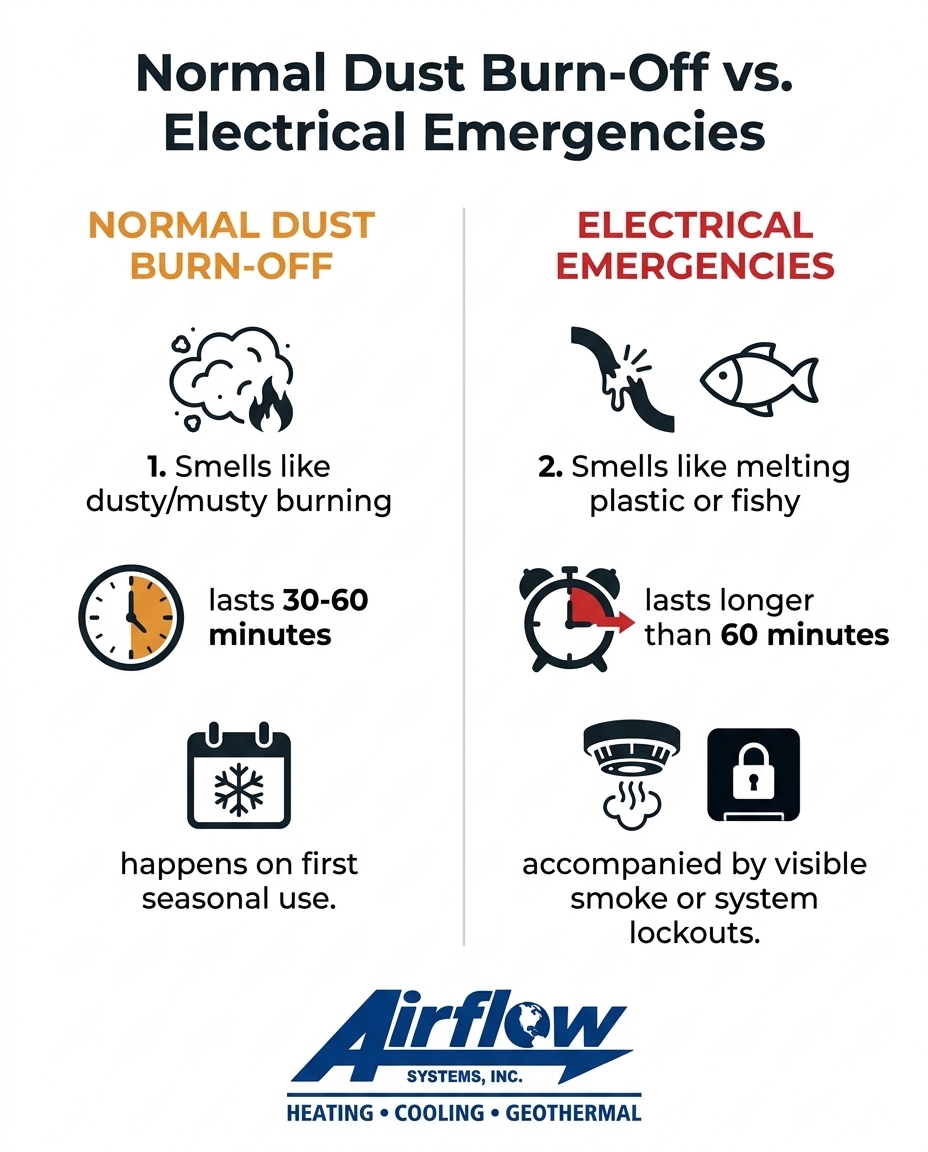
Differentiating between harmless dust and dangerous electrical or mechanical issues is a critical skill for any homeowner. Because heat pumps and ductless units do not use combustion, persistent smoke or harsh chemical smells are never normal. If your system crosses the line from a dusty odor to an electrical one, you must act quickly to protect your property.
• Type of Odor — Normal Dust Burn-Off: Smells like a dusty, musty campfire or scorched lint. — Electrical / Mechanical Emergency: Smells like melting plastic, burning rubber, or a fishy chemical scent.
• Duration — Normal Dust Burn-Off: Fades steadily and disappears within 30 to 60 minutes. — Electrical / Mechanical Emergency: Persists well beyond an hour, or grows stronger the longer the unit runs.
• Visual Cues — Normal Dust Burn-Off: No visible smoke anywhere near the vents or the indoor air handler. — Electrical / Mechanical Emergency: Visible smoke, sparking, or soot accumulating around the registers.
• System Behavior — Normal Dust Burn-Off: Produces steady, warm air while the thermostat reaches the set temperature. — Electrical / Mechanical Emergency: The system short-cycles rapidly, trips the circuit breaker, or locks out entirely.
If you experience any of the emergency warning signs listed above, provide strict instructions to everyone in the household: turn off the unit at the thermostat immediately, and then switch off the dedicated circuit breaker in your electrical panel to cut all power to the equipment. A plastic or fishy smell often indicates melting wire insulation or an overheating motor.
Under no circumstances should you attempt to remove the access panels to inspect the wiring yourself. Electrical diagnostics are strictly for licensed professionals. Touching the wrong capacitor or live wire can result in severe injury. Instead, leave the system powered down and reach out to a certified technician who provides comprehensive HVAC solutions to safely diagnose and repair the electrical fault.
Sluggish Switchovers: Bouncing Between Heating and Cooling
Aside from the initial burning smell, the second most common issue homeowners face during fall startup is a system that seems to struggle with switching modes. Charlottesville's fluctuating fall weather is notorious for its unpredictability. You might wake up to frost on the grass in the morning, only to need the air conditioning by three in the afternoon. This requires your heat pump to bounce between modes constantly.
Mechanical Equalization: When you switch your thermostat from cooling to heating, a component inside the outdoor unit called the reversing valve has to physically shift position to change the flow of refrigerant. This process is not always instantaneous. The system requires time for the internal pressures to equalize before it can start producing warm air. If the air feels lukewarm for the first ten minutes, give the system time to run through its cycles before assuming there is a mechanical failure.
Defrost Cycles: As the outdoor temperatures drop near freezing, moisture in the air can freeze on the outdoor coils. Your heat pump will automatically enter a defrost cycle to melt this ice. During a defrost cycle, the outdoor fan stops spinning, the unit might make a loud "whoosh" sound, and the indoor vents may temporarily blow cool air. This is a built-in protection mechanism, not a breakdown.
Thermostat Delays: Modern digital thermostats often have built-in time delays to protect the compressor from short-cycling during these rapid weather swings. If your screen flashes "waiting" or "delay," simply step back and let the technology do its job. Patience is often the best troubleshooting tool during erratic fall weather.
Essential Home Maintenance Tips and Troubleshooting for Fall
While electrical repairs require a professional, there are several safe, non-technical steps you can take to ensure your heating system starts up smoothly and efficiently. Adding these tasks to your seasonal routine will improve your indoor air quality and help prevent unexpected breakdowns.
• Check and replace indoor air filters: Before the heavy winter usage begins, swap out your old, dust-clogged filter for a fresh one. A dirty filter restricts proper airflow, forcing the blower motor to work harder and increasing the intensity of the initial dust burn-off smell.
• Clear the outdoor compressor unit: Fall brings falling leaves, snapping branches, and blowing debris. Walk outside and ensure there is at least two feet of clear space around your outdoor unit. Remove any vegetation or leaves that have gathered against the coil fins to ensure the system can breathe.
• Verify thermostat settings: Double-check that your system is actually set to "Heat" rather than "Emergency Heat" or "Fan Only." Running your system on Emergency Heat when it is not necessary will bypass the efficient heat pump and rely solely on expensive electric backup strips.
• Assess your zone heating: If you utilize ductless technology, verify that the indoor heads are clean and unobstructed. This is a great time to evaluate your home's layout, especially if you have been researching the best rooms for a mini split system to address stubborn cold spots.
• Schedule a professional tune-up: If your system has not been inspected in over a year, a preventative maintenance visit is highly recommended. A technician will safely clean the internal components, reducing the severity of startup odors and catching minor wear and tear before it escalates.
Why Accurate Diagnostics Matter More Than Scare Tactics
Unfortunately, a burning smell during fall startup can sometimes be used by unscrupulous contractors to push unnecessary, immediate system replacements. When a homeowner is already anxious about a potential safety hazard, high-pressure sales tactics can make the situation incredibly stressful. This is why getting a second opinion and relying on accurate diagnostics is so important.
As an independent, family-owned business, Airflow Systems believes in providing honest assessments rather than corporate scare tactics. If your system is simply experiencing a heavy dust burn-off, we will tell you exactly that. If there is a genuine electrical fault, we will show you the worn component and explain your repair options clearly.
A thorough, objective assessment identifies the true root cause of the problem. Whether we are transitioning your home from summer air conditioning services to winter heating preparations, tailored advice based on your home's specific layout and heating needs saves you stress and money in the long run. You deserve a service partner who prioritizes your safety and your budget equally.
Frequently Asked Questions About Fall Heating Startup
Why does my heat pump smell like it's burning?
A burning smell from a heat pump is usually caused by dust burning off the heating elements. Over the summer, household dust and airborne particles settle on the indoor coils. When the heat engages for the first time in the fall, these components get hot and cook off the debris. It can occasionally indicate an electrical issue if the smell is distinctly plastic-like or fishy.
How long should a heater smell like burning dust?
Normal dust burn-off typically dissipates within 30 to 60 minutes of continuous operation. The smell should steadily decrease in intensity as the system runs. If the odor lasts longer than an hour, or if it grows stronger instead of fading, you should turn the system off and request a professional inspection.
When is an HVAC smell an emergency?
An HVAC odor becomes an emergency when you see visible smoke, smell melting plastic, or detect a harsh chemical or electrical burning scent. It is also a major red flag if the odor persists past the one-hour mark or is accompanied by the system tripping your circuit breaker. These signs require an immediate shutdown at the thermostat and breaker panel, followed by professional attention.
Is it normal for a mini split to smell when first turned on for heating?
Yes, it is completely normal for a mini split to emit a brief burning smell during its first heating cycle. Dust settles on the indoor coils and internal components year-round, regardless of the system type. The initial heat cycle will briefly burn this organic matter off, creating a temporary odor that should clear up quickly.
Should I run the fan to clear out the burning smell?
Opening windows to create a cross-breeze is better than relying solely on the HVAC fan. While running the system fan can help circulate the indoor air, it is crucial to confirm that the smell originates from harmless dust rather than a mechanical failure. If you suspect an electrical issue, running the fan could make the problem worse, so ventilating the room naturally is the safest approach.
Get Peace of Mind for Your Winter Comfort
As the temperatures drop across Charlottesville and Albemarle County, ensuring your heating system is safe and reliable becomes a top priority. Applying these home maintenance tips and troubleshooting strategies can help you confidently navigate the fall startup period. We want to reassure homeowners that most startup smells are completely harmless, but your family's safety should always come first.
If you have followed the 60-minute rule and are still experiencing persistent odors, strange noises, or sluggish performance, do not hesitate to reach out for a professional inspection. Getting an honest, expert assessment removes the guesswork and ensures your equipment is ready to handle the winter months ahead. Schedule a comprehensive tune-up today to secure lasting peace of mind for your home.
Book Expert Service Or Contact Us
Our Service Process
A Hassle-Free Service Experience
01
Consultation & Diagnosis
We start by listening to your needs and performing a thorough diagnosis of your system to recommend the best solution.
02
Transparent Quoting
We provide a clear, upfront estimate with no hidden fees, so you know exactly what to expect.
03
Expert Service & Follow-Up
Our factory-trained technicians complete the work to the highest standards, and we follow up to ensure your complete satisfaction.
testimonials
What Our Customers Are Saying
Our customers consistently praise our exceptional service and attention to detail, making us a trusted choice for all your HVAC needs.
where we operate
Service areas