

Choose an option to see quick actions and get help faster.
.svg)
Surviving a Summer Breakdown: The True Cost of Waiting for Parts
August in Charlottesville is unforgiving, and as families gear up for the back-to-school transition, understanding exactly why local ownership matters when you need a warranty part in a hurry can be the difference between a quick fix and a miserable week. At Airflow Systems, we see the late-summer heat push cooling equipment to its absolute limits, running near-continuously just to maintain a baseline level of indoor comfort. When an air conditioner inevitably falters under that relentless strain, the immediate priority is restoring the chill to your home. Most homeowners assume that if their system is still under the manufacturer's guarantee, the resolution will be swift and straightforward. Unfortunately, the logistical reality of acquiring specific components during peak season is a hidden challenge that only reveals itself when you are already sweating in your living room.
If you need reliable air conditioning services, securing a contractor who understands the urgency of an August heatwave is essential for a fast recovery.
The dread of an unexpected failure is compounded when you realize that not all service providers have the same access to replacement materials. Being stuck in a centralized national distribution network often means your comfort is put on hold while a component travels across the country. In contrast, relying on a locally owned company's regional connections changes the timeline dramatically. In our experience, the decision point for homeowners isn't just about who can diagnose the problem, but who actually has the logistical leverage to secure the necessary components without bureaucratic delays.
The Anatomy of a Modern HVAC Repair: Why Generic Parts Don't Work
In our years servicing Charlottesville homes, we've watched modern high-efficiency cooling systems become incredible feats of engineering, but that sophistication comes with highly specific technical requirements. Gone are the days when our technicians could simply swap out a generic contactor or capacitor from a universal bin in the back of their van to get any unit running again. Today's variable-speed compressors and communicating thermostats rely on complex, manufacturer-specific electronic components to function.
When you call for AC repair on a newer, high-efficiency unit, the technician is often dealing with highly specialized circuitry. If a proprietary OEM control board fails, you cannot safely or legally substitute it with an off-the-shelf alternative without voiding the manufacturer's guarantee and risking severe damage to the rest of the system.
The Challenge of Specialized Components
The proprietary hurdle: A proprietary OEM control board acts as the brain of your cooling system. It dictates exactly when the compressor ramps up, how much refrigerant flows, and the precise speed of the indoor blower motor. Because these boards are engineered for specific models, they are not universally interchangeable.
Peak demand scarcity: Our dispatch team notices that during the height of summer, these exact specialized components experience a massive surge in demand. Every broken unit across the region is pulling from the same limited pool of replacement materials. When your system requires a highly specific OEM part, the challenge shifts from diagnosing the mechanical failure to physically locating the component in a strained supply chain.
• Communication errors: Generic substitutes cannot interface with proprietary communicating thermostats.
• Efficiency losses: Off-brand components often fail to regulate variable-speed motors correctly, destroying the energy efficiency you paid for.
• Safety protocols: OEM parts contain specific safety lockouts and voltage regulations designed exclusively for that exact model.
National Chains and the 1-800 Corporate Queue
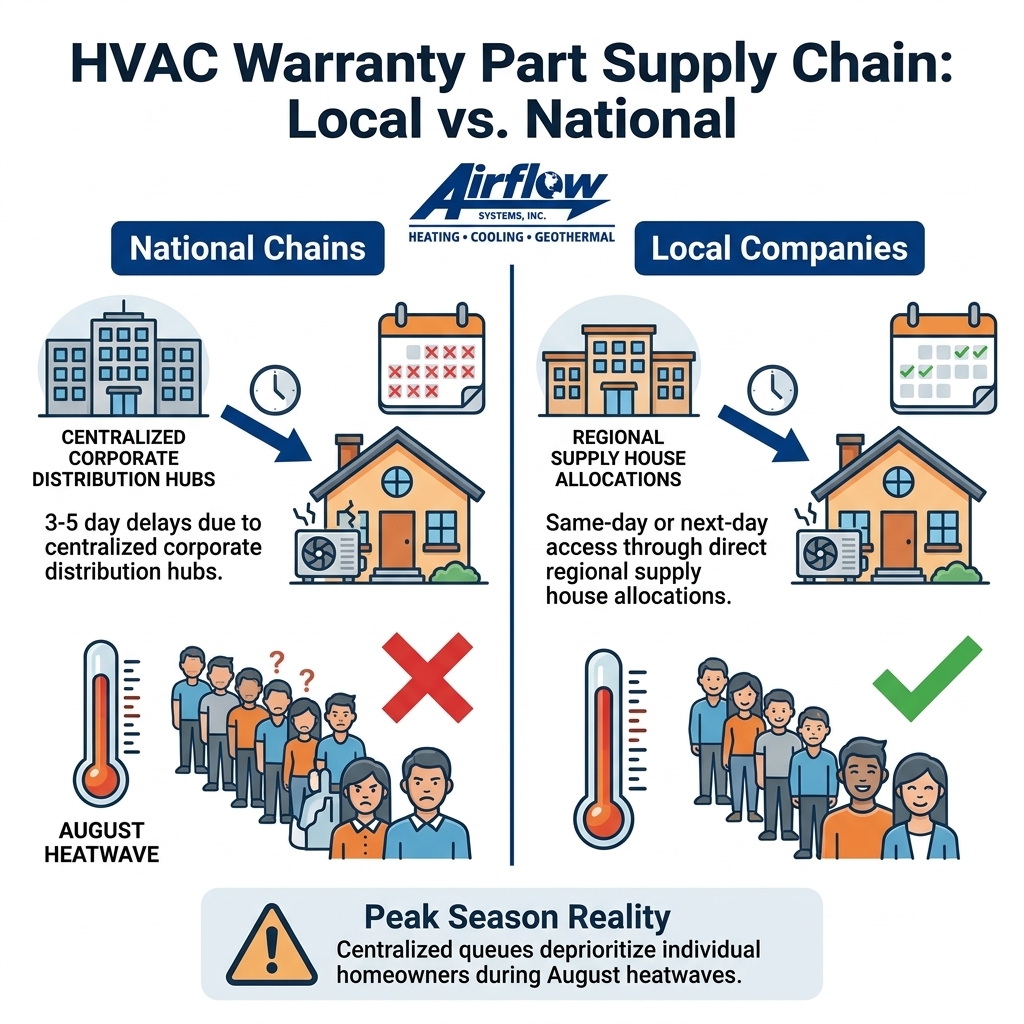
We often hear from frustrated homeowners who previously dealt with large, out-of-town operators or massive corporate franchises, only to find themselves stepping into a rigid, highly centralized logistical machine. These organizations process warranty claims through centralized corporate hubs, often located several states away. This structure is designed for corporate efficiency and inventory control, not for the urgent comfort of an individual homeowner suffering through an August heatwave.
Understanding why choosing a family-owned HVAC company makes a difference becomes painfully clear when you look at the timeline of a corporate warranty claim. The process is bogged down by layers of administrative red tape that simply cannot be bypassed.
The 3-5 Day Bureaucratic Delay
When a technician from a national chain diagnoses a failed proprietary OEM control board, the repair order goes into a massive digital queue. Here is what that timeline typically looks like:
1. The corporate diagnosis: The local technician submits the part request to a regional manager or centralized dispatch center.
2. The warranty approval: A separate administrative department verifies the coverage, a process that can take 24 to 48 hours during peak season.
3. The warehouse order: Once approved, the order is sent to a massive national distribution warehouse, often located in the Midwest or Southwest.
4. The shipping transit: The part is picked, packed, and shipped via standard commercial freight, adding another 2 to 3 days of transit time.
Throughout this entire process, your specific work order is just a number in a national queue. The corporate structure deprioritizes individual emergencies in favor of standardized procedure, leaving you waiting 3 to 5 days—or longer—for a resolution.
The Local Advantage: Direct Supply House Relationships
The mechanical and logistical advantage of working with an independent, locally invested team changes the entire supply chain equation. Partnering with a local HVAC company like ours at Airflow Systems means you benefit directly from our established, personal relationships with regional supply house managers right here in Charlottesville.
We do not have to route requests through a corporate hub in another state. When a proprietary component fails, our technicians can literally pick up the phone, call the manager at the local distribution center, and secure the item immediately. This direct line of communication bypasses the bureaucratic red tape entirely.
How Local Allocations Work
Regional distributors operate differently than national warehouses. They hold specific part allocations reserved exclusively for their trusted, locally-owned contractor partners. Because our team at Airflow Systems has spent decades building these relationships, we have priority access to the inventory sitting on shelves right in our community.
• Part Verification — National Corporate Chain: Routed to out-of-state administrative department — Locally Owned Company: Handled directly by the local service manager
• Inventory Sourcing — National Corporate Chain: Pulled from a centralized national warehouse — Locally Owned Company: Secured from reserved local supply house allocations
• Transit Time — National Corporate Chain: 3 to 5 days via commercial freight shipping — Locally Owned Company: Same-day or next-day local counter pickup
• Priority Level — National Corporate Chain: Just another ticket number in a nationwide queue — Locally Owned Company: Directly managed by a local team invested in your comfort
Keeping operational logistics within the community translates directly to faster recovery times. When the parts are sourced locally, the repair happens locally, and your home returns to a comfortable temperature days sooner than it would through a centralized corporate channel.
Climate Reality: Why Days Matter During Peak Summer
Our technicians know firsthand that the severe impact of losing cooling capabilities during the hottest weeks of the year cannot be overstated. In Charlottesville, the sweltering, highly humid August weather turns a broken air conditioner from a minor inconvenience into a genuine safety and comfort crisis. When the humidity spikes and temperatures soar, the interior of a home can quickly become unbearable, making a 3-5 day wait for a centralized part shipment completely unacceptable.
Continuous operation during these extreme temperatures drastically increases the failure rate of sensitive electronics. A proprietary OEM control board is most likely to fail exactly when you need it most—during an extended, brutal August heatwave. The necessity of rapid response times is about protecting your home's interior, preserving your family's comfort, and preventing secondary issues like rapidly spreading indoor humidity.
Real Solutions for Real Heat
The urgency of local response: One local homeowner experienced this firsthand when an AC system issue, combined with complications from their original installation, caused a breakdown during the peak summer heat. Because they were working with our responsive local team, our own Technician Shannon was able to step in, correct the underlying AC problem, and resolve the inherited issues promptly, all while keeping the final invoice completely reasonable. That level of agility simply isn't possible when a technician is waiting on a corporate shipping department.
• Humidity control: Without active cooling, Charlottesville's summer humidity quickly permeates drywall, fabrics, and cabinetry.
• Sleep disruption: Elevated indoor temperatures make restful sleep impossible, impacting your daily life and focus.
• Pet safety: Homes that heat up rapidly pose a severe risk to indoor pets who cannot regulate their body temperatures effectively.
Navigating Warranty Coverage and Logistics
We frequently have to clear up a common misconception about how manufacturer coverage actually functions when a system breaks down. Understanding the fine print is crucial for managing expectations during an emergency. A manufacturer's warranty guarantees that the physical part will be provided to replace a defective component, but it does absolutely nothing to guarantee the speed of its delivery.
The logistics of shipping, tracking, and fulfillment fall entirely on the shoulders of the contractor you hire. The manufacturer will gladly supply a new proprietary OEM control board, but if your contractor's operational efficiency relies on slow, centralized shipping, you will still be the one waiting in the heat.
The Contractor's Role in Speed
Logistical capabilities matter: Your contractor's supply chain network dictates the repair timeline. Choosing a team whose logistical capabilities match the urgency of the repair is vital. Recently, one of our Airflow Systems customers dealt with a leaking coil in their air handler. The issue was quickly diagnosed by our local team, and because the logistics were handled efficiently through regional channels, the repair was completed as soon as the specific part arrived, minimizing the downtime.
The local translation: Local ownership directly translates to faster part acquisition because the contractor takes personal responsibility for tracking down the component. We aren't waiting for an automated email from a warehouse; we are actively driving to the supply house to pick up the item and get your system back online.
Proactive Protection: Catching Failing Parts Early
We always tell our customers that the absolute best way to handle an end-of-season cooling emergency is to prevent it from happening in the first place. Catching failing parts early helps homeowners avoid the stress of emergency part sourcing altogether. While you cannot predict every mechanical failure, routine evaluations can spot issues with sensitive electronics long before they completely break down.
Enrolling in a comprehensive preventative maintenance plan ensures that a professional is evaluating the health of your system before the August heatwave hits. Identifying a stressed proprietary OEM control board in May is vastly preferable to dealing with its sudden failure in late summer.
What Technicians Look For
During a proactive evaluation, our technicians check the electrical tolerances of your system's most critical components. We are looking for early warning signs that indicate an impending failure:
• Voltage irregularities: Fluctuations in power can indicate that a control board is beginning to degrade.
• Burnt contacts: Visual inspections often reveal scorch marks or pitting on electrical connections before they sever completely.
• Swelling capacitors: Bulging components are a clear sign that a part is struggling to hold a charge and needs immediate replacement.
• Erratic communication: Delays between the thermostat's signal and the compressor's response often point to a failing proprietary board.
Securing peace of mind knowing the system is prepared for continuous operation reduces the risk of a late-summer emergency. By catching these issues early, we can source and install the necessary components on your schedule, entirely avoiding the frantic rush of peak-season breakdowns.
Secure Faster Solutions with a Trusted Local Team
When the Charlottesville heat is at its worst, the logistical advantage of local ownership becomes your most valuable asset. Relying on a team with direct, established relationships with regional supply houses means faster parts, less bureaucratic red tape, and significantly less time sweating in a hot house while waiting for a corporate shipment.
Partnering with locally invested experts ensures that your comfort is prioritized over standardized national procedures. If you want the reassurance of rapid response times and a team that knows how to navigate regional supply chains effectively, reach out to our trusted local team at Airflow Systems to discuss your cooling needs and secure faster solutions today.
Frequently Asked Questions
Why is my AC warranty part taking so long to arrive?
If you are working with a large national chain, your warranty part is likely stuck in a centralized corporate distribution queue. These organizations process claims through out-of-state administrative hubs, adding significant delays for approvals and commercial freight shipping. Local companies like Airflow Systems bypass this by sourcing directly from regional supply houses.
How long does it usually take to get an HVAC warranty part?
Through a centralized national supply chain, specialized components often take 3 to 5 days to arrive during peak season. However, if your contractor has direct relationships with local supply house managers, they can often secure the necessary items the same day or the next day.
Should I use a local HVAC company or a large chain for warranty work?
Using a local HVAC company provides a distinct logistical advantage for warranty work. Independent contractors can leverage their regional supply house relationships to expedite specialized parts quickly, whereas large chains are bound by slow, rigid corporate distribution networks.
Do HVAC warranties cover the cost of expedited shipping?
Most standard manufacturer warranties cover the cost of the physical replacement part, but they do not cover expedited shipping or labor. If a component must be rushed from a national warehouse, the homeowner is often responsible for the steep overnight freight charges.
How do local HVAC companies get parts faster than national chains?
Local HVAC companies cultivate personal relationships with regional supply house managers who hold specific inventory allocations for their trusted partners. Instead of waiting for a corporate warehouse to process an order, local technicians can pick up the parts directly from the community distributor.
Can a generic part be used if the proprietary OEM part is delayed?
For modern, high-efficiency systems, generic parts generally cannot be used as a substitute for proprietary OEM components like control boards. Using an unauthorized off-the-shelf part can void your manufacturer's guarantee and risks causing severe electrical damage to the rest of the unit.
Book Expert Service Or Contact Us
Our Service Process
A Hassle-Free Service Experience
01
Consultation & Diagnosis
We start by listening to your needs and performing a thorough diagnosis of your system to recommend the best solution.
02
Transparent Quoting
We provide a clear, upfront estimate with no hidden fees, so you know exactly what to expect.
03
Expert Service & Follow-Up
Our factory-trained technicians complete the work to the highest standards, and we follow up to ensure your complete satisfaction.
testimonials
What Our Customers Are Saying
Our customers consistently praise our exceptional service and attention to detail, making us a trusted choice for all your HVAC needs.
where we operate
Service areas