

Choose an option to see quick actions and get help faster.
.svg)
Is It Time to Repair or Replace Your HVAC System?
Knowing when to repair vs replace your HVAC system can save you from throwing money at a unit that's already on its way out — or from spending thousands on a new system you didn't actually need yet. Here's a quick-reference guide to help you decide:
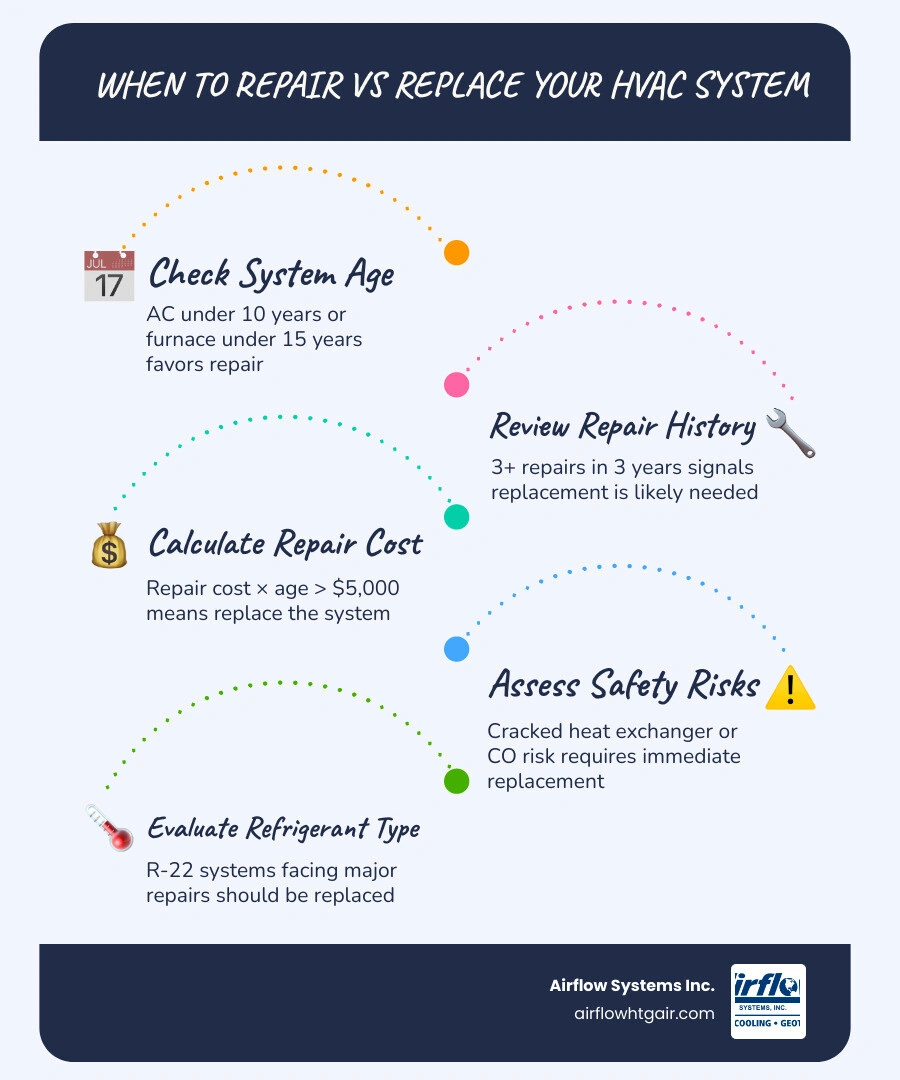
Repair your HVAC system if:
• The system is less than 10 years old (AC) or less than 15 years old (furnace)
• The repair cost is less than 30% of a full replacement cost
• You've had only one or two repairs in the past few years
• The issue is a minor wear part (capacitor, thermostat, flame sensor)
Replace your HVAC system if:
• Your AC is older than 10–12 years or your furnace is older than 15 years
• The repair cost multiplied by the system's age exceeds $5,000
• You've had three or more repairs in the past three years
• Your system uses R-22 refrigerant and needs a major repair
• There is a cracked heat exchanger, carbon monoxide risk, or other safety hazard
• Your energy bills have been climbing steadily with no clear cause
Every Central Virginia homeowner eventually faces this decision. Your heating or cooling system starts acting up — maybe it's struggling through a July heat wave in Charlottesville, making strange noises, or pushing your energy bills higher every month. And then a technician hands you a repair quote that makes you wonder: is it even worth fixing?
The honest answer is that it depends on several factors working together — not just the repair cost on its own. System age, repair history, efficiency ratings, refrigerant type, and how long you plan to stay in your home all play a role. Most HVAC systems last between 10 and 15 years, and the closer yours gets to that window, the more carefully you need to weigh every dollar you put into it.
This guide walks you through every factor that matters, so you can make a confident, informed decision — whether that's a targeted repair to buy a few more years, or a full replacement that pays off in comfort and energy savings down the road.
Warning Signs Your Heating and Cooling System Needs Attention

When an HVAC system begins to struggle, it rarely goes quiet. It usually gives off several warning signs that it requires professional attention. Recognizing these signs early can mean the difference between a simple, low-stress fix and a midnight system failure during a Central Virginia cold snap.
If your home is experiencing comfort issues, strange noises, or sudden spikes in your energy bills, it is time to call in a professional. Regular HVAC Service Charlottesville VA can help diagnose minor issues before they cascade into system-wide failures. However, if your system breaks down completely in the middle of winter or during a humid summer weekend, you may need to reach out for Emergency HVAC Services Charlottesville VA to restore safety and comfort to your household.
Inconsistent Comfort and Airflow
Are you constantly playing tug-of-war with your thermostat? If some rooms in your Charlottesville home feel like an icebox while others feel like a sauna, your system is struggling to distribute air evenly. Poor airflow can stem from a failing blower motor, clogged ductwork, or a system that has simply lost its capacity to keep up with demand.
In Central Virginia, high humidity is a constant summer companion. A properly functioning air conditioner does more than cool the air; it also extracts moisture. If your home feels swampy or you notice condensation forming on your windows, your system is no longer dehumidifying effectively. When these comfort issues become a daily struggle, scheduling a professional inspection for AC Repair Charlottesville VA is the best way to determine if a targeted fix will restore balance, or if the system is simply too worn out to perform.
Frequent Breakdowns and Rising Utility Bills
An occasional repair is a normal part of owning any mechanical system. However, if you find yourself calling a technician multiple times a year, you are likely trapped in a repair spiral. If your system has required three or more repairs in the last three years, it is a strong indicator that the internal components are failing in rapid succession.
At the same time, keep a close eye on your monthly utility bills. While energy rates fluctuate, a sudden, unexplained spike in your heating or cooling costs means your system's efficiency is in steep decline. As components wear out, the system must run longer and work harder to achieve the same temperature. If you are constantly paying for Furnace Repair Charlottesville VA while watching your energy bills climb, it is a clear sign that continuing to patch up the old unit is no longer financially prudent.
When to Repair vs Replace Your HVAC System: Key Decision Factors
Deciding when to repair vs replace your HVAC system is rarely about a single broken part. Instead, it is about looking at the big picture. You must weigh the immediate cost of a repair against the long-term reliability and efficiency of a new system.
When we evaluate a system for our neighbors in Central Virginia, we look at several key decision factors. These include the age of the equipment, the overall repair history, your future plans for your home, and whether a new HVAC Installation Charlottesville VA will ultimately save you more money over the next several years.
Understanding When to Repair vs Replace Your HVAC System Based on Equipment Age
Age is one of the most reliable indicators of where your system stands on its operational timeline. While regular maintenance can extend a system's life, mechanical wear and tear eventually catch up.
Here are the typical lifespans for standard residential heating and cooling equipment:
• Central Air Conditioners: 12 to 15 years
• Heat Pumps: 10 to 15 years
• Gas Furnaces: 15 to 20 years
If your air conditioning unit is older than 10 years or your furnace is older than 15 years, it is time to start planning for a replacement rather than investing in major repairs. If a major component fails on an older system, investing in AC Replacement Charlottesville VA or Furnace Replacement Charlottesville VA is often the smarter long-term investment, as it spares you from the compounding repair costs that define a system's final years.
How Safety Hazards Dictate When to Repair vs Replace Your HVAC System
While financial formulas are helpful, safety concerns always override the math. There are certain critical safety hazards that should immediately trigger an HVAC replacement, regardless of how recently you repaired the system.
For homes with gas furnaces, the most serious hazard is a cracked heat exchanger. The heat exchanger is responsible for keeping dangerous combustion gases, including carbon monoxide, separate from the air circulating through your home. If a heat exchanger cracks, it can leak carbon monoxide into your living spaces.
Other safety red flags include:
• A yellow, flickering pilot light or burner flame (which indicates incomplete combustion and carbon monoxide risk) instead of a steady, blue flame.
• Scorching, soot build-up, or unusual burning odors around the furnace cabinet.
• Repeatedly tripped circuit breakers or melted wiring, which present severe fire hazards.
In these high-risk scenarios, trying to patch the system is unsafe. If your system presents a safety hazard, switching to a safe, modern heating solution or scheduling an immediate Heat Pump Repair Charlottesville VA to assess your options is the only responsible path forward.
Applying Financial Rules of Thumb Conceptually
When you are faced with a repair quote, it helps to have a structured, mathematical way to evaluate your options. Rather than relying on guesswork, we recommend using a couple of industry-standard rules of thumb to help guide your decision.
To keep your system running reliably, regular HVAC Maintenance Charlottesville VA is essential. However, when a breakdown does occur, the table below offers a conceptual framework for comparing your options, followed by a deeper look at the two most popular decision-making rules.
• System Age — Lean Toward Repair: Under 10 years — Lean Toward Replacement: Over 10–15 years
• Repair Cost vs. Replacement — Lean Toward Repair: Less than 30% of replacement cost — Lean Toward Replacement: Exceeds 30% to 50% of replacement cost
• $5,000 Rule Result — Lean Toward Repair: Total calculation is under $5,000 — Lean Toward Replacement: Total calculation exceeds $5,000
• Refrigerant Type — Lean Toward Repair: Uses eco-friendly R-410A or newer — Lean Toward Replacement: Uses phased-out R-22 (Freon)
• Safety Status — Lean Toward Repair: No safety or combustion issues — Lean Toward Replacement: Confirmed cracked heat exchanger or electrical hazard
The $5,000 Rule Explained
The $5,000 rule is a simple, time-tested mathematical formula used by homeowners and technicians alike to evaluate repair viability.
To apply this rule, you simply multiply the exact age of your system by the repair quote you received:
System Age (Years) × Repair Cost (Dollars) = Score
• If the total is under $5,000: The system is generally a good candidate for repair.
• If the total exceeds $5,000: You should seriously consider replacing the system.
For example, if you have an 8-year-old air conditioner that needs a repair quote of $300, the math is:
8 × 300 = 2,400
Since $2,400 is well below the $5,000 threshold, repairing the system is a highly reasonable choice.
However, if you have a 12-year-old system that needs a major repair quote of $600, the calculation changes:
12 × 600 = 7,200
Because $7,200 far exceeds the threshold, the math strongly suggests that your money is better spent on a replacement.
The 50% Rule for Major Components
Another reliable guideline is the 50% rule. This rule states that if the cost of repairing your existing HVAC system exceeds 50% of the cost of a brand-new system, replacement is almost always the better financial decision. In fact, many industry experts recommend a more conservative 30% threshold for older systems. If the cost of a repair exceeds 30% of the replacement cost on a unit that is past its 10th birthday, you are likely better off upgrading.
This rule is particularly relevant when dealing with major component failures, such as a failed compressor in an air conditioner or heat pump. The compressor is the heart of the system, and replacing it is a highly labor-intensive process. If you face a compressor failure on a unit that is over a decade old, investing in Heat Pump Replacement Charlottesville VA will give you a fully warranted, highly efficient system, rather than a patched-up unit with other aging parts waiting to fail.
Technological Advancements and Environmental Regulations
The HVAC industry has undergone massive technological and regulatory shifts over the last decade. If you are comparing a system built fifteen years ago to one manufactured today, you are looking at entirely different levels of technology.
These advancements directly impact your decision of when to repair vs replace your HVAC system. Modern systems must adhere to strict environmental standards, use safer refrigerants, and offer significantly higher efficiency ratings (such as SEER2 for cooling, AFUE for gas furnaces, and HSPF2 for heat pumps). For homeowners in HVAC Replacement Crozet VA or HVAC Replacement Keswick VA, upgrading to these modern standards can dramatically lower monthly operating costs.
The Transition to Eco-Friendly Refrigerants
One of the most significant changes in residential cooling is the phase-out of older chemical refrigerants. The EPA completely banned the production and import of R-22 (often known as Freon) in 2020 due to its ozone-depleting properties.
If your air conditioner was installed before 2010, there is a high probability it uses R-22. Because the supply of R-22 is extremely limited, repairing a refrigerant leak on an older system has become incredibly expensive. Furthermore, the industry is currently undergoing a secondary phase-down of R-410A (the refrigerant that replaced R-22) in favor of newer, low-global-warming-potential (GWP) alternatives.
If you live in HVAC Replacement Earlysville VA and have an older system with a major refrigerant leak, attempting to recharge it is often a temporary, expensive band-aid. Upgrading to a modern system that uses current, eco-friendly refrigerants is the most environmentally responsible and cost-effective path forward.
Energy Efficiency and Long-Term Savings
Modern HVAC systems are remarkably efficient compared to those built just a decade ago. Standard efficiency models today can save you between 20% and 40% on your monthly heating and cooling costs compared to older units. If you choose an ENERGY STAR certified system, you can expect even greater performance.
• ENERGY STAR Air Conditioners and Heat Pumps can save up to 20% on heating and cooling costs compared to standard new models.
• ENERGY STAR Furnaces are up to 15% more efficient than conventional models, allowing you to get more heat out of every unit of fuel.
Additionally, modern systems utilize variable-speed technology. Unlike older systems that run at either 100% capacity or 0% (like a noisy car that only goes from zero to sixty with nothing in between), variable-speed systems continuously adjust their output to match your home's exact comfort needs. This results in incredibly consistent temperatures, superior humidity control, and whisper-quiet operation. For homeowners in HVAC Replacement Ruckersville VA, these efficiency gains, combined with available utility rebates and state incentives, can allow a new system to pay for itself over time.
Frequently Asked Questions about HVAC Replacement Timing
How long do central air conditioners and furnaces typically last?
On average, a central air conditioner lasts between 12 and 15 years, while a high-quality gas furnace can last between 15 and 20 years. Heat pumps typically have a lifespan of 10 to 15 years.
However, these lifespans depend heavily on how well the system is maintained. Our Central Virginia climate brings hot, humid summers and freezing winters, which means your system works hard throughout the year. Scheduling a regular HVAC Tune Up Charlottesville VA is the single best way to ensure your system reaches the upper end of its expected lifespan.
Should I replace my furnace and air conditioner at the same time?
In most cases, yes. If your outdoor air conditioner and indoor furnace are of similar age, replacing them together is highly recommended.
HVAC systems are designed to work as a matched pair. If you connect a brand-new, high-efficiency outdoor AC unit to an old, worn-out indoor blower motor, the system will struggle to achieve its rated efficiency, and you may experience premature wear and tear. Additionally, combining the installation allows you to save significantly on labor costs compared to scheduling two separate installation visits years apart.
How does my planned length of stay in my home affect the decision?
If you plan to live in your home for seven years or more, investing in a high-efficiency replacement makes excellent financial sense, as you will have plenty of time to recoup the investment through lower monthly utility bills and enjoy the superior comfort.
If you plan to sell your home within the next year or two, a minor repair may be the more practical choice to keep the system operational. However, keep in mind that an ancient, unreliable HVAC system can be a major red flag for potential home buyers during an inspection. A newly installed, fully warranted system can significantly boost buyer confidence and prevent negotiating hurdles during the sale process.
Conclusion
Deciding when to repair vs replace your HVAC system is a major decision, but you do not have to make it alone. By weighing the system's age, evaluating the frequency of your repairs, and keeping safety as your top priority, you can choose the path that makes the most sense for your family's comfort and budget.
At Airflow Systems Heating & Air, we have served our neighbors in Charlottesville and Central Virginia as a trusted, family-owned contractor since 1988. Our certified professionals utilize the latest diagnostic technologies and represent major, reliable HVAC brands. We believe in providing honest, straightforward advice, helping you understand your options without any high-pressure sales tactics.
Whether you need a reliable repair to keep your current system running smoothly or are ready to explore an energy-efficient upgrade, we are here to help. Contact us today to schedule a professional comfort assessment for your HVAC system!
Book Expert Service Or Contact Us
Our Service Process
A Hassle-Free Service Experience
01
Consultation & Diagnosis
We start by listening to your needs and performing a thorough diagnosis of your system to recommend the best solution.
02
Transparent Quoting
We provide a clear, upfront estimate with no hidden fees, so you know exactly what to expect.
03
Expert Service & Follow-Up
Our factory-trained technicians complete the work to the highest standards, and we follow up to ensure your complete satisfaction.
testimonials
What Our Customers Are Saying
Our customers consistently praise our exceptional service and attention to detail, making us a trusted choice for all your HVAC needs.
where we operate
Service areas