


Choose an option to see quick actions and get help faster.
.svg)

The Central AC vs Ductless Mini Split Comparison Every Virginia Homeowner Should See

The central ac vs ductless mini split comparison comes down to one core question: does your home already have ductwork, and how well is it working?
Here's a quick breakdown to help you decide:
• Requires ductwork — Central AC: Yes — Ductless Mini Split: No
• Best for — Central AC: Larger homes with existing ducts — Ductless Mini Split: Additions, older homes, zoned spaces
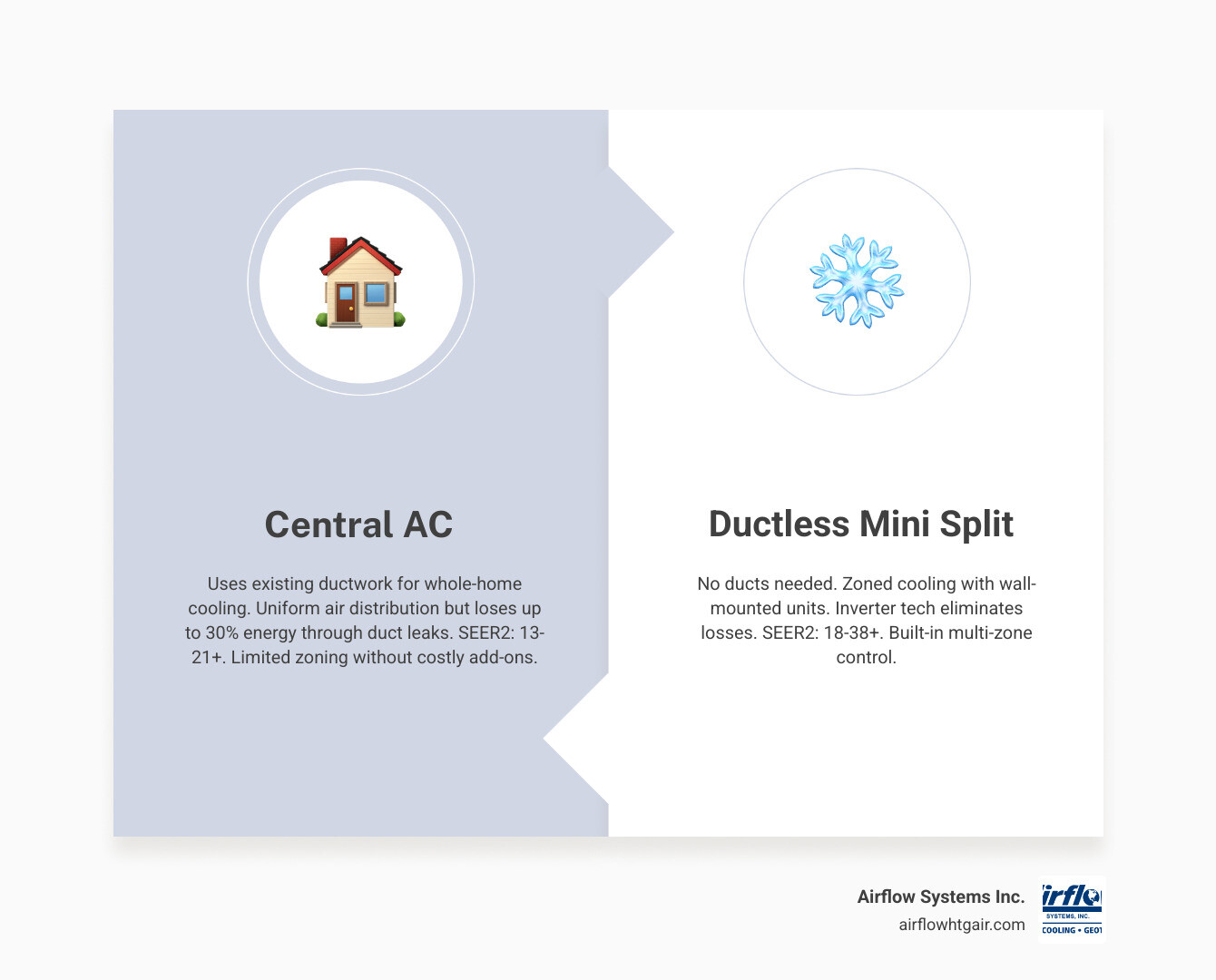
• Typical SEER range — Central AC: 13-21+ SEER2 — Ductless Mini Split: 18-38+ SEER2
• Energy loss from ducts — Central AC: Up to 30% — Ductless Mini Split: None
• Zoning — Central AC: Possible, but costly to add — Ductless Mini Split: Built-in by design
• Aesthetics — Central AC: Hidden vents, very discreet — Ductless Mini Split: Visible wall-mounted units
• Heating capability — Central AC: Paired with furnace — Ductless Mini Split: Heat pump models available
• Lifespan — Central AC: 15-20 years — Ductless Mini Split: 15-20 years
If you already have well-sealed ducts and want whole-home cooling, central AC is likely your most cost-effective path. If your home has no ductwork, has a new addition, or you want room-by-room control, a ductless mini split often makes more sense - and can use up to 30% less energy in the right setup.
Here in Central Virginia, that choice gets more nuanced. Our summers are humid and hot, our winters can swing from mild to surprisingly bitter, and many homes - especially older properties in and around Charlottesville - simply weren't built with modern ductwork in mind. That means the "right" system isn't always obvious, and a one-size-fits-all answer can end up costing you real money.
At Airflow Systems Inc., we help homeowners work through exactly this kind of decision every day. This guide walks you through the key differences so you can make a confident, informed choice for your home and your family's comfort.
Understanding the Central AC vs Ductless Mini Split Comparison
When we look at a central ac vs ductless mini split comparison, we are essentially looking at two different philosophies of home comfort. One is a "set it and forget it" whole-house approach, while the other offers surgical precision.
Both systems rely on the same basic scientific principles. They use an outdoor condenser unit to dissipate heat and an indoor component to absorb heat from your air using refrigerant lines. However, the way they move that cooled air into your living room or bedroom is where they go their separate ways.
A central AC system is a "split system" because it has components both inside and outside, but it relies on a single, powerful indoor air handler to push air through a network of hidden ducts. A ductless mini split, as the name implies, skips the ducts entirely. Instead, it uses small, individual indoor air handlers mounted directly on the walls or ceilings of the rooms you want to cool.
For many of our neighbors in Central Virginia, the decision isn't just about technology; it’s about the architecture of the home. If you’re living in a historic home near downtown Charlottesville, tearing open plaster walls to install bulky ductwork for a central system might be a nightmare. In that scenario, the mini split is often the clear winner. On the other hand, if you’re in a newer build with existing infrastructure, upgrading your central unit might be the path of least resistance.
If you are curious about how these systems fit into your overall home health, you can learn more about our HVAC services to see which installation style aligns with your goals.
How Central AC Works with Existing Ductwork
Central air conditioning is the traditional heavyweight of the American HVAC world. It operates on a "forced air" principle. A large fan in your indoor unit pulls warm air from your home through "return" vents, passes it over cold evaporator coils, and then pushes that chilled air back through "supply" ducts to every corner of the house.
The primary advantage here is uniformity. When the thermostat clicks on, the entire home—from the kitchen to the guest room—moves toward the same temperature. For large families who use every square inch of their home simultaneously, this is often the most convenient setup. It also allows for high-quality air filtration and humidity control to be managed at a single, central point.
The Mechanics of a Ductless Mini Split Comparison
Ductless mini splits are often seen as the "modern" alternative, though the technology has been a global standard for decades. The secret to their success is inverter technology. Unlike traditional central AC units that often operate like a light switch—either 100% on or 100% off—mini splits use variable-speed compressors.
These compressors can ramp up or down like a dimmer switch, running at exactly the speed needed to maintain a steady temperature. This prevents the "blast of cold air followed by a warm lull" cycle common in older central systems. Because there are no ducts, there is no "duct loss"—meaning 100% of the air cooled by the system actually ends up in your living space.
Energy Efficiency and the Impact of Duct Losses
Efficiency is perhaps the most significant battleground in the central ac vs ductless mini split comparison. In the HVAC industry, we measure this using SEER2 (Seasonal Energy Efficiency Ratio) ratings. While high-end central AC systems can reach impressive ratings of around 21 to 26 SEER2, ductless mini splits frequently soar into the 30s, with some ultra-efficient models hitting 38 or higher.
But the numbers on the box don't tell the whole story. The biggest enemy of central AC efficiency is the ductwork itself. According to the Department of Energy, typical duct systems lose about 25% to 30% of their cooling energy through leaks, poor insulation, or "thermal bypass" (where cool air warms up while traveling through a hot attic).
Imagine buying a gallon of milk but having 30% of it leak out of the bag before you get home. That is essentially what happens with many central systems. By eliminating the ducts, mini splits eliminate this waste entirely. If you’re concerned about how much energy your current system is wasting, we recommend looking into home energy diagnostics to identify where those "leaks" are happening in your own home.
Zoning Benefits in a Central AC vs Ductless Mini Split Comparison
One of our favorite things to point out to Charlottesville homeowners is the power of zoning. In a central AC system, you generally have one thermostat. If you want your bedroom at 68 degrees for sleeping, you have to cool the empty kitchen, the unused dining room, and the laundry room to 68 degrees as well.
Ductless mini splits offer built-in zoning. Each indoor head has its own thermostat and remote. This allows you to:
• Keep the home office cool during the day while the rest of the house stays at a higher, energy-saving temperature.
• Let every family member set their bedroom to their own personal comfort level.
• Turn off the cooling entirely in guest rooms that aren't being used.
This targeted cooling is a massive energy saver and is one of the primary reasons mini splits can lead to lower monthly utility bills, even if the upfront equipment is specialized.
Choosing the Right System for Your Home Layout
The layout of your home is often the ultimate tie-breaker. We see a wide variety of home styles in Central Virginia, from sprawling farmhouses to compact bungalows.
In a central ac vs ductless mini split comparison, the "best" system often depends on where you are standing in the house. For instance, if you have a multi-story home where the upstairs is always five degrees warmer than the downstairs, a mini split can be the perfect "booster" to solve that specific comfort gap.
If you are planning a renovation or need a solution for a specific area, you can explore our detailed page on mini-split systems to see how they integrate into different room types.
When Central Air is the Logical Choice
Central air remains the gold standard for large, open-concept homes that already have functional ductwork. If your ducts are in good shape and well-insulated, replacing an old central unit with a new, high-efficiency SEER2-rated model is often the most logical financial move.
Homeowners also choose central AC for its "invisible" nature. If you’ve spent years perfecting your interior design and don't want a unit mounted on the wall, central AC’s discreet floor or ceiling vents are the way to go. Furthermore, central systems are excellent for integrating whole-home indoor air quality systems, such as UV lights or high-efficiency HEPA filters, which treat every cubic inch of air in the house simultaneously.
When to Go Ductless for Maximum Flexibility
Ductless systems shine in scenarios where central AC struggles. We frequently recommend them for:
• Garage Workshops: Want to work on your car or hobbies year-round without a massive renovation? A single-zone mini split is a perfect fit.
• Historic Homes: Charlottesville is full of beautiful older homes that lack the space for 12-inch ducts. Mini splits only require a small 3-inch hole for refrigerant lines.
• Attic Conversions and Sunrooms: These spaces often have unique heat loads that "overtax" an existing central system. Adding a mini split ensures these rooms stay comfortable without making the rest of the house freezing.
• Guest Suites: Allow your visitors to control their own climate without messing with your main thermostat.
Maintenance, Lifespan, and 2026 Efficiency Standards
Both systems have a typical lifespan of 15 to 20 years, but how you get there depends on maintenance. For central AC, maintenance involves changing a single large filter every 1 to 3 months and ensuring the outdoor unit stays clear of debris. You also need to keep an eye on the health of your ducts; over time, they can accumulate dust or develop leaks that require professional sealing.
Mini splits require a bit more "hands-on" attention from the homeowner. Because the indoor units are smaller, their filters are smaller too. We recommend cleaning these reusable filters every 2 to 4 weeks, especially if you have pets. It’s a simple process—just pop them out, rinse them in the sink, let them dry, and put them back.
As we move into 2026, efficiency standards are becoming stricter. The Department of Energy has updated testing procedures (SEER2 and HSPF2) to better reflect real-world conditions, particularly the air pressure found in ductwork. This makes the inherent efficiency of ductless systems even more attractive. Additionally, under the Inflation Reduction Act, many homeowners in Central Virginia can qualify for federal tax credits of up to $2,000 for installing qualifying high-efficiency heat pump systems.
To keep either system running at peak performance for its full 20-year life, regular AC maintenance is essential. A professional tune-up once a year ensures your refrigerant levels are correct and your electrical components are safe.
Frequently Asked Questions about Cooling Systems
Can mini-splits provide heating during Virginia winters?
Yes! Most modern mini splits are actually "heat pumps." This means they can reverse their operation to pull heat from the outdoor air and move it inside. Even when it’s chilly in Charlottesville, there is still heat energy in the air.
While older heat pumps used to struggle when temperatures dropped below freezing, today’s "cold-climate" mini splits can provide efficient heating even when it’s well below zero. This makes them an excellent year-round solution. If you’re considering making the switch, check out our heat pump installations for more details on how this technology handles our local winters.
Is it possible to use both systems in one home?
Absolutely. In fact, many of the most comfortable homes we service in Central Virginia use a "hybrid" approach. You might have a traditional central AC and furnace for the main living areas but use a mini split for a "problem" room like a finished basement or a master suite that never seems to get enough airflow. This gives you the best of both worlds: whole-home coverage and precision control where you need it most.
How do noise levels compare between the two?
This is one area where the central ac vs ductless mini split comparison usually favors the mini split. Because the compressor is located outside and the indoor units use very sophisticated, small fans, mini splits are often "whisper-quiet." Most indoor units operate at around 19 to 26 decibels—which is quieter than a library.
Central AC systems aren't necessarily "loud," but you will definitely hear the "whoosh" of air coming through the vents when the system kicks on. If you are a light sleeper or have a home office where you need total silence for calls, the quiet operation of a mini split is a major perk.
Conclusion
Choosing between central AC and a ductless mini split isn't about finding a "winner"—it's about finding the right fit for your specific Charlottesville home. Whether you need the invisible, whole-home power of a central system or the high-efficiency, zoned flexibility of a mini split, the goal is the same: a comfortable home and a manageable energy bill.
At Airflow Systems Inc., we’ve been the trusted experts in Central Virginia since 1988. As a family-owned business, we take pride in helping our neighbors navigate these complex choices with honest advice and certified expertise. We don't just install boxes; we design comfort solutions tailored to your life.
Ready to see which system is right for you? Schedule your AC installation or a professional comfort assessment with us today, and let’s get your home ready for whatever the Virginia weather throws our way.
Book Expert Service Or Contact Us
Our Service Process
A Hassle-Free Service Experience
01
Consultation & Diagnosis
We start by listening to your needs and performing a thorough diagnosis of your system to recommend the best solution.
02
Transparent Quoting
We provide a clear, upfront estimate with no hidden fees, so you know exactly what to expect.
03
Expert Service & Follow-Up
Our factory-trained technicians complete the work to the highest standards, and we follow up to ensure your complete satisfaction.
testimonials
What Our Customers Are Saying
Our customers consistently praise our exceptional service and attention to detail, making us a trusted choice for all your HVAC needs.
where we operate
Service areas