


Choose an option to see quick actions and get help faster.
.svg)

How to Tell If Your AC Compressor Is Failing (Before It Costs You Big)
Knowing how to tell if your ac compressor is failing could save you from a sweltering summer and an expensive emergency repair. The compressor is the heart of your air conditioning system — it pressurizes refrigerant and keeps cool air moving through your home. When it starts to go, the whole system suffers.
Here are the most common warning signs to watch for:
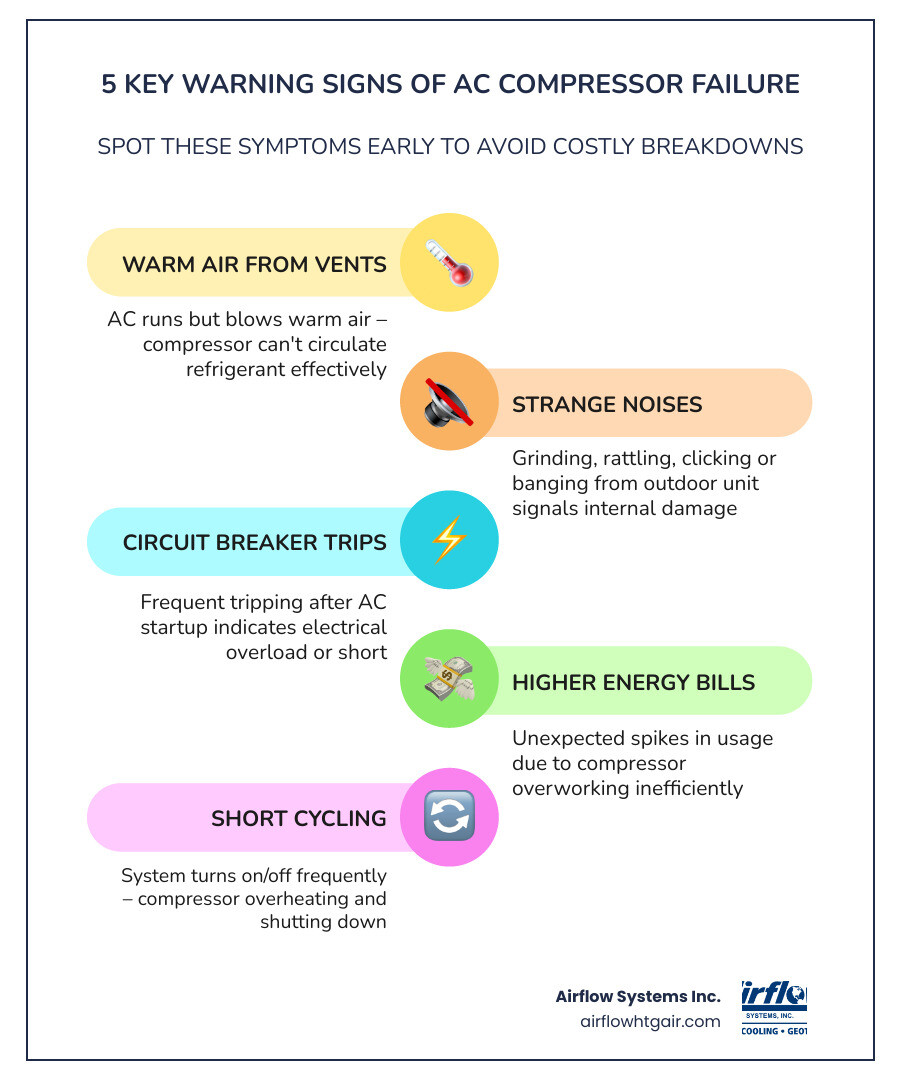
• Warm air blowing from vents even when the AC is running
• Strange noises from the outdoor unit — grinding, rattling, clicking, or banging
• Circuit breaker tripping repeatedly after turning the AC on
• Higher energy bills without a change in usage habits
• Short cycling — the system turning on and off more frequently than normal
• Refrigerant leaks — puddles or oily residue near the outdoor unit
• Hard starting — the unit shudders or struggles before kicking on
Any one of these signs is worth paying attention to. More than one showing up at the same time? That's your system telling you it needs help now, not later.
Most AC compressors last between 10 and 15 years with proper maintenance — but stress from dirty coils, low refrigerant, or electrical problems can cut that lifespan short. The good news is that catching problems early almost always means simpler, less costly fixes.
7 Signs Your AC Compressor Is Failing
The compressor is often called the "heart" of your HVAC system because it functions much like a human heart, pumping the "blood" (refrigerant) through the "veins" (copper lines) to keep the system alive. In Charlottesville, where our summers can swing from pleasantly warm to oppressively humid, a failing compressor is the last thing you want to deal with.
If you are wondering how to tell if your ac compressor is failing, look closely at these seven red flags:
1. Warm Air Blowing from Vents
This is usually the first sign homeowners notice. If your thermostat is set to "cool" and the fan is blowing, but the air coming out of your registers feels like a lukewarm breeze, your compressor may be struggling. The compressor's job is to pressurize the refrigerant so it can release heat outside. If it can't reach the necessary pressure, the refrigerant won't get cold enough to absorb heat from your indoor air. Before assuming the worst, check your programmable thermostats to ensure the settings haven't been bumped.
2. Strange and Loud Noises
Your outdoor unit should hum steadily. If it starts sounding like a bag of silverware in a dryer, you have a problem.
• Grinding or Screeching: This often indicates that internal bearings are wearing out or the motor is seizing.
• Rattling or Banging: This could mean a mounting bracket has come loose or a small internal component has broken off and is bouncing around.
• Clicking: A clicking sound when the unit tries to start often points to an electrical relay issue.
3. Repeatedly Tripping the Circuit Breaker
If you have to make frequent trips to your electrical panel to flip the AC breaker back on, stop immediately. A failing compressor often overheats and draws an excessive amount of electricity—more than the circuit is designed to handle. This is a safety feature meant to prevent electrical fires. If your breaker trips, it’s time for AC repairs rather than just flipping the switch again.
4. Refrigerant Leaks
Refrigerant doesn't get "used up" like gas in a car; it circulates in a closed loop. If you see puddles or oily stains around the base of your outdoor unit, you likely have a leak. Low refrigerant levels force the compressor to work twice as hard to move heat, leading to a "burnout" where the motor eventually fails due to lack of cooling and lubrication provided by the refrigerant.
5. Hard Starting (Shaking on Startup)
Does your outdoor unit look like it’s trying to jump off its concrete pad when it kicks on? This is called "hard starting." It happens when the compressor struggles to overcome the pressure in the lines to begin its cycle. This stuttering puts immense strain on the motor and the electrical components.
6. Short Cycling
Short cycling is when your AC turns on, runs for a minute or two, and then shuts off—only to repeat the process ten minutes later. While this can be caused by an oversized unit or a faulty thermostat, it’s also a classic sign of a compressor that is overheating and shutting itself down to prevent permanent damage.
7. Unexplained Spikes in Energy Bills
If your cooling habits haven't changed but your utility bill looks like a phone number, your compressor is likely losing efficiency. As internal parts wear down, the motor has to run longer and pull more power to achieve the same cooling effect. We often recommend home energy diagnostics to see exactly where your home is losing efficiency.
Common Causes of Compressor Stress and Failure
While age is a factor, many compressors fail prematurely because of "preventable" stress. Understanding these causes can help you extend the life of your system.
Dirty Condenser Coils
The outdoor unit contains coils that release the heat collected from your home. If these coils are covered in dust, grass clippings, or spider webs, the heat gets trapped. This causes the compressor to run at much higher temperatures and pressures than it was designed for. Think of it like trying to run a marathon while wearing a heavy winter parka in July—eventually, you’re going to collapse.
Low Refrigerant and Leaks
As mentioned, refrigerant carries the oil that lubricates the compressor's moving parts. When a leak occurs, the compressor loses its "blood" and its "lube." Running a compressor with low refrigerant is a guaranteed way to cause a mechanical seizure.
Electrical Failures
Voltage spikes, blown capacitors, or corroded wiring can all lead to compressor failure. A faulty capacitor is a particularly common culprit in Central Virginia; if it can't provide the "jolt" needed to start the motor, the compressor will sit there and hum until it burns out.
Lack of Maintenance
Most of the issues listed above are caught during a standard maintenance visit. When a system isn't cleaned and inspected annually, small problems like a loose wire or a slightly dirty coil turn into a dead compressor.
Restricted Airflow
A clogged air filter doesn't just make your house dusty; it chokes the entire system. When air can't flow over the indoor evaporator coil, the refrigerant doesn't evaporate properly. This can cause liquid refrigerant to flow back into the compressor. Since liquids can't be compressed, this "slugging" can literally break the internal pistons of the compressor.
Repair vs. Replace: Making the Right Choice for Your Home
When the verdict comes back that the compressor is failing, you face a big decision: do you replace just the part or the entire system?
FactorConsider Repairing If...Consider Replacing If...System AgeThe unit is less than 10 years old.The unit is 12–15+ years old.WarrantyThe compressor is still under manufacturer warranty.The warranty has expired.Frequency of RepairsThis is the first major issue you've had.You've had multiple repairs in the last 2 years.EfficiencyYou are happy with your monthly energy bills.You want to upgrade to a higher SEER rating.Refrigerant TypeYour system uses modern R-410A.Your system uses obsolete R-22 (Freon).
In many cases, if your system is over a decade old, putting a brand-new compressor into an old system is like putting a brand-new engine into a car with 300,000 miles and a rusted frame. The other components—like the fan motor or the indoor coil—are likely nearing the end of their lives too. Opting for a full AC installation often makes more financial sense in the long run because modern systems are 20-40% more efficient than those built just 10 years ago.
Frequently Asked Questions
How to tell if your AC compressor is failing vs. a refrigerant leak?
While the symptoms overlap, a refrigerant leak often produces a distinct hissing or bubbling sound. You might also see ice forming on the copper lines or the indoor evaporator coil. A failing compressor is more likely to produce mechanical noises like grinding or clattering. However, because a leak can cause a compressor to fail, they often go hand-in-hand. A professional HVAC service technician uses specialized gauges to measure pressure and determine exactly which issue is at play.
What are the immediate steps to take if your AC compressor is failing?
If you notice the signs mentioned above—especially the circuit breaker tripping or loud grinding noises—shut the system off at the thermostat immediately. Continuing to run a failing compressor can cause it to "burn out" acidically, which contaminates the entire line set and makes a simple repair impossible. After shutting it down, check your air filter. If it's pitch black with dust, replace it, but keep the system off until a professional can inspect the damage.
How long does a typical AC compressor last?
In the Charlottesville and Central Virginia area, we typically see compressors last 10 to 15 years. The lifespan depends heavily on how hard the system has to work. Homes with poor insulation or those that skip annual tune-ups will see their compressors fail much sooner. On the other hand, a well-maintained system in a shaded area might push past the 20-year mark.
Conclusion
Your air conditioner is one of the most significant investments in your home's comfort. Understanding how to tell if your ac compressor is failing allows you to be a proactive homeowner rather than a reactive one. By catching the early signs of "hard starting" or strange noises, you can often address the underlying cause—like a bad capacitor or dirty coils—before the compressor itself gives up the ghost.
At Airflow Systems Inc., we’ve spent years helping Charlottesville families stay cool through the toughest Virginia heatwaves. As a family-owned contractor, we believe in honest diagnostics and certified expertise. Whether you need a simple tune-up to keep your "heart" pumping or a full system upgrade to improve your home's efficiency, we are here to help.
Don't wait for the hottest day of the year to find out your AC is on its last legs. Schedule your AC inspection with Airflow Systems Inc. today and ensure your home stays a cool sanctuary all summer long.
Book Expert Service Or Contact Us
Our Service Process
A Hassle-Free Service Experience
01
Consultation & Diagnosis
We start by listening to your needs and performing a thorough diagnosis of your system to recommend the best solution.
02
Transparent Quoting
We provide a clear, upfront estimate with no hidden fees, so you know exactly what to expect.
03
Expert Service & Follow-Up
Our factory-trained technicians complete the work to the highest standards, and we follow up to ensure your complete satisfaction.
testimonials
What Our Customers Are Saying
Our customers consistently praise our exceptional service and attention to detail, making us a trusted choice for all your HVAC needs.
where we operate
Service areas