

Choose an option to see quick actions and get help faster.
.svg)

Why Your AC Is Working Harder Than It Should in Charlottesville, VA
How shade insulation and sealing reduce your AC workload is one of the most practical things a Charlottesville, VA homeowner can understand heading into summer. If your home bakes in the sun all day, lets heat seep through thin walls, and leaks cool air through gaps around windows and doors, your AC never really catches a break. It just keeps running, driving up your energy bills and wearing itself out faster than it should.
Here is a quick summary of how these three strategies work together to ease the burden on your cooling system:
• Shading - Blocking direct sunlight from hitting your outdoor AC unit and windows reduces the heat your system has to fight. The U.S. Department of Energy reports that a shaded AC unit can use up to 10% less electricity than one sitting in full sun.
• Insulation - A well-insulated home slows the transfer of outdoor heat into your living spaces, meaning your AC runs less often and for shorter periods. Proper insulation and air sealing combined can save homeowners an average of 15% or more on annual heating and cooling costs.
• Air sealing - Gaps around windows, doors, outlets, and ductwork let cool air escape and hot air sneak in. Sealing those leaks keeps the conditioned air you paid for right where it belongs.
Together, these three approaches stop heat at the source instead of forcing your AC to constantly play catch-up.
Here in Central Virginia, summers bring stretches of intense heat and humidity that put real strain on HVAC systems. Many older homes in the Charlottesville area have thin or missing insulation, drafty windows, and outdoor AC units baking on sun-exposed sides of the house. That combination can push your system to the edge — and sometimes beyond it.
This guide walks you through exactly what is happening inside and around your home, and what you can do about it.
The Science of Heat Transfer: Why Your AC is Overworking
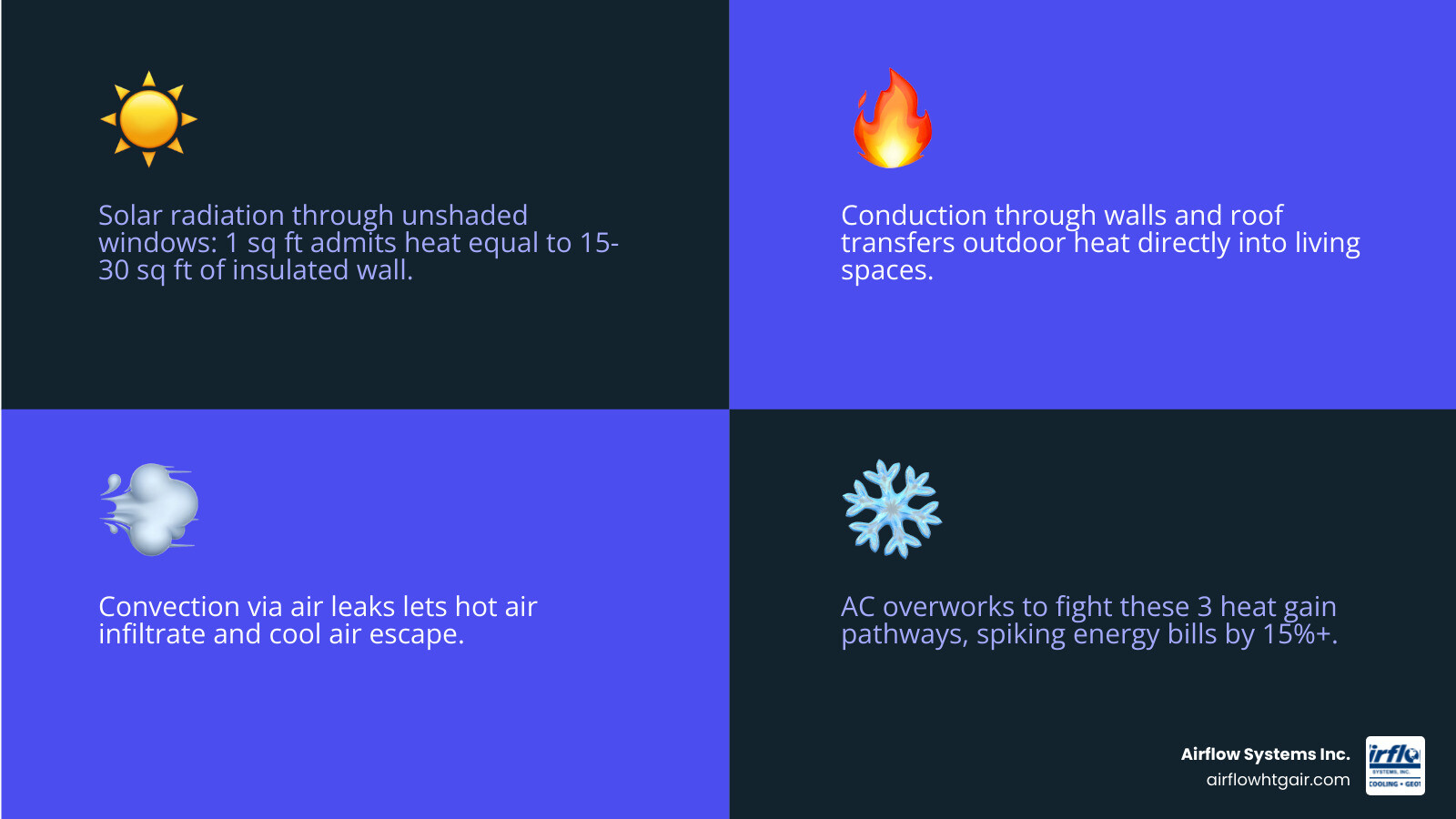
To understand how to help your system, we first have to look at the physics of why your home gets hot. Heat is a restless traveler; it always moves from warmer areas to cooler ones. This process, known as heat transfer, happens in three main ways:
1. Radiation: This is primarily the direct sunlight hitting your roof and windows. One square foot of unshaded west-facing glass can admit as much heat as 15 to 30 square feet of insulated wall.
2. Conduction: This is heat moving through solid materials. When the Virginia sun beats down on your siding or roof, that heat "soaks" through the materials and into your home.
3. Convection: This is heat carried by moving air. Hot humid air from outside finds its way through tiny cracks and gaps, while your expensive, cool air leaks out.
When these three forces work together, they create a massive "heat load." For a typical Air Conditioning unit, direct sun alone can add between 1,500 and 2,500 BTUs per hour of extra heat to the condenser. That is a significant amount of extra work your system has to do before it even begins to cool your living room.
Thermal bridges—areas like wall studs or window frames that conduct heat better than the surrounding insulation—further complicate things. In April 2026, as we look at modern cooling trends, we see that the most efficient homes aren't just the ones with the newest ACs; they are the ones that have mastered the art of blocking these heat pathways.

How Shade Insulation and Sealing Reduce Your AC Workload
When we talk about easing your hvac workload, we are really talking about two things: saving you money and making your equipment last longer. An AC system that has to run 20 hours a day to fight off the Virginia humidity will inevitably wear out faster than one that runs 12 hours a day in a well-protected home.
By implementing these strategies, you reduce "cycling"—the process of your AC turning on and off. Constant cycling is where the most wear and tear occurs and where the most energy is consumed. Studies show that a comprehensive approach to shading and sealing can lead to at least 15% savings on annual costs.
Comparison: Unshaded vs. Shaded & Sealed Performance
• AC Unit Energy Use — Standard Home (Unprotected): 100% (Full Sun) — Optimized Home (Shaded/Sealed): ~90% (Shaded) — Efficiency Gain: Up to 10%
• Annual Cooling Costs — Standard Home (Unprotected): High — Optimized Home (Shaded/Sealed): 15%+ Lower — Efficiency Gain: Significant
• Indoor Temperature Stability — Standard Home (Unprotected): Fluctuating — Optimized Home (Shaded/Sealed): Consistent — Efficiency Gain: Improved Comfort
• System Lifespan — Standard Home (Unprotected): Average — Optimized Home (Shaded/Sealed): Extended — Efficiency Gain: Long-term Value
How Shade Insulation and Sealing Reduce Your AC Workload through Thermal Barriers
Insulation is your home’s primary defense against conduction. We measure the effectiveness of insulation using "R-values"—the "R" stands for resistance to heat flow. The higher the R-value, the better the material is at keeping the heat out.
In Central Virginia, attic temperatures can easily soar to 140 degrees or more. Without a proper thermal barrier, that heat radiates downward into your bedrooms. Blog/Home Insulation Air Sealing Energy Efficiency strategies often suggest adding radiant barriers in the attic. These are thin layers of reflective material that bounce heat back toward the roof instead of letting it soak into your fiberglass or cellulose insulation.
How Shade Insulation and Sealing Reduce Your AC Workload by Preventing Air Infiltration
Air sealing is the "forgotten" partner of insulation. You could have the thickest insulation in the world, but if there’s a gap around your chimney or plumbing stacks, hot air will simply bypass the insulation and enter your home.
We often recommend Home Energy Audits to find these hidden culprits. Common areas for air infiltration include:
• Gaps in weatherstripping around doors.
• Leaky window sills.
• Unsealed electrical outlets on exterior walls.
• Openings where utility lines enter the home.
When your home’s "envelope" is sealed, you prevent pressure imbalances that "suck" hot air in from the attic or crawlspace every time the AC kicks on.
Strategic Shading: Protecting Your Unit and Windows
One of the most frequent questions we get is: "Does shading my outdoor unit actually help?" The answer is a resounding yes, but only if done correctly.
If your outdoor condenser is sitting in the direct afternoon sun, it has to work much harder to "dump" the heat it collected from inside your house. By providing shade, you can improve the unit's efficiency by up to 10%. However, the golden rule of shading an AC unit is airflow. If you wrap your AC in a tight box or plant thick shrubs right against it, you will actually trap heat and make the problem worse.
When Preparing Your Ac For A Virginia Summer, consider these shading methods:
• Landscaping: Plant deciduous trees (trees that lose their leaves in winter) on the south and west sides of your home. They provide deep shade in the summer but allow the sun to warm your home in the winter.
• Awnings: Installing awnings over windows can block up to 65-77% of solar heat gain.
• Lattice Panels: A simple lattice fence can shade the unit while still allowing the massive volume of air the system needs to breathe.
Prioritizing Insulation and Air Sealing for Maximum Efficiency
If you are looking for the biggest "bang for your buck," start at the top. Because heat rises and roofs take the brunt of the solar radiation, the attic is usually the most inefficient part of a Charlottesville home.
We recommend checking your attic insulation levels; if you can see your floor joists, you likely need more. Beyond just adding "fluff," professional air sealing is vital. This involves using spray foam or caulk to seal the "top plate"—the area where your walls meet the attic—and around recessed lighting fixtures, which are notorious for leaking air.
Don't forget the Mainenance Plan for your ductwork. Leaky ducts can decrease cooling efficiency by as much as 20%. If your ducts are running through a 140-degree attic and they aren't properly sealed and insulated, the air coming out of your vents will be much warmer than it should be, forcing the AC to run longer cycles.
Frequently Asked Questions about AC Efficiency
Does shading my AC unit really save 10% on energy?
While the U.S. Department of Energy notes that shading can improve efficiency by up to 10%, the real-world results depend on your climate and the unit's orientation. In the humid Central Virginia climate, shading helps most during the peak afternoon hours (2 PM to 6 PM). The key is to ensure the shade doesn't block the hot air being exhausted from the top of the unit.
What are the most common air leak locations in Charlottesville homes?
In our experience serving the Charlottesville area, the biggest leaks are often found in the attic (around the pull-down stairs and plumbing vents), the basement or crawlspace (where the wood frame meets the foundation), and through "penetrations" like electrical outlets and recessed lights.
Can I over-insulate my home and cause moisture issues?
It is difficult to "over-insulate," but it is possible to "under-ventilate." A home needs to breathe to exhaust moisture from showering and cooking. This is why we focus on a balanced approach—sealing the leaks that waste energy while ensuring your HVAC system provides proper ventilation and humidity control.
Conclusion
At Airflow Systems Inc., we’ve been helping our neighbors in Charlottesville and Central Virginia stay comfortable since 1988. As a family-owned business, we know that a high energy bill is the last thing you want to deal with during a beautiful Virginia summer.
Understanding how shade insulation and sealing reduce your AC workload is the first step toward a more comfortable, efficient home. Whether you need a professional energy assessment, duct sealing, or a precision tune-up to ensure your system is ready for the heat, our team of certified professionals is here to provide honest, expert service.
Don't let your hard-earned money leak out through the attic or bake away in the sun. Schedule your professional cooling assessment today and let us help you keep your cool all season long.
Book Expert Service Or Contact Us
Our Service Process
A Hassle-Free Service Experience
01
Consultation & Diagnosis
We start by listening to your needs and performing a thorough diagnosis of your system to recommend the best solution.
02
Transparent Quoting
We provide a clear, upfront estimate with no hidden fees, so you know exactly what to expect.
03
Expert Service & Follow-Up
Our factory-trained technicians complete the work to the highest standards, and we follow up to ensure your complete satisfaction.
testimonials
What Our Customers Are Saying
Our customers consistently praise our exceptional service and attention to detail, making us a trusted choice for all your HVAC needs.
where we operate
Service areas