


Choose an option to see quick actions and get help faster.
.svg)
When Repairing Your Old AC Unit Costs More Than It's Worth
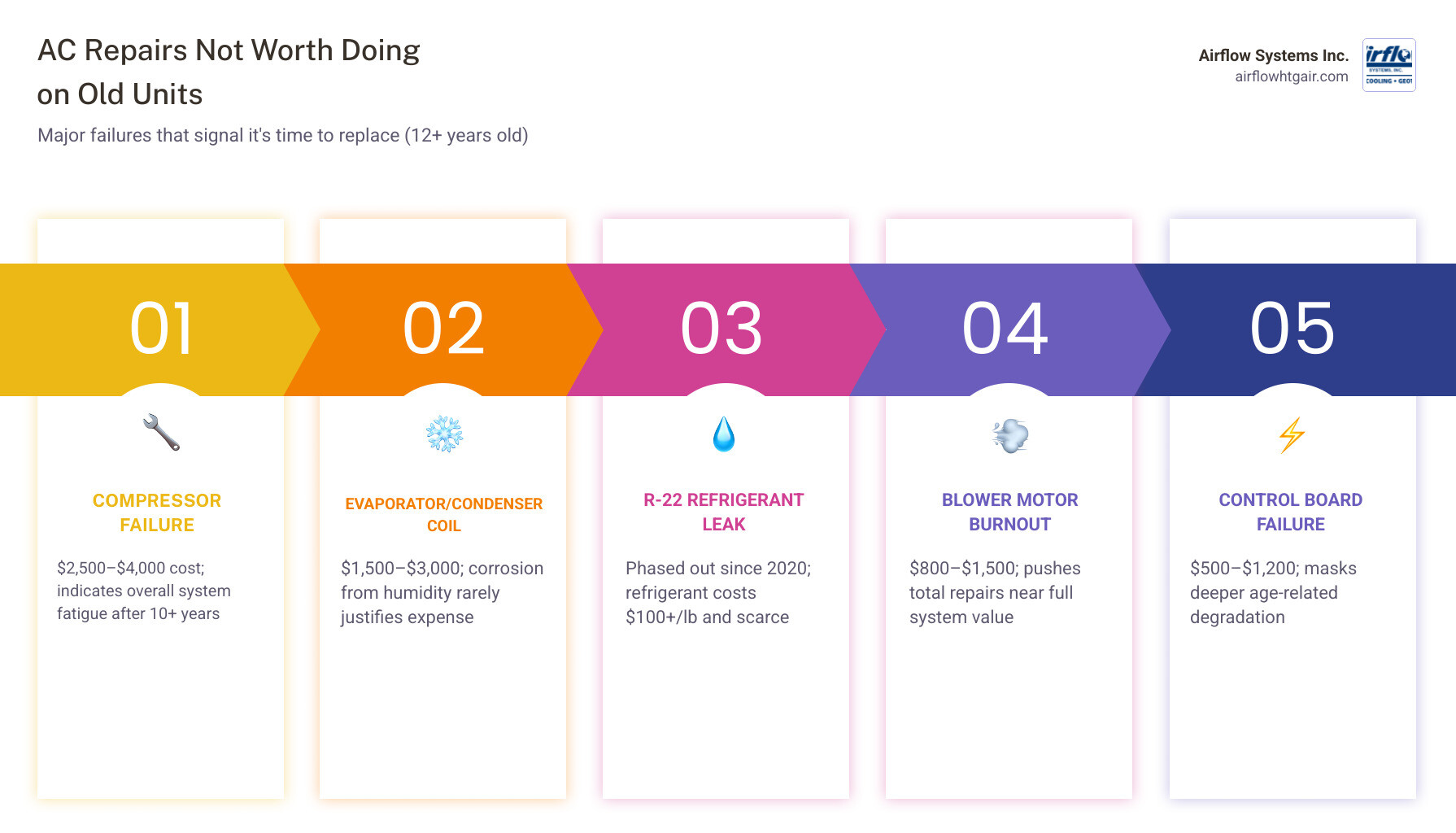
AC repairs that are not worth doing on an old unit include compressor replacement, evaporator or condenser coil replacement, R-22 refrigerant leak repairs, blower motor replacement, and control board replacement — especially on systems 12 years or older. Here's a quick breakdown:
• Compressor replacement — Why It's Usually Not Worth It on an Old Unit: High cost; signals system-wide decline
• Evaporator/condenser coil replacement — Why It's Usually Not Worth It on an Old Unit: Expensive; old unit won't recoup the value
• R-22 refrigerant leak repair — Why It's Usually Not Worth It on an Old Unit: R-22 is phased out and extremely scarce since 2020
• Blower motor replacement — Why It's Usually Not Worth It on an Old Unit: Cost approaches replacement value on aging systems
• Control board replacement — Why It's Usually Not Worth It on an Old Unit: Rarely fixes underlying age-related issues
Your AC broke down in the middle of a Charlottesville, VA summer — and now you're staring at a repair quote that makes your stomach drop. The question every Central Virginia homeowner faces at some point is this: do you fix it, or do you finally replace it? It sounds simple, but the math gets complicated fast. Most central air conditioning systems are built to last 10 to 15 years, and once a unit crosses that threshold, every repair dollar you spend could be money thrown at a system that's already on borrowed time. Understanding which repairs make sense — and which ones don't — can save you from a costly mistake.
How to Determine if Your AC is Too Old for Repairs

In our experience serving the Charlottesville community since 1988, we have seen systems that defy the odds, but the average lifespan of a central air conditioning system remains 10 to 15 years. By the time a unit reaches its 12th birthday, it has endured over a decade of humid Virginia summers. The components have expanded and contracted thousands of times, and the efficiency has naturally begun to decline.
When we talk about whether a unit is "too old," we aren't just looking at the date on the manufacturer's plate. We are looking at the cumulative wear and tear. A system that has been meticulously maintained might still have some life at year 14, while a neglected unit might be a "total loss" by year nine. However, as of April 2026, any unit manufactured before 2011 is officially in its "golden years."
If you are noticing signs your AC needs repair before summer, such as weak airflow or frequent cycling, the age of the unit should be your primary filter for decision-making. We often tell our neighbors that once a system hits 15 years, replacement often deserves serious consideration regardless of how small the current repair seems. At this stage, you aren't just fixing a part; you're essentially financing the "retirement" of an obsolete machine.
If you are in the surrounding areas and need an honest assessment, our team providing AC repair Palmyra VA can help you determine if your system is a candidate for a fix or if it’s time to move on.
Using the $5,000 Rule for ac repairs that are not worth doing on an old unit
One of the most reliable ways to take the emotion out of the "repair vs. replace" debate is to use the $5,000 Rule. This is a simple mathematical formula that helps you see the long-term value of your investment.
To use the rule, multiply the age of your unit by the estimated cost of the repair. If the total exceeds $5,000, the repair is likely not worth the money.
For example, if you have a 12-year-old unit that needs a repair costing roughly a quarter of a new system's price:
• 12 (years) x [Repair Cost] = Total
• If that total is over $5,000, you are better off putting that money toward a new, high-efficiency system.
This rule works because it accounts for the "remaining life" of the equipment. Spending money on an older unit is risky because even if you fix the current problem, another component is likely to fail shortly after. We see this often when providing HVAC repair Syria VA; homeowners fix a fan motor only to have the compressor fail two months later. The $5,000 rule protects your investment by ensuring you aren't over-committing to a sinking ship.
Identifying specific ac repairs that are not worth doing on an old unit
Not all repairs are created equal. Some are minor "band-aids" that can buy you another season, while others are major surgical procedures that the "patient" might not survive. We categorize ac repairs that are not worth doing on an old unit as those that involve the core refrigeration cycle or major mechanical motors.
When a major component fails, it often indicates a system-wide decline. If your unit is over 10 years old and requires a new compressor or a set of coils, you are looking at a "slow bleed" of your finances. You might pay for the repair today, but you are still stuck with an old, inefficient system that uses outdated refrigerant and offers no warranty.
In many cases, choosing AC replacement Somerset VA is the more logical path when major components fail. It stops the cycle of frequent, expensive service calls and gives you peace of mind with a new manufacturer's warranty. If you find yourself calling for AC repair Esmont VA more than once a season, that is a clear signal that the cumulative cost of repairs is rapidly approaching the cost of a modern upgrade.
Major ac repairs that are not worth doing on an old unit
When we look at the internal components of an AC, certain failures are considered "catastrophic" for older units. These are the parts that are difficult to access, labor-intensive to replace, and expensive to source.
1. Compressor Failure: The compressor is the "heart" of your AC. If it fails on a unit that is 12-15 years old, we almost always recommend a full replacement. A compressor failure often introduces contaminants into the refrigerant lines, meaning a simple swap might not even last.
2. Evaporator and Condenser Coils: These coils are prone to corrosion (pitting) over time, especially in our humid Central Virginia climate. Once they start leaking, "patching" them is rarely a permanent fix. Replacing them is a major expense that usually warrants AC replacement Palmyra VA instead.
3. Blower Motor Burnout: While a blower motor is slightly less expensive than a compressor, on a system nearing the end of its life, the labor and part cost still represent a significant percentage of the total system value.
• Compressor — Average Life Expectancy: 10-15 Years — Replacement Value on Old Unit: Very Low (High Risk)
• Evaporator Coil — Average Life Expectancy: 10-12 Years — Replacement Value on Old Unit: Low (Likely to leak again)
• Blower Motor — Average Life Expectancy: 12-15 Years — Replacement Value on Old Unit: Medium (Depends on system health)
• Condenser Fan — Average Life Expectancy: 10-15 Years — Replacement Value on Old Unit: Medium (Can be a bridge repair)
Why R-22 refrigerant leaks are a dealbreaker in 2026
If your AC was installed before 2010, there is a high probability it uses R-22 refrigerant (commonly known as Freon). As of April 2026, R-22 has been completely phased out of production and importation for six years. This means any R-22 used for repairs today must be reclaimed or recycled, making it incredibly scarce and expensive.
If an old R-22 system has a leak, the cost to find the leak, repair the metal, and "top off" the refrigerant can be staggering. Furthermore, putting expensive, rare refrigerant into a system that is already 15+ years old is a gamble. If the unit develops another leak elsewhere, that expensive gas simply vanishes into the atmosphere.
When an AC is not cooling properly, the first thing we check is the refrigerant type. If it’s R-22, we are very honest with our customers: the environmental impact and the sheer cost of the chemical make it one of the most prominent ac repairs that are not worth doing on an old unit.
Comparing efficiency: SEER vs. SEER2 standards
Technology has moved fast in the last decade. If you are running an AC from 2010, it likely has a SEER (Seasonal Energy Efficiency Ratio) rating of 10 or 13. By today's standards, that is incredibly inefficient.
In 2023, the industry moved to SEER2 standards, which use more rigorous testing to reflect real-world conditions. Modern units now start at 14.3 SEER2 (equivalent to about 15 SEER) and can go much higher.
• Energy Savings: Upgrading from a 10 SEER system to a modern 16+ SEER2 system can cut your cooling costs by 30% to 50%.
• Humidity Control: Modern systems, especially those with variable-speed compressors, are much better at removing the "sticky" feeling from Charlottesville air.
• Technology: New systems integrate with smart thermostats and offer much quieter operation.
When you weigh a major repair on an old unit, you must factor in the "efficiency tax" you are paying every month on your utility bill. Choosing HVAC replacement Banco VA isn't just about avoiding a repair; it’s about lowering your monthly overhead for the next 15 years.
Performance Red Flags That Signal Replacement
Sometimes, the unit hasn't completely "died" yet, but it is sending you warning signs that repairs are a waste of money. We call these performance red flags. If your system is old and exhibiting these symptoms, it’s time to stop the service calls and start looking at new options.
• Skyrocketing Energy Bills: If your electricity usage is 30% higher than it was three summers ago, but the weather has been the same, your components are working too hard to produce the same amount of cooling.
• Inconsistent Cooling: Does one bedroom feel like a sauna while the living room is a walk-in freezer? Older units lose the ability to balance airflow and maintain steady temperatures.
• Strange Noises: Grinding, squealing, or heavy clanging sounds usually indicate mechanical failure in the compressor or motor bearings. In an old unit, these sounds are often the "death rattle" of the system.
• Musty Odors: Persistent smells can indicate biological growth inside the evaporator coil or ductwork issues that an old, struggling blower can no longer overcome.
• Frequent Breakdowns: If you have our number on speed dial because the capacitor, contactor, or fan keeps failing, you are experiencing the "slow bleed." Two or three significant repairs in a 24-month period are a definitive sign that the system is done.
Many of these are the same signs your AC needs repair before summer, but when they happen simultaneously on a 12-year-old unit, the diagnosis shifts from "repair" to "replace."
Frequently Asked Questions
Is a 12-year-old AC worth fixing in Charlottesville?
It depends on the repair. If it’s a simple electrical fix like a capacitor or a clogged condensate line, it’s usually worth it to keep the unit going for a few more seasons. However, if it’s a major component like the compressor or if the unit uses R-22 refrigerant, the math usually favors replacement. Given the humidity in Central Virginia, a 12-year-old unit is already in the final third of its life.
What is the most expensive part to replace on an old unit?
The compressor is generally the most expensive part, followed closely by the evaporator coil. Because these repairs require opening the sealed refrigerant system, the labor costs and the cost of the refrigerant itself often make these the top ac repairs that are not worth doing on an old unit.
How much can I save on utilities with a new SEER2 system?
Most homeowners in the Charlottesville area see a reduction of 25% to 40% on their cooling costs when moving from a 10-15 year old unit to a modern SEER2 system. If your old unit is 20 years old, the savings can be as high as 50%. Over the lifespan of the new unit, these savings can often pay for a significant portion of the installation cost.
Conclusion
At Airflow Systems Inc., we’ve been a part of the Charlottesville community for over three decades. We understand that an AC replacement is a significant decision for any family. Our goal isn't just to sell you a new box; it's to ensure your home is comfortable, safe, and efficient.
We take pride in our family-owned values and our reputation for honesty. If a simple repair will safely get your old unit through another two years, we’ll tell you. But if we see you're about to "throw good money after bad," we’ll provide the data and the options you need to make the best financial choice for your household.
Don't spend another summer worrying if your old AC will make it through the next heatwave. Whether you need a final repair or a brand-new high-efficiency installation, we are here to help.
Schedule your professional AC assessment today with Airflow Systems Inc. and experience the difference that local expertise and honest service can make for your Central Virginia home.
Book Expert Service Or Contact Us
Our Service Process
A Hassle-Free Service Experience
01
Consultation & Diagnosis
We start by listening to your needs and performing a thorough diagnosis of your system to recommend the best solution.
02
Transparent Quoting
We provide a clear, upfront estimate with no hidden fees, so you know exactly what to expect.
03
Expert Service & Follow-Up
Our factory-trained technicians complete the work to the highest standards, and we follow up to ensure your complete satisfaction.
testimonials
What Our Customers Are Saying
Our customers consistently praise our exceptional service and attention to detail, making us a trusted choice for all your HVAC needs.
where we operate
Service areas