


Choose an option to see quick actions and get help faster.
.svg)
Why Virginia Humidity Makes Your AC Work Harder Than You Think
Understanding how your AC removes moisture and why it matters starts with one simple truth: cooling your home and drying it out are two different jobs — and your air conditioner has to do both at the same time.
Here's a quick answer:
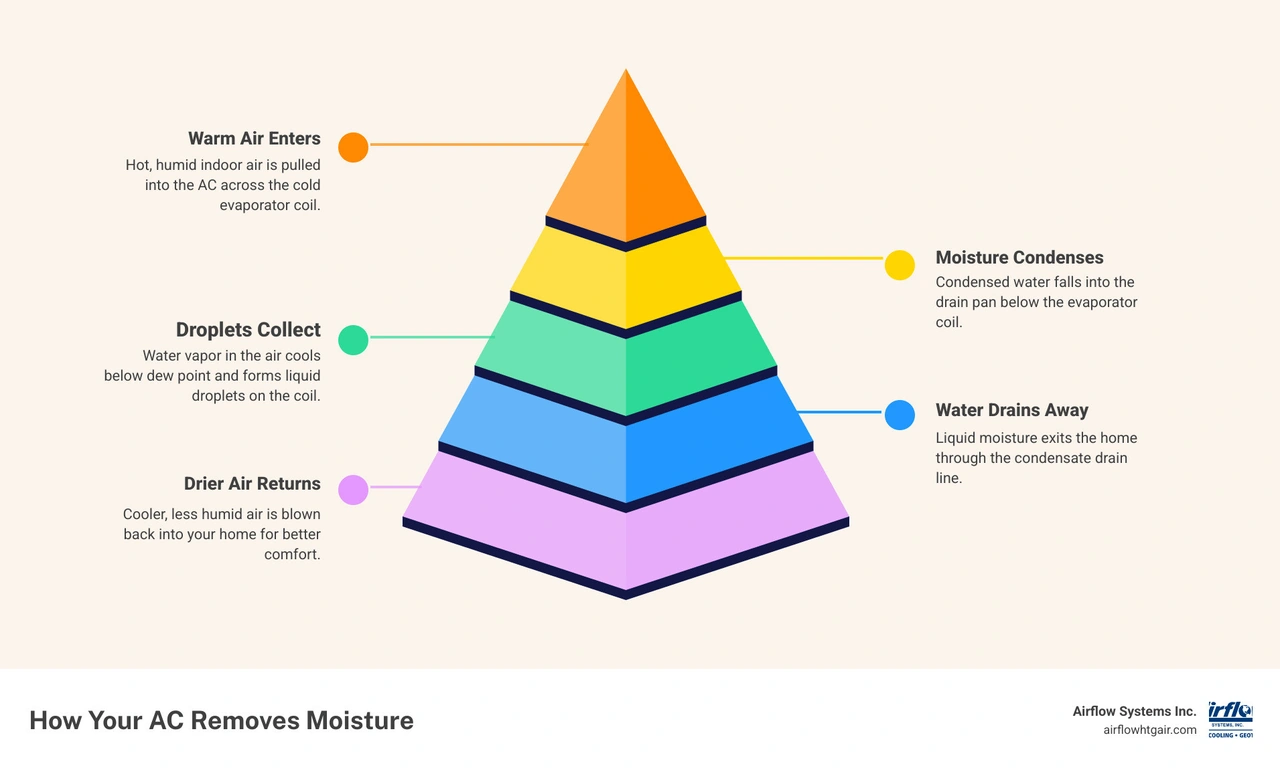
• 1. Warm, humid air enters the system — What Happens: Your AC pulls hot indoor air across a cold evaporator coil
• 2. Moisture condenses on the coil — What Happens: Water vapor cools below its dew point and turns to liquid droplets
• 3. Water drains away — What Happens: Droplets fall into a condensate pan and exit through a drain line
• 4. Drier air returns to your home — What Happens: The air blown back in is both cooler and less humid
• 5. Comfort improves — What Happens: Lower humidity means your body can cool itself more effectively
In Central Virginia, this process matters more than almost anywhere else. Summer mornings in the region regularly bring humidity levels between 70% and 80%. That means your AC isn't just fighting heat — it's constantly battling moisture that makes a 75°F room feel stuffy, sticky, and downright uncomfortable.
When the system works well, you feel the difference immediately. When it doesn't — whether because of an oversized unit, a dirty coil, or a clogged drain line — you end up with that frustrating combination: a home that feels cold but clammy. Cool air, but no real comfort.
This guide breaks down exactly how that moisture removal process works, what can go wrong, and what Virginia homeowners can do to keep their indoor air balanced all summer long.
How Your AC Removes Moisture and Why It Matters
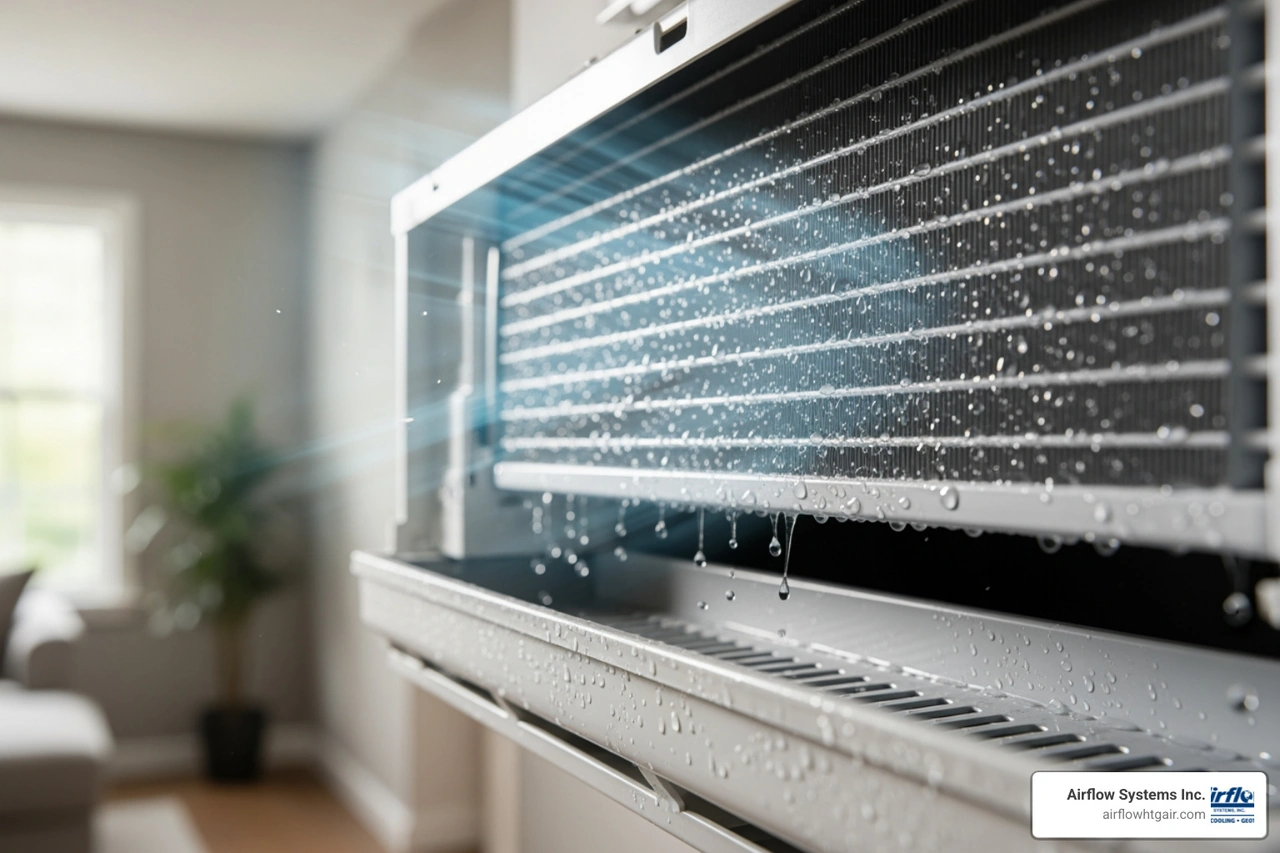
Your air conditioner removes moisture at the indoor evaporator coil. That coil is filled with cold refrigerant, so when warm return air passes over it, two things happen at once:
• Heat is pulled out of the air
• Some of the water vapor in the air turns into liquid
That second part is the key to how your AC removes moisture and why it matters. If the coil surface is cold enough to drop the air below its dew point, moisture condenses on the coil just like water forms on a cold drink sitting outside in July.
The droplets collect, run into the condensate pan, and leave through the drain line. What comes back through your vents is not just cooler air, but drier air too.
Why does that matter so much? Because comfort is not just about temperature. A room can read 72 degrees on the thermostat and still feel sticky if indoor humidity is too high. Moisture also affects indoor air quality, can encourage mold and dust mites, and may contribute to warped wood, peeling paint, and musty odors over time.
How your ac removes moisture and why it matters: the condensation process in simple terms
Here is the simplest way to picture it:
1. Your AC pulls in warm indoor air
2. That air moves across a cold evaporator coil
3. Water vapor in the air hits the cold surface
4. The vapor condenses into liquid droplets
5. The water drains away
6. The system sends cooler, drier air back into the house

The cold-glass analogy works well here. On a humid Virginia day, a glass of iced tea "sweats" because moisture in the air turns to liquid on the colder surface. Your evaporator coil does the same thing, only on purpose.
This is also where dew point matters. Dew point is the temperature at which air can no longer hold all its moisture, so water starts to condense. When your AC coil drops the passing air below that point, moisture removal begins.
Sensible cooling vs. latent cooling: temperature drop vs. moisture removal
Air conditioners do two jobs, and HVAC pros describe them with two terms:
• Sensible cooling: lowering the air temperature
• Latent cooling: removing moisture from the air
Both matter. A system that only handles sensible cooling may get the house to the thermostat setting but still leave it feeling damp. A good comfort balance means handling both the heat you can feel on a thermometer and the moisture you cannot see but definitely notice.
• Sensible cooling — What it does: Lowers air temperature — What you notice: The room feels cooler
• Latent cooling — What it does: Removes moisture from the air — What you notice: The room feels drier and less sticky
Latent cooling usually takes time. That is one reason longer, steadier cooling cycles often manage humidity better than quick bursts.
Why high humidity feels warmer even when the thermostat says otherwise
Your body cools itself by evaporating sweat from your skin. High humidity slows that evaporation. So even if the air temperature is lower, your body cannot get rid of heat as efficiently.
That is why humidity changes the "feels like" temperature indoors too, not just outside.
A useful comparison from the research says a 75 degree room at 50% relative humidity can feel cooler than a 72 degree room at 65% humidity. Same house, lower thermostat setting, less comfort. Not exactly a great trade.
If you want a deeper look at why muggy air drives discomfort and system strain, read how heat and humidity drive up your cooling costs.
What Indoor Humidity Should Be in Virginia Homes
For most homes, the ideal indoor relative humidity range is 30% to 50%. During summer in Central Virginia, many homeowners find that about 45% to 55% feels best, but once indoor humidity starts pushing past 60%, the air usually feels muggy and indoor moisture problems become more likely.
A simple hygrometer can help you track this. Many smart thermostats also show indoor humidity.
The ideal relative humidity range for comfort, health, and air quality
Here is a practical way to think about it:
• 30% to 50% RH: ideal general range
• 45% to 55% RH: often a good summer target
• Above 60% RH: commonly feels clammy and supports mold and dust mites
The research also notes that some people start feeling humidity effects around 40%. That is why comfort is personal, but the 30% to 50% range is still the best overall benchmark for comfort, health, and air quality.
Balanced humidity helps with:
• Better comfort at normal thermostat settings
• Less muggy, sticky air
• Lower risk of mold and mildew growth
• Reduced dust mite activity
• Healthier indoor air for people with allergies or respiratory irritation
What can happen when humidity stays too high indoors
When indoor humidity stays high for long periods, the problems go beyond comfort.
Health and air quality risks include:
• Mold and mildew growth
• Musty odors
• More dust mites and allergens
• Respiratory irritation for sensitive occupants
Home-related risks include:
• Window condensation
• Damp surfaces
• Peeling paint or wallpaper
• Warped wood floors, trim, or furniture
• Water stains and moisture damage in some areas
Moisture has a way of finding weak spots in a home. Sometimes the first warning is a musty smell. Sometimes it is a foggy window in summer. Sometimes it is that one room that always feels like the air is wearing a wet sweater.
Common signs your home is cool but still too damp
If your AC is running but the house still feels off, high humidity may be the reason.
Watch for these warning signs:
• Rooms feel cool but clammy
• A sticky or muggy feeling indoors
• Musty smells
• Damp basement air
• Condensation on windows
• Bedding or upholstery feeling slightly damp
• Visible mold or mildew spots
• Peeling paint or wallpaper
• Water around the indoor unit
For more ways to get ahead of summer moisture issues, see getting your air conditioner ready for hot, humid weather.
Why Some AC Systems Cool the House but Don’t Dry the Air Well
A lot of humidity complaints come down to one issue: the system is lowering temperature, but not running in a way that removes enough moisture.
That can happen because of:
• Oversized equipment
• Short cycling
• Improper blower speed
• Fan settings that re-evaporate moisture
• Maintenance issues
• Duct leakage
• Older single-stage operation that shuts off too quickly
Why an oversized AC often leaves a home cool but clammy
Bigger is not always better with air conditioning. In fact, field studies referenced in the research show many AC systems are oversized by 24% to over 100%.
An oversized AC can cool the house too quickly. That sounds nice until you realize what happens next: the thermostat is satisfied fast, the system shuts off early, and the coil does not stay cold long enough to remove much moisture.
That is called short cycling, and it often creates the classic "cool but clammy" problem.
Here is the pattern:
• The unit blasts cold air
• The thermostat reaches setpoint quickly
• The cycle ends sooner than it should
• Moisture removal is limited
• Indoor RH stays high
Temperature gets handled. Latent load does not.
Auto vs. On: the thermostat fan setting that helps moisture removal
For humidity control, the thermostat fan should usually be set to Auto, not On.
Why? Because when the cooling cycle ends, the evaporator coil is still wet. If the fan keeps running in the On position, it can blow some of that moisture right back into the home as it re-evaporates off the coil.
With Auto:
• The fan runs only during cooling cycles
• Condensed moisture has more time to drain away
• Indoor humidity control is usually better
With On:
• Air keeps moving over a wet coil
• Some moisture can return to the air
• The home may feel more humid
For more thermostat guidance, check out best thermostat strategies for summer AC savings.
How blower speed changes how your ac removes moisture and why it matters
Blower speed affects how long air stays in contact with the evaporator coil.
In general:
• Faster airflow can improve temperature delivery
• Slower airflow can improve dehumidification
Why? Slower air movement gives the air more time over the cold coil, which can help the coil stay colder and allow more moisture to condense. Too much airflow can reduce that effect.
That said, airflow has to be balanced correctly. Too low can create other issues, including poor comfort or even icing in some cases. This is one reason blower setup is not a guessing game.
Dry Mode and modern inverter AC systems for better humidity control
Some systems include a Dry Mode, and it can be helpful during mild but muggy weather.
Dry Mode generally works by:
• Running the compressor and fan in a way that prioritizes moisture removal
• Using lower or adjusted fan speeds
• Extending operation to remove humidity without overcooling as much
This is especially helpful on days when your home feels damp, but the temperature is not high enough to call for much normal cooling.
Modern inverter systems also tend to manage humidity better than traditional single-stage units because they can modulate output instead of running only at full blast or fully off. That means:
• Longer run times
• More even temperatures
• Better part-load humidity control
• Less short cycling
Many ductless mini-splits and variable-speed systems use this kind of technology. If you want to understand that setup better, read how does a ductless mini-split work.
Maintenance Problems That Reduce Dehumidification
Even a correctly sized AC can struggle with humidity if maintenance issues get in the way.
How dirty evaporator coils and clogged drain lines interfere with moisture removal
A dirty evaporator coil cannot transfer heat as effectively. Dust and buildup act like insulation on the coil surface, which can reduce cooling performance and interfere with condensation.
That means:
• Less effective moisture removal
• Reduced airflow
• Lower overall efficiency
• More comfort complaints
A clogged condensate drain line creates a different problem. Your AC may still form condensation, but if the water cannot leave properly, it can back up into the pan, trigger shutoffs, or create overflow and water damage risk.
Both problems are common and both can hurt dehumidification.
Other hidden issues that make humidity problems worse
Several other issues can make a home feel damp even when the AC is running:
• Dirty air filter reducing airflow
• Low refrigerant affecting coil temperature
• Iced evaporator coil
• Supply or return duct leaks
• Return leaks pulling in humid attic or crawl space air
• Blocked supply or return vents
• Outdoor humidity entering through air leaks around the home
If your system seems off, AC not cooling properly? what to check first is a good next read.
Seasonal maintenance steps that support better humidity control
Good humidity control starts before the hottest stretch of summer.
Helpful maintenance steps include:
• Replacing air filters regularly
• Checking and cleaning evaporator coils
• Inspecting the condensate pan and drain line
• Verifying airflow and blower settings
• Checking refrigerant performance
• Looking for duct leakage
• Measuring indoor humidity during tune-ups
If you want to stay ahead of breakdowns and clammy-air complaints, visit signs your AC needs repair before summer and how to prepare your AC for summer.
When an AC Alone Isn’t Enough
Sometimes the air conditioner is working properly, but the home still has more moisture than the system can reasonably remove.
That is especially common in Central Virginia basements, during shoulder seasons, or in homes with extra moisture sources.
When your ac needs help from a dehumidifier
You may need a whole-house or portable dehumidifier when:
• Indoor RH stays above 50%
• Humidity regularly climbs above 60%
• The house feels damp on mild days when the AC does not run much
• A basement stays musty
• You notice persistent mold or mildew concerns
• There are comfort issues in specific rooms
Portable dehumidifiers can help in one problem area, like a basement or a damp bedroom. Whole-house dehumidifiers are better when humidity affects the entire home and you want integrated control through the HVAC system.
How your home itself can add more moisture than the AC can remove
Your AC is not the only thing affecting humidity. Your house and daily routines add moisture too.
Common indoor moisture sources include:
• Long showers
• Cooking
• Laundry
• Dishwashers
• Basement dampness
• Crawl space moisture
• Plumbing leaks
• Air leaks around doors, windows, and ducts
The home envelope matters too. Weak sealing, insulation gaps, and infiltration let humid outdoor air enter and raise the indoor moisture load. For more on reducing that burden, read how shade, insulation, and sealing reduce your AC workload.
Exhaust fans in bathrooms and kitchens can also help. Running them during use and for 20 to 30 minutes afterward can reduce moisture spikes.
How your ac removes moisture and why it matters for year-round comfort in Central Virginia
In Central Virginia, humidity is not only a peak-summer problem. Muggy mornings, rainy stretches, and shoulder-season weather can all leave a house feeling damp even when temperatures are moderate.
That is why understanding how your AC removes moisture and why it matters helps with more than summer comfort. It supports:
• More stable indoor comfort
• Better indoor air quality
• Lower risk of mold and musty odors
• Less strain from overworking the thermostat
• Healthier conditions throughout the home
Frequently Asked Questions About How Your AC Removes Moisture and Why It Matters
Should I lower the thermostat to remove more humidity?
Sometimes lowering the thermostat makes the system run longer, which can remove more moisture. But it is not a great humidity-control strategy by itself.
Why not?
• You may end up too cold
• It does not fix underlying sizing or maintenance problems
• It can increase runtime without solving the root cause
• Humidity may return quickly when the system cycles off
If humidity is a persistent issue, it is better to look at system performance, airflow, fan settings, and whether supplemental dehumidification is needed.
Is window condensation in summer a sign of too much indoor humidity?
Often, yes.
If you see condensation on the inside of windows during summer, that usually means humid indoor air is hitting a cooler glass surface and reaching its dew point. It can be an early warning that indoor RH is too high.
Not every case means there is a major problem, but repeated window "sweat" is worth paying attention to.
When should I call for help if my home still feels sticky?
It is time to schedule service when you notice any of the following:
• Persistent clammy air
• Indoor RH that keeps staying above 50% to 60%
• Musty odors
• Visible mold or mildew
• Water around the indoor unit
• Weak cooling combined with damp air
• A system that seems to short cycle
If you are getting ready for peak humidity season, Preparing Your AC for a Virginia Summer is a smart place to start.
Conclusion
Humidity is a big part of summer comfort in Charlottesville and across Central Virginia. When your air conditioner is working as it should, it does more than cool the air. It removes moisture, improves comfort, supports healthier indoor air, and helps protect your home from damp-related problems.
If your home feels cool but still sticky, the issue may be airflow, sizing, maintenance, thermostat settings, or simply more moisture than the AC can handle alone. That is where we can help. At Airflow Systems Inc., we help homeowners balance comfort and humidity with trusted AC repair, maintenance, and air conditioning solutions tailored to our climate.
For more information about your options, visit More info about air conditioning services.
Book Expert Service Or Contact Us
Our Service Process
A Hassle-Free Service Experience
01
Consultation & Diagnosis
We start by listening to your needs and performing a thorough diagnosis of your system to recommend the best solution.
02
Transparent Quoting
We provide a clear, upfront estimate with no hidden fees, so you know exactly what to expect.
03
Expert Service & Follow-Up
Our factory-trained technicians complete the work to the highest standards, and we follow up to ensure your complete satisfaction.
testimonials
What Our Customers Are Saying
Our customers consistently praise our exceptional service and attention to detail, making us a trusted choice for all your HVAC needs.
where we operate
Service areas