

Choose an option to see quick actions and get help faster.
.svg)
What Are the Most Common AC Repairs and What Causes Them?
Understanding the most common AC repairs and what causes them can save you from a sweltering summer surprise — especially here in Charlottesville, VA, where heat and humidity push your cooling system hard for months at a time. Whether your AC is blowing warm air, making strange noises, or simply refusing to start, the root cause is usually one of a handful of well-known issues that HVAC technicians see again and again.
Here is a quick overview of the most common AC repairs and their causes:
• Airflow restriction / frozen coils — Primary Cause: Dirty or clogged air filter
• Capacitor failure — Primary Cause: Heat stress, power surges, normal wear
• Refrigerant leak — Primary Cause: Improper installation, wear and tear, corrosion
• Clogged condensate drain — Primary Cause: Algae and mold buildup in drain line
• Thermostat malfunction — Primary Cause: Dead batteries, poor placement, calibration issues
• Electrical failures — Primary Cause: Corroded wiring, worn contactors, tripped breakers
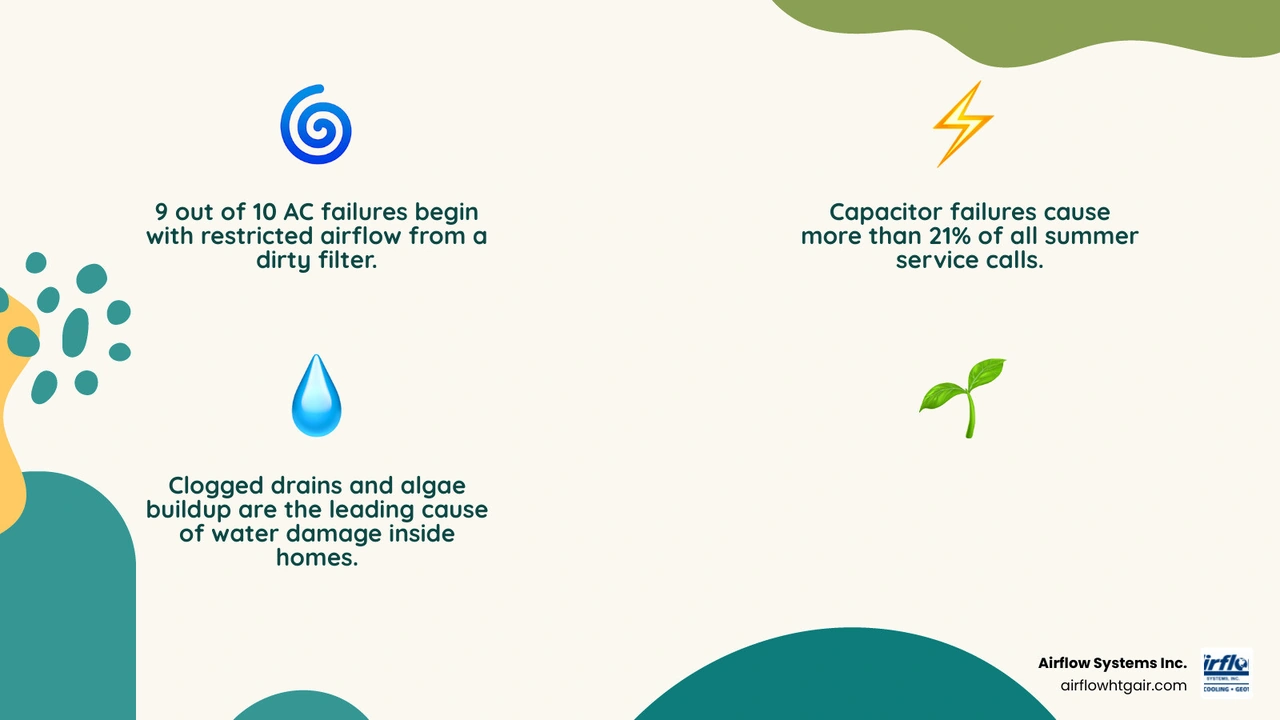
In fact, research from real HVAC service calls shows that nearly 9 out of 10 central AC performance problems trace back to a dirty air filter — and bad capacitors alone account for more than 1 in 5 service visits. Most of these breakdowns are preventable with routine care, but knowing what to look for is the first step.
Keep reading to learn what is really going on inside your system, and what you can do about it before the next heat wave hits Central Virginia.
The Most Common AC Repairs and What Causes Them
When we talk about most common ac repairs and what causes them, we aren't just looking at random mechanical failures. Most issues are the result of three specific environmental factors: heat stress, power surges, and simple neglect. In Charlottesville, our summers are not just hot; they are incredibly humid. This means your air conditioner isn't just lowering the temperature; it is working overtime to wring moisture out of the air.
This constant operation puts immense pressure on every internal component. If a system hasn't been properly vetted before the season starts, these stressors find the weakest link in the chain. Identifying these Signs Your AC Needs Repair Before Summer can be the difference between a quick part replacement and a total system shutdown during a July heatwave.

Airflow Restrictions: One of the Most Common AC Repairs and What Causes Them
It might sound like an exaggeration, but nine times out of ten, central AC issues are related to a dirty air filter. It is the single most important component you can maintain yourself, yet it is the most frequently ignored.
When a filter is clogged with Charlottesville dust, pet hair, and pollen, your system has to work twice as hard to pull air through the mesh. This causes several "domino effect" problems:
• Blower Motor Strain: The motor that turns the fan has to pull against a vacuum. This leads to overheating and eventual motor burnout.
• Reduced Efficiency: Your system runs longer cycles to reach the temperature set on your thermostat, driving up your utility bills.
• Frozen Coils: This is the most ironic AC problem. Without enough warm air blowing over the cold evaporator coils, the condensation on the coils freezes solid, turning your AC into a block of ice that can’t cool your home.
We recommend checking your filters every 30 days during the peak of summer. If you can’t see light through the filter, it’s time for a change.
Electrical Failures: One of the Most Common AC Repairs and What Causes Them
Electrical issues are the "silent killers" of HVAC systems. Among the most common ac repairs and what causes them, capacitor failure is the undisputed leader. Statistics show that bad capacitors account for 52 out of 242 repair calls, or roughly 21.5% of all service visits.
• Capacitors: Think of a capacitor like a high-powered battery that gives your motors the "jolt" they need to start. Heat is the natural enemy of capacitors. When it’s 95 degrees in Central Virginia, the electrical components inside your outdoor unit can reach much higher temperatures, causing them to bulge or leak oil. If you hear a humming sound but the fan isn't spinning, a bad capacitor is likely the culprit.
• Contactors: These are the switches that turn the power on and off. Over time, they can become pitted or "welded" shut, or ants may even get stuck between the contacts, preventing the system from starting.
• Corroded Wiring: High humidity levels in Virginia can lead to rust and corrosion on electrical terminals, causing intermittent power loss or short circuits.
Refrigerant Leaks and Frozen Evaporator Coils
There is a common misconception that air conditioners "use up" refrigerant like a car uses gas. In reality, your AC is a sealed system. If the refrigerant level is low, it means you have a leak.
Refrigerant leaks are among the most common ac repairs and what causes them because they are often caused by the natural vibration of the unit, which can create tiny pinhole leaks in the copper coils over time. In May 2026, it is also important to note that the industry has fully transitioned away from R-22 (Freon). If you have an older system that still uses R-22, a leak often means it is time to discuss replacement rather than repair, as the old refrigerant is no longer manufactured.
How to spot a leak:
1. Hissing or Bubbling: A distinct sound coming from the indoor or outdoor unit.
2. Sweet Odors: Some refrigerants have a faint, chemically sweet smell.
3. Ice on the Lines: Low refrigerant causes the coils to drop below freezing, leading to ice buildup.
4. Humidity Spikes: Since refrigerant is responsible for removing heat and moisture, a leak will make your home feel "sticky." This is a major factor in How Heat and Humidity Drive Up Your Cooling Costs.
Drainage Issues and Thermostat Malfunctions
Your air conditioner is essentially a massive dehumidifier. As it cools the air, moisture condenses on the evaporator coil and drips into a drain pan. From there, it should flow out of your house through a PVC pipe.
However, the combination of water and darkness inside your AC is the perfect breeding ground for algae and mold. Over time, this "slime" can clog the drain line. When the water has nowhere to go, it backs up into the pan. Most modern systems in Charlottesville have a "float switch" that will automatically shut the system off if it detects a backup to prevent water damage to your ceilings or floors.
If your AC suddenly stops running and won't turn back on, check your drain pan. A simple flush with vinegar or a professional clearing of the line is a very common and necessary repair.
Thermostat TroublesSometimes the "repair" isn't with the AC at all, but the brain controlling it. Thermostat malfunctions are frequently caused by:
• Dead Batteries: A simple fix that accounts for many "emergency" calls.
• Poor Placement: If your thermostat is in direct sunlight or near a kitchen, it will get false readings, causing the system to short-cycle.
• Calibration Issues: Over time, the sensors can drift, leading to a home that feels much warmer than the display suggests. This is a primary reason Why Your AC Bill Spikes in Virginia Summers.
Prevention and Replacement Decisions in 2026
As we move through 2026, the technology in our homes is becoming more efficient, but also more complex. When faced with a breakdown, every homeowner eventually asks: "Should I fix it or replace it?"
Generally, a well-maintained central AC system should last between 15 to 20 years. However, if you are experiencing frequent repairs on a system that is over 12 years old, the cost of parts may no longer be a wise investment.
• Upfront Cost — Repairing Old System: Lower — New System Installation: Higher
• Energy Efficiency — Repairing Old System: Decreases annually — New System Installation: SEER2 compliant (High Efficiency)
• Reliability — Repairing Old System: Potential for recurring issues — New System Installation: 10+ year warranty
• Refrigerant — Repairing Old System: May use obsolete R-22 or R-410A — New System Installation: Uses latest eco-friendly R-32 or R-454B
• Comfort — Repairing Old System: Standard cooling — New System Installation: Variable speed / Better humidity control
Taking the time for Preparing Your AC for a Virginia Summer is the best way to avoid this dilemma. Annual maintenance—which includes cleaning the condenser coils, checking electrical connections, and verifying refrigerant levels—can extend your system's life by years.
If you are already seeing AC Repair Red Flags That Mean You Need a New System, it is better to plan a replacement in the spring rather than waiting for a total compressor failure in August. That How Compressor Replacement Often Means Full System Replacement because the labor and part costs often approach the price of a more efficient, modern unit.
For those with systems in good health, simply Getting Your Air Conditioner Ready for Hot Humid Weather by clearing debris from around the outdoor unit and keeping vents unblocked can prevent the most common service calls.
Conclusion
Understanding the most common AC repairs and what causes them empowers you to take better care of your home's most vital summer appliance. From the simple monthly task of changing your air filter to scheduling a professional multi-point inspection, prevention is always more affordable than a mid-summer emergency.
At Airflow Systems Inc., we’ve been part of the Charlottesville community since 1988. As a family-owned business, we believe in honest, transparent service. We don't just want to fix your air conditioner; we want to help you understand how to keep it running efficiently for years to come. Whether you need a quick capacitor replacement or a consultation on a new high-efficiency SEER2 system, our team is here to ensure your Central Virginia home stays a sanctuary of comfort.
If your system is acting up or you want to prevent a breakdown before the humidity arrives, reach out to us for expert AC Repair today. We’ll get your cool air back on track with the local expertise and family values you can trust.
Book Expert Service Or Contact Us
Our Service Process
A Hassle-Free Service Experience
01
Consultation & Diagnosis
We start by listening to your needs and performing a thorough diagnosis of your system to recommend the best solution.
02
Transparent Quoting
We provide a clear, upfront estimate with no hidden fees, so you know exactly what to expect.
03
Expert Service & Follow-Up
Our factory-trained technicians complete the work to the highest standards, and we follow up to ensure your complete satisfaction.
testimonials
What Our Customers Are Saying
Our customers consistently praise our exceptional service and attention to detail, making us a trusted choice for all your HVAC needs.
where we operate
Service areas