

Choose an option to see quick actions and get help faster.
.svg)
Why Hot Humid Summers Are So Hard on Your AC System
What shortens your AC lifespan in hot humid summers is not just one thing — it's a combination of compounding stresses that hit your system every single day the season runs. Here's a quick look at the main culprits:
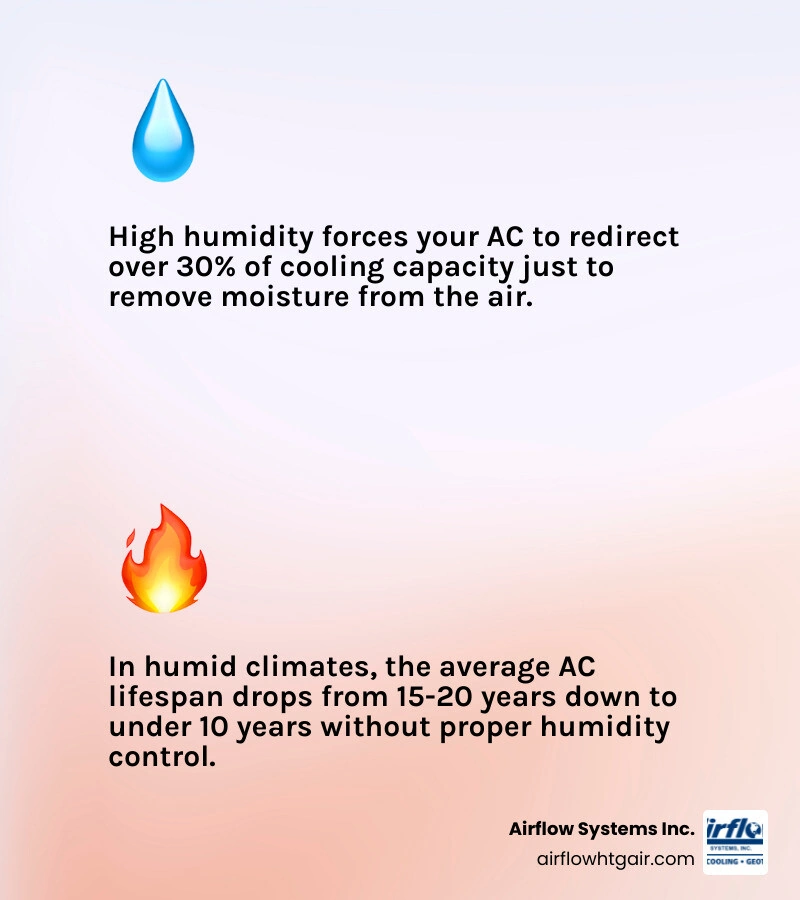
• Latent heat overload — Humidity forces your AC to remove moisture and cool the air at the same time, redirecting roughly 30% or more of its cooling capacity just to condense water vapor
• Compressor overwork — Longer run cycles drive up internal temperatures, breaking down lubricating oil and accelerating mechanical wear
• Coil corrosion — Persistent moisture triggers formicary and galvanic corrosion on copper and aluminum components, leading to refrigerant leaks
• Clogged condensate drains — High moisture volume overwhelms drain lines, causing water backups, mold growth, and automatic shutdowns
• Dirty, sticky filters — Humid air makes dust and pollen clump together, clogging filters far faster than in dry conditions and starving the system of airflow
• Short cycling — An oversized or struggling system turns on and off repeatedly without completing a full cycle, wearing out the compressor prematurely
If you live in Charlottesville, VA or anywhere in Central Virginia, these aren't just abstract risks. Central Virginia summers routinely bring high humidity alongside heat, and that combination is genuinely tough on cooling equipment.
The U.S. Department of Energy puts the average central AC lifespan at 15 to 20 years — but in hot, humid regions, many systems start showing serious wear well before the 10-year mark. The difference between a system that lasts 10 years and one that lasts 18 almost always comes down to how well it's protected from humidity-related stress.
Below, we break down exactly what's happening inside your system during a humid Central Virginia summer, how to spot the warning signs early, and what you can do right now to protect your investment.
Handy what shortens your ac lifespan in hot humid summers terms:
• how long does an ac unit last in central virginia
• when should you replace your air conditioner
Understanding What Shortens Your AC Lifespan in Hot Humid Summers
To understand why humidity is such a silent killer for air conditioners, we have to look at how an AC actually works. Most people think an air conditioner simply blows cold air into a room. In reality, it is a heat and moisture removal machine.
HVAC professionals divide cooling into two categories:
1. Sensible Cooling: This is the process of lowering the actual air temperature that you read on your thermostat.
2. Latent Cooling: This is the process of removing water vapor (humidity) from the air.
When the outdoor air is dry, your air conditioner can focus almost 100% of its energy on sensible cooling. It lowers the indoor temperature quickly, completes its cycle, and shuts down to rest.
However, when relative humidity climbs during a sticky Central Virginia July, the thermodynamics change completely. Water vapor holds a massive amount of "latent heat." Before your AC can lower the indoor temperature by even a single degree, it must first condense that airborne water vapor into liquid water on the cold evaporator coils.
According to the U.S. Department of Energy, when relative humidity is high, roughly 30% or more of your air conditioner's BTU cooling capacity is redirected solely to condensing water vapor out of the air. This dual workload means the system has to run significantly longer to achieve the same temperature drop.
This relentless runtime acts as a direct "lifespan tax" on your equipment. To put this in perspective, let’s look at how local climates affect how many years of service you can expect from a central air conditioner:
• Dry / Moderate Climates — Typical Operating Hours Per Year: 600 – 1,000 hours — Average AC Lifespan: 15 – 20 years — Primary Wear Mechanisms: General mechanical age, dust
• Humid / Coastal Climates — Typical Operating Hours Per Year: 2,500 – 4,000 hours — Average AC Lifespan: 10 – 14 years — Primary Wear Mechanisms: Relentless runtime, coil corrosion, high head pressures
• Central Virginia (Charlottesville) — Typical Operating Hours Per Year: 1,200 – 1,800 hours — Average AC Lifespan: 12 – 15 years — Primary Wear Mechanisms: High summer humidity, seasonal temperature swings, biological growth
Because our local weather swings from freezing winters to muggy summers, the metal components in your system experience significant thermal expansion and contraction. Combined with the heavy summer moisture load, a neglected system in our region can easily fail years ahead of schedule. Understanding How Long Does an AC Unit Last in Central Virginia is the first step in realizing how crucial preventative care is for your home.
5 Critical Summer Hazards That Accelerate AC Wear
When summer humidity settles over Central Virginia, it creates several distinct physical and mechanical hazards inside your cooling system. Left unaddressed, these issues trigger a domino effect of component failures.

To protect your home, we must understand the core problems that arise when preparing your system for the peak of summer. Properly Getting Your Air Conditioner Ready for Hot Humid Weather requires identifying and mitigating these five critical hazards.
How Overworked Compressors and What Shortens Your AC Lifespan in Hot Humid Summers Intersect
The compressor is the heart of your air conditioning system. It pumps refrigerant between the indoor evaporator coil and the outdoor condenser coil. Under normal conditions, the compressor cycles on, runs for 15 to 20 minutes, and cycles off.
However, during a hot, humid summer, two things happen to the compressor:
• Relentless Run Cycles: Because the system is fighting high latent heat, the compressor must run continuously for hours to keep the home comfortable.
• High Head Pressures: High outdoor temperatures make it difficult for the outdoor condenser unit to shed heat. This forces the compressor to pump refrigerant against much higher pressures (often exceeding 500 PSI in modern R-410A systems).
This combination of long runtimes and high operating pressures causes the compressor's internal temperature to soar. When the compressor's internal temperature exceeds 225°F, the lubricating oil inside begins to break down. This degraded oil turns acidic, losing its ability to lubricate the moving steel parts.
Without proper lubrication, mechanical friction increases, leading to winding failure, electrical shorts, and eventual motor burnout. Because the compressor is the most expensive component in your system, a burnt-out compressor often means you are looking at a full system replacement. You can learn more about why this happens in our guide on How Compressor Replacement Often Means Full System Replacement.
How Coil Corrosion and What Shortens Your AC Lifespan in Hot Humid Summers Damage Components
Persistent moisture on your indoor evaporator coil does more than just drip into a pan — it actively eats away at the metal.
There are two primary forms of corrosion that destroy AC coils in humid climates:
1. Formicary Corrosion: This occurs when moisture on the copper tubing mixes with organic acids found in indoor air (emitted by household cleaning products, cosmetics, paints, and building materials). This chemical reaction creates microscopic, needle-like tunnels through the copper walls, eventually causing hard-to-find pinhole refrigerant leaks.
2. Galvanic Corrosion: This happens when two dissimilar metals—such as copper tubes and aluminum fins—come into contact in the presence of an electrolyte (condensate water). The water acts as a bridge, causing the aluminum to sacrifice itself and corrode, which severely degrades heat transfer efficiency.
As refrigerant leaks develop from this corrosion, the system’s refrigerant charge drops. A low refrigerant charge causes the pressure inside the evaporator coil to plunge, which ironically leads to ice forming on the coil, even when it is 95°F outside. If you notice ice on your system, read our troubleshooting guide on Ice Forming on Your AC Unit Causes and What to Do to prevent permanent compressor damage.
Clogged Condensate Lines and Biological Growth
A central air conditioner in a humid environment can pull up to 10 to 20 gallons of water out of your indoor air every single day. All of this water collects on the evaporator coil and must drain out of your home through a narrow PVC condensate line.
Because the inside of your air handler is dark, damp, and warm, it is the perfect breeding ground for:
• Algae and bacteria
• Mold spores
• Biofilm (slime)
Over time, this biological growth combines with household dust to form a thick clog inside the drain line. When the line clogs, the water has nowhere to go. It backs up into the drain pan.
Modern systems are equipped with safety float switches that automatically shut down the AC when water rises to prevent major water damage to your ceilings and floors. If your system suddenly cuts out on a humid afternoon, a clogged drain is a highly likely culprit. For a step-by-step diagnostic checklist, see our AC Not Turning On Complete Guide.
Suffocating Airflow from Sticky, Damp Filters
Airflow is the lifeblood of your HVAC system. Your AC needs a steady, unrestricted volume of air passing over the indoor coil to absorb heat and moisture.
In dry climates, dust simply blows onto the air filter and sits there. But in a humid Central Virginia summer, the air filter absorbs moisture from the air, becoming damp. This dampness makes household dust, pet dander, and pollen stick to the filter fibers like glue.
A damp, dirty air filter clogs much faster than a dry one, rapidly restricting airflow. This restriction increases "static pressure" within the ductwork, forcing the indoor blower motor to work twice as hard to push air through the home. This extra strain leads to motor overheating and premature failure.
To understand how a simple piece of fiber can cause systemic failures, read about How Dirty Air Filters Destroy Your AC Performance. To keep your system breathing easily, make sure you know How Often to Change Your AC Filter in Humid Climates.
Repair vs. Replace: Making the Smart Choice in Charlottesville
Every homeowner eventually faces the tough decision: should you patch up your aging air conditioner one more time, or is it time to invest in a new, energy-efficient system?
When making this decision in Central Virginia, we recommend using a reliable industry framework known as the 5,000 Rule.
To use the 5,000 Rule, simply multiply the age of your air conditioning system by the estimated cost of the repair. If the resulting number is greater than $5,000, your money is almost always better spent on a replacement. If the number is below $5,000, a repair is usually the smarter financial move.
For example:
• Scenario A: A 12-year-old system needs a $450 repair. (12 × 450 = 5,400). Since 5,400 exceeds 5,000, replacing the unit is likely the wiser long-term investment.
• Scenario B: An 8-year-old system needs a $300 repair. (8 × 300 = 2,400). Since 2,400 is well below 5,000, repairing the unit makes perfect sense.
Beyond the math of the 5,000 Rule, you must also consider the rapid evolution of HVAC technology and environmental regulations. Older systems running on R-22 Freon (which was completely phased out of production) are incredibly expensive to service because the refrigerant supply is extremely limited. Upgrading to a modern system not only eliminates these refrigerant worries but also can reduce your summer cooling bills by 20% to 40% due to higher SEER2 efficiency ratings.
To help weigh your options, read our analysis of AC Repairs That Are Not Worth Doing on an Old Unit and learn how national environmental updates impact your home in How AC Refrigerant Changes Affect Homeowners.
Early Warning Signs Your System is Struggling
You don’t have to wait for your air conditioner to completely break down on a 95-degree afternoon to know it is in trouble. Your system will give you several clear warning signs when it is struggling with humidity-related stress:
• Clammy or Sticky Indoor Air: If your thermostat reads 71°F but your skin feels clammy and damp, your AC is failing to perform latent cooling. This is often a sign of an oversized system that is short cycling, or a system with a failing compressor.
• Musty Odors from the Vents: A sour, musty smell when the AC turns on indicates mold, mildew, or bacterial biofilm growing on your evaporator coil or inside a dirty condensate pan.
• Rising Energy Bills: If your electricity usage is 20% to 30% higher than during the same month last year (with similar outdoor temperatures), your system is losing efficiency due to dirty coils, low refrigerant, or failing electrical components.
• Strange Noises: Clicking, buzzing, or grinding sounds are clear indicators of electrical or mechanical strain.
Catching these issues early can save you from catastrophic system failures. Review our guide on Signs Your AC Needs Repair Before Summer and learn how to decode unusual system sounds in AC Making Strange Noises What They Mean.
Proactive Steps to Extend AC Longevity
The best defense against what shortens your AC lifespan in hot humid summers is a proactive maintenance routine. By taking a few simple steps, you can add 3 to 5 years of reliable service to your system:
• Maintain Clearance Around the Outdoor Unit: Keep shrubs, weeds, and debris trimmed back at least two feet on all sides, and maintain four feet of clear space above the outdoor condenser. This allows the hot air to rise and shed efficiently.
• Clean the Outdoor Condenser Coils: Dust, pollen, and grass clippings can coat the outdoor coils, acting as an insulating blanket that traps heat. Learn how to safely rinse away this buildup in our How to Clean Your AC Condenser Unit Safely guide.
• Check and Replace Your Filters Monthly: During peak summer (June through September), inspect your air filters every 30 days. If they are gray or covered in dust, replace them immediately.
• Schedule Professional Maintenance Twice a Year: A certified technician can check refrigerant charges, tighten electrical connections, clean the condensate drain line, and measure airflow to catch minor issues before they turn into expensive breakdowns.
For comprehensive, local care in Central Virginia, check out our AC Maintenance Charlottesville VA services to keep your cooling system running at peak performance all summer long.
Frequently Asked Questions About AC Lifespan in Humid Summers
How does high humidity damage an AC compressor?
High humidity forces your air conditioner to run significantly longer cycles to extract water vapor from the air. Because the system runs constantly, the compressor operates under sustained high-pressure and high-temperature conditions.
When internal compressor temperatures exceed safe limits, the lubricating oil breaks down and becomes acidic. This leads to increased mechanical friction, wear on the internal bearings, and eventual motor burnout.
Can a whole-home dehumidifier extend my AC's lifespan?
Yes, absolutely. A dedicated whole-home dehumidifier handles the latent heat load independently of your air conditioning system. By removing moisture from the air before it reaches your AC, the dehumidifier allows your cooling system to focus solely on lowering the air temperature.
This significantly reduces AC runtimes, minimizes starting cycles, lowers wear on the compressor and fan motors, and lowers your overall energy consumption.
How often should I change my AC filter during a humid summer?
While many filter packages claim they last up to 90 days, the reality of a humid summer is closer to 30 to 45 days. High indoor humidity makes airborne dust, pet dander, and pollen damp and sticky, causing these particles to cling to the filter fibers and clog the filter much faster than in dry seasons.
We recommend checking your filter every 30 days during the peak cooling season. For more details on choosing the right filter, refer to our guide on How Often to Change Your AC Filter in Humid Climates.
Conclusion
A hot, humid summer is the ultimate test of endurance for your home's air conditioning system. From overworked compressors and corroding coils to clogged drain lines and suffocating air filters, high humidity introduces a wide range of mechanical stresses that can quietly shave years off your system’s lifespan.
Fortunately, you do not have to let the summer weather dictate how long your cooling system lasts. By staying vigilant for early warning signs, replacing your air filters regularly, and keeping the outdoor unit clear of debris, you can keep your system running reliably for years to come.
At Airflow Systems Inc., we have been helping homeowners in Charlottesville, VA and the surrounding Central Virginia areas stay cool and comfortable since 1988. As a premier, family-owned contractor, our certified professionals use the latest diagnostic technologies to protect your HVAC investment.
Don't wait for a mid-summer breakdown to find out if your system is struggling. Schedule a professional AC Tune Up Charlottesville VA with us today, or visit our cooling services page to Schedule professional cooling services today and ensure your home remains a cool, comfortable sanctuary all summer long.
Book Expert Service Or Contact Us
Our Service Process
A Hassle-Free Service Experience
01
Consultation & Diagnosis
We start by listening to your needs and performing a thorough diagnosis of your system to recommend the best solution.
02
Transparent Quoting
We provide a clear, upfront estimate with no hidden fees, so you know exactly what to expect.
03
Expert Service & Follow-Up
Our factory-trained technicians complete the work to the highest standards, and we follow up to ensure your complete satisfaction.
testimonials
What Our Customers Are Saying
Our customers consistently praise our exceptional service and attention to detail, making us a trusted choice for all your HVAC needs.
where we operate
Service areas