

Choose an option to see quick actions and get help faster.
.svg)

Why Your AC Runs Constantly During Virginia Heat Waves
If you've been wondering why your AC runs constantly during Virginia heat waves, here's the short answer: a combination of extreme outdoor heat, high humidity, and home heat gain can push even a healthy system into near-nonstop operation. But constant running can also signal a real problem — like a dirty filter, low refrigerant, or a failing component — that needs attention before your system breaks down on the hottest day of the year.
Quick Answer: Why Your AC Runs Constantly During Virginia Heat Waves
• Outdoor temps above 95°F — Is It Normal?: Yes — AC units are designed to cool only 15–20°F below outdoor temperature
• High humidity forcing moisture removal — Is It Normal?: Yes — Virginia's humid climate adds extra load
• Dirty or clogged air filter — Is It Normal?: No — restricts airflow and forces longer run times
• Low refrigerant or refrigerant leak — Is It Normal?: No — reduces cooling ability and strains the compressor
• Dirty condenser or evaporator coils — Is It Normal?: No — blocks heat transfer and forces nonstop operation
• Thermostat set to "On" instead of "Auto" — Is It Normal?: No — fan runs continuously even when not cooling
• Aging, oversized, or undersized equipment — Is It Normal?: No — poor sizing and worn components can cause constant running
• Poor insulation or air leaks — Is It Normal?: No — heat enters faster than the system can remove it
Virginia summers regularly climb into the upper 80s and 90s — and when heat waves push temperatures toward or past 100°F, your air conditioner has to work much harder than it was designed to. Add in the region's heavy humidity, older homes with settled insulation, and high pollen counts that clog filters fast, and it's easy to see why so many Central Virginia homeowners find themselves with an AC that never seems to shut off.
The tricky part is knowing whether your system is simply working hard under tough conditions — or quietly wearing itself out because something is wrong. That distinction matters, because an AC running nonstop isn't just uncomfortable; it drives up energy bills, puts stress on expensive components like the compressor and capacitors, and raises the risk of a breakdown right when you need cooling the most.

Why your ac runs constantly during virginia heat waves can be normal
In a perfect world, your air conditioner would cycle on, cool your home to the desired temperature in about 15 to 20 minutes, and then take a well-deserved break. However, during a scorching July afternoon in Charlottesville, the world is far from perfect.
Most residential AC systems are designed based on "design conditions," which for our part of Virginia, usually top out in the low-to-mid 90s. When the mercury hits 98°F or 100°F, your system is technically operating outside its comfort zone. An AC unit is generally built to maintain an indoor temperature that is about 20 degrees cooler than the air outside. If it’s 100°F on your patio, and you’re asking for 70°F inside, your system is going to run almost continuously just to get close to that 30-degree difference. This is especially true during peak afternoon hours (typically 2 PM to 7 PM) when the "latent heat" (stored heat in your walls and furniture) is at its highest.
When constant running means your AC is struggling, not just working hard
While we expect longer cycles during a heat wave, "constant" shouldn't mean "forever without results." If your AC has been running for six hours straight and the indoor temperature is actually rising, or if the air coming out of the vents feels lukewarm, you aren’t just dealing with a hot day—you’re dealing with a struggling system.
Watch out for these red flags:
• The Setpoint Gap: Your thermostat is set to 72°F, but the display says it's 80°F inside and hasn't moved in hours.
• Sticky Air: The house feels "heavy" or humid, even though the air is moving.
• Uneven Cooling: One room is an ice box while the living room feels like a sauna.
• Weak Airflow: You can barely feel air coming out of the registers.
How Virginia Heat and Humidity Push AC Systems Past Normal Cycling
Living in Central Virginia means dealing with a humid subtropical climate. This unique weather profile is a major reason why your AC runs constantly during virginia heat waves. We don't just have high temperatures; we have "soupy" air that makes the cooling process twice as difficult.
Why your ac runs constantly during virginia heat waves after 95°F
Once the outdoor temperature crosses the 95°F threshold, the physics of heat exchange get difficult. Your outdoor unit (the condenser) works by releasing the heat it gathered from inside your home into the outdoor air. When the outdoor air is already extremely hot, it’s much harder for that heat to "jump" off the coils.
This creates a backlog of heat, forcing the compressor to work at maximum capacity for hours on end. In historic Charlottesville neighborhoods where homes might have older windows or less-than-ideal orientation toward the sun, this solar load can overwhelm even a perfectly maintained system.
Humidity makes your AC remove moisture before it lowers temperature
In Virginia, the humidity is often the real culprit behind long run times. An air conditioner has two jobs: lowering the air temperature and removing moisture. In fact, your AC must remove a significant amount of humidity before you will actually feel the temperature drop.
This moisture removal happens at the evaporator coil, where water vapor turns into liquid (condensate) and drips away. During a humid heat wave, your system spends a massive amount of energy just tackling the "latent heat" of the moisture in the air. If your Indoor Air Quality is poor or the humidity is too high, the system will keep running simply because it hasn't finished drying out the air yet.
Home heat gain can overwhelm a healthy system
Sometimes the AC isn't the problem—the house is. Heat gain is the amount of heat that enters your home through the roof, walls, and windows.
• Attic Heat: On a 100-degree day, your attic can easily reach 140°F. If your insulation is thin or settled, that heat radiates directly into your living space.
• Air Leaks: Gaps around doors and windows act like a vacuum, pulling in hot, humid Virginia air.
• Solar Load: Unprotected west-facing windows can act like giant heaters in the late afternoon.
Normal Heat-Wave Behavior vs. Warning Signs
• Runtime — Normal Behavior: Runs 40-50 mins per hour — Warning Sign: Never shuts off for 24+ hours
• Indoor Temp — Normal Behavior: Stays within 2-3 degrees of setpoint — Warning Sign: Temperature climbs despite AC running
• Air Temperature — Normal Behavior: Cool air (approx. 15-20° drop from intake) — Warning Sign: Lukewarm or room-temperature air
• Humidity — Normal Behavior: Air feels dry and comfortable — Warning Sign: Air feels "sticky," "heavy," or damp
The Most Common Causes of Nonstop AC Operation in Virginia Homes
If the weather is hot but not record-breaking, and your system is still running a marathon, it’s time to look at mechanical issues. Here are the most frequent reasons we see for an overworked AC in Central Virginia.
Dirty air filters, blocked vents, and weak airflow
A dirty air filter is the number one cause of HVAC service calls. In Virginia, high pollen counts and dust can clog a filter in as little as 30 days during peak season. When the filter is clogged, your blower motor has to work harder to pull air through, and the lack of airflow prevents the refrigerant from absorbing heat effectively. This can even lead to a frozen evaporator coil—yes, your AC can literally turn into a block of ice in 100-degree weather!
Ensuring your vents aren't blocked by furniture or heavy drapes is also vital. We recommend regular AC Maintenance to ensure your internal components aren't being choked by dust.
Low refrigerant or refrigerant leaks
Refrigerant is the "blood" of your AC system. It doesn't get "used up" like gas in a car; it circulates in a closed loop. If your levels are low, it means you have a leak. Low refrigerant reduces the system's ability to remove heat, meaning it has to run much longer to achieve the same cooling effect. If you hear a hissing sound or see ice on the copper lines outside, you likely need a professional AC Repair.
Dirty condenser and evaporator coils
Your outdoor unit's coils are exposed to the elements. Grass clippings, "cottonwood" seeds, and dirt can coat these coils, acting like a thermal blanket that traps heat inside. If the heat can't escape the outdoor unit, the cooling process stalls. Keeping a two-foot clearance around your unit and scheduling an AC Tune-Up to have the coils professionally cleaned can significantly reduce run times.
Thermostat settings or placement problems
Sometimes the fix is as simple as a setting. If your thermostat fan is set to "On" instead of "Auto," the fan will blow 24/7, even when the cooling cycle is finished. This can make you think the AC is running constantly when it's just the fan.
Also, consider the placement of your thermostat. If it’s in a sunny hallway or near a kitchen appliance, it will "think" the house is hotter than it actually is. For the best results, check out our Best Thermostat Strategies for Summer AC Savings or consider a Smart Thermostat Installation to better manage your home's climate.
Aging, oversized, or undersized equipment
As of May 2026, many homes in the Charlottesville area are still using systems that are 12 to 15 years old. As components wear down, they become less efficient, requiring more time to do the same job.
Conversely, a system that is the wrong size for your home causes major issues. An oversized unit will "short cycle," cooling the air so fast it doesn't remove humidity, leaving you cold but clammy. An undersized unit will simply never reach the target temperature. If you're seeing AC Repair Red Flags That Mean You Need a New System, it might be time to discuss a modern AC Replacement.
What Constant AC Operation Does to Your Home and System
An AC running nonstop isn't just a nuisance; it's a liability. When a system is pushed to its absolute limit for days on end, several things start to happen.
Higher energy use and surprise summer bill spikes
This is the most immediate impact. Every hour your compressor runs, your electric meter is spinning. Constant operation can lead to astronomical utility bills during the summer months. To understand the relationship between weather and your wallet, read more about Why Your AC Bill Spikes in Virginia Summers.
More wear on compressors, capacitors, and fan motors
Mechanical parts have a finite lifespan. When your system runs 20 hours a day instead of 8, you are essentially packing three years of wear into a single summer. The most common failure points during a heat wave are:
• Capacitors: These provide the "jolt" to start your motors. They hate heat and are the most frequent part to fail in July.
• Contactors: The electrical switches that engage the system can pit and burn over time.
• Compressors: The heart of the system. If it overheats from constant running, it can fail permanently.
Learn How to Tell If Your AC Compressor Is Failing before the unit gives up entirely.
Comfort and indoor air problems can get worse even while the AC runs
Surprisingly, a system that runs all the time can actually make your air quality worse. If the evaporator coil is constantly wet and never has a chance to dry out, it can contribute to a "musty" smell. Furthermore, if the system is struggling, it may stop effectively circulating air, leading to stagnant, dusty rooms. If you start hearing your AC Making Strange Noises: What They Mean, it’s a sign that the mechanical stress is reaching a breaking point.
What Homeowners Can Check During a Virginia Heat Wave
Before you panic and call for emergency service, there are several "DIY-friendly" checks you can perform to see if you can help your system catch its breath.
Start with the thermostat, filter, and airflow basics
1. Check the Mode: Ensure it’s on "Cool" and the fan is on "Auto."
2. Be Realistic: During a 100-degree heat wave, try setting the thermostat to 75°F or 78°F. It’s much easier for the system to maintain 78°F than 68°F.
3. The Filter Test: If you can't remember the last time you changed the filter, do it now. A fresh filter can sometimes drop indoor temperatures by several degrees within an hour.
4. Open the Vents: Make sure all supply and return registers are open and unobstructed. Closing vents in unused rooms actually increases pressure and can damage your system.
Reviewing these Signs Your AC Needs Repair Before Summer can help you stay ahead of the curve.
Reduce the amount of heat your house is gaining
• The "Cave" Method: Close all blinds and curtains, especially on the south and west sides of the house. This can prevent up to 30% of unwanted heat from entering.
• Appliance Timing: Don't run the dishwasher or dryer during the heat of the day. These appliances add both heat and humidity to your home.
• Insulation Check: Proper attic insulation can prevent up to 40% of heat transfer. If your home was built before 2000, you likely need an insulation top-off.
Check the outdoor unit for airflow restrictions
Go outside and look at your condenser. Is it "breathing" clearly?
• Remove any tall grass, weeds, or debris within two feet of the unit.
• If the coils look dusty or covered in pollen, you can gently rinse them with a garden hose (use low pressure only—never a power washer, as it will flatten the delicate fins).
• Ensure the top fan is spinning freely and not making a loud "grinding" noise.
For more specialized care, our Air Conditioning Services can handle the deep cleaning that a garden hose can't reach.
When to Call for Professional Help in Charlottesville and Central Virginia
Sometimes, despite your best efforts, the heat wins. There are certain situations where only a certified technician can resolve the issue of why your ac runs constantly during virginia heat waves.
Call if your AC runs constantly and still cannot cool or dehumidify
If you’ve changed the filter, cleared the outdoor unit, and adjusted the thermostat, but your home is still 80°F and climbing, you have a mechanical failure. This could be a refrigerant leak, a failing blower motor, or a compromised compressor.
In Central Virginia, we also see many homes with heat pumps. If your heat pump is struggling, it might be stuck in a "defrost" cycle or have a faulty reversing valve. Our Heat Pump Services and general HVAC Services are designed to pinpoint these specific issues quickly.
Schedule service if you notice warning signs of damage or failure
Don't wait for the system to stop completely. Call us if you notice:
• Burning Smells: This often indicates electrical wires overheating.
• Frequent Breaker Trips: If your AC trips the circuit breaker, do NOT keep flipping it back on. This is a safety feature telling you the system is drawing too much power.
• Ice Buildup: If you see ice on the indoor or outdoor lines, turn the system OFF and call us immediately. Running a frozen system can destroy the compressor.
• Water Leaks: A clogged condensate line can cause water damage to your ceilings or floors.
If you’re seeing any of these signs, please Contact Us right away.
Conclusion: The Best Way to Stop Constant AC Running Before the Next Heat Wave
While Virginia heat waves are inevitable, a struggling AC system doesn't have to be. Most of the reasons why your ac runs constantly during virginia heat waves can be prevented with a little foresight.
The best defense is a proactive offense. Seasonal maintenance in the spring ensures your coils are clean, your refrigerant levels are topped off, and your electrical components are strong enough to handle the "marathon" of a 100-degree July. By combining professional maintenance with realistic thermostat expectations and home efficiency upgrades like better insulation, you can keep your home a sanctuary of cool air all summer long.
If your system is currently running nonstop and you’re worried about its health, don't wait for a total breakdown. Our team at Airflow Systems Inc. has been serving the Charlottesville community since 1988, and we know exactly what it takes to keep local homes comfortable during our toughest summers. More info about air conditioning services is just a click away—let's make sure your AC is ready for the final stretch of the season!
Book Expert Service Or Contact Us
Our Service Process
A Hassle-Free Service Experience
01
Consultation & Diagnosis
We start by listening to your needs and performing a thorough diagnosis of your system to recommend the best solution.
02
Transparent Quoting
We provide a clear, upfront estimate with no hidden fees, so you know exactly what to expect.
03
Expert Service & Follow-Up
Our factory-trained technicians complete the work to the highest standards, and we follow up to ensure your complete satisfaction.
testimonials
What Our Customers Are Saying
Our customers consistently praise our exceptional service and attention to detail, making us a trusted choice for all your HVAC needs.
where we operate
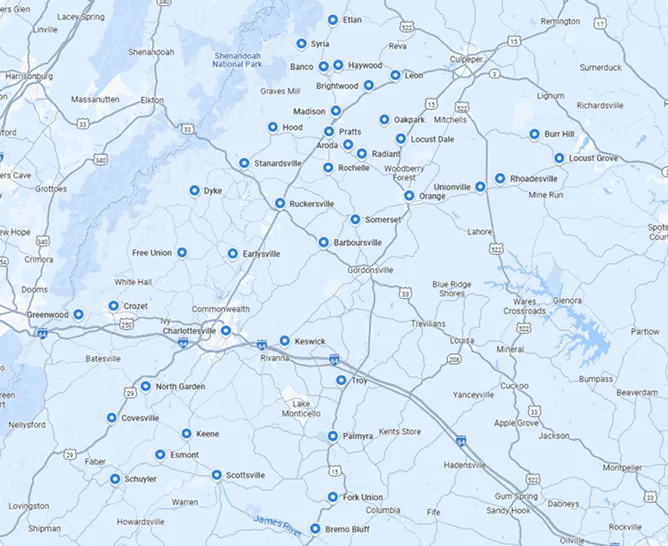
Service areas