


Choose an option to see quick actions and get help faster.
.svg)
The Hidden Cause of Late-Summer AC Power Loss
Your air conditioning is running nonstop, but the house still feels warm and uncomfortable. If you are dealing with this frustrating scenario, understanding exactly how we diagnose a refrigerant leak when your system slowly loses power is the first step toward restoring your home's comfort. When your cooling system struggles to keep up during the hottest part of the year, it rarely means the equipment is just "getting old." More often than not, there is a specific, measurable physical issue preventing the system from moving heat outside.
If you are experiencing a sudden drop in cooling performance, you can always explore our air conditioning services to have a professional evaluate your equipment.
By the time August arrives, your air conditioner has been working tirelessly through months of peak thermal load. This late-summer, end-of-season cooling period is exactly when systems are most vulnerable to breakdowns. The constant vibration of the compressor, combined with the continuous expansion and contraction of copper lines as temperatures fluctuate, takes a heavy toll on the equipment. Over time, this stress can cause microscopic breaches at the brazed joints or along the delicate fins of the evaporator and condenser coils.
The core problem: A system that runs continuously but slowly loses its ability to cool is often suffering from a physical refrigerant leak. Because these micro-leaks allow the vital heat-transfer fluid to escape into the atmosphere, the system loses its capacity to cool your home. Resolving this issue requires precise, professional diagnostics to locate the invisible breach, rather than a temporary and ineffective "top-off."
Understanding the Closed-Loop Refrigeration Cycle
To understand why a leak is such a critical issue, you first need to understand how your air conditioner actually works. Many homeowners operate under the assumption that an air conditioner consumes refrigerant over time, much like a vehicle burns through a tank of gasoline. This is a widespread misconception that leads to poor maintenance decisions.
Your central air conditioning system operates as a sealed, completely closed-loop environment. The refrigerant inside the copper lines is never "used up" or "burned off" during normal operation. Instead, it continuously cycles through the system, changing states from a low-pressure liquid to a high-pressure gas and back again. This phase-change process is what absorbs heat from inside your home and releases it outside.
Why Low Refrigerant Always Means a Leak
Because the system is a closed loop, the amount of refrigerant inside (known as the "charge") should remain exactly the same on the day the system is installed as it is ten years later. If a technician connects their gauges and finds that the system is low on refrigerant, there is definitively a physical hole somewhere in the copper lines or coils. The fluid has escaped.
• Fuel is burned to create mechanical energy. — Closed-Loop Systems (Like ACs): Refrigerant simply changes states (liquid to gas).
• Requires regular refilling to continue operating. — Closed-Loop Systems (Like ACs): Never requires refilling unless a physical break occurs.
• Low fuel is a normal operational state. — Closed-Loop Systems (Like ACs): Low refrigerant indicates a mechanical failure.
When you encounter an AC not cooling properly, verifying the integrity of this closed loop is always a primary diagnostic step. If the loop is broken, simply adding more refrigerant will only result in that new refrigerant leaking out again.
The First Warning Sign: A Sudden Loss of Dehumidification
The Problem: Long before your thermostat registers a significant rise in indoor temperature, you will likely notice a change in how the air inside your home actually feels. The house may begin to feel clammy, sticky, or unusually heavy.
The Cause: In Charlottesville's hot, humid August weather, a slow refrigerant leak first manifests as a failure to dehumidify the home. Your air conditioner performs two distinct jobs: it lowers the sensible temperature (the number on the thermostat), and it removes latent heat (the humidity in the air). To extract moisture from the indoor air circulation, the indoor evaporator coil must reach a very specific, cold temperature. When refrigerant levels drop due to a slow leak, the pressure inside the system changes, which prevents the evaporator coil from getting cold enough to pull condensation out of the air.
The Solution: Recognizing this early warning sign makes early detection possible. If you notice these symptoms, a professional diagnostic visit can catch a slow leak before the system loses so much refrigerant that it completely stops cooling or causes the compressor to overheat.
• Sticky indoor air: The home feels humid even when the AC is running.
• Musty odors: Excess moisture remaining in the ductwork can lead to stale smells.
• Longer run times: The system runs for hours trying to satisfy the thermostat because humid air holds more heat.
The Legal and Environmental Ban on 'Topping Off'
When a system is low on refrigerant, a common request from homeowners is to simply "top it off" to get through the rest of the summer. However, knowingly adding refrigerant to a leaking system without locating and repairing the breach is not just a waste of resources—it is a violation of environmental laws.
Strict regulatory compliance: Federal regulations, specifically EPA Section 608 refrigerant handling regulations, explicitly prohibit the intentional venting of refrigerants into the atmosphere. Because modern refrigerants can have a significant impact on the environment, technicians are legally required to handle them with extreme care.
If a professional knows that an air conditioner has a leak, continuously recharging the system means they are knowingly allowing regulated chemicals to escape into the environment. Professional leak detection is not merely a best practice or an upsell; it is a strict compliance measure required to protect the environment and ensure your equipment operates safely. Ignoring a leak and opting for a quick recharge ultimately wastes your investment, as the new refrigerant will inevitably leak out, leaving you right back where you started.
Professional Diagnostic Method: Electronic Leak Detectors
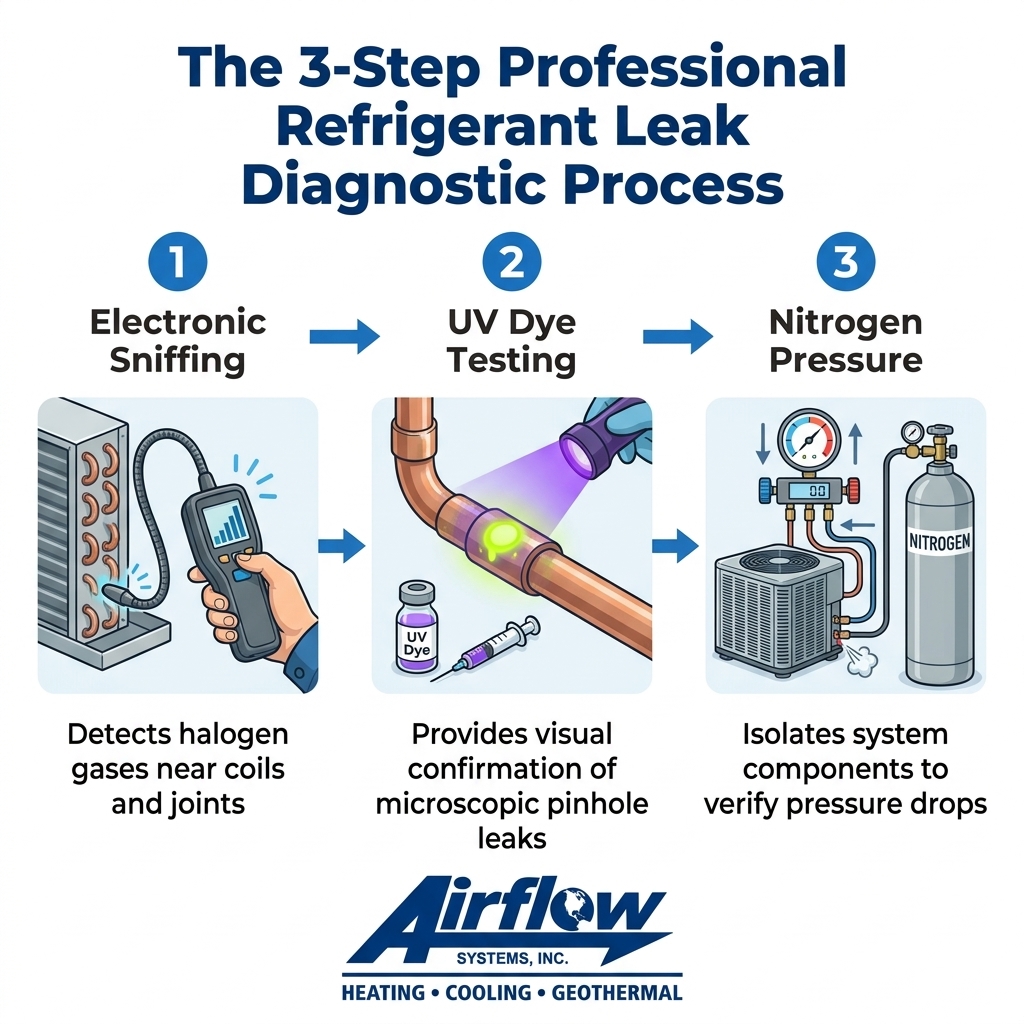
When a technician confirms that a system is low on refrigerant, the search for the breach begins. The first highly technical tool used in professional leak searches is the electronic leak detector, commonly referred to as an electronic "sniffer."
How Electronic Sniffers Work
These sensitive devices are specifically calibrated to detect trace amounts of halogenated gases in the air. The technician slowly sweeps the sensor wand along the intricate network of the indoor evaporator coil, the outdoor condenser coil, and all the brazed joints connecting the line set. The sniffer continuously pulls in air samples, and if it detects even microscopic parts-per-million of refrigerant gas, it triggers an audible alarm and visual indicators.
Electronic sniffers are excellent for identifying the general vicinity of a micro-leak within complex coil structures. Because coils are made of hundreds of tightly packed metal fins, finding a pinhole leak by eye is nearly impossible. The sniffer narrows down the search area rapidly.
This precise diagnostic approach yields real results. In one case, a homeowner experienced a sudden loss of cooling due to a leaking coil in their indoor air handler. By utilizing proper diagnostic tools, the technician figured out the exact location of the problem without guesswork and fully repaired it as soon as the replacement part came in, restoring the system's integrity.
Pinpointing the Source: UV Dye Testing
While electronic sniffers are highly effective at finding the general area of a leak, they can sometimes be triggered by lingering gases trapped in tight spaces. When an electronic sniffer needs precise verification, or if a leak is incredibly slow, technicians move to a secondary visual confirmation method: UV dye testing.
This process involves injecting a specialized, system-safe fluorescent dye directly into the refrigeration cycle. This dye is formulated to mix perfectly with the system's refrigerant and compressor oil without altering the system's performance or damaging internal components.
Once injected, the air conditioner is allowed to run normally. As the refrigerant circulates throughout the closed loop, the dye travels with it. Eventually, the dye seeps out at the exact site of the breach, no matter how small. Technicians then return and use a specialized ultraviolet (UV) light and yellow-tinted glasses to inspect the coils and lines. Under the UV light, the escaping dye glows brightly, providing undeniable visual confirmation of microscopic pinhole leaks that are otherwise completely invisible to the naked eye. This pinpoint accuracy ensures that the repair targets the exact point of failure.
Isolation and Verification: Nitrogen Pressure Tests
In cases where a leak is severe, hidden inside walls, or difficult to pinpoint while the system is running, technicians utilize a highly controlled nitrogen pressure test. This is a definitive method for isolating the leak to a specific component of the HVAC system.
The nitrogen pressure testing process follows strict, sequential steps to ensure safety and accuracy:
1. Safe Recovery: Before pressure testing can begin, any remaining refrigerant inside the system must be safely recovered into a dedicated, DOT-approved recovery cylinder. This adheres to EPA Section 608 regulations and prevents any further environmental contamination.
2. Pressurization: Once the system is empty, the technician introduces inert, dry nitrogen into the copper lines. Nitrogen is used because it does not contain moisture (which would damage the compressor) and it is completely safe for the environment.
3. Simulating Operating Conditions: The system is pressurized with the nitrogen to safely simulate normal operating pressures, often reaching several hundred PSI.
4. Monitoring and Isolation: Technicians connect sensitive digital pressure gauges to the system and monitor them for any pressure drops. They also listen carefully for audible hissing sounds. By isolating the indoor coil, the outdoor unit, and the line set from one another, they can watch the gauges to see exactly which component is failing to hold pressure.
Moving from Diagnosis to a Permanent Repair
Once the exact location of the leak is pinpointed through sniffing, dye testing, or nitrogen isolation, the focus shifts from diagnosis to implementing a permanent repair. Depending on where the breach is located, this might involve repairing a brazed joint on the copper line set or replacing a compromised evaporator coil entirely.
As a trusted independent local business, we frame our refusal to do temporary "freon top-offs" as a strict commitment to ethical service, permanent fixes, and environmental compliance. We believe that applying a band-aid to a mechanical failure does a disservice to the homeowner. A proper repair restores the system to factory specifications, ensuring reliable cooling and optimal energy efficiency for years to come.
After the physical repair is made, the technician must pull a deep vacuum on the entire system using a specialized vacuum pump. This critical step removes all ambient air, moisture, and non-condensables from the lines. Even a single drop of moisture left inside the copper tubing can mix with refrigerant oil to create destructive acids that will eventually destroy the compressor. Only after a deep vacuum is achieved and verified by a micron gauge is the system recharged with virgin refrigerant by exact weight.
This commitment to thoroughness makes a noticeable difference. In one instance during the heat of summer, a technician found and corrected a significant AC leak while also identifying and fixing underlying issues left behind by the original installer. By explaining the work clearly, the homeowner understood that the permanent fix would prevent future breakdowns. Keeping your system monitored through a routine HVAC maintenance plan ensures that these types of vulnerabilities are caught early.
Securing Your Comfort with Ethical AC Solutions
Understanding how electronic sniffers, UV dye tests, and nitrogen pressure tests work empowers you to make informed decisions about your home comfort. When an HVAC professional insists on performing a leak search rather than just adding more refrigerant, they are protecting both your expensive equipment and the environment.
Proper leak detection is the only way to guarantee that your air conditioner will operate reliably when you need it most. If you notice your system running constantly but failing to dehumidify or cool your home, do not wait for a complete breakdown. Seek professional diagnostics at the first sign of power loss to secure a permanent, ethical solution. Reach out for comprehensive AC repair to restore your system's performance the right way.
Frequently Asked Questions
How do HVAC techs find refrigerant leaks?
Professionals use a combination of electronic leak detectors, UV fluorescent dye, and nitrogen pressure testing to locate breaches. Electronic sniffers detect trace halogen gases in the air, while UV dye provides visual confirmation of microscopic pinholes under a specialized light.
Why won't my AC company just add more freon?
Adding refrigerant to a leaking system without fixing the hole is both ineffective and environmentally irresponsible. Because air conditioners are closed-loop systems, any lost refrigerant indicates a physical breach that will simply allow new refrigerant to leak out again.
What happens if you just keep adding freon to an AC?
Continuously topping off a leaking system forces the compressor to work harder, significantly increasing your energy bills and risking catastrophic equipment failure. Furthermore, the escaping refrigerant harms the environment and violates federal handling regulations.
Can a slow refrigerant leak cause my AC to freeze up?
Yes, a slow refrigerant leak is one of the most common causes of a frozen evaporator coil. When the refrigerant level drops, the pressure inside the coil drops as well, causing the remaining fluid to become so cold that it freezes the natural condensation right onto the metal fins.
Is it illegal to top off a leaking AC system?
Under EPA Section 608 regulations, it is illegal to intentionally vent regulated refrigerants into the atmosphere. Knowingly adding refrigerant to a system with a confirmed, unrepaired leak is considered a violation of these environmental protection laws.
Book Expert Service Or Contact Us
Our Service Process
A Hassle-Free Service Experience
01
Consultation & Diagnosis
We start by listening to your needs and performing a thorough diagnosis of your system to recommend the best solution.
02
Transparent Quoting
We provide a clear, upfront estimate with no hidden fees, so you know exactly what to expect.
03
Expert Service & Follow-Up
Our factory-trained technicians complete the work to the highest standards, and we follow up to ensure your complete satisfaction.
testimonials
What Our Customers Are Saying
Our customers consistently praise our exceptional service and attention to detail, making us a trusted choice for all your HVAC needs.
where we operate
Service areas