


Choose an option to see quick actions and get help faster.
.svg)

When Reliable Cooling Fails in Late Summer
By the time August arrives, your cooling system has already run a marathon. Here at Airflow Systems, we know that diagnosing late-summer AC short-cycling after weeks of heavy use is a critical priority when a system that operated flawlessly through June and July suddenly begins to struggle. The late-summer heat is unforgiving, and losing your reliable indoor comfort right at the finish line of the season is incredibly frustrating. You rely on your system to maintain a consistent temperature, but instead, you are met with sudden, rapid bursts of air that fail to cool the house.
The primary symptom you will notice is the system turning on and off in rapid, inefficient bursts. This behavior is mechanically known as short-cycling. It is not just an annoyance; it is a clear distress signal from your equipment. Your system is attempting to cool your home but is being forced to shut down prematurely to protect its internal components. When this happens in August or late-summer, the root cause is rarely a sudden, random part failure. Instead, our team typically finds that it is the result of cumulative wear and tear.
As a homeowner, your main decision point is identifying whether this rapid cycling is caused by a basic airflow restriction—like a heavily soiled indoor filter—or if it stems from severe late-summer condenser coil fouling. A simple filter change takes minutes, but a fouled outdoor coil requires professional intervention to prevent permanent equipment damage. When evaluating these symptoms, securing professional air conditioning services is the safest way to restore reliable performance and properly diagnose the true cause of the malfunction.
The Cumulative Toll of Continuous Summer Operation
To understand why a dependable air conditioner suddenly starts short-cycling in August, you have to look at the preceding months. A breakdown late in the season is rarely an isolated event. It is the compounding result of weeks of heavy, continuous operation. Every hour your system runs, it pulls massive volumes of outdoor air across its condenser coils.
June: The Accumulation Begins
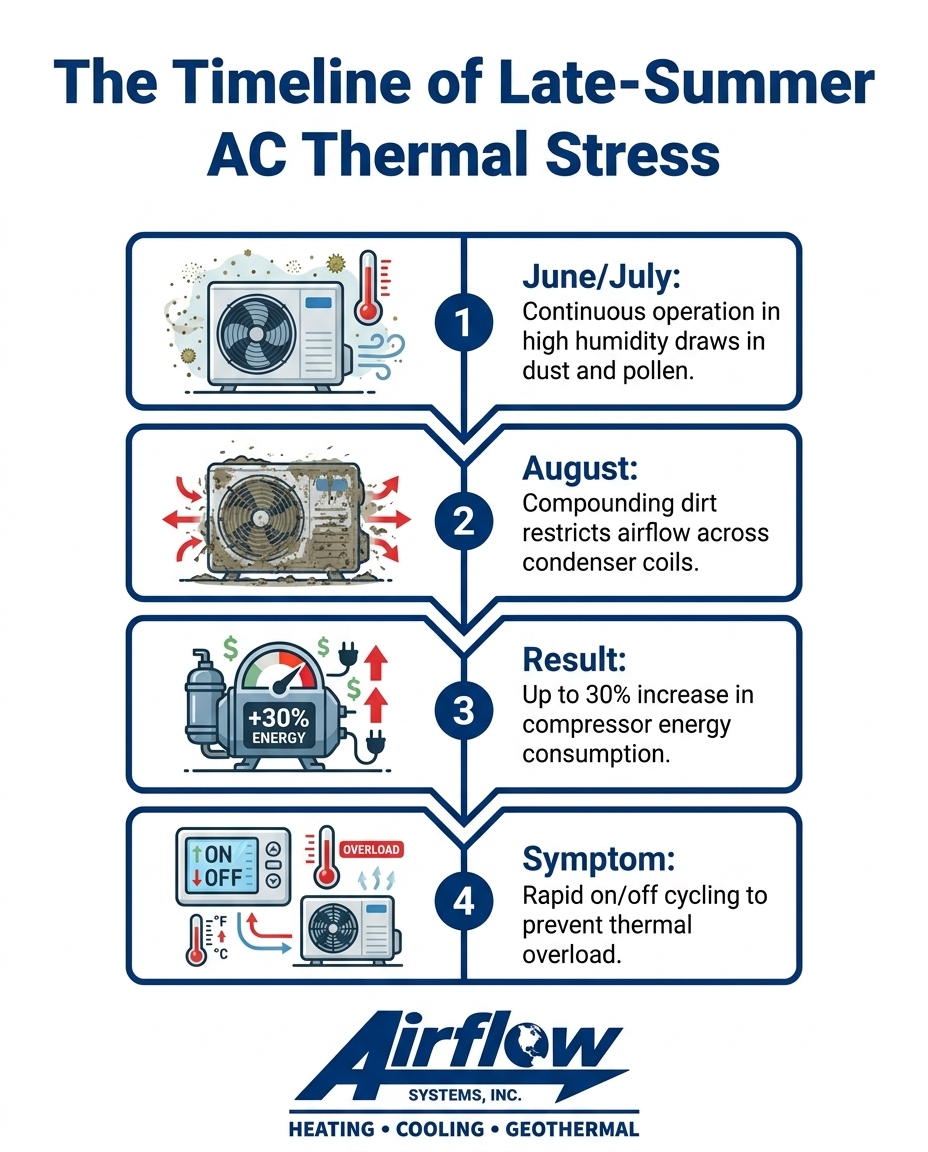
In early summer, your outdoor unit is typically clean. However, as the system cycles on to combat the rising temperatures, the outdoor fan draws in surrounding air to dissipate heat. Along with that air comes early-summer pollen, fine dust, and yard debris from fresh landscaping. At this stage, the dirt layer is thin. The system still breathes easily, and performance remains high.
July: The Continuous-Run Crucible
As the season peaks, the workload intensifies dramatically. Our technicians see firsthand how Charlottesville's specific high-humidity, continuous-run conditions in July force the system to process massive amounts of air just to keep the indoor humidity in check. The moisture in the air combined with the continuous operation creates a sticky surface on the outdoor coils. The system rarely gets a chance to rest. This lack of downtime prevents the unit from cooling naturally. The dust and debris that were lightly resting on the coils in June are now baked onto the aluminum fins, creating a restrictive, insulating blanket.
August: The Breaking Point
By the time August arrives, that compounding dirt has formed a severe barrier. The system is still trying to reject heat from your home, but the heavily fouled coils trap that heat inside the unit. The compressor runs hotter and hotter. Eventually, the thermal stress becomes too much, setting the stage for protective shutdowns and the rapid cycling behavior that disrupts your back-to-school transition.
Recognizing the Signs of AC Short-Cycling
Understanding the mechanical symptoms of short-cycling is the first step in protecting your investment. A healthy air conditioner operates in steady, predictable rhythms. When those rhythms break down, the system is actively warning you that it cannot complete its primary function safely.
Normal Cooling Cycles: Under typical conditions, an air conditioner will run for 15 to 20 minutes at a time. This duration is necessary to effectively lower the indoor temperature and, just as importantly, to extract humidity from the air.
Short-Cycling Behavior: We define short-cycling explicitly as rapid on/off cycling intervals that fail to complete a full cooling cycle. The system might run for only two to five minutes before abruptly shutting down, only to restart a few minutes later. This rapid cycling is often a protective shutdown mechanism. Internal sensors detect that the compressor is overheating or that refrigerant pressures have spiked to dangerous levels, and they cut the power to prevent a catastrophic thermal overload.
Ignoring this symptom is highly dangerous to the compressor. Every time a compressor starts, it draws a massive surge of electricity—known as inrush current—and experiences the highest level of mechanical friction before its lubricating oils fully circulate. Forcing a system to endure rapid on/off cycling intervals multiplies this wear and tear exponentially, which can quickly lead to permanent compressor failure. One local homeowner recently called us about a persistent summer AC problem traced back to compounding issues from their original installer; our thorough technician found and corrected the underlying mechanical problem, explaining the exact cause of the rapid cycling clearly before restoring the system to full capacity. If you notice these rapid starts and stops, securing professional AC repair immediately is the only way to halt the damage.
The Hidden Culprit: Compounding Dirt on Condenser Coils
When investigating late-summer short-cycling, the most common hidden culprit is located outside your home. The outdoor condenser unit plays a vital mechanical role in your overall comfort: it is responsible for releasing the heat that the indoor unit absorbed from your living space.
The condenser relies on thousands of tiny aluminum fins to maximize surface area and transfer heat into the outdoor air. When compounding dirt, cottonwood, grass clippings, and pollen accumulate over weeks of heavy use, they clog these delicate fins. This restricts airflow and effectively traps the heat inside the unit. Instead of blowing hot air away from the house, the condenser stews in its own thermal energy.
The impact on efficiency and mechanical safety is severe. According to Department of Energy data, a dirty condenser coil can increase compressor energy consumption by up to 30 percent while significantly reducing the system's overall cooling capacity. The compressor has to work much harder to pump refrigerant through a hot, restricted coil.
This explains the mechanical transition from peak early-summer performance to late-summer thermal shutdowns. In June, the clean coils reject heat effortlessly. By August, the thick layer of baked-on grime forces the compressor's internal temperature to skyrocket, triggering the high-pressure switch or internal thermal overload protector. While safely cleaning your AC condenser unit is a critical maintenance task, attempting a deep clean on a severely fouled, short-cycling system requires professional tools and expertise to avoid bending the fragile fins or driving the dirt deeper into the coil.
Troubleshooting: Airflow Checks vs. Professional Diagnostics
When your system begins exhibiting rapid on/off cycling intervals, there is a clear boundary between safe homeowner troubleshooting and the need for a licensed HVAC professional. Taking the right steps immediately can save you from unnecessary service calls, but crossing the line into DIY repairs can permanently damage your equipment.
Safe Homeowner Airflow Checks:
• Inspect the indoor air filter: Check and replace heavily clogged indoor air filters. A blocked filter starves the system of air, causing the indoor coil to freeze and triggering a low-pressure shutdown. This is the most common, safe homeowner fix for airflow issues.
• Verify vent clearances: Ensure that all indoor supply and return vents are fully open. Move any rugs, curtains, or heavy furniture that might be blocking the grilles.
• Check the thermostat settings: Confirm that the thermostat is set to "Cool" and that the fan is set to "Auto." Sometimes, a malfunctioning thermostat can send erratic signals that mimic short-cycling.
When to Call a Professional:
If you have verified that the filter is clean and the vents are open, but the rapid cycling continues, the issue likely stems from severely fouled outdoor coils, low refrigerant, or failing electrical components. Our team strictly advises that dismantling the outdoor unit for deep coil cleaning requires a licensed professional. High-voltage capacitors retain lethal charges even when the power is off, and improper cleaning techniques can destroy the delicate aluminum fins.
• Rapid cycling with a dirty indoor filter — Likely Cause: Restricted indoor airflow causing coil freeze — Required Action: Replace filter and monitor system
• Rapid cycling with a clean filter — Likely Cause: Fouled outdoor condenser coil or thermal overload — Required Action: Schedule professional diagnostic
• System shuts down and outdoor unit is excessively hot — Likely Cause: Compressor overheating / High-pressure trip — Required Action: Turn system off immediately and call HVAC pro
Why Honest Professional Assessment Matters
When an older air conditioner starts struggling in August, the fear of needing a complete system replacement often causes homeowners to delay calling for help. However, accurate diagnostics are far more valuable than jumping to worst-case conclusions. An older unit struggling at the end of the season might simply need a thorough, professional deep clean and a capacitor replacement rather than a full, expensive replacement.
This is where technical transparency during a diagnostic visit protects your investment. As an independent, family-owned Central Virginia company, our team at Airflow Systems focuses on providing honest, thorough diagnostics to fix the actual problem—like severely dirty coils—rather than using a short-cycling older unit as an excuse to push for an immediate, unnecessary replacement. A recent service call demonstrated this approach perfectly: a Charlottesville homeowner's HVAC system needed immediate service, and our responding technician performed an extremely thorough diagnostic, caring deeply about doing a good job and identifying the true root cause rather than rushing the appointment.
Consistent upkeep and planned care can prevent these late-season thermal stress surprises entirely. By securing a routine maintenance plan, your system receives the deep cleaning and electrical testing it needs before the heavy summer workload begins, ensuring that cumulative dirt never reaches the point of causing a system shutdown.
Frequently Asked Questions About Late-Summer AC Cycling
Why is my AC suddenly short cycling in late summer?
Your AC is likely experiencing cumulative thermal stress and severe dirt buildup on the outdoor coils over the preceding months. After running continuously through June and July, the system accumulates layers of dust and pollen. By late summer, this buildup severely restricts airflow, causing the system to overheat and shut down prematurely to protect itself. Regular maintenance is required to clear this cumulative debris.
Can dirty condenser coils cause an AC to short cycle?
Yes, dirty condenser coils are a primary cause of short-cycling. The dirt acts as an insulator, trapping heat inside the unit and restricting the airflow needed to cool the refrigerant. This causes the compressor to overheat rapidly, triggering internal safety switches that shut the system down defensively. Once the unit cools slightly, it tries to start again, resulting in a rapid on/off loop.
How do you diagnose AC short cycling?
You should always start by checking the indoor air filter; a severely clogged filter restricts airflow and can cause the system to cycle rapidly. If the filter is clean and all vents are open, a professional must take over the diagnostic process. A licensed technician will assess refrigerant pressures, test electrical components like the run capacitor, and evaluate the cleanliness of the outdoor coils to pinpoint the exact mechanical failure.
Will short cycling damage my AC compressor?
Yes, continuous rapid starts and stops cause immense wear and tear on the compressor. The highest amount of electrical and mechanical stress occurs during the initial startup phase of a cooling cycle. Forcing the compressor to endure these rapid on/off cycling intervals constantly can overheat the motor windings and prevent proper oil circulation, potentially leading to permanent, irreversible compressor failure.
How long should an AC run before turning off in high humidity?
A properly sized and functioning AC should typically run for 15 to 20 minutes per cycle, depending on the ambient temperature and humidity levels. In highly humid conditions, longer cycles are actually beneficial, as the system needs extended run times to pull moisture out of the indoor air. Cycles lasting less than ten minutes are a strong indicator that the system is short-cycling and requires professional assessment.
Protect Your Compressor Before the Season Ends
Rapid on/off cycling intervals are a critical warning sign that requires a logical, professional approach to resolve. Your air conditioning system is designed to provide steady, reliable comfort, and when it begins to stutter and shut down prematurely, it is actively trying to protect its most vital components from catastrophic failure.
Addressing compounding dirt and thermal stress now prevents permanent compressor damage before the cooling season officially ends. Do not force a struggling system to limp across the finish line of summer. Take action to protect your equipment and your comfort. Schedule a professional diagnostic today to safely restore proper airflow, clear away months of accumulated debris, and ensure your system remains reliable for the rest of the season and beyond.
Book Expert Service Or Contact Us
Our Service Process
A Hassle-Free Service Experience
01
Consultation & Diagnosis
We start by listening to your needs and performing a thorough diagnosis of your system to recommend the best solution.
02
Transparent Quoting
We provide a clear, upfront estimate with no hidden fees, so you know exactly what to expect.
03
Expert Service & Follow-Up
Our factory-trained technicians complete the work to the highest standards, and we follow up to ensure your complete satisfaction.
testimonials
What Our Customers Are Saying
Our customers consistently praise our exceptional service and attention to detail, making us a trusted choice for all your HVAC needs.
where we operate
Service areas