

Choose an option to see quick actions and get help faster.
.svg)
Closing the Windows: The Hidden Impact on Your Home's Air
The September ragweed peak and early fall harvest are approaching fast. If you are serious about Fall Allergen Defense: Upgrading Filtration Before Ragweed Season Peaks is the single most important step you can take to protect your household. As the weather shifts, most homeowners instinctively shut their windows to keep the chill out, unknowingly trapping a dense cloud of seasonal irritants indoors. At Airflow Systems, Inc., we see this pattern every year: addressing your indoor air quality right now ensures you are not breathing recycled dust all season long.
During the summer months, homes often benefit from a mix of active air conditioning and occasional open windows, which allows for some natural ventilation. However, the transition to cooler weather changes the airflow dynamics of your house entirely. By sealing the building envelope to retain heat, you also seal in everything else. Pet dander, volatile organic compounds (VOCs) from household cleaners, and the fine particulate matter tracked in from outside have nowhere to go. Because your HVAC system acts as the respiratory system of your home, it pulls all of these trapped particulates through your return vents and circulates them through your living spaces five to seven times a day.
The critical decision point:
• Sticking with the status quo: Continuing to rely on basic 1-inch fiberglass filters means allowing fine particulates to bypass your filtration entirely, settling on your furniture and entering your breathing zones.
• Taking proactive action: Upgrading to a more robust filtration system captures these microscopic irritants before symptoms worsen.
We often warn our customers that a sharp drop in indoor air quality occurs rapidly as these trapped particulates accumulate. You might notice more dust on your hard surfaces, frequent sneezing, or a general feeling of stuffiness, especially in the morning. Professional evaluation is the first step to identifying exactly what is circulating in your home's air. By understanding the specific challenges of the season, you can make an informed decision about the right filtration strategy for your property.
The Dual Threat: Ragweed Blooms and Agricultural Harvest Dust
Early fall introduces a massive spike in airborne particulate matter that typical summer conditions simply do not present. Over our years serving Charlottesville and surrounding Albemarle County, our technicians have seen how this time of year creates a uniquely challenging environment for residential indoor air quality. It is not just one irritant causing the problem; it is a heavy, combined load that overwhelms standard HVAC systems.
First, native ragweed plants enter their peak blooming phase. A single ragweed plant can produce up to one billion pollen grains in a single season. These grains are incredibly light and aerodynamic, designed by nature to travel for hundreds of miles on the wind. They easily find their way into your home through tiny gaps around doors, windows, and rooflines, or simply hitch a ride on your clothing and pets.
Second, a pattern we see often is that this pollen release coincides directly with local farming operations kicking into high gear. The heavy agricultural harvest dust prevalent in our area during early fall is a major factor. Tractors and combines working the dry fields kick up massive clouds of organic matter, soil, and dried plant material. This fine agricultural dust mixes with the ragweed pollen, creating a dense, highly irritating particulate soup that drifts into residential neighborhoods.
This combination creates a heavy load on residential HVAC systems. Standard filters are quickly saturated, and the sheer volume of particulate matter forces the system to work harder just to pull air through the return vents. Understanding this dual threat is essential for proper allergy defense. To understand exactly what is circulating through your ductwork, our team uses professional indoor air quality testing to provide a clear baseline, allowing you to see the invisible load your system is fighting against.
The 10-to-20 Micron Problem: What Standard Filters Miss
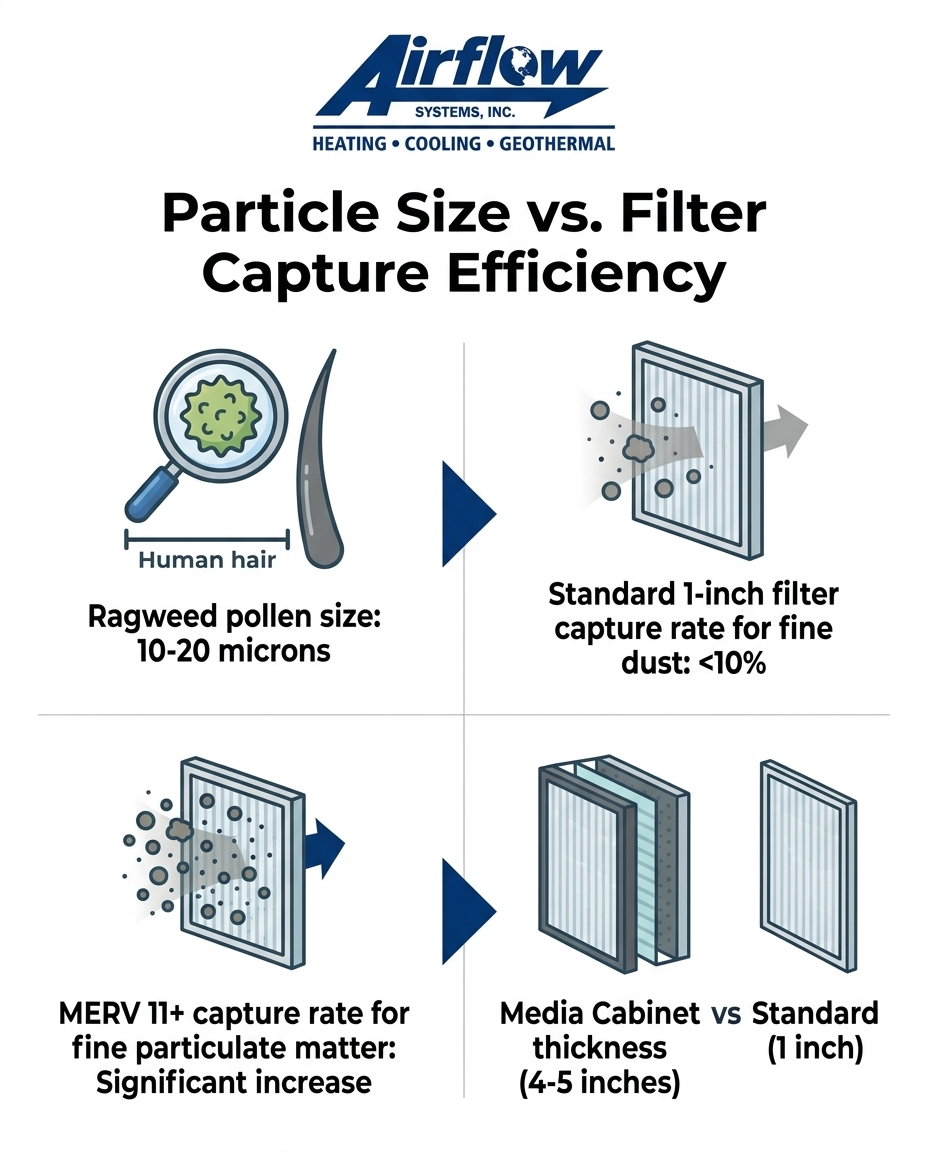
To understand why standard 1-inch fiberglass filters fail against fall particulates, you have to look at the microscopic mechanics of the particles themselves. The size of an airborne particle is measured in microns. For context, a single strand of human hair is roughly 70 microns in diameter. Ragweed pollen grains typically measure between 10 and 20 microns in size, while agricultural dust can be even smaller, often falling into the 2.5 to 10-micron range.
The problem with basic filtration:
A frequent frustration we hear on service calls is that standard 1-inch fiberglass filters are designed primarily to protect the HVAC equipment from large debris, not to clean the air you breathe. They act as "boulder catchers" for your furnace and air handler, stopping large items like pet hair, carpet fibers, and heavy lint from coating the sensitive mechanical components. They are completely ineffective against the microscopic threats of the September ragweed peak and early fall harvest.
The cause of the failure:
The woven fiberglass mesh in a basic filter is simply too porous. These basic filters capture less than 10% of particles in the pollen and fine dust micron range. The other 90% passes right through the filter media, travels through the blower motor, and is pushed back out into your home.
• Household Lint & Hair — Average Size (Microns): 50 - 100+ — 1-Inch Fiberglass Capture Rate: High (Effectively Blocked)
• Ragweed Pollen — Average Size (Microns): 10 - 20 — 1-Inch Fiberglass Capture Rate: Less than 10%
• Agricultural Dust — Average Size (Microns): 2.5 - 10 — 1-Inch Fiberglass Capture Rate: Near 0%
• Pet Dander — Average Size (Microns): 5 - 10 — 1-Inch Fiberglass Capture Rate: Very Low
The resulting solution:
Because fine agricultural dust easily bypasses basic filtration, settling on furniture and circulating through breathing zones, a mechanical upgrade is necessary. We recommend a filter media dense enough to catch 10-micron particles without suffocating the system itself.
The Airflow Trap: Risks of Restrictive Hardware Store Filters
When homeowners notice the sudden influx of fall dust and suffer through allergy flare-ups, their first instinct is usually a trip to the local hardware store. They scan the aisles, find the 1-inch filter with the highest possible rating, and slide it into their return grille. Unfortunately, our repair team frequently responds to service calls where this common reaction has created a much larger, more expensive problem for the HVAC system.
These dense, heavily pleated filters can severely restrict system airflow. Your HVAC equipment is calibrated to operate within a specific range of static pressure—essentially, the resistance the blower motor has to overcome to pull air through the ductwork. When you install a highly restrictive 1-inch filter, it acts like a heavy wool blanket over the return vent. The blower motor is forced to work much harder to pull the same volume of air.
The cascading effects of restricted airflow:
• Overheating components: The furnace heat exchanger can overheat if enough air isn't moving across it to dissipate the warmth.
• Poor temperature control: Weak airflow means the conditioned air never reaches the furthest rooms in your house, leaving hot and cold spots.
• Higher energy bills: The blower motor consumes significantly more electricity as it struggles against the resistance.
• System breakdowns: The strain dramatically shortens the lifespan of the motor and can lead to premature failure.
Understanding how dirty filters affect your HVAC system—or overly restrictive clean ones—is critical. Effective filtration requires a delicate balance between particle capture and healthy airflow. As the local experts in Charlottesville and surrounding Albemarle County, our team at Airflow Systems, Inc. provides honest, system-safe filtration upgrades rather than pushing restrictive, one-size-fits-all box store filters that choke your equipment.
Professional Filtration Solutions for Heavy Dust
In our experience, achieving clean indoor air without damaging your HVAC system requires moving beyond the standard 1-inch filter slot. Professional filtration upgrades are designed to handle the heavy load of the September ragweed peak and early fall harvest while maintaining the precise static pressure your equipment needs to operate efficiently.
1. Evaluate current static pressure: Our technicians measure the existing airflow resistance to determine what level of filtration the ductwork can safely handle.
2. Select the appropriate MERV rating: Upgrading to a MERV 11 or higher filter significantly increases the capture rate of fine particulate matter, including ragweed and harvest dust.
3. Install a dedicated media cabinet: The existing 1-inch filter rack is replaced or bypassed in favor of a much larger housing designed for thick, high-capacity filters.
4. Seal the duct transitions: The new cabinet is professionally sealed by our team to ensure no unconditioned, dusty air bypasses the filter media.
Understanding MERV Ratings for Allergies
MERV stands for Minimum Efficiency Reporting Value. It is a standardized scale that rates how effectively a filter captures particles of specific sizes, including the problematic 10-to-20 micron range. Standard fiberglass filters usually sit at MERV 1 to 4. For residential allergy defense in our service area, we consistently recommend MERV 11 to 13 as the sweet spot. A MERV 11 filter is dense enough to capture a high percentage of ragweed pollen, pet dander, and fine agricultural dust, but not so restrictive that it requires commercial-grade blower motors to push air through it.
The Advantage of Media Cabinets
The secret to high MERV ratings without airflow restriction lies in surface area. Dedicated media cabinets utilize filters that are 4 to 5 inches thick. These filters are heavily pleated in an accordion design. If you were to unfold a 4-inch media filter, the actual surface area of the filtration material would be massive compared to a flat 1-inch filter. This expansive surface area provides thousands of tiny pathways for air to flow freely while still trapping harvest dust and pollen. Furthermore, because they hold so much more material, we find these advanced setups require less frequent changes—often lasting six to twelve months—and provide superior protection during peak allergy seasons.
Timing Your Upgrade with Seasonal Maintenance
Early fall is the ideal time to evaluate both your filtration strategy and your overall system health. The transition from summer cooling to fall heating is a critical period for your HVAC equipment. In Central Virginia, the rapid temperature shifts during fall mean you might be running the air conditioner during a warm afternoon and switching the furnace on by late evening. This unpredictable demand requires a reliable, well-maintained system.
During our fall pre-heating-season tune-ups, we frequently find that transitioning from cooling to heating requires a clean system to prevent burning off accumulated summer dust. If you have been using a basic 1-inch filter all summer, a layer of fine dust has likely settled on your furnace's heat exchanger or heat pump coils. When the heating cycle kicks on for the first time, this settled dust burns off, creating a noticeable, unpleasant odor and circulating even more particulate matter into your home.
A comprehensive seasonal tune-up ensures the system can handle the added filtration without strain. During this visit, our technicians clean the internal components, check the electrical connections, and verify that the blower motor is operating at peak efficiency. If you are upgrading to a media cabinet, this is the perfect time to have it installed and calibrated. Proactive scheduling prevents breakdowns when the first cold snap arrives, ensuring your heating systems are ready to perform safely and cleanly throughout the winter months.
Frequently Asked Questions About Fall Allergens and HVAC Systems
If you are considering an HVAC maintenance plan to prepare for the September ragweed peak and early fall harvest, you likely have questions about how your system interacts with seasonal allergens. Here are the most common inquiries our team receives from local homeowners.
Can upgraded HVAC filters reduce fall allergies?
Yes, we consistently see that upgrading your HVAC filter can significantly reduce fall allergy symptoms indoors. Standard filters only catch large debris, but high-efficiency filters (like MERV 11 or higher) are specifically designed to trap the microscopic pollen grains and mold spores that trigger allergic reactions. By capturing these irritants before they circulate through your ductwork, a proper filter acts as a whole-home air purifier.
Why is my house so dusty in the fall?
Your house gets dusty in the fall due to a combination of dry weather, agricultural harvesting, and closing your windows. As local fields are harvested, massive amounts of fine dirt and organic matter are kicked into the air and carried by the wind into residential areas. Once this dust enters your home, closed windows trap it inside, allowing it to settle rapidly on your furniture and floors.
What is the best HVAC filter for ragweed?
We recommend a 4-to-5-inch thick media filter with a MERV rating between 11 and 13 as the best HVAC filter for capturing ragweed. Ragweed pollen grains are extremely small (10 to 20 microns), meaning they easily pass through standard 1-inch fiberglass filters. A thicker media filter provides the density needed to trap the pollen without restricting the necessary airflow to your blower motor.
Does my HVAC filter help with agricultural harvest dust?
A standard 1-inch filter does very little to stop agricultural harvest dust, but a high-capacity media filter handles it exceptionally well. Harvest dust is incredibly fine and can quickly clog thin, basic filters, leading to poor system performance. Upgrading to a deeper pleated filter gives your system the surface area required to hold large volumes of dust while keeping your indoor air clean.
How often should I change my air filter during allergy season?
If you use a standard 1-inch pleated filter, you should check it every 30 days and replace it at least every 45 to 60 days during peak allergy season. The heavy load of pollen and dust will saturate thin filters much faster than usual. However, if our team installs a 4-to-5-inch media cabinet, you typically only need to replace the filter every 6 to 12 months, even during heavy allergen periods.
Is a MERV 11 or MERV 13 better for capturing pollen?
Both MERV 11 and MERV 13 are highly effective at capturing pollen, but MERV 13 filters catch a slightly higher percentage of the finest particles, including some bacteria and virus carriers. However, MERV 13 filters are also more restrictive to airflow. For most residential systems we service, a MERV 11 provides the perfect balance of excellent pollen capture and safe, efficient system airflow.
Breathe Easier This Fall with Tailored Filtration
The air you breathe inside your home shouldn't be dictated by the agricultural schedules and weed blooms outside. Standard 1-inch filters are simply inadequate against the dense clouds of ragweed and harvest dust that blanket Charlottesville and surrounding Albemarle County every fall. Relying on them means allowing microscopic irritants free reign over your living spaces.
System-safe upgrades, such as dedicated media cabinets and appropriate MERV-rated filters, protect both your respiratory health and your expensive HVAC equipment. They trap the fine particulates that cause sneezing and dust buildup without suffocating your blower motor. Before you close your windows for the season, let our team at Airflow Systems, Inc. schedule a professional evaluation of your indoor air quality and filtration needs. Taking action now ensures your home remains a clean, comfortable refuge all season long.
Book Expert Service Or Contact Us
Our Service Process
A Hassle-Free Service Experience
01
Consultation & Diagnosis
We start by listening to your needs and performing a thorough diagnosis of your system to recommend the best solution.
02
Transparent Quoting
We provide a clear, upfront estimate with no hidden fees, so you know exactly what to expect.
03
Expert Service & Follow-Up
Our factory-trained technicians complete the work to the highest standards, and we follow up to ensure your complete satisfaction.
testimonials
What Our Customers Are Saying
Our customers consistently praise our exceptional service and attention to detail, making us a trusted choice for all your HVAC needs.
where we operate
Service areas