

Choose an option to see quick actions and get help faster.
.svg)
Is Your Heating System Ready for Virginia's Unpredictable Winters?
Are you trying to weigh a Heat Pump vs. Gas Furnace for Virginia's Unpredictable Winters, wondering which technology will actually keep your home comfortable when the temperature drops? You are certainly not alone. As the September pre-heating-season transition begins, our team at Airflow Systems, Inc. talks to many homeowners who find themselves staring down an aging heating system, trying to decide between modern electric solutions and traditional gas heating options before the first real freeze sets in.
The core decision point usually comes down to two distinct paths: relying entirely on a modern cold-climate heat pump, or installing a dual-fuel setup that pairs an electric heat pump with a gas furnace backup. Making this choice now, during the early fall transition, is critical. Our dispatchers see it every year: waiting until a system completely fails in the middle of a December cold snap often leads to rushed decisions and limited equipment availability. By evaluating your options proactively, you set the stage for a deep-dive comparison tailored specifically to our regional weather patterns, ensuring your home stays warm efficiently all season long.
To learn more about your foundational options, explore our heat pump systems or schedule a heat pump installation consultation to get a customized assessment for your property.
Understanding the Central Virginia Climate Challenge
Standard national heating advice often fails to account for the specific realities of the Charlottesville VA climate zone. When you read generic articles about heating systems, they usually assume you live in an area with either consistent deep freezes (like the Northeast) or year-round warmth (like the Deep South). Central Virginia presents a completely different environmental challenge that demands a more versatile heating solution.
Our region is defined by rapid day-to-night temperature swings. It is incredibly common to experience a mild, sunny afternoon where temperatures hover around 55 or 60 degrees, only for the thermometer to plummet 30 or more degrees after sunset. These moderate daytime temperatures followed by sudden, sub-freezing nights create a unique, fluctuating heating load on your home's HVAC system. A system that works perfectly well at 2:00 PM might struggle to keep up at 2:00 AM if it is not properly matched to the environment.
Furthermore, in our years servicing Charlottesville and the surrounding Blue Ridge foothills, we've seen firsthand how distinct local microclimates affect heating loads. Depending on your home's elevation, its exposure to winter winds, and how cold air settles in local valleys, your property might experience harsher conditions than a home just a few miles away. This specific climate zone demands versatile heating solutions that can operate efficiently during mild afternoons and deliver robust, uninterrupted heat during sudden nighttime freezes. Modern HVAC technology has evolved specifically to address these exact environmental demands, giving homeowners better options than ever before.
How Modern Cold-Climate Heat Pumps Handle the Cold
To understand your options, it helps to separate outdated myths from the actual capabilities of current cold-climate technology. Historically, standard heat pumps struggled when the temperature dropped below 40 degrees. Today, that is no longer the case. Modern cold-climate heat pumps are engineered specifically to maintain high performance even when winter weather is at its worst.
The mechanics of heat transfer: Unlike a traditional furnace that burns fuel to generate heat, a heat pump operates by transferring heat. Even in freezing weather, there is ambient thermal energy in the outside air. The heat pump extracts this heat, compresses it to a higher temperature, and moves it inside your home. Because moving heat requires significantly less energy than creating it, this process is remarkably efficient.
Variable-speed technology: The secret behind modern cold-climate models is the variable-speed compressor. Instead of operating on a simple on/off cycle like older units, variable-speed compressors can ramp up or down in tiny increments. This allows them to extract ambient heat effectively even when temperatures drop below freezing, running continuously at lower speeds to maintain a perfectly even indoor temperature.
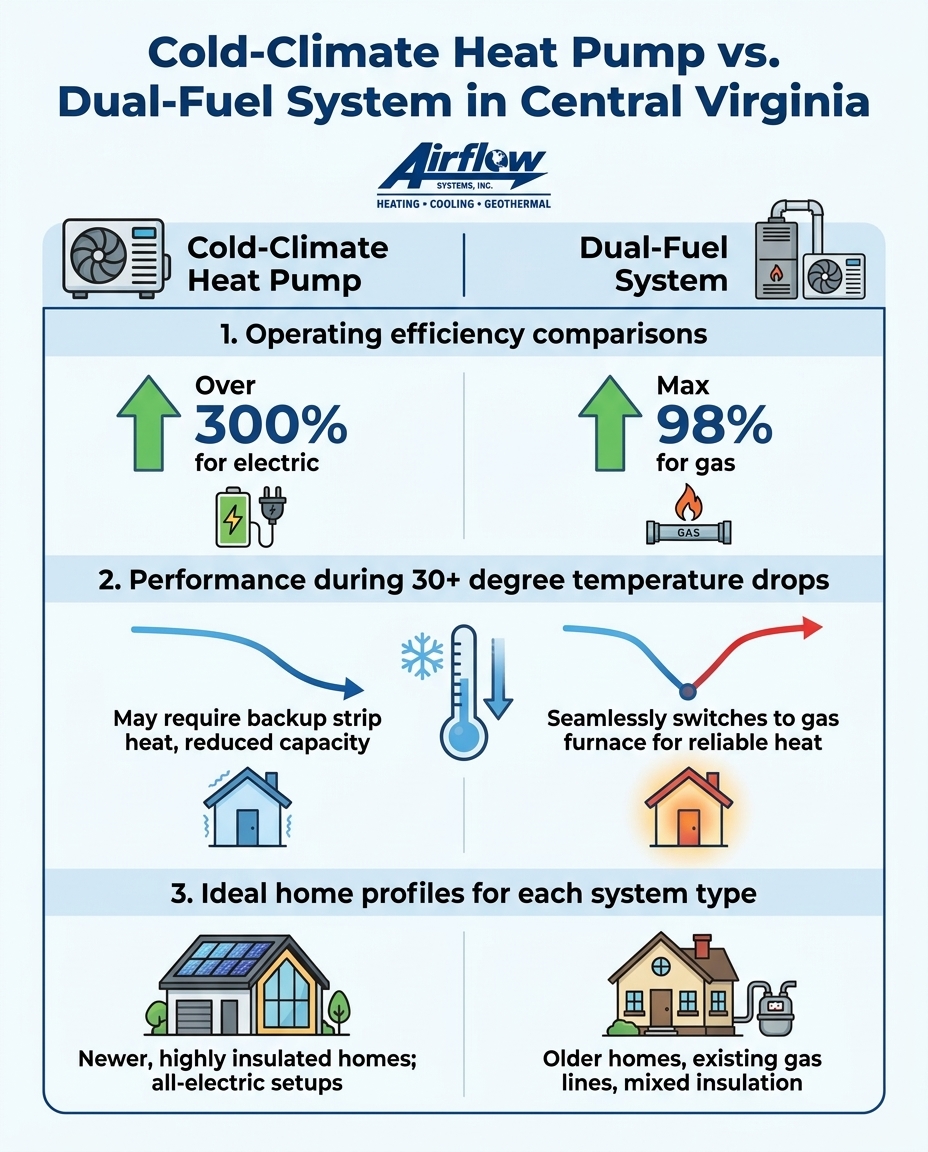
Unmatched efficiency: Because of these advancements, cold-climate heat pumps can maintain operating efficiencies of over 300 percent. This means that for every unit of electricity they consume, they produce three units of heat. Relying on advanced electric heating during our moderate winter days provides massive environmental and efficiency benefits. If you are curious about how this translates to local performance, you can read more about heat pump efficiency in the Mid-Atlantic region.
The Case for Dual-Fuel Heating Systems
While cold-climate heat pumps are incredibly capable, they are not the only solution for fluctuating temperatures. For many homes, a dual-fuel heating system offers the perfect balance of efficiency and robust heating power. A dual-fuel system is exactly what it sounds like: a hybrid approach that pairs an electric heat pump with a traditional gas furnace.
The problem of extreme temperature plummets: When temperatures drop severely, an electric heat pump has to work much harder to extract heat from the outside air. While modern units can handle this, their efficiency naturally decreases as the temperature approaches zero. If your home is older, drafty, or lacks top-tier insulation, the heat pump might run continuously just to maintain a baseline temperature, leading to higher electricity usage and a home that feels slightly chilly.
The automatic solution: A dual-fuel system solves this by automatically switching between heat sources based on the outdoor temperature. During moderate weather (above a designated "balance point," usually around 35 to 40 degrees), the system uses the highly efficient electric heat pump. When a severe cold front moves in and temperatures plummet, the system automatically shuts off the heat pump and ignites the gas furnace. This provides the intense, high-capacity heat that combustion furnaces are known for, exactly when you need it most.
Just last season, a local Charlottesville homeowner reached out to our Airflow Systems, Inc. technicians when their 30-plus-year-old oil heat and AC system finally needed replacement. Because they already had existing natural gas service to the property, we recommended converting to a dual-fuel system, replacing everything except the existing ductwork. The outcome was transformative: their home climate became more comfortable than ever, and the robust new setup entirely eliminated their previous need for supplemental cooling units in the summer, since the heat pump handles both heating and cooling seamlessly. If you are considering a similar upgrade, professional gas furnace installation is a critical component of building a reliable dual-fuel setup.
Side-by-Side Comparison: Efficiency, Performance, and Comfort
Choosing the right path requires evaluating how each system performs under the specific stresses of a Virginia winter. Operating efficiency is the first major difference. An electric heat pump achieves its high efficiency (often over 300 percent) by moving heat. A gas furnace, even the most advanced condensing model, maxes out at around 98 percent efficiency because it must consume fuel to generate heat. However, efficiency is only part of the equation—performance during extreme weather matters just as much.
During a severe winter cold snap where temperatures dropped to minus 5 degrees Fahrenheit, one of our customers found their old, standard heating system completely insufficient, leading to severe discomfort and high utility bills. They decided to have our team install a complete, high-end AC/Heat Pump and LP Gas furnace dual-fuel system. By combining the technologies, their home is now consistently comfortable year-round, and their electric bills were cut by almost half because the system automatically optimizes which fuel source to use.
To help you weigh your options, here is a direct comparison of the two approaches:
• Primary Heat Source — Cold-Climate Heat Pump (All-Electric): Electricity (ambient heat transfer) — Dual-Fuel System (Hybrid): Electricity (mild) / Natural Gas or LP (freezing)
• Extreme Cold Performance — Cold-Climate Heat Pump (All-Electric): Maintains heat, but efficiency drops slightly — Dual-Fuel System (Hybrid): Switches to furnace for intense, rapid heating
• Operating Efficiency — Cold-Climate Heat Pump (All-Electric): Up to 300%+ during moderate weather — Dual-Fuel System (Hybrid): Optimizes fuel use based on outdoor temperature
• Maintenance Needs — Cold-Climate Heat Pump (All-Electric): Requires bi-annual checks (runs year-round) — Dual-Fuel System (Hybrid): Requires checks for both heat pump and gas burner
• Lifespan Expectancy — Cold-Climate Heat Pump (All-Electric): 12 to 15 years (continuous use) — Dual-Fuel System (Hybrid): 15 to 20 years (shared workload extends life)
While both systems require professional upkeep, regular furnace repair and maintenance on the combustion side of a dual-fuel system is vital to ensure safe operation when the winter freeze hits.
When to Choose a Cold-Climate Heat Pump
• Homes with robust insulation: If your home is well-sealed and retains heat effectively, an all-electric system will perform beautifully without needing a backup.
• Prioritizing maximum energy efficiency: Homeowners looking to reduce their carbon footprint and eliminate fossil fuel combustion on their property often prefer this route.
• Leveraging incentives: Properties looking to take advantage of generic federal tax credits and local utility rebates for high-efficiency electric upgrades often find this the most rewarding option.
When to Choose a Dual-Fuel System
• Existing gas infrastructure: Homes that already have existing natural gas lines or liquid propane (LP) tanks can easily integrate a furnace backup.
• Older properties: Historic or drafty homes that struggle to retain heat during severe cold snaps benefit greatly from the intense heat output of a gas furnace.
• Total peace of mind: Homeowners who want the high efficiency of a heat pump but prioritize the security of a robust combustion backup for the coldest nights of the year.
The Importance of Custom Load Calculations for Local Homes
Understanding the technology is only half the battle; ensuring the equipment is sized correctly for your specific home is where the real success lies. A common mistake we see in the HVAC industry is relying solely on square footage to determine the right heating system size. Square footage is a starting point, but it is far from the whole picture.
To truly match a system to your home, a professional must perform a custom load calculation (often called a Manual J). This calculation takes into account local architecture, the quality and R-value of your insulation, the number and direction of your windows, and the condition of your existing ductwork. A historic home in Charlottesville with original windows will have a vastly different heating load than a newly constructed, tightly sealed home of the exact same size.
This is where working with an independent, local expert makes all the difference. National retail chains often push generic, one-size-fits-all box units based on rough estimates, leading to systems that short-cycle, waste energy, or fail to keep the home comfortable. At Airflow Systems, Inc., our team provides personalized, climate-specific recommendations rather than pushing a specific brand or oversized unit. Proper installation and meticulous sizing are just as critical as the equipment technology itself. A top-of-the-line cold-climate heat pump will perform poorly if it is installed on undersized ductwork or mismatched to the home's thermal envelope.
Why Early Fall is the Optimal Time to Upgrade
Timing your heating upgrade correctly can save you a significant amount of stress. The September pre-heating-season transition is widely considered the optimal window to evaluate and replace failing systems. Evaluating your aging unit now prevents the dreaded emergency breakdown in the middle of a December holiday gathering.
Flexible scheduling and preparation: Pre-heating-season installations allow for much more flexible scheduling. During the early fall, our technicians are not yet overwhelmed with emergency no-heat calls, meaning you can choose an installation date that works for your schedule before the first frost arrives. It also gives you ample time to weigh your options between a heat pump and a dual-fuel system without feeling rushed.
Financial incentives: Planning ahead also gives you time to research financial benefits. Generic federal tax credits and local utility rebates may apply to qualifying high-efficiency installations. Because these programs change frequently and have specific equipment requirements, upgrading in the fall gives you time to consult a tax professional and ensure your chosen system qualifies for available incentives.
Ultimately, securing your upgrade before unpredictable winter weather patterns lock in guarantees that your family will remain comfortable, no matter what the Virginia climate decides to do this year.
Frequently Asked Questions About Heating in Central Virginia
Is a heat pump enough for Virginia winters?
Yes, a modern cold-climate heat pump is generally more than enough for Virginia winters. These advanced units utilize variable-speed compressors to extract ambient heat from the air even when temperatures drop well below freezing. However, if your home is older or poorly insulated, you might experience slightly longer run times during the coldest nights. Our professional assessment will confirm if your specific home's thermal envelope is suited for an all-electric setup.
At what temperature does a heat pump become inefficient?
Older standard heat pumps typically begin losing efficiency around 35 to 40 degrees Fahrenheit. In contrast, modern cold-climate heat pumps are designed to retain high efficiency down to 5 degrees Fahrenheit or even lower. While they do work harder as the temperature drops, they still remain significantly more efficient than traditional electric resistance heating (like baseboards or space heaters) across all winter temperatures.
What is a dual-fuel heating system?
A dual-fuel heating system is a hybrid setup that combines an electric heat pump with a traditional gas or propane furnace. During mild and moderately cold weather, the system uses the highly efficient heat pump to warm the home. When the temperature drops below a specific set point (the balance point), the system automatically shuts off the heat pump and activates the gas furnace to provide intense, high-capacity heat.
Do I need a gas furnace backup with a heat pump?
You do not strictly need a gas furnace backup if you invest in a correctly sized cold-climate heat pump and your home is well-insulated. However, our team highly recommends a gas backup if you already have natural gas lines, if your home struggles to retain heat, or if you want the absolute assurance of high-capacity combustion heating during severe winter cold snaps.
How long does a modern heating system installation take?
Most standard heating system replacements take a single full day to complete, usually between six to eight hours. If you are upgrading from a single-stage system to a complex dual-fuel setup, or if significant ductwork modifications are required, the process may extend into a second day. Our installation team will always provide a clear timeline during your initial consultation so you know exactly what to expect.
Can I upgrade my heating system before winter officially starts?
Absolutely, and it is highly recommended. Upgrading in the early fall ensures your new system is fully operational before the first freezing night. Fall scheduling is typically more flexible, allowing you to avoid the rush of emergency service calls that always occur during the first major winter storm of the year.
Schedule Your Heating System Evaluation Today
Choosing the right heating system for your home does not have to be an overwhelming process. Whether you lean toward the incredible efficiency of a modern cold-climate heat pump or the robust reliability of a dual-fuel system, the key is matching the technology to your specific home and our unique local climate.
You deserve a clear, climate-specific decision framework that explains exactly when a cold-climate heat pump is sufficient and when a dual-fuel setup makes more sense for your specific region. Do not wait for the first winter freeze to test your aging equipment. Contact the Airflow Systems, Inc. team today to schedule a personalized assessment, and let our local experts help you confidently secure your early fall upgrade.
Book Expert Service Or Contact Us
Our Service Process
A Hassle-Free Service Experience
01
Consultation & Diagnosis
We start by listening to your needs and performing a thorough diagnosis of your system to recommend the best solution.
02
Transparent Quoting
We provide a clear, upfront estimate with no hidden fees, so you know exactly what to expect.
03
Expert Service & Follow-Up
Our factory-trained technicians complete the work to the highest standards, and we follow up to ensure your complete satisfaction.
testimonials
What Our Customers Are Saying
Our customers consistently praise our exceptional service and attention to detail, making us a trusted choice for all your HVAC needs.
where we operate
Service areas