

Choose an option to see quick actions and get help faster.
.svg)
The Reality of Late-Summer Cooling Costs
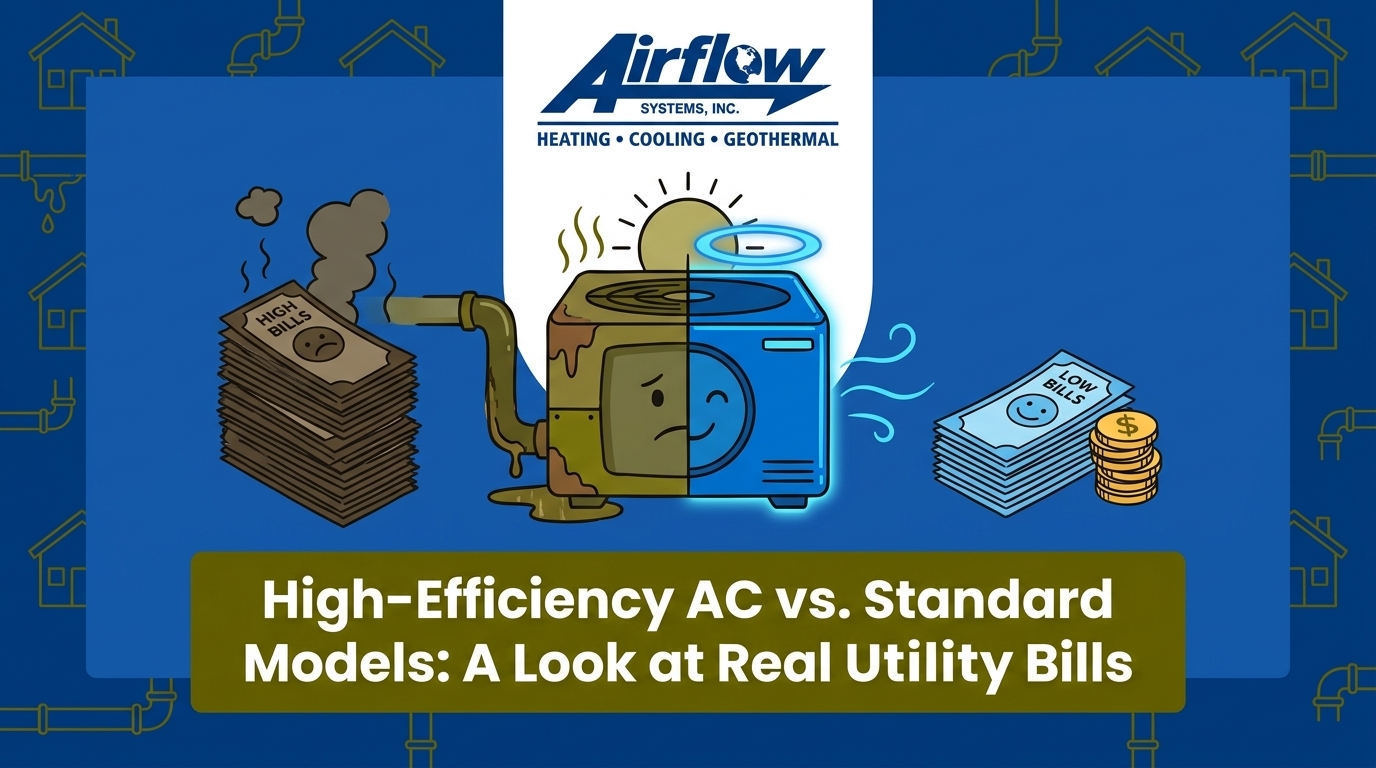
At Airflow Systems, Inc., we believe that analyzing High-Efficiency AC vs. Standard Models: A Look at Real Utility Bills provides the clearest picture of what that replacement choice actually means for your home. Your air conditioner has been running nonstop to keep up with the heat, but the house still feels warm. Then, the Dominion Energy bill arrives. Opening that statement during the peak of August late-summer cooling demand—just as the busy back-to-school transition begins—is often the tipping point for homeowners realizing their aging, struggling system simply cannot keep up anymore.
You are now facing a critical decision point: do you replace your failing unit with a standard model to minimize the initial upfront cost, or do you invest in high-efficiency technology to lower your long-term energy consumption? In our experience serving Charlottesville, this is not a choice that should be made based on generic manufacturer claims or glossy brochures. It requires a transparent, data-driven look at how your home uses electricity.
Our team always frames this discussion around actual kilowatt-hour (kWh) usage rather than abstract ratings. By evaluating your local climate demands and the true operational cost of different air conditioning systems, you can make a confident choice that prioritizes both your long-term comfort and your monthly energy management.
Decoding SEER2: What Efficiency Actually Means for Your Home
To understand how a new system will impact your utility usage, you first need to understand how efficiency is measured today. In recent years, the industry transitioned to the SEER2 (Seasonal Energy Efficiency Ratio 2) standard. This updated testing protocol better reflects real-world duct conditions and the external static pressure your equipment actually faces when pushing air through your home.
While a standard unit meets the modern baseline requirements for energy consumption, a High-Efficiency SEER2 model utilizes advanced technology to drastically alter how that cooling power is delivered. Here is how that mechanical difference translates to your daily power consumption:
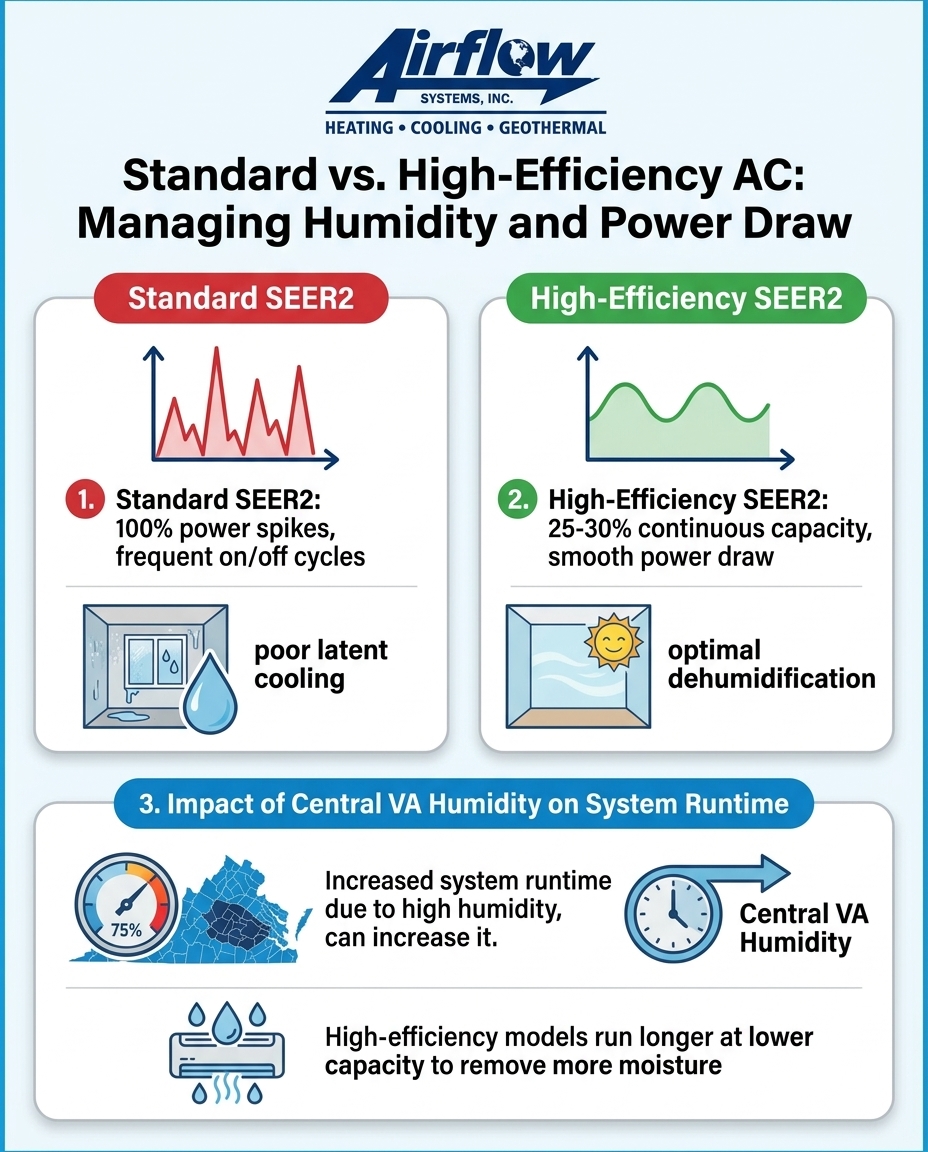
1. The single-stage limitation: Standard SEER2 models typically rely on single-stage compressors. These units only know one speed: 100% capacity. When the thermostat calls for cooling, the system surges on, draws maximum amperage, blasts cold air until the target temperature is reached, and shuts completely off.
2. The variable-speed advantage: High-efficiency models utilize variable-speed or modulating compressors. Instead of constantly turning on and off, these units can scale their output down to as low as 25% to 30% of their total capacity. They run continuously at a low, steady speed, precisely matching the cooling demand of the house.
3. Eliminating power spikes: The most power-intensive moment for any air conditioner is the startup cycle. Because variable-speed units run continuously at lower speeds, they avoid the frequent, massive power spikes associated with single-stage equipment.
4. Accumulated kWh reduction: Over the course of a long cooling season, that smooth, continuous power draw significantly reduces your total kilowatt-hour consumption compared to a unit that turns on and off dozens of times a day.
If you are exploring different system architectures, comparing mini split and central AC costs can also highlight how variable-speed technology operates in both ducted and ductless applications.
How Local Humidity Drives Kilowatt-Hour Consumption
The problem: In our years of keeping homes comfortable, our technicians at Airflow Systems, Inc. have seen firsthand how Central Virginia's subtropical climate and highly humid late summers force air conditioners to work significantly harder. Many homeowners do not realize that cooling a house involves two distinct processes: sensible cooling (dropping the actual temperature) and latent cooling (removing moisture from the air). When humidity levels soar, standard systems often struggle to manage both effectively.
The cause: Because a standard single-stage unit blasts air at 100% capacity, it often cools the room down to the target temperature very quickly. The thermostat then shuts the system off before it has had enough time to extract the latent humidity from the air. This results in a cold but clammy home. To combat that sticky feeling, homeowners naturally push the thermostat even lower, forcing the single-stage unit to run another high-amperage cycle, driving up the utility bill.
The solution: Variable-speed compressors in high-efficiency units solve this by running continuously at lower capacities. Because the air is constantly moving over the indoor coil at a slower pace, the system acts as a highly effective whole-home dehumidifier. Drier air naturally feels cooler to the human body. When your home is properly dehumidified, you can comfortably set your thermostat several degrees higher without sacrificing comfort, which directly reduces your overall kilowatt-hour consumption.
This principle holds true across different types of equipment in Central VA / Charlottesville. For example, one local apartment owner recently faced a tight deadline due to a real estate contract and needed a rapid, effective HVAC solution for a tricky space. By opting for a highly efficient mini-split system, they achieved ultra-efficient latent cooling that handled the humid late-summer transition flawlessly, proving that matching the right variable-speed technology to the space yields exceptional comfort and efficiency.
Side-by-Side: Standard SEER2 vs. High-Efficiency SEER2
To make an informed decision, it helps to look at the mechanical and operational differences side-by-side. While both options will cool your home, the way they consume electricity and manage your indoor climate varies drastically.
• Compressor Type — Standard SEER2 Model: Single-stage (100% on or completely off) — High-Efficiency SEER2 Model: Variable-speed (Modulates from 25% to 100%)
• Power Draw Profile — Standard SEER2 Model: High peak surges during frequent startups — High-Efficiency SEER2 Model: Low, continuous, steady electrical draw
• Humidity Control — Standard SEER2 Model: Basic (often leaves the home feeling clammy) — High-Efficiency SEER2 Model: Superior (continuous air circulation extracts maximum moisture)
• Temperature Consistency — Standard SEER2 Model: Noticeable temperature swings between cycles — High-Efficiency SEER2 Model: Precise, even temperatures throughout the home
• Impact on Utility Usage — Standard SEER2 Model: Baseline kWh consumption — High-Efficiency SEER2 Model: Significant percentage reduction in seasonal kWh usage
Choosing a High-Efficiency SEER2 system means shifting from a reactive cooling strategy to a proactive climate management strategy. By keeping the air moving and the humidity low, the system simply does not have to work as hard during peak afternoon heat.
Calculating Your True Break-Even Point
The most important metric when evaluating a high-efficiency upgrade is your true break-even point. This is the moment when the accumulated kilowatt-hour savings generated by the new system completely offset the higher initial investment required to install it. Once you pass the break-even point, every kWh saved is a direct reduction in your overall cost of homeownership.
To calculate this accurately, you must establish a baseline. Pull your past utility bills from the previous summer. Look specifically at your total kWh usage during peak months like July and August, rather than just the final amount due. Compare this peak usage against the mild "shoulder" months (like April or October) when neither the AC nor the heat is running heavily. The difference between those two figures represents your baseline cooling load.
It is critical to avoid relying on generic national ROI calculators. A formula designed for a dry climate in the Southwest will not accurately reflect the latent cooling demands of Central VA / Charlottesville. Working with our experienced professionals at Airflow Systems, Inc. ensures you receive a transparent, honest break-even analysis based on your real local usage patterns and the specific thermal realities of your home, rather than exaggerated manufacturer claims. If you want to deeply understand where your home is losing energy before upgrading your equipment, professional home energy audits provide the exact data needed to make an informed choice.
Variables That Impact Your ROI Timeline
Your break-even timeline is not static; it is influenced by the unique characteristics of your house. Several factors will either accelerate or delay your return on investment:
• Insulation and thermal envelope: A well-insulated home retains the dehumidified air produced by a high-efficiency unit much longer, maximizing the system's efficiency and speeding up your ROI.
• Ductwork condition and sizing: If your ducts are undersized, leaking, or poorly designed, even the most advanced variable-speed compressor will struggle to deliver air efficiently. Static pressure issues must be resolved to realize true efficiency gains.
• Thermostat habits: Homeowners who leverage the superior dehumidification of a high-efficiency unit by setting their thermostat a few degrees higher will see a much faster return on investment than those who demand frigid temperatures year-round.
Leveraging Rebates and Incentives to Offset Upgrades
One of the most effective ways to accelerate your break-even point is to reduce the initial investment required for a High-Efficiency SEER2 unit. Federal, state, and local entities frequently offer financial incentives designed to encourage homeowners to adopt energy-saving technology.
Navigating these programs requires a bit of diligence, but the reduction in your upfront costs makes the effort highly worthwhile. Here is how you can leverage these programs:
1. Federal tax credits: High-efficiency heat pumps and advanced air conditioning systems often qualify for generic energy efficiency tax credits under current federal initiatives. These credits are applied when you file your annual taxes and can significantly offset the cost of premium equipment.
2. Local utility rebates: Power providers often incentivize the removal of older, inefficient systems. Upgrading to qualifying high-efficiency models reduces the strain on the local power grid during peak summer hours, and utilities frequently offer rebates to encourage this shift.
3. Verify current programs: Because incentive programs change frequently based on funding and legislation, you should always consult with a tax professional and check your utility provider's official website to verify current eligibility requirements before installation.
4. Strategic payment structures: When you combine verified rebates with flexible HVAC financing options, the initial out-of-pocket investment for a variable-speed system can often be structured to mirror the cost of a standard installation, allowing you to start harvesting kWh savings immediately.
Commonly Asked Questions About AC Efficiency and Utility Bills
Is a high-efficiency AC worth the investment in Virginia?
Yes, our team consistently finds that a high-efficiency system is an excellent investment for Virginia homeowners. The region's hot, highly humid summers require air conditioners to run long cycles to manage both temperature and moisture. Variable-speed technology handles these specific climate demands far better than standard units, resulting in improved comfort and a measurable reduction in seasonal kilowatt-hour consumption.
How does high humidity affect my AC utility bill?
High humidity makes the air feel significantly warmer than the actual temperature, prompting most people to lower their thermostats. Standard air conditioners have to run multiple high-power cycles to remove that moisture, drawing maximum electricity each time they start up. This constant cycling in humid weather is a primary driver of high peak-season utility bills.
What is the exact difference between standard SEER2 and high-efficiency AC?
The primary difference lies in the compressor technology. A standard SEER2 unit uses a single-stage compressor that operates strictly at 100% capacity, turning on and off to maintain temperature. A high-efficiency AC utilizes a variable-speed compressor that can modulate its output, running continuously at a low, energy-sipping speed to provide precise temperature and humidity control.
How much electricity (kWh) does a high-efficiency AC actually save?
The exact kilowatt-hour savings depend on your home's thermal envelope, your ductwork, and your previous system's baseline efficiency. However, upgrading from an aging, struggling 10 SEER unit to a modern high-efficiency SEER2 model typically yields a substantial percentage reduction in seasonal power usage, as the new system avoids the massive power spikes associated with frequent startup cycles.
Does a higher SEER2 rating mean the system will dehumidify my home better?
Yes, higher SEER2 ratings generally correlate with vastly superior dehumidification. Because these premium units use variable-speed technology to run longer, slower cycles, they pull significantly more latent moisture out of the indoor air. This continuous air circulation prevents the clammy feeling often left behind by standard, single-stage equipment.
How long does it typically take to reach the break-even point on a variable-speed AC?
The break-even timeline varies based on your local utility rates, your typical summer usage, and the condition of your home's insulation. By analyzing your past August late-summer cooling bills and comparing your baseline kWh usage against the projected efficiency of the new unit, our technicians can provide a realistic, customized timeframe for when your accumulated savings will offset the initial upgrade cost.
Make a Confident, Data-Driven Cooling Decision
Choosing between a standard replacement and a high-efficiency upgrade is not just about comparing options; it is about taking control of your long-term comfort and your household kilowatt-hour management. When your current system is struggling through the intense heat of late summer, simply swapping it for another basic unit often means committing to another decade of high utility usage and mediocre humidity control.
By evaluating your options through a clear, realistic framework based on Central Virginia's specific climate demands, you can calculate a true break-even point that makes sense for your family. Do not let another season of excessive power consumption drain your resources. If you are ready for a transparent evaluation of your current system and usage patterns from a local team you can trust, explore our current HVAC replacement special and schedule a professional consultation with Airflow Systems, Inc. to find the exact High-Efficiency SEER2 solution that meets your needs.
Book Expert Service Or Contact Us
Our Service Process
A Hassle-Free Service Experience
01
Consultation & Diagnosis
We start by listening to your needs and performing a thorough diagnosis of your system to recommend the best solution.
02
Transparent Quoting
We provide a clear, upfront estimate with no hidden fees, so you know exactly what to expect.
03
Expert Service & Follow-Up
Our factory-trained technicians complete the work to the highest standards, and we follow up to ensure your complete satisfaction.
testimonials
What Our Customers Are Saying
Our customers consistently praise our exceptional service and attention to detail, making us a trusted choice for all your HVAC needs.
where we operate
Service areas