


Choose an option to see quick actions and get help faster.
.svg)

The Challenge of Modern Comfort in Century-Old Spaces
The thick, oppressive heat of late-summer August has a way of exposing a building's weaknesses, especially when you are trying to balance modern climate control with delicate, century-old architecture. For many homeowners we work with at Airflow Systems, Inc., executing historic home cooling retrofits: preserving architecture while adding comfort becomes the ultimate balancing act. You want relief from the end-of-season heat as families transition back to school, but you refuse to gut the original millwork, tear down intricate crown molding, or destroy the character that made you fall in love with the property in the first place. Older structures were simply not designed with modern forced-air ductwork in mind, leaving residents to suffer through sweltering summers or rely on noisy, inefficient window units that detract from the home's aesthetic appeal.
If you are currently evaluating your air conditioning solutions, understanding how modern technology adapts to historic structural limitations is the first critical step toward a successful system upgrade.
The core dilemma of historic cooling:
• Structural limitations: Pre-1950s homes lack the wall cavities and drop ceilings required to hide standard bulk ductwork.
• Aesthetic preservation: Cutting into original surfaces permanently alters the historical value and visual charm of the home.
• Moisture management: Older homes breathe differently, and improper cooling can lead to severe humidity issues within the walls.
In our experience, the central decision point for owners of older properties usually comes down to choosing a system that respects the building's envelope rather than tearing it apart. Today, the two most viable contenders we recommend for preserving the integrity of older homes are ductless mini-split units and high-velocity mini-duct systems. Both offer distinct advantages for retrofitting, bypassing the need for invasive demolition while finally delivering the consistent, reliable cooling that century-old spaces desperately need.
Why Traditional Ductwork Fails Lath and Plaster Walls
To understand why standard "rip and replace" HVAC installations are so detrimental to older properties, you have to look at how these homes were originally built. Our technicians frequently work in the Charlottesville historic districts, where homes were commonly constructed using lath and plaster walls. This traditional building method involves nailing narrow strips of wood (lath) horizontally across the wall studs, then applying multiple coats of wet plaster over them. The plaster oozes through the gaps in the lath, forming "keys" that lock the entire rigid structure together once dry.
The physical limitations of lath and plaster include:
• Extreme fragility under vibration: Unlike modern drywall, which can be cleanly cut and easily patched, plaster is highly susceptible to cracking. The vibration from reciprocating saws used to cut large registers can cause the plaster keys to break behind the wall, leading to crumbling sheets of material.
• Lack of standard stud bays: Older homes often feature irregular framing, balloon framing, or solid masonry walls. There is rarely a standard 16-inch or 24-inch stud bay available to run standard 6-inch or 8-inch sheet metal ductwork.
• Irreplaceable finishes: Once original plaster, custom wainscoting, or historic millwork is breached, it cannot be perfectly replicated. Patch jobs inevitably look like patch jobs.
Forcing traditional central air into these spaces requires building bulky soffits, lowering ceilings, or sacrificing vital closet space to hide the massive trunks of sheet metal. Beyond the aesthetic tragedy, this structural compromise can actually lower the property value of a historically significant home. Furthermore, older homes are inherently dusty, and we have seen firsthand how opening up 100-year-old wall cavities can introduce decades of settled debris into your living space. Maintaining pristine indoor air quality during a retrofit is nearly impossible when you are tearing down original walls to force a modern square peg into a historic round hole.
The Mechanics of High-Velocity Mini-Duct Systems
When traditional ductwork is entirely off the table, high-velocity mini-duct systems step in as our premier solution for historic preservation. Unlike conventional forced-air systems that rely on high volumes of air moving slowly through large metal trunks, high-velocity systems operate on a completely different physical principle. They deliver conditioned air at a much higher speed through incredibly small, flexible tubing.
Key components of high-velocity cooling:
• Compact air handlers: The indoor unit is significantly smaller than a traditional furnace or air handler, allowing it to fit into tight attics, crawlspaces, or even custom-built enclosures in a basement.
• Flexible mini-ducts: The distribution network utilizes seamless, insulated flexible tubing that is typically only 2 to 2.5 inches in diameter—roughly the size of a shop vacuum hose.
• Aspiration mixing: Instead of dumping cold air into a room and waiting for it to settle, high-velocity systems use a principle called aspiration. The air enters the room at a high velocity, creating a gentle, continuous mixing effect that eliminates hot and cold spots without creating noticeable drafts.
The aesthetic benefit of high-velocity mini-duct systems is unparalleled. Because the ducts are so small, they terminate in unobtrusive circular vents that are only a few inches wide. These small outlets can be seamlessly integrated into the ceiling, the floor, or high up on a wall. Better yet, our clients love that the vent covers can be painted to match original plaster, or finished in custom wood stains to blend perfectly into historic baseboards or floorboards.
Threading the Needle: Non-Invasive Routing
The true genius of high-velocity mini-duct systems lies in how they are installed. Our installation teams utilize the home's existing architectural chases to hide the main trunk lines and branch ducts. This process requires a deep understanding of historic home construction.
Instead of cutting through structural beams, our technicians gently snake the flexible 2-inch ducts through existing wall cavities, thread them over original floor joists, or run them down through abandoned chimney flues. We frequently use the dead space behind stacked closets to run vertical lines between floors. Because the tubing bends and flexes, it can easily bypass antique plumbing stacks and structural timbers without requiring a single compromise to the home's framing.
Navigating Visual Intrusion: Mini-Splits vs. Hidden Ducts
While high-velocity systems are the gold standard for invisibility, ductless systems offer a highly efficient alternative that avoids ductwork entirely. When we guide a homeowner through a historic retrofit, it often means weighing the visual trade-offs of mini-split systems against the hidden nature of mini-ducts.
Ductless mini-splits consist of an outdoor compressor connected to one or more indoor air handling units via a small conduit containing the power and refrigerant lines. They are incredibly energy-efficient and offer precise, room-by-room zoned temperature control. However, the visual trade-off is that the indoor air handlers are typically mounted high on the wall. In a historically significant parlor, a formal dining room, or a space with intricate crown molding, a modern plastic appliance hanging on the wall can severely disrupt the historical ambiance.
There are situations, however, where ductless systems are the perfect fit. We recently worked with a local homeowner who found themselves pressed for time due to a real estate contract and needed a cooling solution for a smaller, distinct apartment space within an older property. Because they were on a tight back-to-school deadline and the space had severe structural limitations, a ductless system was the ideal answer. Our technicians discussed the options, and ultimately installed mini split systems that provided ultra-efficient, targeted cooling right on schedule, proving that ductless technology works exceptionally well when rapid deployment and high efficiency are the top priorities.
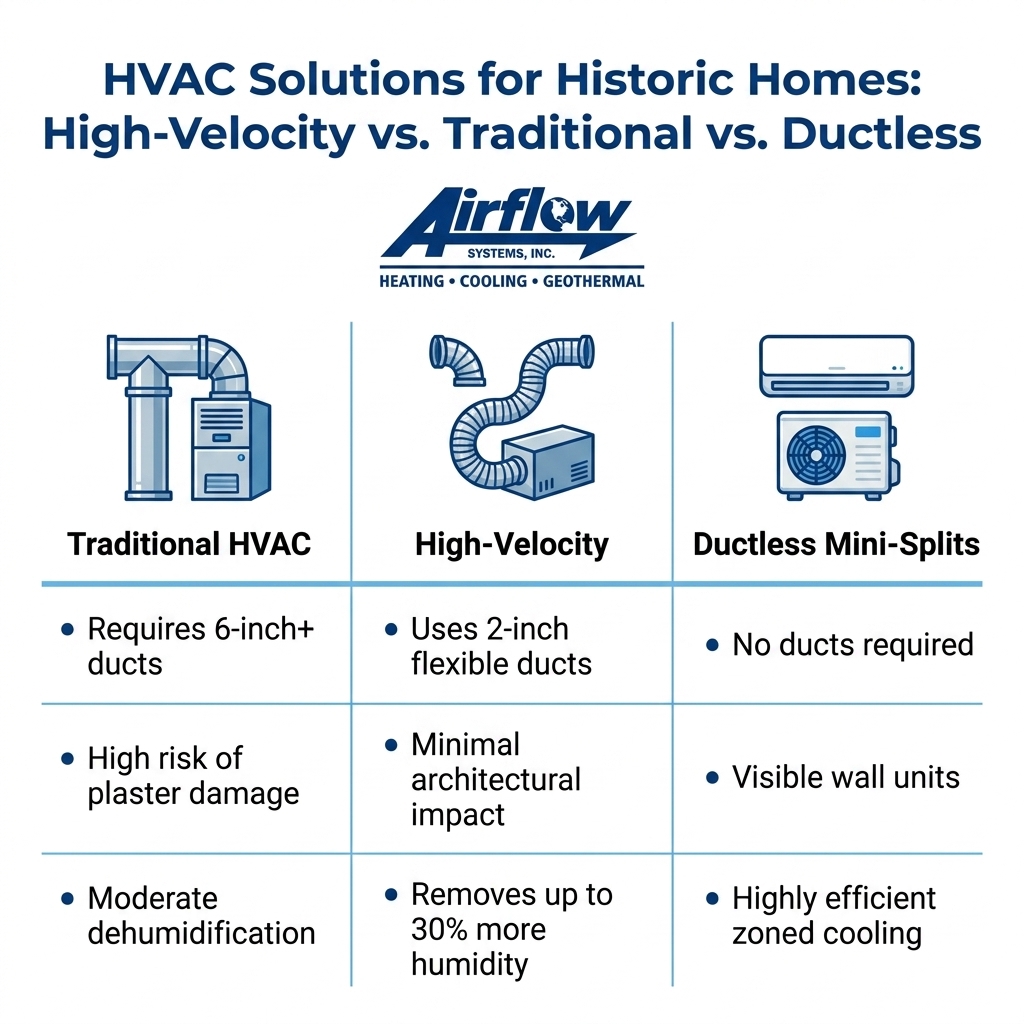
• Aesthetic Impact — High-Velocity Mini-Ducts: Virtually invisible; small 2-inch vents blend into woodwork. — Ductless Mini-Splits: Visible wall or floor cassettes in each cooled zone. — Traditional Central Air: Highly invasive; requires large grilles and bulkheads.
• Installation Disruption — High-Velocity Mini-Ducts: Minimal; flexible ducts snake through existing cavities. — Ductless Mini-Splits: Very low; only requires a 3-inch hole through the exterior wall. — Traditional Central Air: High; requires significant drywall/plaster removal.
• Dehumidification — High-Velocity Mini-Ducts: Excellent; removes up to 30% more moisture. — Ductless Mini-Splits: Good; variable speed compressors handle humidity well. — Traditional Central Air: Moderate; often struggles in drafty older homes.
• Best Use Case — High-Velocity Mini-Ducts: Whole-home historic preservation. — Ductless Mini-Splits: Additions, isolated rooms, or strict budget/timeline constraints. — Traditional Central Air: New construction or homes with existing ductwork.
In many historic homes, we find that a hybrid approach yields the best results. A homeowner might choose high-velocity mini-duct systems for the main historic quarters—such as the formal living room, dining room, and primary bedrooms—while utilizing ductless units for a newer addition, a converted attic space, or an isolated sunroom where visual preservation is less critical.
Meeting the Standards of Architectural Review Boards
Modifying a historic home is rarely a solo decision. In areas like the Charlottesville historic districts, local preservation societies and architectural review boards (ARBs) hold strict authority over what modifications can be made to a property. Their primary goal is to ensure that the historical character of the neighborhood remains intact, which means they heavily scrutinize any exterior changes to the building envelope.
Common restrictions imposed by architectural review boards include:
• Prohibition of window units: Many historic districts outright ban window AC units on street-facing facades because they destroy the historical sightlines of the property.
• Concealment of exterior equipment: Outdoor condenser units must often be hidden behind specific types of fencing, landscaping, or placed at the rear of the property where they cannot be seen from the public right-of-way.
• Restrictions on exterior line sets: Running thick plastic line sets down the exterior siding of a historic home is frequently rejected by ARBs.
This is where careful system selection becomes paramount. High-velocity systems and carefully placed ductless compressors can satisfy these strict preservation guidelines by remaining largely out of sight. Because high-velocity systems use a central air handler located inside the home, the exterior footprint is limited to a single condenser unit that our team can easily hide. When evaluating a mini split vs window unit comparison, we find that the ductless system wins with review boards every time, provided the exterior line sets are routed internally or hidden within architecturally approved conduit.
Navigating these rules requires more than just mechanical knowledge; it takes the kind of independent, local hands-on experience our team at Airflow Systems, Inc. brings to older Central Virginia homes. Working with a contractor who understands the nuances of local preservation rules ensures that your cooling project won't be stalled by compliance violations or rejected permits.
Combating Late-Summer Humidity and Moisture Damage
Temperature control is only half the battle when preserving an older home. The hot, highly humid Central Virginia summers present a unique environmental threat to century-old building materials. When peak late-summer August humidity infiltrates a drafty historic home, it doesn't just make the occupants uncomfortable—it actively attacks the architecture.
Historic wood floors, antique furniture, and custom millwork act like sponges in high humidity. When moisture levels remain unchecked, these materials swell, warp, and buckle. Furthermore, excessive moisture can cause historic plaster to soften, degrade, and eventually detach from the lath behind it. Traditional window units often fail to adequately dehumidify large, drafty historic spaces because they only condition the air immediately surrounding the unit, leaving the peripheral areas of the home damp and vulnerable.
How advanced cooling protects historic materials:
1. Lower coil temperatures: High-velocity systems operate with a colder cooling coil than traditional forced-air systems. This allows them to extract significantly more moisture from the air as it passes through the handler.
2. Continuous air circulation: The aspiration effect ensures that conditioned, dehumidified air reaches every corner of the room, preventing pockets of stagnant, moist air from settling against historic wallpaper or woodwork.
3. DOE validated performance: Department of Energy (DOE) guidelines note that high-velocity systems can remove up to 30% more humidity than conventional HVAC systems, making them uniquely suited for damp, historic environments.
Before installing any new system, we highly recommend assessing the home's thermal envelope. Understanding where your home leaks air can help maximize the efficiency of your new cooling system. Investing in comprehensive home energy audits will identify drafts around original windows and doors, allowing you to seal the envelope appropriately without compromising the home's historical integrity. By controlling both the temperature and the moisture, you are actively preserving the physical materials of the home for generations to come. Homeowners should also note that federal tax credits or utility incentives may apply to qualifying high-efficiency installations, adding even more value to the retrofit.
Frequently Asked Questions About Historic Home AC
How do you air condition a historic home?
At Airflow Systems, Inc., we find the safest and most effective way to air condition a historic home is by using non-invasive methods like high-velocity mini-ducts or ductless mini-splits. These systems are specifically designed to avoid destroying original walls, ceilings, and millwork. By utilizing flexible, small-diameter tubing or ductless technology, you can introduce modern climate control without the need for major demolition or compromising the home's aesthetic.
Can you put central air in an old house without ducts?
Yes, you can absolutely add central air to an older home that lacks existing ductwork. This is achieved by installing a high-velocity system that uses 2-inch flexible tubing, which our installers can easily snake through existing wall cavities, closets, and floor joists. Alternatively, homeowners can opt for ductless wall cassettes, which require no ductwork at all and connect directly to an outdoor compressor via small refrigerant lines.
What is the best AC for a 100-year-old house?
The best system depends heavily on the home's specific layout and your preservation goals. We generally recommend high-velocity systems as the best option for preserving interior aesthetics, as their tiny vents are virtually invisible. However, ductless mini-splits offer excellent zoned efficiency and are often our preferred choice for additions, isolated rooms, or when budget and timeline constraints are the primary driving factors.
What is a high-velocity HVAC system?
A high-velocity HVAC system is a specialized type of central air conditioning designed specifically for retrofitting buildings without existing ductwork. It delivers conditioned air at a high speed through very small, flexible ducts (usually 2 inches in diameter). This high-speed delivery creates an aspiration effect in the room, mixing the air thoroughly to eliminate hot and cold spots while removing significantly more humidity than standard systems.
How do you cool a historic home without damaging plaster?
You protect historic plaster by avoiding the large structural cuts required for traditional sheet metal ducts. Instead, our technicians utilize natural architectural chases—like the backs of closets, abandoned chimney flues, and spaces between floor joists—to run flexible mini-ducts. This non-invasive routing ensures that the delicate keys holding the lath and plaster together remain completely undisturbed during the installation process.
Protect Your Home's Architectural Legacy with the Right Cooling Solution
Adding modern comfort to your property does not have to mean sacrificing the historical integrity of your home. Whether you are battling the oppressive heat of late-summer August or looking to protect your antique woodwork from severe humidity, there is a technological solution designed specifically for your structural challenges. From the invisible integration of high-velocity mini-duct systems to the targeted efficiency of ductless units, executing historic home cooling retrofits: preserving architecture while adding comfort is entirely achievable.
A clear understanding of the installation process, the mechanics of the technology, and the strict requirements of local preservation boards ensures a successful, stress-free retrofit. Don't let another sweltering summer compromise your comfort or your home's legacy. Reach out to schedule a comprehensive assessment with our local experts at Airflow Systems, Inc., who understand both the complex mechanics of modern HVAC and the delicate nuances of historic preservation.
Book Expert Service Or Contact Us
Our Service Process
A Hassle-Free Service Experience
01
Consultation & Diagnosis
We start by listening to your needs and performing a thorough diagnosis of your system to recommend the best solution.
02
Transparent Quoting
We provide a clear, upfront estimate with no hidden fees, so you know exactly what to expect.
03
Expert Service & Follow-Up
Our factory-trained technicians complete the work to the highest standards, and we follow up to ensure your complete satisfaction.
testimonials
What Our Customers Are Saying
Our customers consistently praise our exceptional service and attention to detail, making us a trusted choice for all your HVAC needs.
where we operate
Service areas