


Choose an option to see quick actions and get help faster.
.svg)
Why Compressor Replacement Often Means a Full System Replacement in Charlottesville, VA
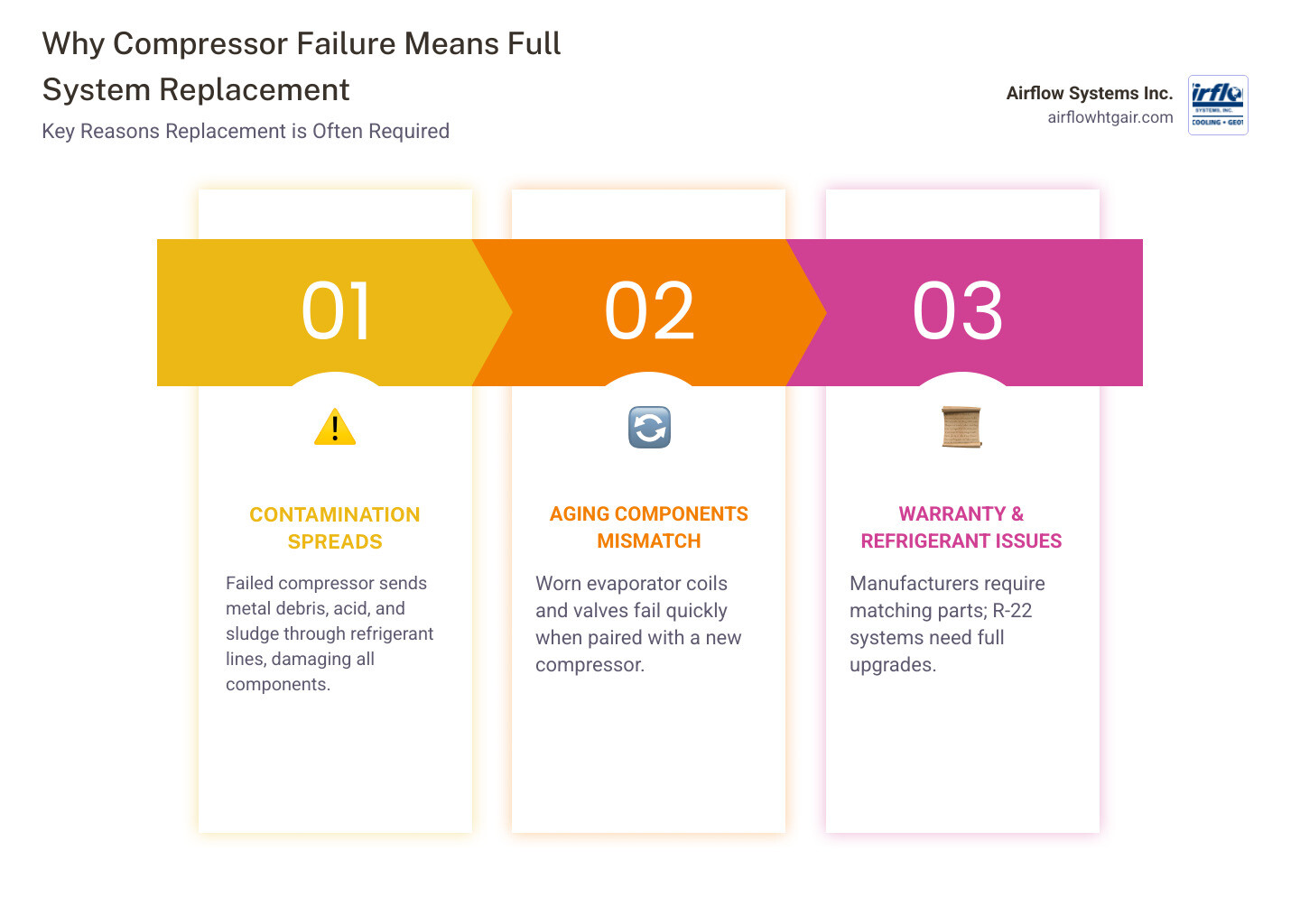
How compressor replacement often means full system replacement comes down to one core reality: when the compressor fails, it rarely fails alone. The damage, wear, and contamination it leaves behind can compromise every other component in the system.
Here is a quick summary of why replacing just the compressor is often not enough:
• Contamination spreads fast - A failed compressor can send metal debris and acidic sludge through the entire refrigerant circuit, threatening any new part you install
• Old components wear together - The evaporator coil, condenser, and expansion valve age in sync with the compressor, so a new compressor paired with worn parts often leads to another breakdown soon after
• Warranty protection may require full replacement - Many manufacturers will not honor a compressor warranty unless matched components are installed alongside it
• Refrigerant compatibility - Older Central Virginia systems still running on phased-out R-22 refrigerant cannot simply receive a new compressor without addressing the broader refrigerant issue
• The 10-year threshold - Industry professionals consistently point to systems over 10 years old as strong candidates for full replacement rather than a costly compressor-only repair
For Charlottesville homeowners, a compressor failure in the middle of a humid Virginia summer is stressful enough without discovering a few months later that a secondary component has failed too. Understanding why one part's failure so often signals a bigger systemic issue can save you from paying twice.
Understanding the Critical Role of Your AC Compressor
To understand why a failure is such a big deal, we first have to look at what the compressor actually does. In HVAC, we often call the compressor the "heart" of your Air Conditioning system. Just as your heart pumps blood to keep your body functioning, the compressor pumps refrigerant through the entire system to keep your home cool.
The compressor’s primary job is to take low-pressure, cool refrigerant gas from the indoor unit and squeeze it into a high-pressure, hot gas. This high-pressure state is what allows the refrigerant to release heat effectively as it passes through the outdoor condenser coils. Without this "squeeze," the heat transfer process stops entirely.
Because the compressor is responsible for moving refrigerant across the indoor and outdoor sections of your home, it is under constant mechanical and thermal stress. It is the most powerful and energy-consuming part of your unit. When this "heart" stops beating, the entire cooling capacity of your home vanishes. In our experience serving Central Virginia since 1988, we’ve seen that a compressor is designed to last the typical lifespan of the system. If it fails prematurely, it’s usually a symptom of a deeper problem—like poor airflow or a refrigerant leak—that has been straining the system for years.
How Compressor Replacement Often Means Full System Replacement Due to Contamination
One of the most common reasons how compressor replacement often means full system replacement is the "burnout" factor. When a compressor motor fails internally, it can create an incredible amount of heat. This heat causes the oil and refrigerant to break down, creating a highly acidic sludge.
This acid doesn't stay inside the compressor. It circulates through your copper lines, the indoor evaporator coil, and the outdoor condenser. If you simply "drop in" a new compressor without addressing this contamination, the residual acid will immediately begin eating away at the insulation of the new motor.
Furthermore, mechanical failures often result in "metal shrapnel." If the internal bearings or pistons of the compressor shatter, they send tiny metal shavings throughout the system. While we always perform a thorough system flushing during an AC Repair, some modern components—especially high-efficiency condensers with micro-channel coils—are nearly impossible to clean completely. Leaving even a few microscopic shards of metal in the lines is like leaving sand in an engine; it’s only a matter of time before the new compressor suffers a catastrophic failure.
Why Pairing a New Compressor with Old Components is Risky
Think of your air conditioner like a pair of dance partners. The outdoor compressor and the indoor evaporator coil are designed to work in perfect synchronization. They move the same amount of refrigerant at the same pressures. As they age, they "wear in" together.
When you introduce a brand-new, high-power compressor to an old, weakened evaporator coil, you create an imbalance. The new compressor operates at peak efficiency, putting higher pressure on an indoor coil that may already have thin spots from years of corrosion. This often leads to the "domino effect," where the indoor coil develops a leak shortly after the outdoor unit is fixed.
This is especially true for a Heat Pump, which works year-round in our Charlottesville climate. These systems face double the wear and tear, making balanced components even more vital for reliable performance.
How compressor replacement often means full system replacement for warranty protection
In the modern HVAC industry of 2026, manufacturers have become much stricter about warranty claims. If a compressor fails, the manufacturer often requires proof that the system was properly flushed and that certain parts, like the liquid line filter drier, were replaced at the same time.
In many cases, if the system is older, a manufacturer may not even offer a replacement compressor that is compatible with your old indoor unit. To get a valid warranty that protects your investment, you often have to upgrade the entire matched system. We always encourage our customers to check our Learning Center for updates on warranty standards, as these can change as technology evolves.
How compressor replacement often means full system replacement in aging Charlottesville homes
Many homes in the Charlottesville and Central Virginia area still have systems that were installed 15 or 20 years ago. These older units typically use R-22 refrigerant, which has been phased out due to environmental regulations.
As of April 2026, R-22 is extremely difficult and expensive to source. If your R-22 compressor fails, you cannot simply put a modern R-410A or R-32 compressor into that old system. The oils and pressures are completely different. To move to a modern, environmentally friendly refrigerant that meets current SEER2 standards, a full system replacement is usually the only logical path forward. You can read more about these transitions on our Blog, where we discuss how modern systems handle the intense Virginia humidity much better than the "senior citizen" units of the past.
Essential Components to Inspect During a Compressor Swap
If we do determine that a compressor-only replacement is the right move for your specific situation (for example, if the unit is only a few years old and still under warranty), it isn't a simple "unbolt and replace" job. Several other parts must be changed to ensure the new compressor survives:
1. The Filter Drier (Receiver/Drier or Accumulator): This is non-negotiable. This part acts as a filter and moisture absorber for the refrigerant. Any time the system is opened to the air, this must be replaced to prevent moisture from turning into acid inside your lines.
2. The Expansion Valve (TXV): This tiny component regulates the flow of refrigerant. If debris from the old compressor is stuck in the TXV, your new compressor will "slug" or "starve," leading to another failure within weeks.
3. The Condenser Coils: These must be chemically cleaned and inspected for leaks.
4. O-rings and Seals: We replace these to ensure there are no tiny leaks that could lead to low refrigerant levels—one of the leading causes of compressor overheating.
During this process, our technicians use a micron gauge to pull a "deep vacuum." This removes every trace of air and moisture from the lines. Knowing the Signs Your AC Needs Repair Before Summer can help you catch small issues before they turn into this level of intensive labor.
Deciding Between Repair and Full HVAC Replacement
When you’re faced with a failed compressor, you’re at a crossroads. To help our Charlottesville neighbors make the best choice, we often use the "50% Rule." If the cost of the repair is more than half the value of a new system—especially on a unit over 10 to 12 years old—replacement is almost always the smarter financial move.
• Expected Lifespan — Compressor Repair: 1–5 additional years — Full System Replacement: 15–20 years
• Warranty — Compressor Repair: Typically 1 year (labor) — Full System Replacement: 10+ years (parts)
• Energy Efficiency — Compressor Repair: Remains the same (low) — Full System Replacement: 20–40% improvement
• Refrigerant — Compressor Repair: Often uses expensive, old types — Full System Replacement: Modern, eco-friendly R-454B or R-32
• Reliability — Compressor Repair: High risk of "domino" failures — Full System Replacement: Maximum peace of mind
Beyond the numbers, a new system offers better indoor air quality and quieter operation. If you’re considering an upgrade, be sure to ask about our HVAC Replacement Special to see how modern technology can fit into your budget. If you're still unsure about the state of your unit, our guide on How to Tell if Your AC Compressor is Failing provides a deeper dive into the symptoms we look for during a diagnostic visit.
Frequently Asked Questions about Compressor Failure
What are the signs that my AC compressor is truly failing?
The most common sign is that your outdoor fan is spinning, but the air coming out of your vents is lukewarm. You might also hear a loud "clunking" or "growling" sound when the system tries to start. If your circuit breaker trips every time the AC kicks on, that is a major red flag that the compressor is "grounded" or "shorted." For a full checklist, visit our page on AC Not Cooling Properly? What to Check First.
How long does a typical compressor replacement take?
A proper compressor replacement is a 4-to-6-hour job. It involves recovering the old refrigerant (which is required by law), cutting out the old unit, brazing in the new one, replacing the filter drier, flushing the lines, pulling a deep vacuum for at least an hour, and then carefully weighing in a fresh charge of refrigerant. We take our time because rushing any of these steps leads to premature failure. You can see a full list of our Services to see how we handle these complex repairs.
Can I just replace the outdoor unit and keep my old indoor coil?
While it is technically possible in some rare cases, we almost never recommend it. Mixing a new outdoor unit with an old indoor coil leads to mismatched SEER2 ratings. This means your "high efficiency" unit will actually run inefficiently, and the different types of oil used in old vs. new systems can lead to a "sludge" that destroys the new compressor. It’s always best to have a matched Air Conditioning system for the best performance and warranty coverage.
Conclusion
At Airflow Systems Inc., we’ve been the trusted Charlottesville HVAC experts for over three decades. We understand that hearing your compressor has failed is never good news, but our goal is to provide you with an honest, family-oriented evaluation of your options. Whether we can save your current unit with a precision repair or it’s time to move toward a more energy-efficient, modern solution, we are here to help you stay comfortable through the peak of the Virginia summer.
Don't let a failing compressor leave you in the heat. Contact us for professional air conditioning services today, and let our NATE-certified technicians give you the peace of mind you deserve.
Book Expert Service Or Contact Us
Our Service Process
A Hassle-Free Service Experience
01
Consultation & Diagnosis
We start by listening to your needs and performing a thorough diagnosis of your system to recommend the best solution.
02
Transparent Quoting
We provide a clear, upfront estimate with no hidden fees, so you know exactly what to expect.
03
Expert Service & Follow-Up
Our factory-trained technicians complete the work to the highest standards, and we follow up to ensure your complete satisfaction.
testimonials
What Our Customers Are Saying
Our customers consistently praise our exceptional service and attention to detail, making us a trusted choice for all your HVAC needs.
where we operate
Service areas