

Choose an option to see quick actions and get help faster.
.svg)
Why Ductwork Installation Mistakes Cost You Comfort and Money
Understanding how ductwork mistakes during installation hurt your comfort is the first step toward a home that stays consistently warm in winter and cool during Central Virginia's humid summers. Most homeowners focus on the furnace or air conditioner itself, but research shows the average duct system operates at only around 60% efficiency — and more than half of new ductwork systems never reach their rated performance due to installation errors.
Here is a quick summary of the most common ways bad ductwork hurts your comfort:
• Uneven temperatures - Undersized or poorly routed ducts restrict airflow, leaving some rooms too hot or too cold
• Higher energy bills - Studies show the average duct system loses 20% to 30% of conditioned air through leaks, gaps, and poor connections
• Poor indoor air quality - Leaky ducts can pull in dust, allergens, and even mold spores from attics and crawl spaces
• System strain and early failure - When ducts restrict airflow, your HVAC equipment works harder and wears out faster
• Humidity problems - Improperly designed systems struggle to control moisture, especially in Central Virginia's climate
• Excessive noise - Sharp bends, undersized ducts, and pressure imbalances create whistling, rattling, and banging sounds at vents
Even a brand-new, high-efficiency HVAC system cannot compensate for a poorly designed or improperly installed duct system. Think of your ductwork as the highway for your home's air — when that highway has bottlenecks, potholes, and dead ends, the air simply cannot get where it needs to go efficiently.
The sections below break down exactly what goes wrong, how to spot it, and what proper installation looks like.
The Science of Airflow: Why Proper Duct Design Matters
To understand why bad installation causes so much trouble, we have to look at the physics of how air moves through your home. Your heating and cooling system is a closed-loop system. It pulls air out of your rooms, conditions it (heats or cools it), and then pushes it back into your living spaces.
For this loop to work perfectly, the system relies on a delicate balance of static pressure. Think of static pressure like blood pressure for your HVAC system. If the pressure is too high, it puts immense strain on the heart of the system—the blower motor. If the pressure is too low, the air won't have enough velocity to actually reach the far corners of your home.
When we perform a new HVAC Installation or a Heating Installation, we must carefully calculate the friction rate of the duct materials. Smooth sheet metal has very little friction, while flexible ductwork has higher friction, especially if it is not stretched completely tight. If an installer ignores these friction rates, the resulting system strain will lead to noisy vents, weak airflow, and premature equipment failure.
Manual D Calculations and Balanced Airflow
In the early days of residential heating, many builders and installers used simple "rules of thumb" to size ductwork. They might look at a room and say, "This looks like it needs an eight-inch duct."
Today, we know that approach is a recipe for drafty rooms and high utility bills. Professional HVAC design requires a strict process outlined by the Air Conditioning Contractors of America (ACCA), known as Manual D.
Before we even think about sizing a duct, we must first perform a Manual J load calculation. This determines exactly how much heating and cooling each individual room needs based on its size, orientation to the sun, insulation levels, and window types. Once we know the required airflow (measured in Cubic Feet per Minute, or CFM) for each room, we use Manual D to design the duct layout.
Manual D calculations ensure that:
• Air velocity is optimized: Air moves fast enough to mix well in the room, but slow enough that you don't hear a constant rushing wind sound.
• Airflow resistance is minimized: The paths are kept as direct as possible to prevent pressure drops.
• Balanced delivery: Every room receives the exact volume of conditioned air it needs to stay comfortable, regardless of how far it is from the main air handler.
The Role of Return Air Vents
Many homeowners assume that comfort is all about the supply vents—the registers that blow hot or cold air into a room. However, the return side of the system is just as critical. If your system cannot pull air out of a room, it cannot push new, conditioned air in.
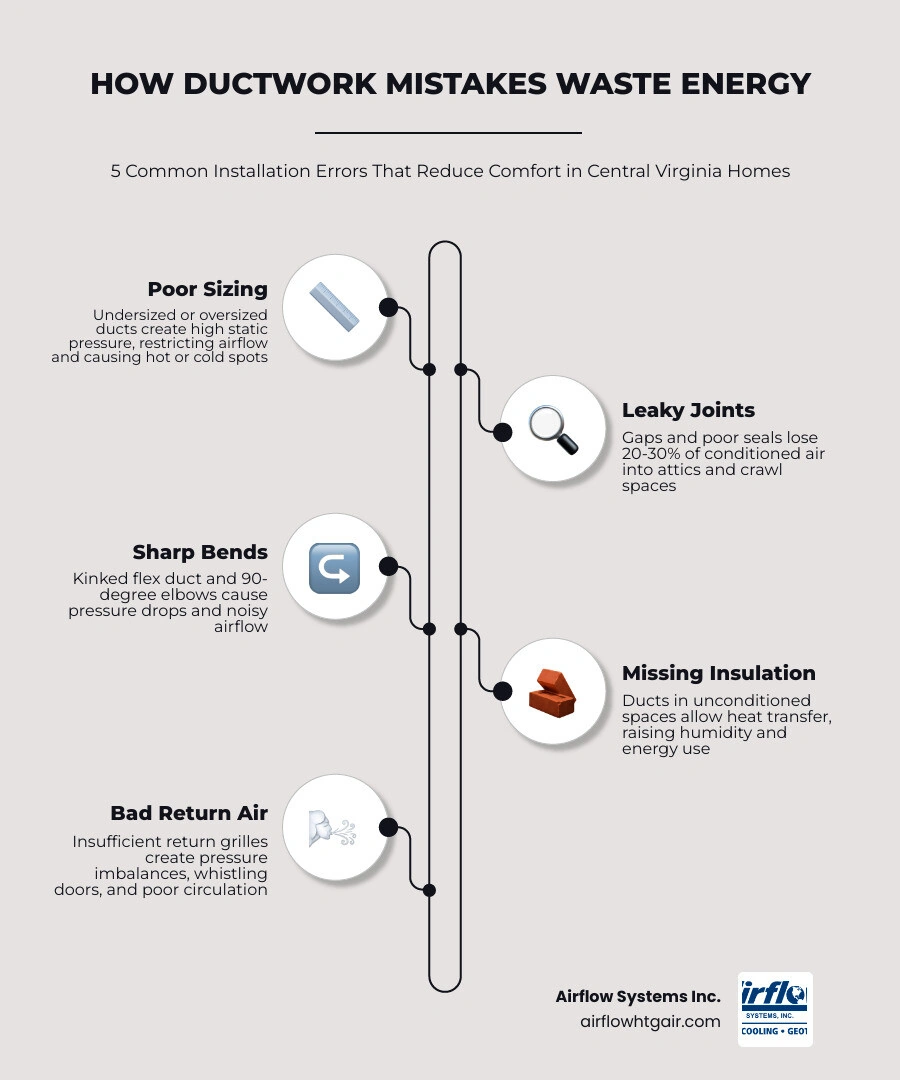
When installers skimp on return air grilles, they create severe pressure imbalances. Have you ever noticed a bedroom door that mysteriously swings shut or whistles when the system kicks on? That is a classic sign of a pressure imbalance caused by a lack of return paths.
Without adequate return vents, rooms with closed doors become pressurized. The supply air cannot enter, so it leaks out of the room through tiny gaps around windows and doors, while the main living areas become depressurized, pulling unconditioned, dusty air in from the outside. Proper design ensures a continuous, balanced cycle of air circulation throughout the entire home.
How Ductwork Mistakes During Installation Hurt Your Comfort
When installers make mistakes, the consequences are felt immediately in your daily life. Let's look at the specific physical blunders that lead directly to comfort issues.

Sizing Blunders: How Ductwork Mistakes During Installation Hurt Your Comfort
One of the most common installation faults we see in Central Virginia is incorrect duct sizing. This issue usually goes in one of two directions, both of which are highly detrimental to your home's comfort.
Undersized Ducts
When ducts are too small, they act like a clogged artery. The blower motor has to work incredibly hard to push air through a restricted space, which causes static pressure to skyrocket.
• The Comfort Impact: You will notice weak, sluggish airflow coming from your registers. Rooms at the end of the run will feel like they are completely cut off from the system.
• The System Impact: The restricted airflow causes evaporator coils to freeze up during a new Air Conditioning Installation or causes heat exchangers to crack during a Furnace Installation. A blower motor that should have lasted 15 to 20 years can easily burn out in just 2 to 5 years.
Oversized Ducts
Some installers believe that "bigger is always better" when it comes to ductwork. This is a myth. If a duct is too large for the volume of air being pushed through it, the air velocity drops dramatically.
• The Comfort Impact: Instead of being projected into the room to mix with the air, the conditioned air simply "falls" out of the register and pools on the floor right beneath the vent.
• The Humidity Impact: Because the air moves too slowly, the system cannot cycle air through the cooling system fast enough to properly dehumidify your home. You are left with a sticky, humid indoor environment.
Poor Sealing and Insulation: How Ductwork Mistakes During Installation Hurt Your Comfort
According to the Department of Energy, the average home loses 20% to 30% of its conditioned air through leaks and poorly sealed connections. When you consider that Central Virginia attics can easily reach 130°F in the summer, any leak in an unconditioned space is a major disaster.
When joints are not sealed with professional-grade mastic sealant or metal-backed foil tape, two things happen:
1. Direct Air Loss: The expensive air you just paid to heat or cool escapes into your attic, basement, or crawl space before it ever reaches your living room.
2. Thermal Transfer and Condensation: If ducts running through hot, unconditioned attics are poorly insulated, the hot attic air heats up the cool air inside the ducts. This thermal bridging forces your air conditioner to run constantly. Furthermore, when hot, humid air hits a cold, poorly insulated metal duct, condensation forms. This dripping moisture can ruin your ceilings and create a breeding ground for mold, directly impacting your home's health. If you suspect your leaky ducts are circulating unwanted particles, it is highly recommended to schedule Indoor Air Quality Testing.
Sharp Bends and Long Runs
Flexible ductwork is highly popular because it is easy to route around structural obstacles. However, it is also the most abused material in the HVAC industry.
A single sharp 90-degree bend in a flexible duct can restrict airflow as much as adding several dozen feet of straight pipe. We frequently find "bunched core" installations, where the inner plastic liner of the flex duct was not pulled completely tight during installation. According to findings from the Lawrence Berkeley National Laboratory, a mere 30% compression in a flexible duct can increase the pressure drop by up to 10 times compared to a properly stretched duct!
When installers route ducts with excessive bends, kinks, and unnecessarily long runs, they create massive pressure drops. The air loses its momentum, leaving the rooms at the end of those runs perpetually uncomfortable.
Signs of Poorly Installed Ductwork in Central Virginia Homes
How do you know if your home is suffering from these installation blunders? Because ductwork is hidden behind walls, under floors, and in attics, you have to look for the physical symptoms of a struggling system.
Keep an eye out for these common warning signs:
• Inconsistent Room Temperatures: One room feels like a sauna while another feels like an icebox.
• Noisy Vents: Whistling, rattling, or deep booming sounds when the blower kicks on.
• Excessive Dust: If you find a fresh layer of dust on your furniture just a day after cleaning, your return ducts may be pulling in dirty air from your attic or crawl space.
• Unexplained High Energy Bills: If your utility bills keep climbing despite keeping up with regular HVAC Maintenance and Air Conditioning Maintenance, your ductwork is likely wasting a massive portion of your heated or cooled air.
To help you narrow down the issue, here is a quick comparison table of how different installation mistakes present themselves:
• Airflow Strength — Likely Cause: Undersized Ducts: Very weak airflow at almost all registers — Likely Cause: Leaky/Unsealed Ducts: Weak airflow only at the end of long runs
• Noise Levels — Likely Cause: Undersized Ducts: Loud rushing air or whistling at the grilles — Likely Cause: Leaky/Unsealed Ducts: Relatively quiet, but the system runs longer
• Dust & Odors — Likely Cause: Undersized Ducts: Normal dust levels — Likely Cause: Leaky/Unsealed Ducts: Excessive dust, musty attic/crawl space odors
• System Behavior — Likely Cause: Undersized Ducts: Short cycling or frequent system shutdowns — Likely Cause: Leaky/Unsealed Ducts: Long, continuous run times without reaching temp
• Energy Impact — Likely Cause: Undersized Ducts: High bills due to system restriction — Likely Cause: Leaky/Unsealed Ducts: High bills due to lost conditioned air
Frequently Asked Questions About Ductwork Performance
Can poorly installed ductwork cause mold growth?
Yes. When cold air passes through uninsulated or poorly sealed metal ducts located in hot, humid unconditioned spaces (like a Central Virginia attic or crawl space in July), the duct surface drops below the dew point. Moisture condenses on the outside of the duct, dripping onto insulation and drywall. This standing moisture, combined with dust and organic building materials, creates the perfect breeding ground for mold. Furthermore, leaky return ducts can pull mold spores directly out of crawl spaces and distribute them throughout your entire home.
How long does residential ductwork typically last?
Generally, residential ductwork has a lifespan of 10 to 15 years before the joints, seals, and flexible materials begin to degrade naturally. Over time, the adhesives in old duct tape dry out, causing joints to separate. If your home's ductwork is more than a decade old and was installed poorly to begin with, a full replacement is often far more cost-effective than trying to patch up dozens of hidden leaks.
Can I seal my own ductwork or should I hire a professional?
While you can easily seal visible, easily accessible duct joints in your basement or utility room using high-quality mastic sealant, DIY sealing is only a partial fix. The vast majority of your ductwork is hidden behind drywall or buried deep in tight crawl spaces. A professional HVAC team has the specialized equipment—such as duct blasters and pressure diagnostic tools—to perform a comprehensive duct leakage test. This test measures exactly how much air is escaping and pinpoints the location of hidden leaks behind your walls.
Restoring Comfort to Your Central Virginia Home
At Airflow Systems Heating & Air, we believe that a great heating and cooling system is only as good as the ductwork that supports it. Since 1988, our family-owned business has provided Charlottesville, VA, and the surrounding Central Virginia communities with honest, energy-efficient comfort solutions.
If you are tired of dealing with hot and cold spots, high energy bills, or noisy vents, let our certified professionals evaluate your duct system. Whether you need a simple repair, a complete redesign, or a brand-new Air Conditioning system, we are here to ensure your home remains the comfortable sanctuary it should be. Contact us today to schedule your professional ductwork inspection!
Book Expert Service Or Contact Us
Our Service Process
A Hassle-Free Service Experience
01
Consultation & Diagnosis
We start by listening to your needs and performing a thorough diagnosis of your system to recommend the best solution.
02
Transparent Quoting
We provide a clear, upfront estimate with no hidden fees, so you know exactly what to expect.
03
Expert Service & Follow-Up
Our factory-trained technicians complete the work to the highest standards, and we follow up to ensure your complete satisfaction.
testimonials
What Our Customers Are Saying
Our customers consistently praise our exceptional service and attention to detail, making us a trusted choice for all your HVAC needs.
where we operate
Service areas