

Choose an option to see quick actions and get help faster.
.svg)
The 72-Degree Illusion: Why Your Home Still Feels Miserable
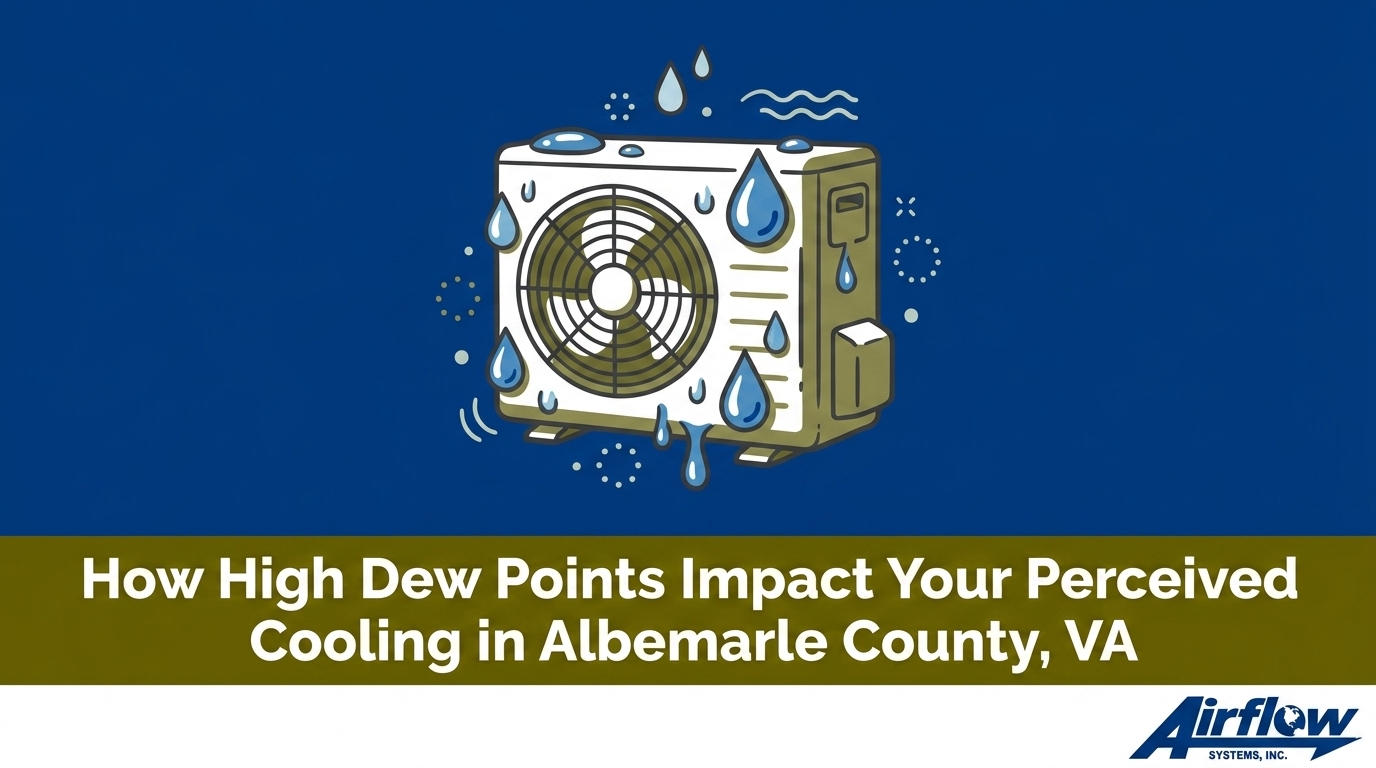
At Airflow Systems, Inc., a pattern we see often during the peak summer heat of July is a homeowner staring at a thermostat that reads exactly 72 degrees, yet their house still feels incredibly warm and sticky. Your air conditioner has been running for hours, so why are you still sweating? Understanding exactly how high dew points impact your perceived cooling in Albemarle County is the missing puzzle piece to solving this frustrating problem. The issue is not the temperature reading on the wall; the issue is the heavy, moisture-laden air that your cooling system is struggling to process.
If you are ready to fix this muggy indoor environment right away, explore our air conditioning services or schedule an AC repair today.
Many homeowners assume that an air conditioner's only job is to pump cold air into a room. In reality, standard cooling systems are designed to alter the temperature, and they only remove airborne moisture as a secondary byproduct of that cooling cycle. When the outdoor humidity spikes, that byproduct process often fails to keep up with the heavy moisture load infiltrating your home. The air inside becomes thick and saturated, trapping heat against your skin and making a perfectly normal 72 degrees feel completely intolerable.
The natural reaction to this discomfort is usually to walk over to the thermostat and push the temperature setting even lower. You might drop it to 68 degrees hoping for relief, but pushing the thermostat down is not the solution. In fact, forcing the system to run colder without addressing the underlying moisture problem often makes the environment feel worse. Achieving true indoor comfort requires a deeper look at your system's performance, understanding the physical properties of the air inside your home, and diagnosing the true cause of the trapped humidity.
Decoding the Science: Sensible vs. Latent Heat in Central Virginia
To understand why your home feels so uncomfortable, our technicians always start by looking at the unique climate characteristics of our region. Virginia's Piedmont region features a humid subtropical climate, meaning that during the warmer months, the air is saturated with water vapor. This introduces two completely different types of heat into your living space, and your air conditioner must battle both of them simultaneously. Measuring success purely by the temperature on the wall ignores the massive, invisible heat load present during muggy weather.
Sensible heat is the heat you can easily measure with a standard thermometer. It is the physical temperature of the air itself. When your thermostat says it is 72 degrees in Albemarle County, it is measuring the sensible heat in the room. When your air conditioner blows cold air out of the supply vents, it is actively lowering the sensible heat.
Latent heat, on the other hand, is the hidden thermal energy trapped inside airborne moisture. It takes a tremendous amount of energy to turn liquid water into water vapor, and that energy remains stored in the humid air inside your home. A thermometer cannot measure latent heat. Your thermostat does not know it is there. However, your body absolutely feels it.
If you are getting your air conditioner ready for hot, humid weather, you need a system capable of managing both heat types.
Comparing the Two Heat Loads
• What it measures — Sensible Heat: The actual temperature of the air — Latent Heat: The hidden heat energy stored in water vapor
• How it is tracked — Sensible Heat: Standard wall thermometer or thermostat — Latent Heat: Hygrometer or dew point monitor
• HVAC removal method — Sensible Heat: Blowing chilled air into the living space — Latent Heat: Condensing water vapor into liquid on the evaporator coil
• Primary symptom — Sensible Heat: The room feels physically hot — Latent Heat: The room feels sticky, heavy, and damp
During a humid afternoon, latent heat is often the primary driver of your discomfort rather than pure sensible heat. Your air conditioner has to work twice as hard: first, it must spend energy wringing the latent heat (moisture) out of the air, and only then can it effectively lower the sensible heat (temperature). If your system is not optimized for this dual workload, the sensible heat drops while the latent heat remains trapped indoors.
How High Dew Points Hijack Your Body's Natural Cooling
Meteorologists and HVAC professionals often talk about relative humidity, but dew point is actually a far more accurate measurement of human comfort. Relative humidity is simply a percentage that changes based on the air temperature. Dew point, however, is an absolute measurement. It represents the exact temperature at which the air becomes completely saturated and must release water in the form of condensation (dew). Because it measures the absolute amount of moisture in the air, dew point directly dictates how your body regulates its own temperature.
The human body relies almost entirely on sweat evaporation to shed excess heat. When you get warm, your skin releases moisture. As that moisture evaporates into the surrounding air, it pulls heat away from your body, creating a natural cooling effect. This biological mechanism works flawlessly in dry climates, but it completely breaks down when the indoor air is already saturated with water vapor.
The Dew Point Comfort Scale
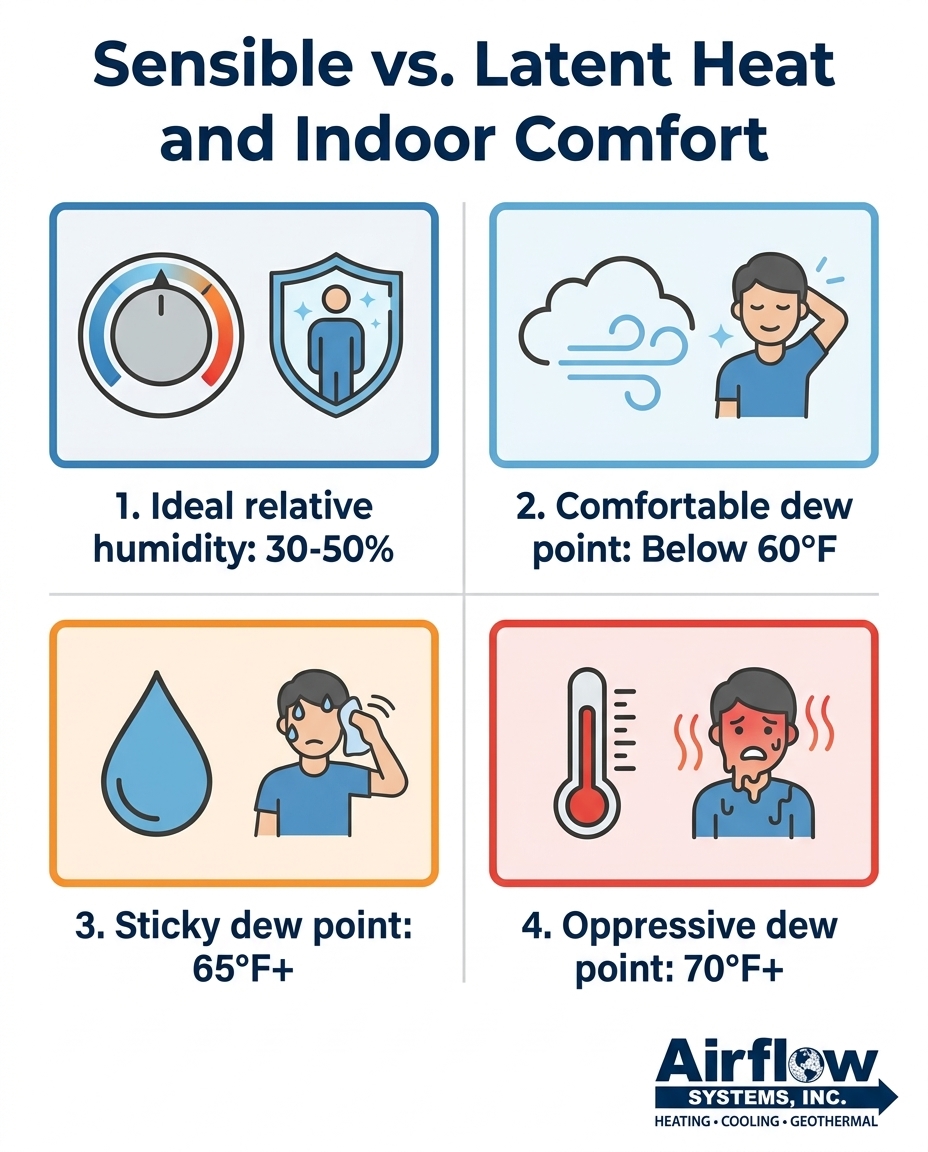
During July peak summer, outdoor moisture levels routinely spike, pushing heavy, damp air into your living space. Here is how different indoor dew points affect your natural ability to cool down:
• Below 55 degrees: The air is dry and crisp. Sweat evaporates instantly, and you feel perfectly comfortable.
• 55 to 60 degrees: The indoor environment is balanced. This is the optimal range for residential comfort.
• 60 to 65 degrees: The air begins to feel slightly heavy. You might notice that your skin feels a bit clammy after light physical activity.
• 65 to 70 degrees: The environment becomes sticky and uncomfortable. Sweat evaporation slows down significantly, trapping biological heat against your skin.
• Above 70 degrees: The air is utterly oppressive. Sweat cannot evaporate at all because the indoor air is completely full of moisture. You will feel miserably hot regardless of what the thermostat says.
When indoor dew points exceed 65 to 70 degrees, the air is simply too saturated to absorb your sweat. Your biological cooling system is effectively hijacked. The moisture stays on your skin, the heat stays trapped in your body, and a room that is technically cooled to 72 degrees feels like a humid swamp. True comfort is impossible until that airborne moisture is physically drained away from the living space.
The Short-Cycling Trap: When Bigger Isn't Better
If your home is suffering from high latent heat loads, the immediate assumption is usually that the air conditioner is broken or simply too old to keep up. While mechanical failures certainly happen, in our experience working on homes throughout Charlottesville and Albemarle County, our team typically sees another incredibly common culprit: an oversized cooling system. In the HVAC industry, bigger is absolutely not better. Installing an air conditioner with too much raw cooling capacity creates a severe operational flaw known as short-cycling, which completely ruins the system's ability to dehumidify the air.
Standard air conditioners need long, steady run cycles to effectively pull moisture from the environment. The dehumidification process takes time. Here is exactly how it works:
1. The cooling cycle begins: The thermostat detects high sensible heat and turns the system on.
2. The indoor coil chills: Refrigerant flows through the indoor evaporator coil, dropping its temperature dramatically.
3. Condensation forms: Warm, humid air from your home blows across the freezing coil. The moisture in the air condenses into liquid water on the metal fins, much like water droplets forming on the outside of a cold glass of iced tea.
4. The moisture drains: The liquid water drips down into a condensate pan and flows safely outside through a drain line.
For this process to work, the air conditioner must run continuously for at least 15 to 20 minutes. The coil needs time to get cold, the water needs time to condense, and the air in your home needs time to circulate multiple times over the cold metal.
When an air conditioner is oversized, it blasts the house with a massive volume of freezing air. It satisfies the thermostat's sensible heat setting in just five or ten minutes, and then it shuts completely off. This rapid on-and-off behavior is called short-cycling. Because the system shuts down so quickly, it never runs long enough to wring the moisture out of the air. The temperature drops to 72 degrees rapidly, but the latent heat remains untouched.
Of course, poor performance is not always due to an oversized unit; sometimes it is a genuine mechanical failure. For example, during a recent service call, a local homeowner noticed a severe drop in performance. Our technician quickly diagnosed a leaking coil in the air handler, resolving the problem as soon as the replacement part arrived. In the summer, a similar mechanical issue—like a leaking coil or a failing blower motor—can disrupt the pressure and temperature of the evaporator coil, completely halting the dehumidification process. Whether the cause is short-cycling or a failed component, the result is exactly the same: a home that is cool, but miserably sticky.
Why Lowering the Thermostat Exacerbates the Problem
When the house feels terribly humid, the most common homeowner reaction is to walk over to the thermostat and push the temperature down to 68 or 67 degrees. It seems logical: if you feel hot, make the room colder. Unfortunately, lowering the temperature without properly removing the latent moisture actually exacerbates the problem and creates a highly uncomfortable phenomenon known as the "cave effect."
The science behind this is tied to how air holds water. Warm air expands, allowing it to hold a large volume of water vapor. Cold air contracts, severely reducing its capacity to hold moisture. When you force your air conditioner to drop the sensible temperature of the room without extracting the water vapor, the air physically shrinks around the moisture. This causes the relative humidity in the room to spike dramatically.
Instead of a warm and sticky 72 degrees, you have now created a freezing, damp environment that feels exactly like a subterranean cave. The air feels heavy, your skin feels clammy, and the environment is deeply uncomfortable. Furthermore, this cold and damp atmosphere is the perfect breeding ground for poor indoor air quality. High relative humidity combined with cold surfaces leads to immediate condensation on windows, walls, and ductwork, which can quickly promote mold and mildew growth.
If you find yourself constantly adjusting the thermostat to fight the dampness, it is time to explore professional indoor air quality solutions. True comfort requires balancing both temperature and moisture removal simultaneously. You cannot brute-force your way to a comfortable home by simply freezing the humid air; the moisture must be actively extracted from the environment.
Professional Solutions for Proper Dehumidification
Fixing a home that suffers from high indoor dew points requires addressing the mechanical capability of the HVAC system. Because this involves refrigerant pressures, electrical load calculations, and ductwork modifications, these are not DIY projects. Attempting to modify system airflow or refrigerant charges without proper licensing can permanently damage the compressor. Instead, resolving heavy latent heat loads requires targeted, professional interventions.
As an independent, locally owned Central Virginia HVAC company, our team at Airflow Systems, Inc. has spent years navigating the unique humidity challenges of the Piedmont region. We know exactly what it takes to keep a home comfortable during our muggy summers. Often, severe humidity issues stem from poor initial setups. One local homeowner recently called us because their AC system needed urgent correction. Our technician found and fixed the immediate AC problem, but also identified and corrected several underlying airflow and sizing issues caused by the original installer. Getting the installation right is critical.
Here are the primary professional solutions we recommend for proper dehumidification across the Albemarle County service area:
1. Upgrading to Variable-Speed HVAC Systems: Older, single-stage air conditioners only have two modes: 100% on or 100% off. Variable-speed systems, however, can adjust their cooling capacity dynamically. On a humid day that isn't extremely hot, a variable-speed unit can run at a low 30% or 40% capacity. This allows the system to run continuously for hours without freezing the house, providing maximum dehumidification and wringing massive amounts of latent heat out of the air. As an added benefit, federal tax credits and utility incentive programs may apply to qualifying high-efficiency installations, so we always recommend checking with a tax professional or your local utility.
2. Installing Whole-Home Dehumidifiers: If your current air conditioner is relatively new and correctly sized, but you still struggle with high dew points, a whole-home dehumidifier is the ultimate solution. These dedicated units tie directly into your existing ductwork. They monitor the moisture levels independently of the thermostat and pull water vapor out of the air even when the air conditioner is not actively running.
3. Performing Professional Load Calculations: If your system is short-cycling because it is oversized, the only permanent fix is replacing it with a correctly sized unit. Professionals use a rigorous mathematical formula called a Manual J load calculation to determine the exact cooling and dehumidification requirements of your specific home, factoring in square footage, window placement, insulation quality, and local climate data.
Frequently Asked Questions About Indoor Humidity and AC Performance
Navigating the complexities of latent heat and indoor comfort can be confusing. Here are clear answers to the most common questions homeowners in Albemarle County ask when their cooling systems struggle to keep up with the summer mugginess.
Why does my house feel humid when the AC is on?
The AC may be short-cycling or oversized, cooling the air before it can extract moisture. Standard cooling systems need long run cycles to pull water vapor out of the indoor air. If the unit blasts cold air and shuts off in just a few minutes, the sensible temperature drops, but the latent heat (humidity) remains trapped in your living space.
What is a comfortable indoor dew point?
A comfortable indoor dew point is generally below 60 degrees; anything above 65 degrees feels sticky. Dew point is a much better indicator of comfort than relative humidity because it measures the absolute amount of water in the air. Keeping the indoor dew point between 55 and 60 degrees ensures your body can efficiently cool itself through natural sweat evaporation.
How does humidity affect perceived temperature?
High humidity prevents sweat from evaporating, making the air feel significantly warmer than the actual temperature. The human body relies on evaporation to shed heat. When the air is already saturated with water vapor, that biological cooling mechanism fails, trapping biological heat against your skin and making a 72-degree room feel miserable.
Does running the AC lower the dew point?
Yes, a properly functioning and correctly sized AC will extract moisture and lower the indoor dew point. As warm indoor air blows across the freezing evaporator coil, the moisture condenses into liquid water and drains away. However, the system must run long enough to process the air; short run times will fail to lower the dew point effectively.
Can an oversized AC cause high indoor humidity?
Yes, an oversized system cools the space too quickly and shuts off before it has time to properly dehumidify the air. This rapid on-and-off operation is called short-cycling. Because the system never runs long enough to pull the moisture out of the air, you are left with a home that is cold but incredibly clammy and damp.
Reclaim Your Comfort from the Summer Humidity
True indoor comfort requires effectively managing both the sensible temperature and the latent dew point inside your home. You should never have to settle for a cold and clammy environment, especially during the relentless heat of July peak summer. If your thermostat says the room is cool but your skin tells a different story, the underlying moisture problem needs professional attention.
Stop fighting the thermostat and let the local experts evaluate your system's performance. Whether you need a comprehensive system evaluation, a sizing calculation, or a targeted AC repair, taking action now ensures your home remains a crisp, comfortable sanctuary all summer long.
Book Expert Service Or Contact Us
Our Service Process
A Hassle-Free Service Experience
01
Consultation & Diagnosis
We start by listening to your needs and performing a thorough diagnosis of your system to recommend the best solution.
02
Transparent Quoting
We provide a clear, upfront estimate with no hidden fees, so you know exactly what to expect.
03
Expert Service & Follow-Up
Our factory-trained technicians complete the work to the highest standards, and we follow up to ensure your complete satisfaction.
testimonials
What Our Customers Are Saying
Our customers consistently praise our exceptional service and attention to detail, making us a trusted choice for all your HVAC needs.
where we operate
Service areas