

Choose an option to see quick actions and get help faster.
.svg)
Evaluating the Math: Are Service Agreements a Genuine Value?
When homeowners ask us, "Is an HVAC Maintenance Plan Actually Worth the Annual Cost?" they are usually wondering if it is just another unnecessary expense pushed by aggressive technicians. If you have ever had a service provider offer you a recurring agreement during a routine visit, you have likely asked yourself this exact question. It is a completely natural reaction. Homeowners are frequently bombarded with subscription services and extended warranties, making it difficult to separate genuine value from corporate upselling tactics.
In our years serving Charlottesville and the Blue Ridge foothills, our team at Airflow Systems typically sees that proactive maintenance is the ultimate dividing line between a comfortable winter and a freezing emergency. As a family-owned, independent local business, we believe in providing honest math rather than high-pressure sales pitches. Evaluating the true value of an HVAC maintenance plan requires looking beyond the immediate transaction. It demands a transparent comparison between the predictable, controlled costs of preventative care and the compounded, relative fees associated with sudden emergency repairs.
The short answer is yes: an HVAC maintenance plan is worth the cost. The relative savings generated through improved energy efficiency, active manufacturer warranties, and the avoidance of after-hours emergency dispatch fees consistently outweigh the upfront commitment of a service agreement.
This is especially true during the critical September pre-heating season transition. Before the weather turns, locking in a predictable tune-up ensures your system is prepared for the months ahead. Let us break down the exact financial and operational mechanics of why proactive care remains the smartest strategy for your home comfort system.
The Hidden Financial Toll of Reactive Winter Breakdowns
To understand the value of a service agreement, you first have to understand the anatomy of a reactive breakdown. Heating and cooling systems rarely fail on a mild Tuesday afternoon. A pattern we see often during Charlottesville winters is that systems break down when under maximum strain—which, in the Blue Ridge foothills, typically means the coldest weekend of the year or a major winter holiday.
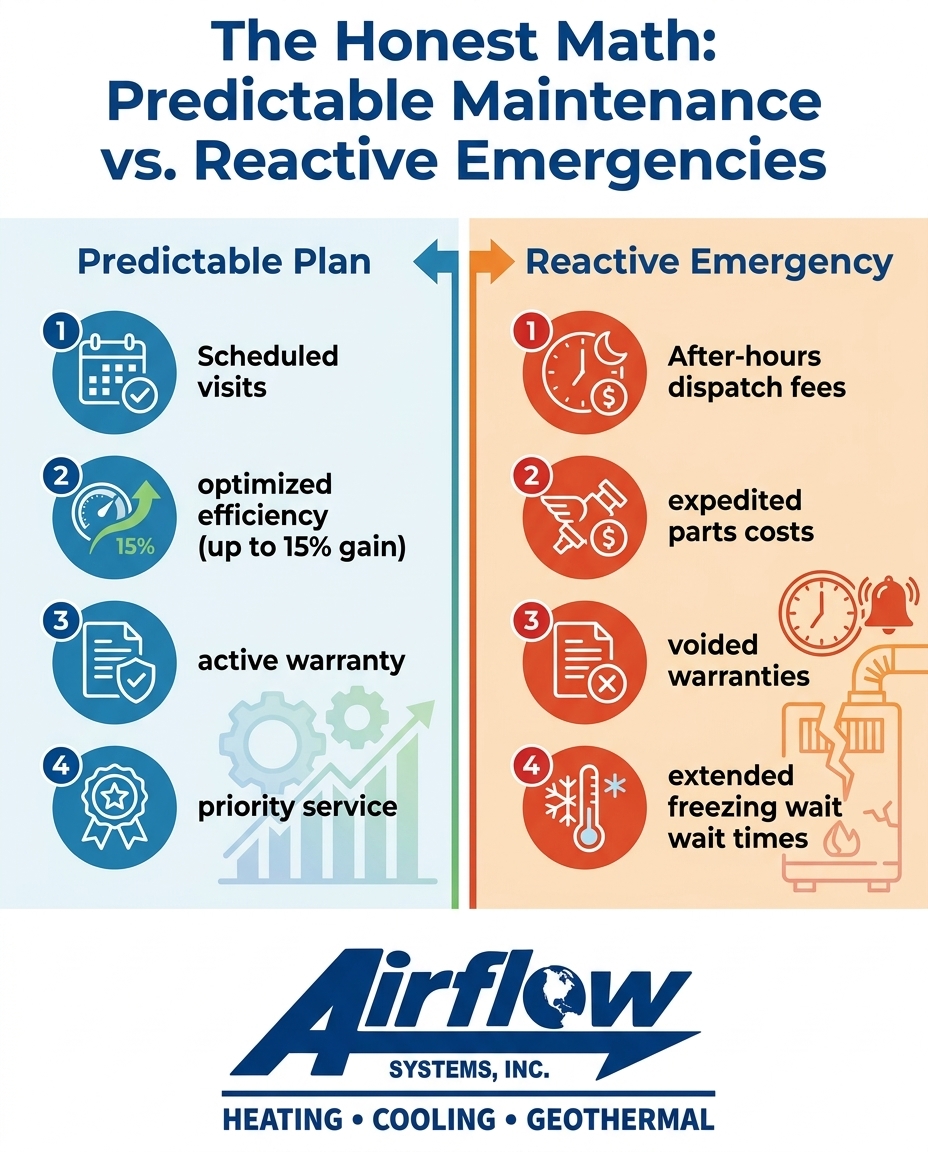
When you operate without a maintenance plan, you are choosing to accept the unpredictable financial toll of reactive repairs. After-hours emergency dispatch fees are significantly higher than standard scheduled rates. This premium accounts for technicians leaving their families on weekends or evenings to restore your heat. Furthermore, if a critical component fails unexpectedly and the local supply house is closed, you may face steep expedited shipping fees just to get the necessary part delivered.
Conversely, regular check-ups keep systems operating smoothly and reliably. One local customer who relies on twice-a-year maintenance noted that having an experienced technician perform semi-annual check-ups keeps their system in top condition and provides valuable expert advice. This proactive approach avoids the chaos of reactive emergencies entirely. If you do eventually need a furnace repair, catching the issue during a scheduled visit eliminates those premium after-hours penalties.
Comparing the Real-World Impacts
The difference between a scheduled tune-up and a midnight emergency goes beyond just the repair bill. It impacts your daily life, your comfort, and your stress levels.
• Dispatch Fees — Predictable Maintenance Plan: Included or heavily discounted; standard rates apply. — Reactive Emergency Breakdown: Premium after-hours, holiday, or weekend rates.
• Parts Sourcing — Predictable Maintenance Plan: Standard procurement during regular business hours. — Reactive Emergency Breakdown: Potential expedited shipping and emergency supply house opening fees.
• System Downtime — Predictable Maintenance Plan: Minimal; maintenance is scheduled around your life. — Reactive Emergency Breakdown: Extended; you wait in a cold house until a technician is available.
• Stress Level — Predictable Maintenance Plan: Low; you have a trusted partner monitoring your system. — Reactive Emergency Breakdown: High; scrambling to find an available contractor during a freeze.
Efficiency Gains and Relative Utility Savings
The financial argument for a maintenance plan extends directly to your monthly utility bills. Unmaintained systems lose a percentage of their operating efficiency every single year. When dust, dirt, and debris accumulate inside your equipment, the system has to work substantially harder to produce the same amount of heating or cooling.
According to data from the U.S. Department of Energy, regular maintenance can improve HVAC efficiency by up to 15%. This is not a theoretical number; it is a direct measurement of how clean components interact with airflow and heat transfer. The hot, humid summers in Charlottesville and the Blue Ridge foothills take a massive toll on your air conditioner. Our technicians consistently find that by the time fall arrives, a system's coils are often coated in microscopic grime, and the blower motor is straining against a heavily loaded filter.
When you invest in professional heating system services during the September pre-heating season transition, the technician restores that lost efficiency. Here is how that translates to relative savings:
• Clean Evaporator and Condenser Coils: Dirt acts as an insulator. When coils are dirty, the refrigerant cannot absorb or release heat effectively, forcing the compressor to run longer cycles. Cleaning them reduces runtime and lowers relative electrical consumption.
• Optimized Airflow: A clogged filter or dirty blower wheel restricts the volume of air moving through your home. The system must run continuously to satisfy the thermostat, driving up your energy burden.
• Calibrated Thermostats and Controls: Precise calibration ensures your system cycles on and off exactly when it should, preventing wasteful short-cycling.
Month over month, the relative utility savings generated by a high-efficiency system help offset the predictable annual cost of the maintenance plan itself.
Catching Minor Wear Before It Becomes Catastrophic Failure
HVAC systems operate under immense physical stress. Motors spin at high speeds, compressors pressurize refrigerant, and igniters generate intense heat. Over time, this constant operation creates natural wear and tear. The fundamental goal of a service agreement is to catch this minor wear before it triggers a catastrophic, cascading failure.
Ignoring small operational changes often leads to severe internal damage. For instance, knowing what strange AC noises mean is helpful, but having a professional identify the source of that auditory warning during a tune-up is invaluable. A slight grinding noise might just be a dry bearing. Lubricating that bearing is a minor, routine maintenance task. Ignoring it, however, causes the motor to overheat, seize, and burn out—transforming a simple adjustment into a major component replacement.
One local homeowner recently scheduled a general HVAC system service and noted how the technician performed a thorough inspection, ensuring an excellent job was done to keep everything running smoothly. That level of detail is what prevents sudden breakdowns. Consider these common examples of minor wear compounding into major damage:
1. Failing Capacitors: A weak capacitor struggles to provide the necessary electrical jolt to start the compressor. If left unchecked, the compressor pulls excessive amperage, overheats, and eventually fails entirely.
2. Frayed Blower Belts: A worn belt will eventually snap. When it does, airflow stops, but the system keeps generating heat or cooling, leading to frozen coils or cracked heat exchangers.
3. Clogged Condensate Drains: A minor algae buildup in a drain line is easily cleared during a September pre-heating season transition visit. If ignored, the line backs up, causing severe water damage to your ceilings, floors, or the sensitive electronics inside the air handler.
Our team recommends addressing these minor issues during a scheduled tune-up because it is significantly less disruptive—and vastly less expensive—than waiting for the entire system to seize in the middle of the night.
Protecting Your Manufacturer Warranty Coverage
One of the most overlooked benefits of an annual maintenance plan is its role in protecting your equipment's manufacturer warranty. Modern HVAC systems are significant investments, and manufacturers back them with warranties that cover the cost of major replacement parts, such as compressors and heat exchangers, for a specified number of years.
However, these warranties are not unconditional. If you read the fine print of standard HVAC manufacturer warranty stipulations, you will find a strict requirement: the equipment must receive professional, annual maintenance. Manufacturers require this because they know that neglecting basic upkeep—like changing filters and cleaning coils—directly causes major components to fail prematurely.
If your compressor fails and you file a warranty claim, the manufacturer will frequently request Proof of Maintenance. If you cannot provide service records showing that the system was professionally maintained, the manufacturer has the legal right to deny the claim, resulting in Voided Coverage. You would then be responsible for paying fully out-of-pocket for the replacement part, which can easily equate to a massive, unexpected expense.
An active service agreement automatically fulfills these documentation requirements. When you are enrolled in a plan, the HVAC company tracks your service history, maintains the records, and ensures that your September pre-heating season transition tune-up is logged. This administrative protection alone justifies the annual cost of the plan, safeguarding you against the financial shock of a denied warranty claim.
The Value of Priority Scheduling During Peak Freezes
While the financial math strongly supports maintenance plans, the non-monetary benefits are equally compelling. Chief among these is priority scheduling. In Charlottesville and the Blue Ridge foothills, the weather can shift dramatically. When the first unpredictable winter freeze strikes the region, hundreds of unprepared systems fail simultaneously.
This creates a massive spike in local demand. During these peak periods, standard service wait times can stretch for days. HVAC companies are forced to triage calls, and if you are not an established customer with a service agreement, you will likely find yourself at the back of a very long line. Waiting in a freezing house with your family is a miserable, stressful experience.
Maintenance plan members skip that line. Priority scheduling guarantees that when you call for help, your ticket is moved to the top of the dispatch board. Whether you are facing a sudden furnace failure in January or need emergency AC repair during a July heatwave, priority service secures a faster response time.
Another local customer experienced this firsthand when they discovered a leaking coil in their air handler. Because they had an established relationship with their service provider, the technician quickly diagnosed the issue and repaired it promptly once the necessary part arrived, doing so at a highly reasonable relative cost. That peace of mind—knowing you have a dedicated team ready to prioritize your family's comfort—is a core component of a plan's true value.
Frequently Asked Questions About HVAC Service Agreements
Even when the math makes sense, homeowners often have specific questions about how these agreements work in practice. Here are the most common inquiries we receive regarding preventative care.
Do I really need annual HVAC maintenance?
Yes, annual maintenance is essential for the longevity and safety of your system. All major equipment manufacturers require routine professional upkeep to keep their warranties intact. Beyond warranty protection, unmaintained equipment loses operating efficiency every year, meaning you will pay progressively higher utility bills for a system that is slowly deteriorating.
What does an HVAC maintenance plan include?
A standard maintenance plan includes comprehensive seasonal inspections, the lubrication of moving parts, and the tightening of all electrical connections. Members also typically receive priority scheduling and potential discounts on standard repairs if issues are found. Most importantly, these visits involve proactive safety checks on critical components like heat exchangers and electrical relays, ensuring your home remains safe.
Does HVAC maintenance save money?
Yes, through relative cost avoidance and efficiency gains. A tuned system requires less energy to heat or cool your home, which offsets the predictable cost of the plan through lower monthly utility bills. Furthermore, catching minor wear and tear early prevents the need for major component replacements and helps you avoid the steep premium of after-hours emergency dispatch fees.
What happens if I skip HVAC maintenance?
Skipping maintenance triggers a compounding effect of wear and tear, starting with dirty coils and clogged filters that restrict airflow and strain the blower motor. This neglect significantly increases the risk of mid-season breakdowns when the system is working its hardest. Ultimately, skipping annual service can void your manufacturer warranty, leaving you financially responsible for major part failures.
How does the local climate impact maintenance frequency?
The specific stress of transitioning from hot, humid summers to cold, unpredictable winters places immense strain on local HVAC systems. Because your equipment battles extreme temperature swings in Charlottesville and the Blue Ridge foothills, a bi-annual approach—scheduling a tune-up in the spring for cooling and during the September pre-heating season transition for heating—is the optimal strategy to maintain peak performance year-round.
Secure Your Home's Comfort With Predictable Preventative Care
When you evaluate the honest math, the decision becomes clear. Choosing an HVAC maintenance plan means choosing predictable, controlled preventative care over the compounding stress and relative expense of reactive emergencies. From preserving crucial manufacturer warranties and restoring lost energy efficiency to securing priority service during the harshest freezes in Charlottesville and the Blue Ridge foothills, a service agreement consistently proves its worth.
Do not wait until your system fails on the coldest night of the year to realize the value of preventative maintenance. Lock in your home's comfort today. Reach out to our independent, local team to discuss the best maintenance options for your specific equipment, and enjoy the peace of mind that comes with knowing your system is fully prepared for whatever the season brings.
Book Expert Service Or Contact Us
Our Service Process
A Hassle-Free Service Experience
01
Consultation & Diagnosis
We start by listening to your needs and performing a thorough diagnosis of your system to recommend the best solution.
02
Transparent Quoting
We provide a clear, upfront estimate with no hidden fees, so you know exactly what to expect.
03
Expert Service & Follow-Up
Our factory-trained technicians complete the work to the highest standards, and we follow up to ensure your complete satisfaction.
testimonials
What Our Customers Are Saying
Our customers consistently praise our exceptional service and attention to detail, making us a trusted choice for all your HVAC needs.
where we operate
Service areas