

Choose an option to see quick actions and get help faster.
.svg)
The Myth of "More Tech is Better" for Indoor Air Quality
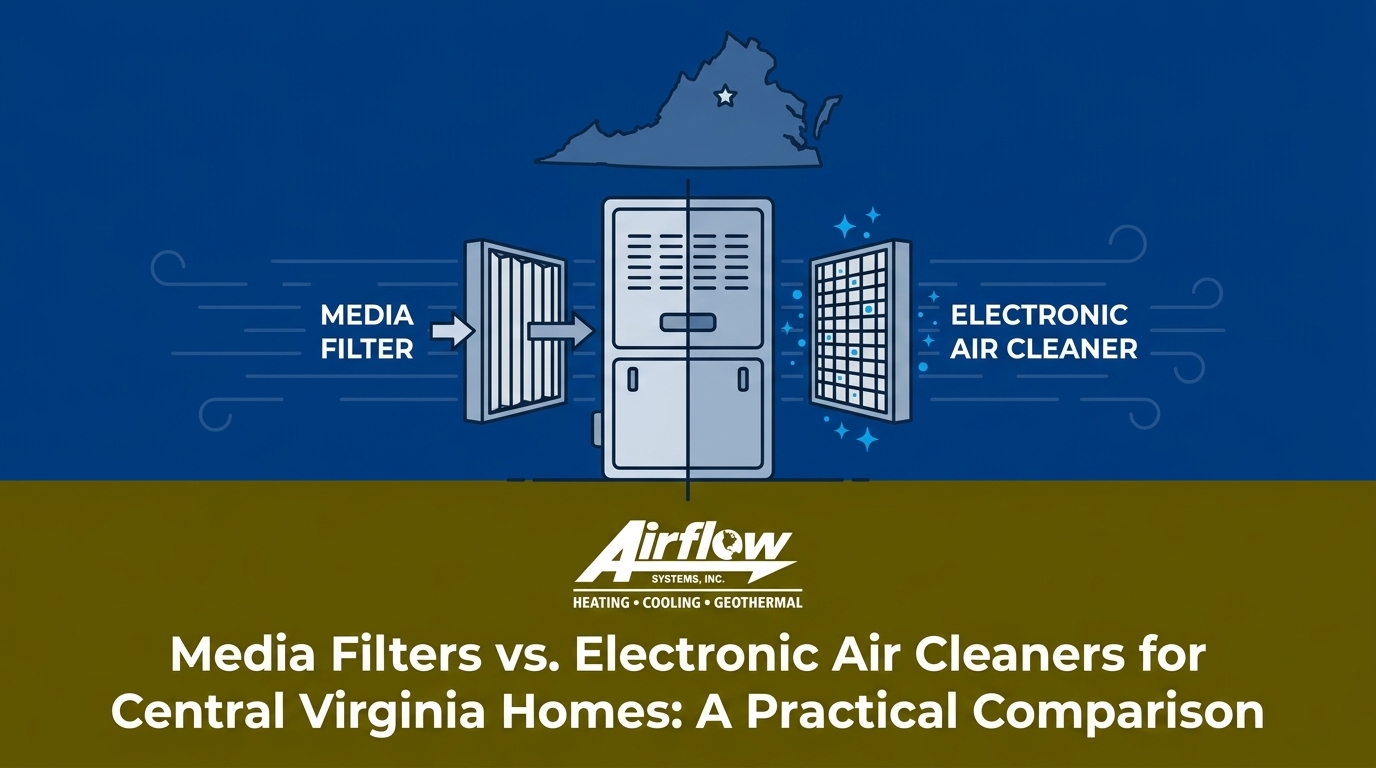
Upgrading to the most complex gadget doesn't automatically mean your home's air will be cleaner. When weighing Media Filters vs. Electronic Air Cleaners for Central Virginia Homes, many property owners assume that an electronic system is the ultimate, unbeatable solution for seasonal allergies. The reality is much more nuanced. Theoretical maximum efficiency in a laboratory setting does not always translate to real-world results, especially if the required maintenance is frequently ignored.
As we head into the September / early fall ragweed season, our team at Airflow Systems, Inc. often reminds customers that choosing between passive reliability and active electronic cleaning becomes a critical decision during your seasonal HVAC tune-up. Evaluating your actual household maintenance habits is the first and most important step to achieving better indoor air quality. A highly advanced system that you forget to clean will consistently underperform a simpler system that requires almost no attention.
For residents in Charlottesville and Central Virginia, the seasonal shift brings a heavy influx of outdoor particulates. You need a filtration strategy that works continuously in the background, without demanding constant intervention. Let's break down the practical differences between these two popular approaches so you can make an informed, stress-free upgrade decision.
The Behavioral Reality of Home Maintenance
In our years of serving Charlottesville homeowners, we've found that the core issue with complex filtration isn't the technology itself; it is human behavior. Life gets busy. Between work, family obligations, and daily chores, remembering to service an HVAC component buried in your basement or utility closet often falls to the bottom of the to-do list. When you install equipment that demands strict, monthly attention to function properly, you are setting a high bar for success. If that bar isn't met, the indoor air quality inside your home suffers immediately. Acknowledging this behavioral reality is the secret to selecting the right equipment for your specific lifestyle.
Understanding Electronic Air Cleaners: High Efficiency, High Maintenance
Electronic air cleaners (EACs) are sophisticated devices installed directly into your ductwork. Instead of simply blocking particles with a physical barrier, they use an electrical charge to actively trap contaminants. When operating under perfect conditions, they offer excellent theoretical efficiency, capturing microscopic pollutants like smoke, smog, and fine pet dander.
Here is how the electronic precipitation process generally works:
1. Pre-filtration: Air first passes through a standard, coarse pre-filter that catches large debris like hair and heavy dust bunnies.
2. Ionization: The air then flows through a grid of highly charged ionizing wires. As microscopic particles pass through this grid, they are blasted with high voltage, giving them a strong positive electrical charge.
3. Collection: Finally, the charged particles enter a section containing grounded collector plates. Because opposites attract, the positively charged particles stick to the negatively charged (or grounded) plates like magnets.
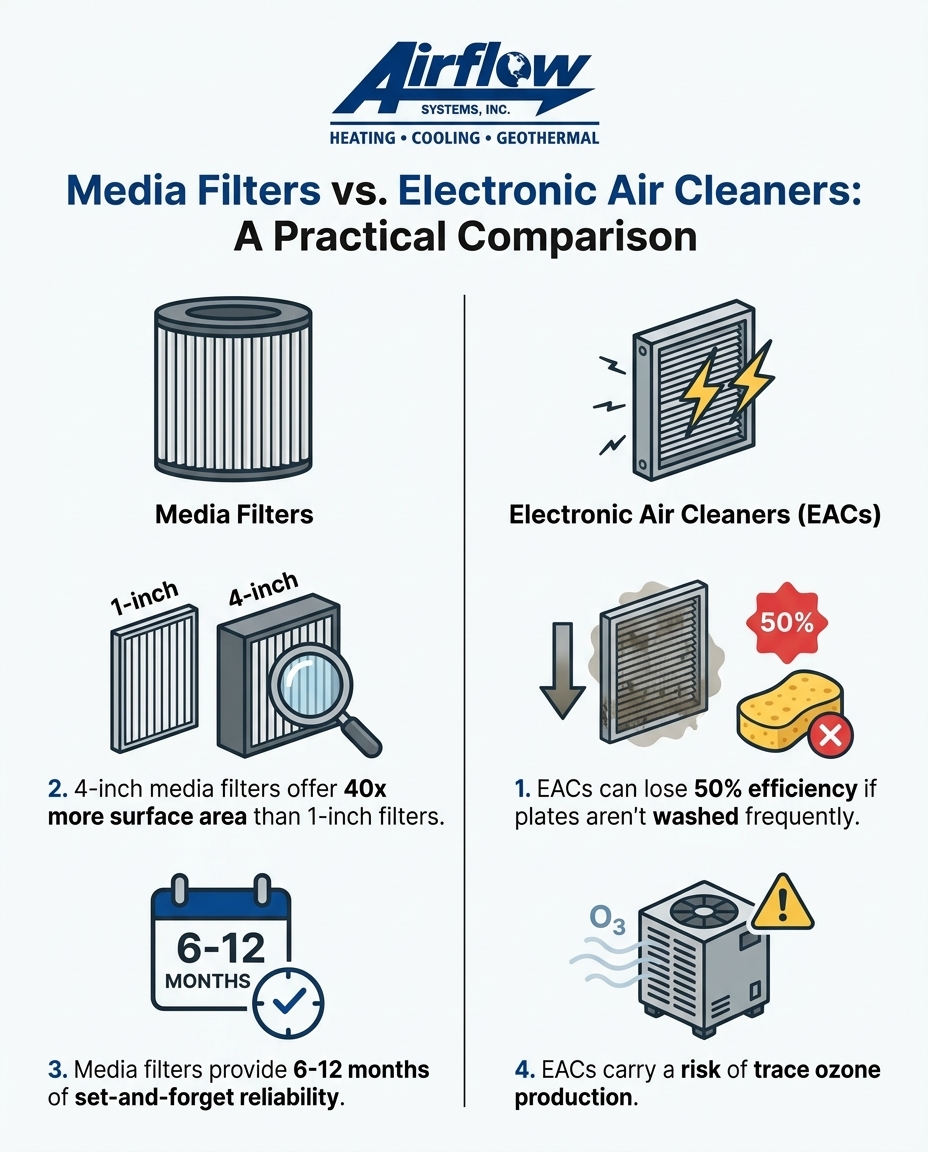
The critical flaw in this process is what happens next. The moment those collector plates become coated with a layer of dust and debris, they begin to lose their magnetic pull. Efficiency drops off a cliff. In fact, an electronic air cleaner can lose up to 50% of its filtering capability if the plates are not washed frequently and thoroughly. If you forget to clean them for a few months, the device essentially stops cleaning your air, allowing allergens to blow right past the plates and into your living space.
The Ozone Factor and Testing Needs
Another factor to consider is ozone production. Some electronic models produce trace amounts of ozone as a byproduct of the ionization process. According to EPA guidelines, even small amounts of ozone can act as a lung irritant for sensitive individuals, which is counterproductive if you are upgrading your system to relieve asthma or allergies. If you currently rely on an older electronic unit and are unsure if it is performing correctly, scheduling indoor air quality testing can reveal exactly what is circulating through your ductwork. Often, our technicians find that homeowners switching to 4-inch pleated media filters experience much cleaner air simply because the media filter never loses its structural integrity or requires electrical charging.
The Case for 4-Inch Pleated Media Cabinets: Set-and-Forget Reliability
At Airflow Systems, Inc., we consistently recommend passive filtration for the vast majority of households because it offers a much more reliable path to clean air. A media air cleaner is a thick, dense filter—usually four to five inches deep—housed inside a dedicated metal cabinet attached to your furnace or air handler. Unlike standard 1-inch filters that you buy at the hardware store, 4-inch pleated media filters provide up to 40 times more surface area.
This massive increase in surface area changes the entire dynamic of how your HVAC system breathes. The deep-pleated design allows for continuous, passive particle capture without relying on electrical charges or complex internal components. Because the filter material is folded back and forth dozens of times, it can hold a massive amount of dust, pollen, and dander before it starts to restrict airflow.
Why Passive Filtration Outperforms Neglected Tech
The greatest advantage of a 4-inch pleated media filter is its "set and forget" nature. Because of the expanded surface area, these filters maintain consistent efficiency for 6 to 12 months without needing to be washed, scrubbed, or electrically reset. You simply slide the old filter out, throw it away, and slide a new one in once or twice a year.
• Consistent Capture Rate: A media filter does not lose half its efficiency just because it caught some dust. In fact, as a media filter slightly loads with debris, its ability to catch microscopic particles actually increases slightly, right up until it needs replacement.
• Zero Electrical Draw: There are no ionizing wires to break, no power supplies to fail, and no electrical consumption required to clean the air.
• Zero Ozone Emissions: Because the filtration is entirely physical, there is absolutely no risk of ozone production, making it the safest choice for severe allergy and asthma sufferers.
For most busy families, this passive reliability vastly outperforms a neglected electronic unit. The best air filter is the one that actually does its job every single day, regardless of whether you remembered to perform maintenance on it that month.
Side-by-Side Comparison: Maintenance, Efficiency, and Real-World Performance
To make the best decision for your home in Charlottesville and Central Virginia, it helps to see exactly how these two technologies stack up against each other in everyday conditions. Both systems require a professional to install the initial cabinet into your ductwork, but the similarities end there.
• Maintenance Frequency — Electronic Air Cleaners (EACs): Requires washing collector plates every 1 to 2 months. — 4-Inch Media Filters: Requires swapping the filter every 6 to 12 months.
• Maintenance Task — Electronic Air Cleaners (EACs): Soaking, scrubbing, and completely drying metal plates. — 4-Inch Media Filters: Slide out the old filter, slide in the new one.
• Efficiency Consistency — Electronic Air Cleaners (EACs): Rapid drop-off; loses up to 50% efficiency as plates get dirty. — 4-Inch Media Filters: Steady, long-term capture; maintains performance for months.
• Airflow Restriction — Electronic Air Cleaners (EACs): Low restriction when clean, but requires proper initial sizing. — 4-Inch Media Filters: Low restriction due to high surface area, requires proper sizing.
• Ozone Risk — Electronic Air Cleaners (EACs): Potential trace emissions from the ionization process. — 4-Inch Media Filters: Zero emissions; completely passive physical filtration.
Tackling Fall Ragweed Season in Central Virginia
The transition from high summer humidity into autumn brings unique biological and particulate challenges to the region. The lingering summer moisture creates an environment where mold and mildew can thrive inside ductwork, while the changing outdoor temperatures trigger massive pollen releases. September / early fall ragweed season is notoriously harsh, and it puts an incredible burden on your home's air circulation systems.
Heavy pollen loads quickly overwhelm standard 1-inch fiberglass filters, clogging them in a matter of weeks. If you have an electronic air cleaner, that same heavy pollen load will rapidly coat the collector plates, rendering the electrical charge useless right when you need it most. This dual-threat of lingering humidity and fresh allergens means your indoor air quality can plummet just as you start spending more time indoors.
Preparing for the Winter Shift
Upgrading your filtration capacity before the heavy heating season begins ensures your system is equipped to handle both fall allergens and winter indoor dust. As you close your windows and rely entirely on your mechanical systems for ventilation, the air inside your home recirculates dozens of times a day. If you are scheduling air conditioning services to wrap up the cooling season, this is the exact right moment to have your technician evaluate your ductwork for a media cabinet upgrade. A high-capacity filter will capture the ragweed now, and continue to seamlessly trap the dry dust, pet dander, and lint that accumulates throughout the winter months.
The Hidden Danger of Neglected Filtration: System Strain and Airflow Drop
Forgetting to wash electronic plates or swap a media filter doesn't just hurt your air quality; it actively chokes your HVAC system. Your furnace and air conditioner are designed to move a very specific volume of air. When a filter or a set of collector plates becomes heavily clogged, it acts like a wall inside your ductwork. This restricted airflow forces the blower motor to work significantly harder to push air through the house, dramatically increasing your daily energy consumption and putting unnecessary wear and tear on expensive internal components.
The quick fix: Checking your filter is the first step whenever your system seems to be struggling. Severe airflow restriction is a leading cause of frozen evaporator coils. When warm house air cannot flow over the indoor coil fast enough, the refrigerant inside drops below freezing, turning the condensation on the coil into a solid block of ice. Understanding how dirty filters cause frozen evaporator coils is crucial for preventing unexpected breakdowns.
Real-World Impact on Equipment Lifespan
Professional installation and regular tune-ups ensure that whichever system you choose is properly integrated without causing static pressure issues. For example, a local Charlottesville homeowner reached out to us this past fall when their system failed, requiring a heat pump replacement in a surprisingly tight utility space. Our skilled team of installers at Airflow Systems, Inc. arrived, successfully replaced the unit, and managed to seamlessly connect an existing high-capacity air cleaner. The result was a new Bosch heat pump that ran beautifully and significantly quieter than the old unit, simply because the airflow and filtration were properly matched and balanced.
Whether you opt for 4-inch pleated media filters or prefer to keep an electronic unit, the integration must be flawless. An improperly sized filter cabinet will restrict air just as badly as a dirty one. Having an expert measure your system's static pressure during installation guarantees that you get the air quality benefits without sacrificing the lifespan of your heating and cooling equipment.
Frequently Asked Questions About Home Air Filtration
Are electronic air cleaners better than media filters?
Theoretically, electronic air cleaners can be highly effective when they are perfectly clean, capturing incredibly small microscopic particles. However, practically speaking, media filters often perform better in real-world conditions. This is because media filters do not suffer from severe efficiency drops due to missed maintenance, providing consistent, reliable protection for your home.
How often should I clean my electronic air cleaner?
Collector plates typically need thorough washing every 1 to 2 months. This frequency depends heavily on your household dust levels, whether you have indoor pets, and the severity of seasonal pollen in Charlottesville and Central Virginia. If you wait until the plates look visibly filthy, the unit has likely already been underperforming for weeks.
Do electronic air filters produce ozone?
Yes, some models can produce trace amounts of ozone as a byproduct of the ionization process used to charge the particles. While usually within regulated limits, even small amounts of ozone can irritate sensitive respiratory systems, making it a concern for asthma and allergy sufferers.
What is a media air cleaner?
A media air cleaner is a thick, pleated filter (usually 4 to 5 inches deep) installed in a dedicated metal cabinet attached to your ductwork. It traps particles passively without electricity, using its massive surface area to hold a large volume of dust and allergens before needing replacement.
Can I replace my electronic air cleaner with a 4-inch media filter?
In many cases, yes. If you are tired of washing electronic plates, one of our HVAC technicians can often remove the electronic internal components and slide a perfectly sized 4-inch pleated media filter directly into the existing cabinet. This instantly converts your high-maintenance electronic system into a reliable, low-maintenance passive filtration system.
Make the Right Choice for Your Home's Air Quality This Fall
The best air cleaner is the one that fits your actual maintenance habits. Before the September / early fall ragweed season fully sets in and forces you to keep your windows closed, take a moment to evaluate your current filtration setup. If you are constantly forgetting to wash your electronic plates, you are not getting the clean air you deserve.
As an independent, family-owned provider, Airflow Systems offers unbiased advice without corporate pressure to upsell. We will gladly recommend a simple, passive media filter if it genuinely serves your home and lifestyle better than a complex electronic gadget. Partner with a local expert who prioritizes your health and practical needs over pushing high-margin equipment.
Take action before the weather turns entirely. Schedule a comprehensive HVAC maintenance plan visit to ensure your system is perfectly calibrated for the transition into winter. By choosing a practical, reliable filtration strategy today, you guarantee a cleaner, healthier, and more comfortable home environment for your family all season long.
Book Expert Service Or Contact Us
Our Service Process
A Hassle-Free Service Experience
01
Consultation & Diagnosis
We start by listening to your needs and performing a thorough diagnosis of your system to recommend the best solution.
02
Transparent Quoting
We provide a clear, upfront estimate with no hidden fees, so you know exactly what to expect.
03
Expert Service & Follow-Up
Our factory-trained technicians complete the work to the highest standards, and we follow up to ensure your complete satisfaction.
testimonials
What Our Customers Are Saying
Our customers consistently praise our exceptional service and attention to detail, making us a trusted choice for all your HVAC needs.
where we operate
Service areas