


Choose an option to see quick actions and get help faster.
.svg)
Myth vs. Reality: Cooling Your Off-Campus Apartment Without Breaking the Lease
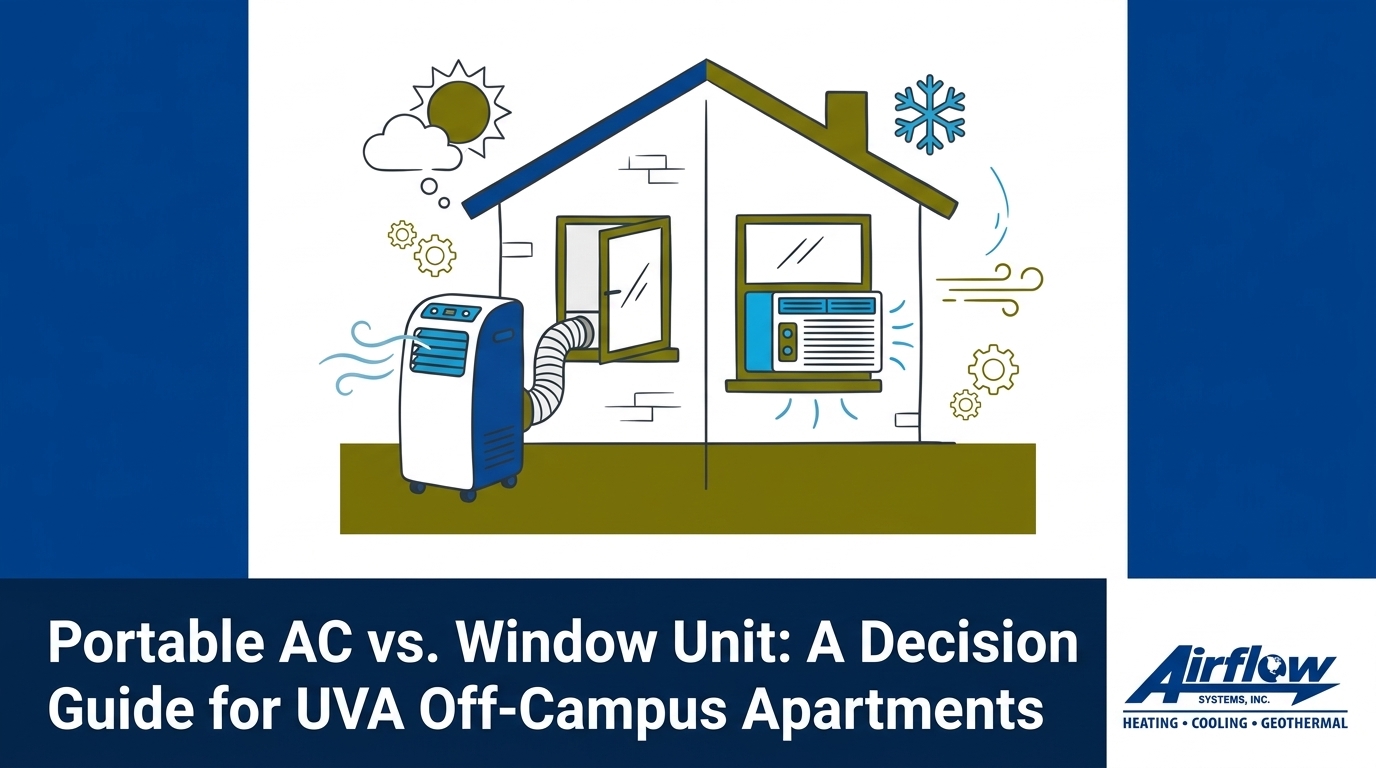
A common misconception among renters is that any off-the-shelf air conditioner can be easily tossed into a bedroom window to beat the heat. However, choosing between a portable AC vs. window unit for UVA off-campus apartments requires far more planning than a quick trip to a big-box store. Renters facing the heavy humidity and high temperatures typical of a Virginia July must navigate strict landlord rules, non-standard windows, and limited floor space. The core decision ultimately comes down to balancing the superior cooling efficiency of one style against the guaranteed lease compliance of another. To make the right choice, you need a clear comparison framework evaluating noise, efficiency, and installation realities for supplemental cooling. If you are exploring permanent air conditioning solutions, our team often finds that upgrading the property's primary system is the most effective route.
The Architectural Reality of Charlottesville's Historic Student Housing
Before comparing specific cooling technologies, it helps to understand the physical constraints of the local housing stock. Many off-campus properties in the Venable and Rugby Road neighborhoods are historic structures that were built long before modern air conditioning became a standard requirement. These structural limitations immediately filter out certain cooling choices for renters.
When attempting to cool these older spaces, our technicians typically see residents run into four distinct architectural and administrative hurdles:
1. Non-standard sash windows: Older homes often feature original wood-frame sash windows that operate differently than modern vinyl replacements. These frames frequently cannot safely support heavy external units without specialized brackets.
2. Strict exterior modification rules: Historic districts and property management companies often dictate what can be visible from the street. A bulky unit protruding from a front-facing window is frequently a direct lease violation.
3. Prohibited mounting hardware: Landlords strictly forbid drilling into original window frames or siding to install the heavy-duty support brackets required for safe operation.
4. Limited electrical capacity: Historic wiring may not support the high amperage draw of multiple large cooling units running simultaneously on the same circuit.
In our years of servicing Charlottesville's older housing stock, our team at Airflow Systems has seen firsthand that these physical constraints often force a renter's hand. If the window frame cannot support the weight or the landlord prohibits visible exterior modifications, the decision matrix shifts immediately.
Window Units: High Efficiency vs. Strict Installation Rules
When our team evaluates portable vs. window supplemental cooling units, the traditional window-mounted system generally wins on raw performance. Because these systems sit partially outside the building, the heat-generating components—specifically the compressor—remain entirely outside your living space. This mechanical separation allows the system to operate with significantly higher efficiency.
However, we always warn renters that this efficiency comes with significant practical hurdles. The major drawback is the high risk of lease violations if the system is installed without proper brackets or explicit landlord approval. Furthermore, improper installation in second- or third-story apartment windows carries severe liability risks if the heavy box were to fall.
• Pro: Superior cooling power: By keeping the hot compressor outside, the system does not radiate heat back into the room it is trying to cool.
• Pro: Better energy efficiency: These systems consistently meet higher U.S. Department of Energy (DOE) Room Air Conditioner standards compared to floor-standing alternatives.
• Con: Installation liability: Securing a heavy metal box in a precarious upper-story window often violates safety clauses in student housing leases.
• Con: Aesthetic restrictions: Property managers frequently ban them to maintain a uniform, historic exterior appearance across the building.
Understanding EER and Cooling Power
When shopping for a unit, you will frequently see an Energy Efficiency Ratio (EER) rating. In simple terms, EER measures how much cooling power (measured in BTUs) the system provides for every watt of electricity it consumes. Higher EER ratings translate to lower utility bills and faster cooling. We note that window-mounted systems almost universally boast higher EER ratings because they exhaust hot air directly into the outdoor environment rather than relying on a long, uninsulated plastic hose routed through the room.
Portable ACs: The Floor Space and Negative Pressure Dilemma
For many renters we speak with, floor-standing portable systems are the default choice because they guarantee lease compliance. Since the entire machine sits inside the room and nothing protrudes outside the building, landlords generally permit them. However, this compliance comes at a steep cost to both efficiency and comfort.
The problem: The most significant tradeoff is sacrificing valuable floor space in cramped student apartments. A portable system requires dedicated clearance away from walls and furniture, consuming square footage that is already at a premium.
The cause: Beyond the physical footprint, the mechanics of a single-hose portable unit create a serious efficiency flaw known as negative pressure. These machines use room air to cool their internal compressor, and then they blow that heated air out the window through a large exhaust hose. Because air is constantly being pushed out of the room, new air must enter to replace it. This forces humid, unconditioned outside air to seep into the apartment through cracks under doors, around window sashes, and through wall outlets.
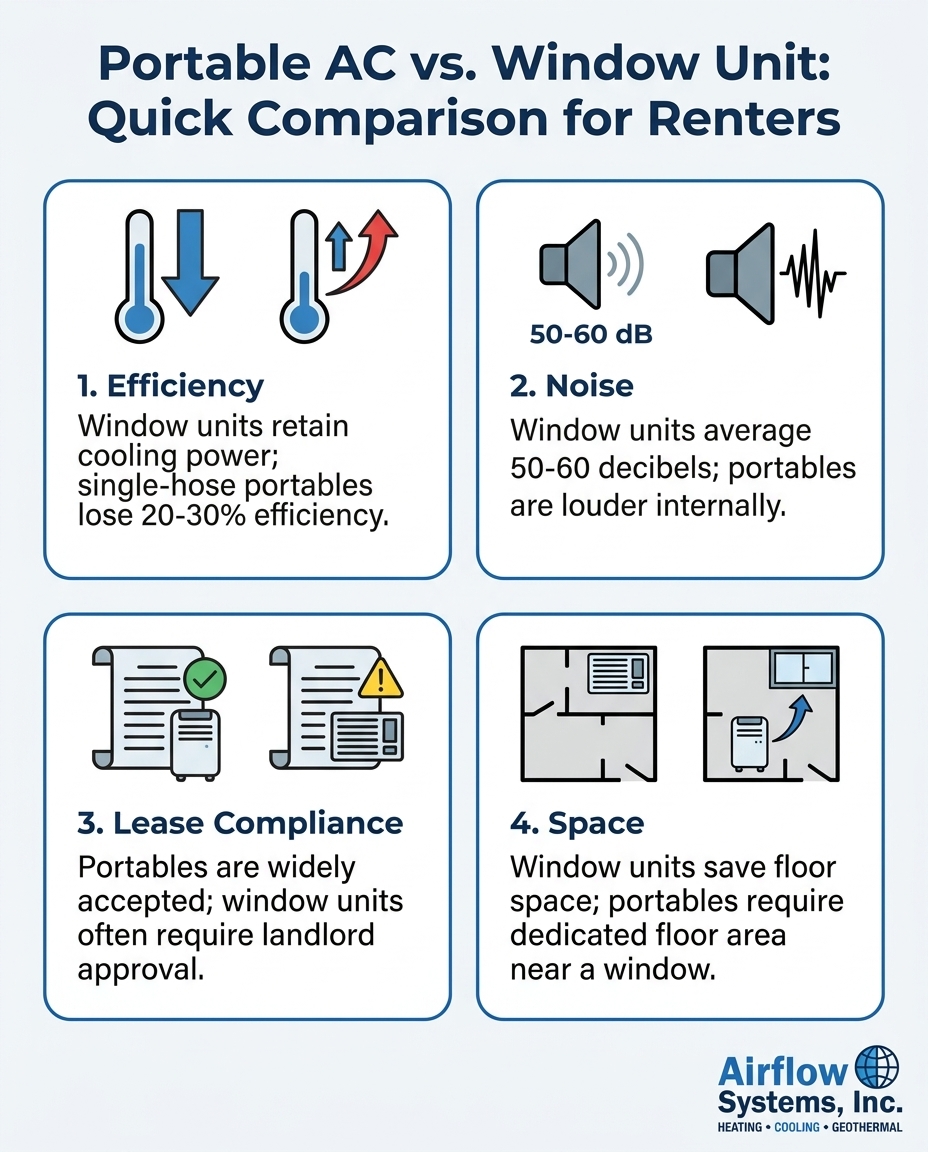
The solution: Our technicians frequently see the downside of this setup during July peaks in Virginia, as drawing in muggy, unconditioned summer air is disastrous for indoor comfort. We always remind renters that single-hose units can be 20-30% less efficient due to exhaust heat radiating back into the room from the hose and the negative pressure effect pulling in hot air. If you must use a portable system to satisfy a lease agreement, understanding this limitation helps manage expectations regarding your utility bills and overall comfort.
Single-Hose vs. Dual-Hose Portables
To mitigate the negative pressure problem, manufacturers produce dual-hose portable systems. One hose draws outside air in to cool the compressor, while the second hose exhausts the hot air back outside. This prevents the machine from creating negative pressure in your bedroom. The challenge we see is that dual-hose models are significantly more expensive and harder to find, often pushing them outside standard student budgets.
Decibel Levels and Study Distractions: Which Unit is Quieter?
A primary concern for the student demographic is maintaining a quiet environment for studying and sleeping. When comparing portable vs. window supplemental cooling units, the acoustic differences are stark.
Window units typically operate between 50-60 decibels. While they are not silent, the loudest mechanical component—the compressor—sits entirely outside the window pane. The glass acts as a sound barrier, meaning you primarily hear the rush of the indoor fan rather than the mechanical grinding of the cooling cycle.
Portable units are inherently louder because the entire mechanical system, including the compressor and exhaust fans, is contained directly inside the room. Operating a portable system is similar to running a large refrigerator next to your desk or bed. For students sensitive to ambient noise, this constant mechanical hum can severely impact concentration during the semester and disrupt sleep quality.
• Cooling Efficiency — Window Unit: High (Compressor outside) — Portable Unit (Single Hose): Low (Negative pressure issues)
• Noise Level — Window Unit: Moderate (50-60 dB inside) — Portable Unit (Single Hose): Loud (Compressor inside room)
• Lease Compliance — Window Unit: Often restricted or banned — Portable Unit (Single Hose): Highly compliant
• Space Requirements — Window Unit: Zero floor space needed — Portable Unit (Single Hose): Requires significant floor clearance
Indoor Air Quality and Humidity Control in Cramped Quarters
Dropping the temperature is only half the battle; effective dehumidification is required for true comfort. In our experience, Charlottesville summers require strong dehumidification capabilities, not just raw temperature drops, to make an apartment feel livable. When the air is heavy with moisture, even a room cooled to 72 degrees will feel sticky and uncomfortable.
Poorly functioning supplemental units can leave rooms feeling damp, which is a significant problem in historic housing. Excess moisture encourages mold growth in older buildings, particularly in poorly ventilated bathrooms or cramped student closets. Both portable and window-mounted systems extract moisture from the air as they run, but they must be maintained properly to do so effectively.
The importance of regular filter maintenance cannot be overstated. A clogged filter restricts airflow, forcing the machine to work harder while failing to remove dust, pollen, and humidity from your living space. If you are cleaning your filters regularly but the apartment's air still feels continually stale, musty, or overly humid, it may be time to seek a professional assessment. Scheduling indoor air quality testing with our team can identify underlying ventilation issues that a simple plug-in machine cannot resolve.
The Ultimate Property Owner Upgrade: Moving Beyond Temporary Cooling
While renters are often stuck choosing between temporary, compromised cooling methods, property owners have a permanent, superior option. Ductless systems completely eliminate the noise, security risks, and inefficiency associated with window and portable units. For landlords and homeowners in the Venable and Rugby Road areas, we highly recommend these systems as the definitive upgrade.
Recently, our crew at Airflow Systems helped a local property owner who faced a small apartment HVAC challenge that required a fast resolution due to a pending real estate contract. Pressed for time and needing a solution that would pass inspection without relying on bulky window boxes, the owner sought our professional guidance. After discussing the available options to bypass temporary setups, our team recommended and installed a minisplit system quickly. The outcome was highly successful: the new minisplit system works better than imagined, providing ultra-efficient, whisper-quiet zoning that completely transformed the space.
As the local authority on transitioning older housing stock to modern standards, our experts at Airflow Systems understand that ductless technology preserves the historic exterior of these homes. There is no need for invasive ductwork, and the low-profile outdoor compressors can be hidden from street view. Permanently resolving small apartment HVAC challenges not only increases property value but drastically improves tenant satisfaction and retention. If you own the property, comparing mini splits to window units quickly reveals that temporary boxes are merely a stopgap measure.
Frequently Asked Questions About Apartment Cooling
Will a window AC violate my lease?
In many historic off-campus properties, yes, a window-mounted system will violate the lease. Landlords frequently ban them due to the liability of the unit falling, the potential damage to original window frames, and strict neighborhood association rules regarding exterior building aesthetics. Always check your specific lease agreement before purchasing one.
Do portable ACs work in high humidity?
Portable systems do provide cooling and dehumidification, but we find that single-hose models struggle significantly in high humidity. Because they create negative pressure, they constantly pull hot, muggy outside air back into the apartment through gaps in doors and windows, forcing the machine to work continuously just to keep up.
Which is quieter for studying: window or portable AC?
A window-mounted system is noticeably quieter for studying and sleeping. Because the compressor—the loudest mechanical part of the system—is located outside the glass, the interior noise is mostly limited to the sound of the fan blowing air. Portable systems keep the noisy compressor right next to your desk.
Are portable ACs as good as window units?
From a strict performance and energy efficiency standpoint, portable systems are not as good as their window-mounted counterparts. They consume more electricity to produce the same amount of cooling, take up valuable floor space, and radiate exhaust heat back into the room through their venting hose.
Do portable air conditioners use a lot of electricity?
Yes, portable systems typically use more electricity than window-mounted alternatives of the same BTU rating. Their lower Energy Efficiency Ratio (EER) means they have to run longer and consume more wattage to achieve the desired room temperature, which can lead to higher summer utility bills.
Can landlords ban window AC units entirely?
Yes, landlords have the legal right to ban window-mounted systems entirely in their lease agreements. They commonly enforce these bans to prevent damage to the property, avoid safety liabilities, and comply with local historic district regulations regarding the outward appearance of the building.
Make the Confident Call for Your Summer Comfort
Navigating the July peak summer heat in Virginia requires a strategic approach to apartment cooling. The core takeaway is straightforward: choose window units for superior efficiency and quieter operation if your lease allows them, or opt for portable units to guarantee strict lease compliance in historic buildings. Remind yourself that true comfort involves managing both the temperature and the heavy local humidity. For property owners tired of dealing with the limitations of temporary cooling, having our team install permanent ductless mini split systems is the smartest way to bypass these seasonal headaches entirely and provide lasting, efficient comfort.
Book Expert Service Or Contact Us
Our Service Process
A Hassle-Free Service Experience
01
Consultation & Diagnosis
We start by listening to your needs and performing a thorough diagnosis of your system to recommend the best solution.
02
Transparent Quoting
We provide a clear, upfront estimate with no hidden fees, so you know exactly what to expect.
03
Expert Service & Follow-Up
Our factory-trained technicians complete the work to the highest standards, and we follow up to ensure your complete satisfaction.
testimonials
What Our Customers Are Saying
Our customers consistently praise our exceptional service and attention to detail, making us a trusted choice for all your HVAC needs.
where we operate
Service areas