


Choose an option to see quick actions and get help faster.
.svg)

Why Is My Mini Split Blowing Warm Air When I Need It Most?
Why is your ductless system suddenly blowing warm air right in the middle of a brutal peak July summer heatwave? When you are sweating in your own living room, the reality of DIY mini split repair: what YouTube doesn't tell you often gets ignored in favor of a fast, cheap fix. You might watch a five-minute video showing someone hooking up a can of refrigerant to their outdoor unit and think you can solve the problem before dinner. That temptation to buy a DIY recharge kit from a big-box store is incredibly strong when you are desperate for relief. However, bypassing a professional diagnosis introduces severe mechanical, legal, and safety risks that those online tutorials conveniently edit out.
If you want to skip the trial and error and get your home cool again quickly, we highly recommend scheduling professional air conditioning repair to resolve the underlying issue permanently.
The YouTube Illusion: Why Recharging Isn't Like Pumping a Tire
The problem: You notice a steady decline in your system's cooling power over a few weeks, or perhaps it stops conditioning the air entirely overnight. You search for a solution online, and a video suggests your system just needs a quick "top-off" of refrigerant to get back on track.
The cause of the misconception: These videos create a psychological trap. They show the physical act of connecting a hose and adding refrigerant, but they completely skip the complex diagnostic phase required to understand why the refrigerant is low in the first place. A ductless mini split operates on a strictly closed-loop system. The refrigerant travels back and forth between the indoor air handler and the outdoor compressor, absorbing heat from inside your home and releasing it outside.
The solution: You must recognize that a low charge definitively means there is a structural breach somewhere in the system. Adding more refrigerant without fixing the hole is a futile, temporary band-aid. The new chemical will simply leak out just like the old chemical did. Understanding these strict mechanical boundaries is especially important when comparing mini splits to window units, which are entirely self-contained and factory-sealed.
The Myth of the 'Routine Top-Off'
HVAC systems do not "consume" or "burn off" refrigerant the way a car engine consumes oil or burns gasoline. The exact amount of refrigerant weighed into your system on the day it was installed should remain inside those copper lines for the entire lifespan of the equipment. A drop in cooling performance always indicates a physical leak—most commonly at the flare connections where the copper lines join the indoor and outdoor units. Treating a refrigerant leak as a routine maintenance item is a fundamental misunderstanding of how heat exchange technology works.
The Severe Physical Dangers of High-Pressure Refrigerants
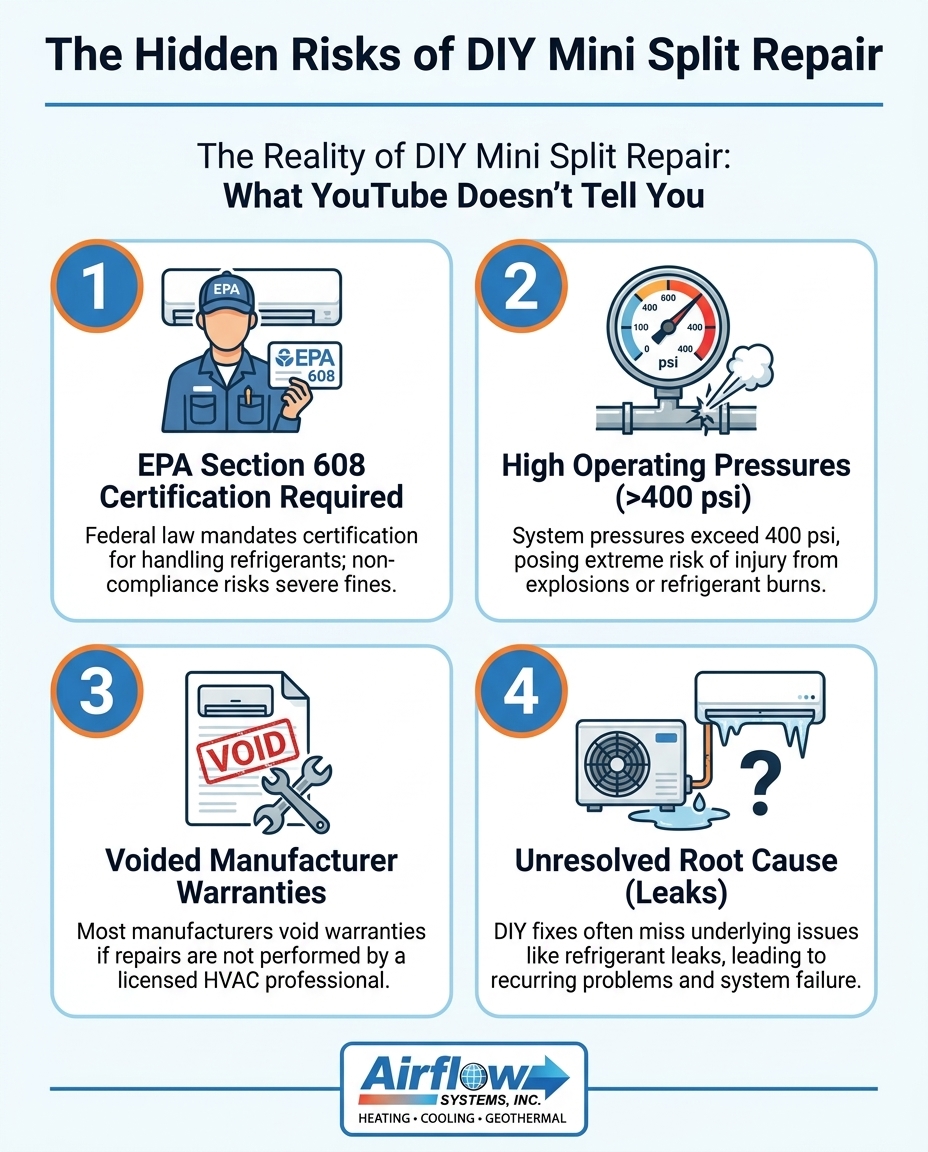
When you watch a video of someone casually handling refrigerant, you do not see the invisible, high-pressure physics at play. Modern mini splits utilize advanced refrigerants, such as R410A, which operate at extreme pressures that often exceed 400 pounds per square inch (psi) on the high side of the system. To put that in perspective, a standard car tire operates at around 32 psi.
Mishandling a system under that much pressure poses severe physical dangers to an untrained homeowner. If you connect or disconnect a hose incorrectly, or use a cheap gauge that fails under stress, the consequences are immediate. Liquid refrigerant boils at incredibly low temperatures. If it sprays onto your skin or into your eyes during a high-pressure blowout, it instantly causes severe freeze-burns and irreversible tissue damage.
Specialized tools required for safe handling:
• Calibrated manifold gauges: Used to read the exact high and low-side pressures without introducing atmospheric air into the system.
• Heavy-duty vacuum pumps: Required to completely evacuate the lines of all moisture and non-condensable gases before any new refrigerant is introduced.
• Micron gauges: Highly sensitive digital tools that measure the depth of the vacuum to ensure zero moisture remains in the copper piping.
• Refrigerant recovery machines: Used to safely extract and store old, contaminated refrigerant so it does not vent into the surrounding air.
Because of these inherent physical risks and the heavy equipment required to do the job safely, you should never attempt any step-by-step DIY procedures to open your refrigerant lines.
The Legal Reality: EPA Regulations and the Clean Air Act
Beyond the physical dangers, there are strict legal barriers surrounding the purchase and handling of HVAC chemicals. Under Section 608 of the federal Clean Air Act, it is illegal for anyone to knowingly vent ozone-depleting substances or modern substitute refrigerants into the atmosphere. The Environmental Protection Agency (EPA) heavily regulates these chemicals because they act as potent greenhouse gases when released freely into the air.
To legally purchase, handle, recover, or charge a system with regulated refrigerants, a technician must carry specific EPA certification. This certification proves they have been trained to capture the chemicals safely using specialized recovery cylinders and heavy-duty extraction machines. When a homeowner attempts a DIY recharge using a cheap kit, they almost always vent some amount of refrigerant into the air during the connection and disconnection process, placing them in direct violation of federal environmental law.
The penalties for improper venting are severe, with the EPA authorized to levy massive fines for violations. Trusting a certified local provider like Airflow Systems guarantees safe, legal, and EPA-compliant refrigerant handling. Professional technicians follow strict protocols to ensure zero environmental contamination occurs during the diagnostic and repair process.
How DIY Attempts Instantly Void Manufacturer Warranties
HVAC equipment represents a major investment in your home's infrastructure. To protect that investment, manufacturers provide extensive warranties on internal components, specifically the highly expensive compressor. However, these warranties come with strict, non-negotiable conditions: all internal component repairs and refrigerant handling must be performed by licensed professionals.
If you attempt to use a DIY recharge kit, you are unknowingly leaving behind a trail of evidence. Cheap, over-the-counter kits often contain chemical sealants or "stop-leak" additives designed to plug holes. These additives react poorly with the highly refined compressor oil inside your mini split, eventually gumming up the internal valves. Furthermore, DIY kits rarely use the exact, pure refrigerant blend required by the manufacturer.
When a professional technician eventually arrives to fix the broken system, they will immediately identify the incorrect pressure markers, chemical traces, and contaminated oil left behind by the DIY attempt. Once the manufacturer is notified that unauthorized chemicals were introduced into the closed loop, the warranty is instantly voided. A voided warranty leaves you fully liable for all future repair costs, including complete compressor replacements or full system failures.
• DIY Recharge Kit — Diagnostic Method: Guesswork based on gauge pressure — Warranty Status: Instantly Voided — Long-Term Result: Repeated leaks, potential compressor death
• Professional Repair — Diagnostic Method: Nitrogen testing, electronic leak detection — Warranty Status: Fully Protected — Long-Term Result: Permanent fix, restored system efficiency
The Perfect Charge: Why Dehumidification Matters in Virginia
A ductless mini split does much more than just lower the temperature of the air in your room. It is essentially a heavy-duty dehumidifier. As warm indoor air blows across the freezing cold evaporator coil, the moisture suspended in the air condenses into water droplets, drips into a drain pan, and is channeled safely outside. This dehumidification process is what makes your home feel crisp and comfortable.
In our region, this secondary function is critical. Charlottesville's high summer humidity requires an exactly calibrated refrigerant charge to properly extract moisture from the air. If you overcharge the system by blindly adding a DIY kit, the evaporator coil cannot reach the precise temperature needed to pull that humidity. If the system is undercharged due to an ongoing leak, the coil will freeze over entirely, blocking airflow and stopping the dehumidification process in its tracks.
A botched DIY job leaves the home dangerously uncomfortable, feeling sticky, heavy, and susceptible to rapid moisture accumulation. Properly calibrated heat pump services ensure the system can handle the heavy load of regional weather extremes without freezing up or losing its moisture-pulling capacity.
The True Value of Professional Leak Diagnosis
The only permanent solution to a system blowing warm air is to locate the exact source of the breach and repair the structural damage. This requires a level of diagnostic precision that simply cannot be achieved with a store-bought can of refrigerant.
When you hire a professional, they do not just guess where the leak is. They use highly sensitive electronic leak detectors (often called "sniffers") that can detect microscopic parts-per-million traces of refrigerant gas in the air. If the leak is hidden, technicians will recover the remaining refrigerant and pump the system full of dry nitrogen to incredibly high pressures. Because nitrogen is a dry, safe gas, technicians can listen for the hiss of the leak or use specialized bubbling solutions on the flare connections to pinpoint the exact failing joint.
A typical pattern we see is a system slowly losing cooling power over several weeks due to a failing component. Recently, a local customer experienced this exact issue with a leaking coil in their air handler. A professional technician diagnosed the exact location of the problem and repaired the leaking coil safely as soon as the replacement part arrived. This restored the system's integrity at a reasonable cost without resorting to temporary, wasteful top-offs.
Once the repair is made, the technician uses a vacuum pump to remove all air and moisture from the lines before weighing in the exact factory specification of new refrigerant. Investing in a routine maintenance plan helps catch these microscopic leaks and normal wear-and-tear on your flare connections long before they result in a mid-summer breakdown.
Frequently Asked Questions About Mini Split Troubleshooting
Can you recharge a mini split yourself?
No, you cannot safely or legally recharge a mini split yourself. It is highly dangerous due to the extreme operating pressures of modern refrigerants, which can cause severe freeze-burns if mishandled. Additionally, purchasing and handling these regulated chemicals is illegal without proper EPA Section 608 certification.
What happens if you overcharge a mini split?
Overcharging can cause liquid refrigerant to enter the compressor, leading to catastrophic system failure. The excess pressure forces the compressor to work far harder than designed, which severely reduces cooling capacity and completely ruins the system's ability to dehumidify your home. This mistake often results in a total system replacement.
Why is my mini split blowing warm air in the summer?
Warm air usually indicates a refrigerant leak, a failed compressor, or a severe airflow restriction caused by a frozen evaporator coil. Because the system operates on a closed loop, any loss of cooling power points to a structural failure that requires specialized professional diagnosis to locate and repair.
Do you need a license to buy mini split refrigerant?
Yes, you need a specific license to purchase regulated HVAC chemicals. The EPA strictly regulates the sale of refrigerants like R410A to certified technicians to prevent environmental harm. Unlicensed individuals attempting to bypass these laws face severe fines and penalties.
How do professionals find a refrigerant leak?
Technicians use specialized tools like electronic sniffers, UV dye injections, and high-pressure nitrogen testing to locate structural breaches. Once the system is pressurized with dry nitrogen, they can pinpoint exact failures in the coils or the copper flare connections, allowing for a permanent mechanical repair rather than a temporary top-off.
Skip the DIY Risks and Restore Your Comfort Safely
The physical hazards of high-pressure blowouts, the legal ramifications of violating EPA regulations, and the financial devastation of instantly voiding your manufacturer warranty far outweigh the perceived convenience of a quick DIY fix. Recharging a leaking system without fixing the hole is a waste of time and resources that will inevitably leave you sweating through the next heatwave.
A professional diagnostic visit provides exactly what you actually need: a permanent, safe, and legal resolution to your cooling problems. By locating the root cause of the leak and repairing the structural damage, a certified technician guarantees your equipment will run efficiently for years to come. If you are tired of dealing with a struggling AC unit, reach out to schedule an inspection for your mini split systems and restore your home's comfort the right way.
Book Expert Service Or Contact Us
Our Service Process
A Hassle-Free Service Experience
01
Consultation & Diagnosis
We start by listening to your needs and performing a thorough diagnosis of your system to recommend the best solution.
02
Transparent Quoting
We provide a clear, upfront estimate with no hidden fees, so you know exactly what to expect.
03
Expert Service & Follow-Up
Our factory-trained technicians complete the work to the highest standards, and we follow up to ensure your complete satisfaction.
testimonials
What Our Customers Are Saying
Our customers consistently praise our exceptional service and attention to detail, making us a trusted choice for all your HVAC needs.
where we operate
Service areas