

Choose an option to see quick actions and get help faster.
.svg)
Facing a Major AC Breakdown at the End of Summer?
Is your cooling system completely failing, or just struggling to keep up with the late-summer heat? The decision between Repairing an Aging AC in August vs. Limping It to Fall for Replacement is one of the most stressful dilemmas a homeowner can face. It is late in the season, the heat is still oppressive, and your air conditioner has picked the absolute worst moment to stop blowing cold air. You are suddenly forced to decide whether to sink money into a 12-year-old system that is past its prime or try to hold out for a planned off-season upgrade. At Airflow Systems, our team has helped countless Charlottesville homeowners navigate this exact situation. For professional guidance, you can rely on our comprehensive air conditioning services and expert AC repair to help you make the smartest choice for your home.
Making this choice requires looking at both the mechanical state of your equipment and the calendar. On one hand, paying for a major repair on an aging unit feels like throwing good money after bad. On the other hand, living without air conditioning during the August / late summer transition is simply not an option for most families. The frustration of a major cooling failure right as the summer season begins to wind down is entirely understandable. You want relief from the heat, but you also want to make a smart, long-term financial decision for your home.
The Intersection of Mechanics and Timing
The core dilemma rests on a delicate balance. If you repair a 12-year-old system now, you might get a few more weeks of comfort, but you still have an obsolete unit that could break down again next spring. Conversely, forcing a failing system to keep running—often called "limping" it—carries its own set of risks, including elevated energy bills and potential property damage. A professional assessment from our technicians can clarify the best path forward, stripping away the guesswork and giving you hard facts about the condition of your compressor, coils, and refrigerant levels.
Here is the thing: you do not have to make this decision in the dark. By evaluating the specific symptoms of your breakdown against the remaining weeks of heavy cooling demand, you can map out a strategy that prioritizes both your immediate comfort and your future peace of mind. The right choice depends heavily on understanding exactly what you are up against environmentally.
The Late-Summer Climate Dilemma: Humidity vs. The Calendar
In our years serving the Charlottesville area, we've seen firsthand how the specific environmental pressures of the Virginia Piedmont region make an August breakdown feel so urgent. During the August / late summer transition, the area is known for average highs in the upper 80s combined with thick, oppressive humidity. This creates an indoor heat index that makes a home feel sticky, stagnant, and incredibly uncomfortable.
The Critical Role of Dehumidification
The underlying problem: Your air conditioner does more than just lower the temperature; it actively removes moisture from the air. When a 12-year-old system stops working in late August, you lose that crucial dehumidification. Without it, indoor humidity levels spike rapidly. High indoor humidity not only makes the air feel significantly hotter than the thermostat reads, but it also creates an ideal breeding ground for mold and mildew in your ductwork and living spaces.
The calendar's contrast: While the current indoor environment might feel unbearable, the calendar tells a different story. The reality is that October in Virginia brings rapid cooling, with temperatures regularly dropping into the comfortable 60s and 70s. The heavy cooling loads of summer vanish almost overnight. This short remaining window of extreme heat severely complicates the decision to invest in a major repair. You are essentially weighing the need for temporary comfort over the next few weeks against the long-term mechanical solutions your home actually requires.
The solution matrix: Navigating this climate dilemma means recognizing that the finish line for the cooling season is very close. If the repair is minor, fixing the unit to restore dehumidification is a simple choice. However, if the repair is major, you must decide if the temporary relief from the late-summer humidity is worth the investment on a system that you will likely need to replace before the next cooling season begins.
Evaluating the Viability of a Late-Season Repair
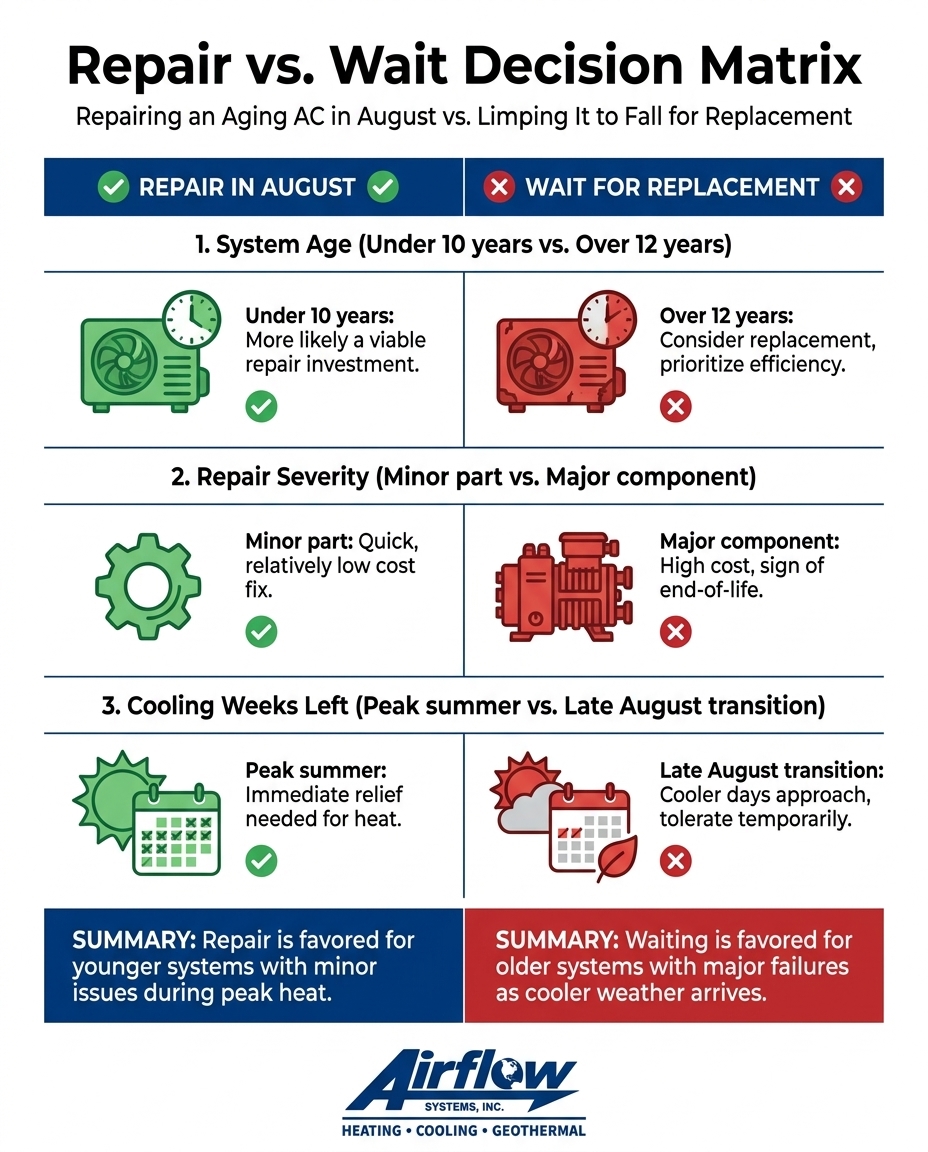
Before you can decide whether to repair or replace, you need a clear framework for determining if a costly fix is mechanically and practically justifiable on an older unit. Not all breakdowns are created equal, and the age of your system plays a massive role in what makes sense.
Minor Fixes vs. Major Systemic Failures
The first step is understanding exactly what has failed. If your system is experiencing a minor component failure, a repair is usually the smartest route, even late in the season. However, major systemic issues change the math entirely.
• Minor component failures: Issues like a blown dual run capacitor, a faulty contactor, or a clogged condensate drain line are relatively straightforward to fix. They do not require opening the sealed refrigerant system.
• Major systemic issues: Problems such as a failed compressor, a cracked heat exchanger, or a severely leaking evaporator coil are complex, labor-intensive, and highly expensive to resolve.
• The R-22 refrigerant factor: If your 12-year-old system still uses R-22 (Freon), late-life repairs become incredibly complicated. R-22 has been phased out, making it scarce and costly. Recharging a leaking R-22 system is often a poor investment.
Recently, our Airflow Systems technicians helped a Charlottesville homeowner facing a leaking coil in their air handler. Because our team diagnosed the problem accurately, the system was repaired as soon as the part arrived, resolving the issue at a reasonable cost without forcing a premature replacement. This highlights how a precise diagnosis is critical. If you are unsure what is causing your system to fail, we recommend understanding AC not cooling properly symptoms before making a final call.
Secondary Breakdowns and Sunk Costs
When evaluating a major repair on a 12-year-old system, you must also weigh the likelihood of secondary breakdowns. Older systems suffer from cumulative wear and tear. You might fix the blower motor today, only to have the compressor fail next month. Weighing the sunk cost of a major repair against the remaining lifespan of the unit is essential. If the repair cost approaches half the value of a new system, and the unit is already past its 10-to-15-year life expectancy, investing in the old equipment rarely pays off.
The Hidden Risks of 'Limping' a Failing System
If you decide against a major repair, your next thought might be to simply "limp" the system along until the weather cools down. While this sounds appealing during the August / late summer transition, trying to force a compromised AC to run through the end of the season carries significant hidden risks. A struggling system does not just perform poorly; it can actively cause harm to your home and your wallet.
Ancillary Property Damage
The danger of frozen coils: One of the most common symptoms of a failing AC (often due to a refrigerant leak or a failing blower motor) is an evaporator coil that freezes solid. If you keep running the system, that block of ice will eventually melt. When it melts rapidly, the condensate drain pan can overflow, sending water cascading into your furnace, down your walls, or through your ceiling. What started as an AC issue can quickly turn into a massive water damage restoration project.
Energy Waste and Component Strain
Skyrocketing energy bills: A failing system operates with severe inefficiency. It will run nonstop trying to reach the temperature set on the thermostat, drawing maximum electricity the entire time. The impact on your monthly energy bills can be staggering, effectively wasting money that could have been put toward a new system.
The cascade effect: HVAC components are designed to work in harmony. When one part is failing, our technicians often see it place an immense strain on everything else. A struggling compressor can cause electrical spikes that damage the control board. A clogged filter or failing fan motor makes the compressor work twice as hard, potentially turning a single part failure into a total system collapse. This is why professional oversight is crucial to determine if mitigation strategies are actually safe to implement. Keeping your system monitored through a professional maintenance plan can help identify these cascading risks before they result in property damage.
Strategic Advantages of a Planned Fall Replacement
If your 12-year-old system is truly at the end of its life, and you can safely bridge the gap through the end of August, scheduling a full system replacement during the milder off-season offers massive logistical, psychological, and practical benefits. Rushing a major home upgrade during a heatwave rarely yields the best results.
Rushed Summer Emergency vs. Planned Fall Installation
The contrast between buying an AC in August versus October is stark. During the summer, contractors are swamped with emergency no-heat/no-cool calls. Equipment inventory can be limited, and you may feel pressured to accept whatever unit is available in the warehouse that day just to get the air flowing again.
• Equipment Selection — Summer Emergency Replacement: Limited to immediate warehouse availability. — Planned Fall Installation: Full access to specific models and high-efficiency tiers.
• Scheduling — Summer Emergency Replacement: Subject to delays and triage based on extreme heat. — Planned Fall Installation: Flexible dates tailored to your personal schedule.
• Decision Pressure — Summer Emergency Replacement: High stress; decisions made in a sweltering home. — Planned Fall Installation: Relaxed environment; time to review options thoroughly.
• System Sizing — Summer Emergency Replacement: Often rushed, potentially leading to improper sizing. — Planned Fall Installation: Adequate time for a meticulous Manual J load calculation.
We recently worked with a local family who needed to replace their aging upstairs AC unit. By scheduling the work with us outside of an emergency heatwave, our courteous crew was able to install the new unit methodically over two days. Our installers were even able to work smoothly around the family's pets, highlighting the relaxed nature of a planned installation. Taking the time to properly size and select a new system without the pressure of a hot house ensures you get exactly what your home needs.
Financial and Seasonal Preparation
Planning for the fall also opens up financial advantages. You have time to research generally applicable energy rebates or federal tax credits for high-efficiency upgrades, ensuring you maximize your return on investment. Furthermore, a planned installation ensures your home is perfectly prepared for both the upcoming winter heating season and the following summer's cooling demands. You start the new year with a fully warrantied, reliable system.
Bridging the Gap: When Immediate Replacement is the Only Option
Sometimes, despite your best efforts to wait for fall, a system completely fails, and waiting weeks for cooler weather is simply not a safe or comfortable option. The August / late summer transition can still produce dangerous heatwaves, and if there are vulnerable individuals in the home, immediate action is required.
Navigating an Unplanned Upgrade
We acknowledge that an immediate replacement is a significant unexpected expense. However, as an independent, family-owned business, our team at Airflow Systems provides honest, pressure-free advice on whether a system can actually survive another month, contrasting sharply with aggressive summer sales tactics you might find elsewhere. If your system is dead and the heat is rising, we focus on solutions rather than pressure.
To help bridge the gap, there are flexible financing options available that allow homeowners to upgrade immediately without absorbing the full upfront shock. These payment solutions act as a bridge, ensuring you do not have to drain your savings to restore comfort to your home. The right choice always balances your immediate comfort needs with long-term home efficiency, and working with a contractor who prioritizes education over high-pressure sales tactics ensures you make the best decision for your family.
Frequently Asked Questions About Late-Summer AC Decisions
Is it worth fixing an old AC in late summer?
The short answer from our technicians is that it depends entirely on the severity of the repair. If a 12-year-old system needs a minor, inexpensive part like a capacitor, fixing it to get through the August / late summer transition makes sense. However, if it requires a major systemic repair like a compressor replacement, investing heavily in an obsolete unit is usually a poor financial decision, and replacement should be considered.
What are the risks of waiting to replace an AC?
Waiting to replace a failing AC can lead to secondary property damage and inflated utility bills. A struggling system runs inefficiently, which drives up energy costs significantly. Furthermore, components like frozen evaporator coils can melt rapidly, causing condensate drain pans to overflow and create extensive water damage in your home.
How can I keep my AC running until fall?
Keeping a struggling AC running requires reducing the load on the system as much as possible. You should change the air filter immediately to ensure maximum airflow, keep all vents open, and use ceiling fans to circulate air so you can set the thermostat a few degrees higher. Having a professional technician perform a targeted tune-up can also help mitigate stress on the aging components.
How long do air conditioners typically last in Virginia?
In our experience throughout the Charlottesville area, central air conditioners generally have a lifespan of 10 to 15 years. The high humidity and intense summer heat force systems to work incredibly hard to dehumidify and cool the air. Once a system passes the 12-year mark, the frequency of breakdowns typically increases, and efficiency drops substantially.
Can you replace an AC system in the fall or winter?
Yes, replacing an AC system during the off-season is highly recommended and offers strategic advantages. Fall and winter installations provide more flexible scheduling, as contractors are not overwhelmed by peak-summer emergency calls. It also allows you the time to carefully select the right high-efficiency equipment without the pressure of a sweltering home.
Get Honest Advice for Your Late-Summer AC Dilemma
Guessing about your system's viability during the August / late summer transition can lead to wasted money, unnecessary stress, and severe discomfort. You do not have to navigate this complex decision alone. Scheduling a professional diagnostic with Airflow Systems gives you a clear, objective picture of your equipment's health, allowing you to weigh the facts without high-pressure sales tactics.
Take action before the next heatwave hits. A thorough evaluation will provide you with a clear, objective decision framework for weighing a repair versus a replacement based on your system's age, the severity of the issue, and the shrinking window of hot weather. Contact Airflow Systems today to get the honest answers you need to keep your home comfortable and efficient.
Book Expert Service Or Contact Us
Our Service Process
A Hassle-Free Service Experience
01
Consultation & Diagnosis
We start by listening to your needs and performing a thorough diagnosis of your system to recommend the best solution.
02
Transparent Quoting
We provide a clear, upfront estimate with no hidden fees, so you know exactly what to expect.
03
Expert Service & Follow-Up
Our factory-trained technicians complete the work to the highest standards, and we follow up to ensure your complete satisfaction.
testimonials
What Our Customers Are Saying
Our customers consistently praise our exceptional service and attention to detail, making us a trusted choice for all your HVAC needs.
where we operate
Service areas