

Choose an option to see quick actions and get help faster.
.svg)
Preparing for Fall: The Hidden Dangers in Aging Gas Furnaces
As the September transition begins and the mornings grow crisper, you need to know exactly how a pre-season inspection prevents carbon monoxide risks before you turn on your thermostat for the first time. In our years serving the Charlottesville area, our team at Airflow Systems, Inc. often sees homeowners fire up their heating systems at the first sign of a chill, completely unaware of the internal wear and tear that previous winters have left behind. The most critical, yet entirely invisible, danger hiding in an older heating system is carbon monoxide (CO) escaping through compromised gas furnace components. Addressing this silent threat requires far more than a simple filter change; it demands a professional evaluation before the first cold snap hits your neighborhood.
If you are ready to ensure your system operates safely this season, explore our heating services or schedule your comprehensive furnace repair and inspection today.
The unseen reality of off-season wear: While your furnace sat idle over the summer, the metal components inside remained exactly as the last winter left them—stressed, fatigued, and potentially cracked. A pattern we see often is homeowners assuming that if the furnace turns on and blows warm air, everything is functioning perfectly. However, the internal combustion process that generates that warmth also produces toxic exhaust gases. Keeping those gases separated from your breathable indoor air is the most important job your furnace has. When aging components begin to fail, that separation is compromised, introducing a severe hazard into your living space right as the September / early fall pre-heating transition begins.
The Mechanics of Heat Exchanger Failure
To understand why older heating systems pose a safety risk, you have to look at the core component responsible for safe heating: the heat exchanger. This vital metal chamber acts as the lungs of your furnace. It separates the toxic combustion gases created by burning fuel from the clean, breathable air that gets circulated through your home's ductwork. As long as the heat exchanger remains perfectly sealed, your indoor air quality remains safe. But metal is not immune to the laws of physics, and over time, the constant stress of operation takes a heavy toll.
The cycle of thermal fatigue: Every time your thermostat calls for heat, the burners ignite, sending intense flames into the heat exchanger. The metal rapidly heats up and expands. Once your home reaches the target temperature, the burners shut off, and the metal cools and contracts. Our technicians know firsthand that Charlottesville VA area homes rely heavily on continuous furnace operation during freezing winters, accelerating this thermal wear and tear. This constant expansion and contraction happens thousands of times over the lifespan of the equipment. Just like bending a paperclip back and forth until it snaps, this process causes metal fatigue.
Eventually, that metal fatigue leads to microscopic hairline cracks. These stress fractures create a direct pathway for carbon monoxide to exit the combustion chamber and enter the air stream that flows into your bedrooms, living room, and kitchen. Because these cracks develop slowly over years of heavy use, they offer no obvious warning signs until the breach is already allowing gases to escape.
Why Micro-Cracks Go Unnoticed
The physics of metal expansion explains why these fractures are so incredibly difficult to spot. When your heating system is turned off and the metal is completely cooled down, the material contracts. This contraction squeezes the edges of the hairline cracks tightly together, making them nearly invisible to the naked eye. They look like nothing more than a faint scratch on the surface of the metal.
However, when the furnace is actively running and the metal is hot, it expands. That expansion forces the cracks to open up exactly when the combustion chamber is full of toxic exhaust gases. This means the furnace only leaks carbon monoxide while it is actively heating your home—the very moment when a basic, cold-state visual check would miss the problem entirely.
Why Standard CO Detectors and Basic Visual Checks Fall Short
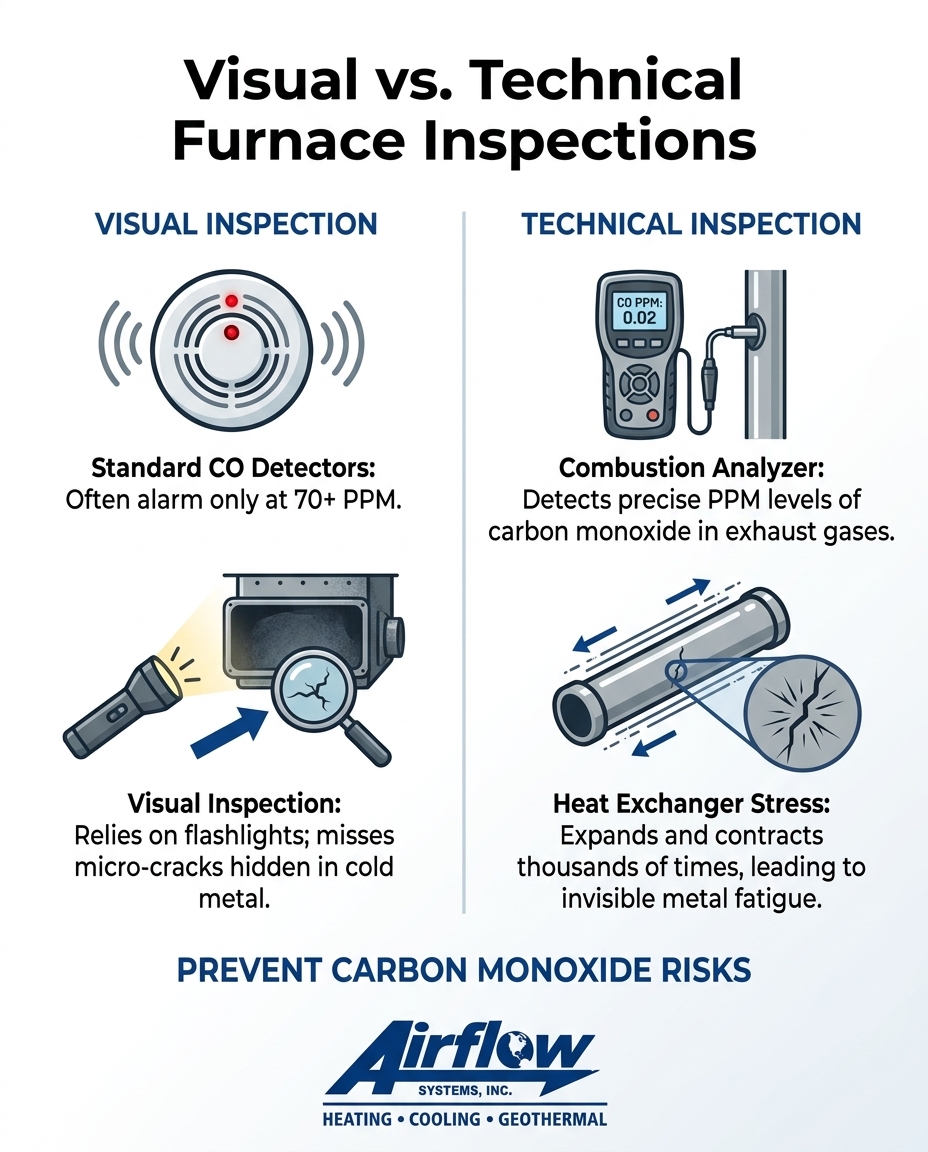
Most homeowners rely on standard ceiling-mounted or plug-in carbon monoxide detectors to keep their families safe. While these devices are a non-negotiable safety requirement for any home with gas appliances, they are designed as a last line of defense, not a preventative diagnostic tool. Standard home carbon monoxide detectors often do not trigger an audible alarm until concentrations in the air reach 70 parts per million (PPM) or higher. They are built to prevent acute, life-threatening emergencies, but they are completely blind to the slow, chronic leaks that occur long before the alarm ever sounds.
Low-level, chronic exposure to carbon monoxide—often hovering between 15 and 50 PPM—can still cause significant health issues. Homeowners exposed to these low levels frequently report persistent headaches, fatigue, nausea, and dizziness, often mistaking these symptoms for a lingering seasonal cold or the flu. Waiting for a standard alarm to sound means you are already reacting to a significant leak rather than preventing one.
• Standard Home CO Detector — What It Senses: High-level ambient CO (usually 70+ PPM) — Limitations & Blind Spots: Misses chronic, low-level leaks; only sounds when the living space is already compromised.
• Basic Visual Inspection — What It Senses: Surface rust, soot, and large, obvious fractures — Limitations & Blind Spots: Relies on a flashlight and human eyesight; completely misses micro-cracks hidden deep within complex, cold metal geometries.
• Low-Level CO Monitor — What It Senses: Ambient CO starting at 5 to 10 PPM — Limitations & Blind Spots: Better for early warning in the home, but still only detects the gas after it has already left the furnace and entered the room.
Furthermore, a basic visual inspection using only a flashlight cannot reliably spot microscopic cracks hidden deep within complex furnace geometries. A technician simply shining a light into the burner compartment is only seeing a fraction of the heat exchanger's surface area. The vast majority of the metal chamber is hidden behind other components or curved in ways that make direct line-of-sight inspection impossible. Relying on a flashlight to clear an aging furnace for winter operation is a gamble with your indoor air quality.
The Technical Advantage: Detecting Invisible Threats with Combustion Analyzers
Because visual inspections and standard wall alarms are insufficient for early detection, true diagnostic safety requires specialized technology. This is where the combustion analyzer becomes the most important tool in our team's diagnostic arsenal. A combustion analyzer is a highly sensitive, digital diagnostic instrument that measures the exact chemical composition of the exhaust gases leaving your furnace. Instead of waiting for carbon monoxide to leak into your home, this tool tests the system at the source of combustion.
How the technology works: One of our trained technicians inserts the analyzer's probe directly into the furnace's exhaust flue while the system is running under full load. The instrument draws a sample of the hot exhaust gases and instantly calculates the levels of oxygen, carbon dioxide, and carbon monoxide. More importantly, it provides precise combustion analyzer parts-per-million (PPM) readings. If a heat exchanger has a microscopic crack, the blower fan will push ambient air through that crack and into the combustion chamber, altering the chemical makeup of the exhaust. The analyzer detects this exact disruption in real-time.
• Precision sensitivity: Detects carbon monoxide fluctuations down to a single part per million, long before the gas becomes a hazard to the household.
• Real-time diagnostics: Tests the furnace while the metal is hot and expanded, capturing the exact moment when hidden cracks open up.
• Efficiency tracking: Measures flue temperature and oxygen levels to ensure the burners are consuming fuel efficiently, saving you money on monthly utility bills.
• Data-driven safety: Replaces the outdated guesswork of flashlight inspections with hard, irrefutable digital data.
At Airflow Systems, Inc., we believe that guessing is never an option when it comes to your safety. That is why the mandatory use of professional-grade combustion analyzers is our gold standard for every heating inspection. By utilizing this advanced technology, we move beyond basic tune-ups and provide a level of technical superiority that guarantees your system is operating exactly as the manufacturer intended.
The Amplified Risk in Weatherized Fall Homes
The danger of an undetected carbon monoxide leak is severely compounded by the way we prepare our houses for the colder months. Modern energy efficiency practices dictate that homes should be tightly sealed against drafts before winter begins. Homeowners invest heavily in weatherstripping, caulking around windows, and upgrading insulation to keep the expensive warm air inside and the freezing wind outside. While this is fantastic for reducing monthly energy bills and maximizing the benefits of utility incentive programs, it fundamentally changes the way air moves through your living space.
The envelope effect: When you seal a building envelope, you are drastically reducing the home's natural ventilation rate. The house can no longer "breathe" as easily as it does during the spring or summer when windows are open and fresh air circulates freely. Charlottesville's freezing winter temperatures force homeowners to tightly weatherize their properties, making early pre-season checks absolutely non-negotiable. If a compromised heat exchanger begins leaking carbon monoxide into a tightly sealed home, those toxic gases have nowhere to escape.
Because the fresh air exchange rate is so low in a weatherized home, indoor air pollutants accumulate rapidly. A minor carbon monoxide leak that might dissipate in a drafty, older house will quickly concentrate to dangerous levels in a modern, energy-efficient property. Ensuring the structural integrity of your furnace before the house is closed up tight is a critical step in maintaining safe indoor air quality. If you have concerns about the pollutants trapped inside your newly weatherized home, professional indoor air quality testing can provide a clear picture of what you and your family are breathing every day.
Securing Peace of Mind with Bi-Annual Maintenance
Understanding the deep technical mechanics of heat exchanger failure highlights exactly why a pre-season inspection is just one piece of a much larger puzzle. True home comfort and safety require a comprehensive, year-round approach to HVAC longevity. Having an experienced technician evaluate your system twice a year—once before the heating season and once before the cooling season—ensures that every component operates safely, efficiently, and reliably.
Consistent check-ups do more than just catch dangerous carbon monoxide leaks; they provide valuable, actionable advice on the overall health of your equipment. A skilled technician tracking your system's performance over time can help you decide exactly when it makes financial sense to repair an aging unit versus replacing it entirely. This proactive approach prevents small, manageable issues from snowballing into catastrophic, mid-season failures.
Just last winter, our team responded to a local homeowner who noticed their system struggling and discovered a leaking coil in the air handler. Because the issue was diagnosed quickly by one of our trained professionals, the repair was completed as soon as the replacement part arrived, restoring their home's comfort without a prolonged outage. This same proactive, fast-acting approach applies to your furnace. Catching a failing component early means you control the timeline of the repair. If you want to lock in this level of reliable, year-round protection, enrolling in a preventative maintenance plan is the most effective way to keep your equipment running safely and efficiently.
Why September is the Ideal Time for Your Heating Evaluation
Timing is everything when it comes to preventative maintenance. Booking your inspection in early fall guarantees that your system is thoroughly cleared for safety before the first time it needs to run continuously. The September / early fall pre-heating transition is the perfect window of opportunity. The weather is still mild enough that your home won't drop to freezing temperatures while our technicians turn the system off to perform our rigorous diagnostic tests.
Avoiding the seasonal rush: Early scheduling allows you to bypass the frantic mid-winter rush. Once the first major freeze hits the region, HVAC technicians are immediately swamped with emergency no-heat calls from homeowners whose neglected systems failed under the sudden heavy load. By booking now, you secure a convenient appointment time and ensure that your system receives the undivided attention it deserves.
1. Clearance before operation: Verifying the heat exchanger's integrity before the burners are forced to run for hours on end.
2. Time for repairs: If a combustion analyzer does detect a micro-crack, discovering it in September gives you ample time to order parts or arrange for a replacement without your family suffering through freezing nights.
3. Peak efficiency: A clean, well-tuned system uses less fuel, meaning you start saving money on your utility bills from the very first day of the season.
Taking action now is the smartest move you can make for your home's safety and comfort. For more insights on why this specific window is so crucial, read our guide on why it's the strategic time to book a heating tune-up. Ultimately, understanding how a pre-season inspection prevents carbon monoxide risks empowers you to make proactive decisions that protect your home, your budget, and your family's health.
Frequently Asked Questions
Can a basic furnace inspection detect carbon monoxide?
A basic visual inspection is generally insufficient for detecting carbon monoxide leaks in older furnaces. Technicians who rely solely on flashlights can easily miss microscopic hairline cracks hidden in the cold metal of a resting heat exchanger. True detection requires specialized diagnostic tools that measure the chemical makeup of the exhaust while the system is actively running.
How does a combustion analyzer work to keep my home safe?
A combustion analyzer is a professional digital tool that reads the exact composition of a furnace's exhaust gases in real-time. By measuring oxygen, carbon dioxide, and carbon monoxide levels at the parts-per-million scale, it detects minute disruptions caused by hidden heat exchanger cracks. This allows technicians to catch dangerous leaks long before the gas ever enters your living space.
Why do furnace heat exchangers crack over time?
Heat exchangers crack due to a process called thermal metal fatigue. Every time your furnace runs, the intense heat of the burners causes the metal chamber to expand rapidly, and it contracts again when the cycle ends. Doing this thousands of times over many years stresses the metal, eventually causing microscopic fractures to form along the seams or curves.
At what PPM is carbon monoxide dangerous from a furnace?
While standard home CO detectors often wait until 70 PPM to trigger an alarm, chronic exposure to lower levels is still hazardous. Extended exposure to levels between 15 and 50 PPM can cause persistent headaches, nausea, dizziness, and fatigue. Ideally, your furnace should not be leaking any measurable carbon monoxide into your home's breathable air supply.
What are the physical signs of a cracked heat exchanger?
Physical signs can include a yellow or wavering burner flame, soot buildup inside the furnace cabinet, or visible rust and corrosion on the exterior of the metal chamber. However, because many cracks are microscopic and hidden deep inside the unit, a furnace can have a severely compromised heat exchanger while showing absolutely no obvious physical symptoms to the naked eye.
How often should older gas furnaces be tested for carbon monoxide leaks?
Older gas furnaces should be rigorously tested at least once a year, ideally during a pre-season inspection in the early fall. Because the risk of metal fatigue increases significantly as the equipment ages, we strongly recommend annual testing with a combustion analyzer as the only reliable way to ensure the heat exchanger remains structurally sound and safe to operate through the winter.
Don't wait until the first freezing night to find out if your older gas furnace is safe to operate. By taking action during the early fall transition, you can rest easy knowing your home is protected from invisible threats. Reach out to our team at Airflow Systems, Inc. today to schedule your comprehensive evaluation and ensure your family breathes safe, clean air all season long.
Book Expert Service Or Contact Us
Our Service Process
A Hassle-Free Service Experience
01
Consultation & Diagnosis
We start by listening to your needs and performing a thorough diagnosis of your system to recommend the best solution.
02
Transparent Quoting
We provide a clear, upfront estimate with no hidden fees, so you know exactly what to expect.
03
Expert Service & Follow-Up
Our factory-trained technicians complete the work to the highest standards, and we follow up to ensure your complete satisfaction.
testimonials
What Our Customers Are Saying
Our customers consistently praise our exceptional service and attention to detail, making us a trusted choice for all your HVAC needs.
where we operate
Service areas